


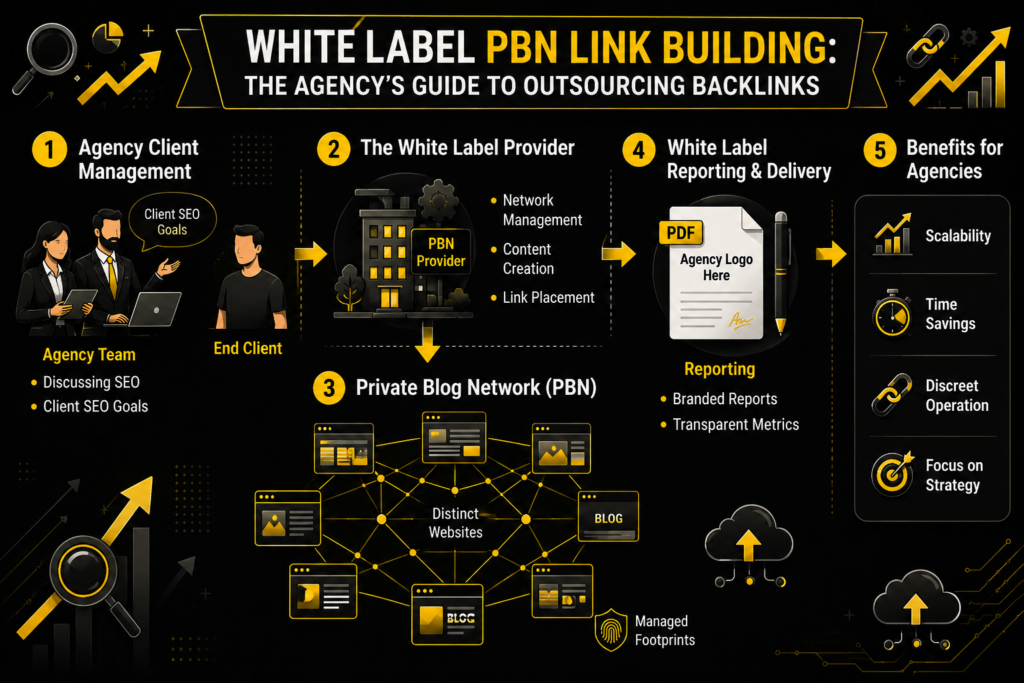
White label link building is the model that allows digital marketing agencies, SEO consultants, and freelance specialists to deliver PBN link campaigns under their own brand — without building or maintaining a private blog network themselves, without hiring dedicated link building specialists, and without the capital investment that a quality PBN infrastructure requires. This guide covers what to look for in a white label PBN supplier, how to structure the margin, how to package the service under your own brand, how to communicate with clients when the underlying mechanism is PBN-based, and how to frame case study reporting that demonstrates value without creating risk exposure.
Table of Contents
- Introduction: what white label link building actually means for agencies
- What to look for in a white label PBN supplier
- Margin structure: how to price white label link building services
- Packaging PBN links under your agency brand
- Client communication when using PBNs
- Case study framing for agency reports
- How to outsource link building without creating client account risk
- FAQ
- Conclusion
Key Takeaways
- White label link building allows agencies to offer comprehensive SEO services including link building without the infrastructure investment of running a PBN — the provider delivers the links, the agency presents them under its own brand.
- The three non-negotiable criteria for a white label PBN supplier are: reporting confidentiality, consistent quality controls (Trust Flow, content quality, hosting diversity), and predictable turnaround that fits your client delivery cycles.
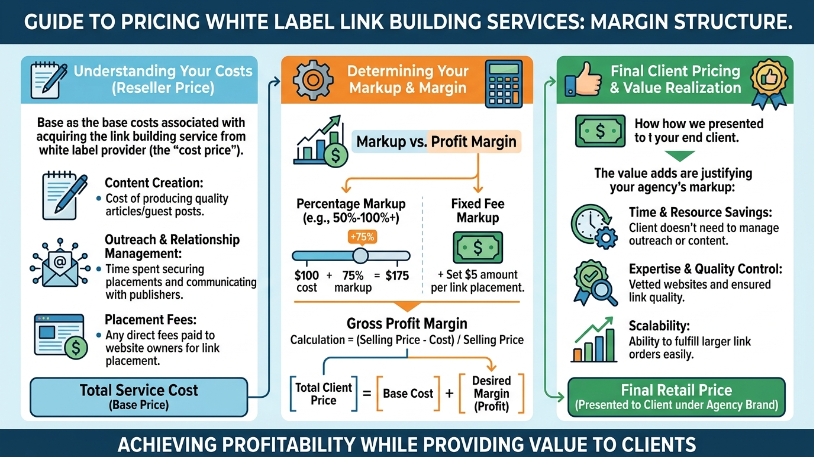
- Typical agency margin on white label PBN link building runs 40–80% — a provider charging £20 per link is typically presented to the client at £35–£55 per link.
- Client communication about PBN links requires honest risk framing without disclosing specific network details. Present it as “premium link placement on aged, authoritative domains” rather than either “editorial links” or “PBN links.”
- The agency that gets reporting right — showing referring domain growth, URL Rating improvement, and keyword ranking movement — retains PBN link building clients significantly longer than agencies that only report link counts.
Introduction: what white label link building actually means for agencies
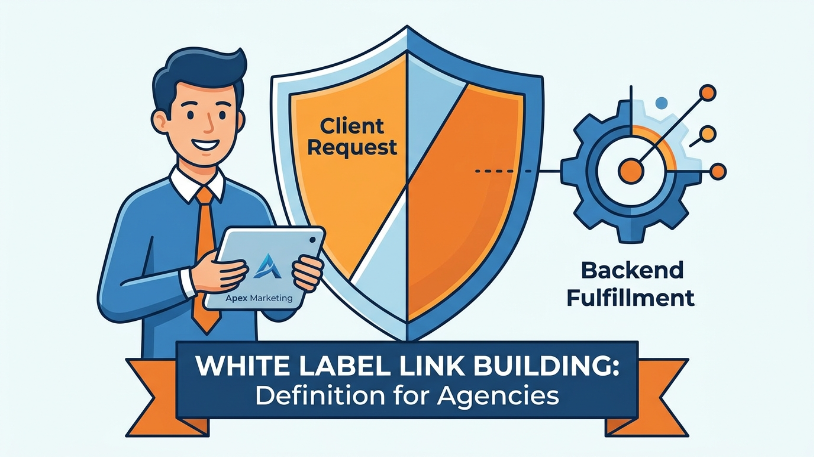
Most digital marketing agencies reach the same inflection point: a client needs link building, the agency knows what is needed, but the operation of actually building high-quality links at scale is entirely different from the SEO strategy work the agency does well. Editorial outreach requires building publisher relationships over months, maintaining dedicated outreach specialists, and accepting response rates around 5–10% even for experienced teams. Running a PBN requires domain acquisition, hosting infrastructure, content production, and technical maintenance across dozens of sites.
White label link building resolves this tension by separating link delivery from client relationship management. A specialist provider builds and maintains the links. The agency presents those links to the client under its own brand, manages the strategy, handles reporting, and captures the margin. Nearly 60% of marketers say link building is the hardest part of SEO — and specialist white label link building services exist precisely because the delivery infrastructure is expensive and time-consuming to build in-house. For a full explanation of how PBN links work, see our complete PBN SEO guide, our PBN links explainer, and our full PBN FAQ.
The agency model that works best treats the white label PBN supplier as infrastructure — like using a hosting provider for client websites. The supplier delivers a commodity component; the agency value is in strategy, targeting, reporting, and client relationship management.
What to look for in a white label PBN supplier
Non-negotiable criterion 1: Reporting confidentiality
The fundamental requirement of any white label relationship is that the end client cannot identify the underlying supplier. Reports delivered to the agency should contain only neutral data — domain, URL, anchor text, DR/TF metrics, indexation status — with no provider logo, company name, or contact details that would allow a client to bypass the agency relationship. The supplier should be contractually bound not to approach the agency clients directly. Ask any prospective supplier directly: “Do you appear on any client reports or communications?” If the answer is not a clear no, move on.
Non-negotiable criterion 2: Quality controls you can verify independently
Never accept a supplier quality claims at face value. Minimum quality specifications for white label PBN placements: domain Trust Flow minimum TF 15 for standard campaigns (TF 25+ for competitive niches); at least some domain organic traffic visible in Ahrefs or Semrush (near-zero organic traffic on a high-DR domain indicates a de-indexed site); article content of 400+ substantive words on a coherent topic (AI-generated filler is detectable); diverse hosting infrastructure (different IP ranges, hosting accounts, nameservers); and gradual indexation over 2–3 weeks rather than bulk simultaneous placement. See our PBN networks and domain selection guide for the full evaluation framework.
Non-negotiable criterion 3: Predictable turnaround
Client reporting happens on monthly cycles. A supplier with unpredictable turnaround creates reporting problems the agency absorbs. Specify: standard article placement 7–14 business days from order to live URL; committed monthly capacity you can plan delivery cycles around; and a replacement policy covering links that go down within 90 days (a quality provider replaces at no cost).
Supplementary criteria: good to excellent
Niche domain availability — can the supplier source domains with content histories matching your client sectors? Anchor text flexibility — does the supplier accept specific anchor text per placement rather than using default commercial anchors? Single-placement exclusivity — exclusive articles with one outbound link maximise per-link equity transfer. See our backlink equity guide for why this matters, and our anchor text strategy guide for the distribution framework every agency should maintain.
Margin structure: how to price white label link building services
Typical provider cost ranges (2026)
| Quality tier | Provider cost | TF range | Content standard |
|---|---|---|---|
| Entry (volume) | £12–£20 per link | TF 15–25 | 400–600 word articles |
| Mid-tier | £20–£40 per link | TF 25–40 | 600–900 word articles |
| Premium | £40–£80 per link | TF 40+ | 800–1,200 word expert content |
| Niche-specific | £60–£120 per link | TF 30–60 | Niche-relevant, topically matched |
Sub-£12 placements almost always indicate public link farms with shared infrastructure — avoid for client accounts.
Agency pricing to clients
The agency margin on white label PBN links covers campaign strategy and targeting, anchor text planning and rotation management, quality verification of each delivery, monthly reporting production, and client communication. Industry standard agency margin runs 40–80% above provider cost: provider cost £25 per link; agency billing £40–£55 per link; margin per link £15–£30; on a 20-link monthly campaign, £300–£600 monthly margin. This margin is appropriate because the agency is providing the strategy layer that determines which pages receive links, which anchor texts are used, and how the campaign integrates with the broader SEO programme.
Monthly retainer vs per-link billing
The retainer model is preferable for client retention — it creates predictable revenue and normalises link building as an ongoing programme. For clients in competitive niches (iGaming, SaaS, finance, legal) who need higher volumes, consider bundled pricing: 40 links per month at a fixed retainer including strategy, reporting, and supplier management — positioned as a managed authority growth programme.
Packaging PBN links under your agency brand
Agencies that package white label link building as “link building” — a deliverable measured in counts — attract price-sensitive clients who leave when they find a cheaper count. Agencies that package it as “authority building” — measured in domain authority growth, URL Rating improvement, and keyword position movement — attract clients who evaluate results and stay.
Service naming and positioning
Avoid naming the service after its mechanism. Name it after its outcome: Domain Authority Growth Programme (monthly retainer described in terms of referring domain targets and authority milestone progression), Managed Link Acquisition (positions the agency as active manager of a multi-source strategy), Off-Page SEO Retainer (frames link building within the broader off-page SEO context).
The monthly deliverables package
Package the following in each monthly client delivery: (1) links delivered — domain, URL, anchor text, DR, TF, indexation status; (2) cumulative referring domain trend chart; (3) URL Rating improvement on target pages; (4) keyword ranking movement via rank tracker; (5) next month strategy — anchor text plan and target pages. This five-component delivery positions the agency as a strategic partner managing a programme, not a vendor delivering a commodity.
Case study framing for agency reports
The three levels of reporting
Level 1 — Link delivery: Domains, anchor text, DR/TF, indexation confirmation. Necessary but not sufficient. Agencies that only report link delivery position themselves as link resellers not strategists.
Level 2 — Authority growth: Referring domain count trend month-over-month, URL Rating of target pages before and after campaign month, Domain Rating trajectory. Shows that links placed are building measurable authority signals rather than just appearing on a spreadsheet.
Level 3 — Ranking and revenue impact: Keyword ranking movement for primary target keywords, organic traffic trend to pages receiving links, pipeline attribution where measurable. Connects link building directly to commercial outcomes — the language that gets budgets approved and renewed at executive level.
The campaign narrative
Each monthly report should include a 150–200 word narrative section covering which pages received links this month, what ranking movement occurred, referring domain growth versus prior period, and what the plan is for next month. This demonstrates strategy, not just execution. It creates a coherent account-level story across reporting periods that justifies retainer renewal.
Handling flat or negative periods
Honest framing for no-movement months: confirm the new referring domains were indexed, note the typical 4–8 week lag between indexation and ranking movement, and point to URL Rating improvement as the leading indicator for upcoming position changes. Our ranking timeline guide provides the data-backed framework that makes these client conversations specific rather than vague.
How to outsource link building without creating client account risk
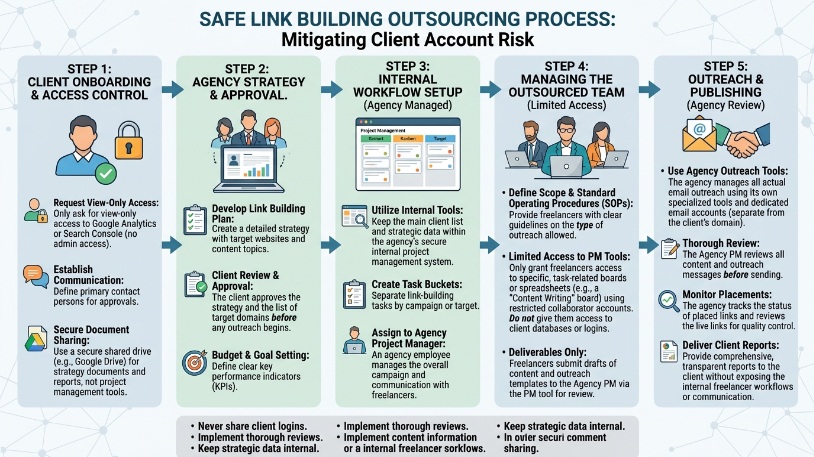
Link building for agencies carries specific risk management responsibilities the agency bears regardless of which supplier delivers the links. Three responsibilities distinguish professional white label link building from careless reselling.
Responsibility 1: Anchor text distribution oversight
The most common cause of client account penalties from PBN campaigns is anchor text over-optimisation that accumulated without agency oversight. Specify anchor text for every single placement rather than delegating to supplier defaults. Maintain a running anchor text log — domain, URL, anchor, date — for each client. Before each monthly campaign, pull the client current Ahrefs Anchors report and verify distribution is within safe parameters before ordering additional links. Full parameters in our anchor text strategy guide.
Responsibility 2: Velocity monitoring across campaigns
Agencies managing multiple clients sometimes inadvertently create velocity problems by ordering links for all clients simultaneously — routing concentrated link building activity through the same supplier network at the same time. Stagger link delivery across client campaigns rather than ordering for all clients at the start of each month. This protects individual client profiles and diversifies the indexation pattern across the supplier network.
Responsibility 3: Pre-campaign quality audit
Before beginning any new white label link building engagement for a client, audit the client existing backlink profile in Ahrefs. Check for: existing PBN-style links from previous campaigns that may limit how many additional PBN links the profile can absorb; existing anchor text distribution to verify headroom for commercial anchors before placing the first link; and any manual action history in Google Search Console. This audit takes 20 minutes and prevents the most common client account problems. See our backlink equity guide for the full profile assessment framework.
FAQ
What is white label link building and how does it work for agencies?
White label link building is a model where a specialist link building provider delivers backlink campaigns under the contracting agency brand. The provider builds the links, the agency presents results to the client as its own service. The agency manages strategy, targeting, anchor text planning, quality verification, and reporting. The provider manages network infrastructure, domain sourcing, content production, and placement mechanics. This separation allows agencies to offer comprehensive SEO services including link building without the capital investment and operational complexity of running a link building operation in-house.
How much should agencies charge for white label link building?
Typical agency pricing for white label PBN link building runs 40–80% above provider cost. A provider charging £25 per link is typically presented to the client at £40–£55, with the margin covering strategy, management, quality verification, and reporting. Monthly retainer packaging produces better client retention than per-link billing because it positions link building as an ongoing programme rather than a commodity purchase. Premium niches (iGaming, legal, finance, SaaS) command higher client billing rates due to higher competition thresholds and more complex anchor text management.
What is the best way to outsource link building for client accounts?
Outsource link building through a supplier that meets three criteria: reporting confidentiality (no supplier branding visible to the client), verifiable quality controls (Trust Flow, organic traffic on donor domains, substantive article content, diverse hosting infrastructure), and predictable turnaround aligned with your monthly reporting cycle. Never accept supplier quality claims at face value — verify each delivery in Ahrefs before presenting to the client. Maintain direct control over anchor text specification rather than delegating to supplier defaults.
How do I explain white label PBN links to a client without causing concern?
Frame it accurately as placement on aged, authoritative domains with substantive topical content. Be honest about the managed risk component of all off-page SEO without claiming zero risk or Google approval. Never claim the links are editorial. The honest framing — managed risk, not zero risk — builds more durable agency relationships than false safety claims. See our white hat vs grey hat SEO guide for the full framework for this client conversation.
What should be included in a white label link building agency report?
Monthly reports should include: a link delivery table with domain, URL, anchor text, DR, TF and indexation status; a referring domain trend chart showing month-over-month growth; URL Rating improvement data for target pages; keyword ranking movement for primary target keywords; and a 150–200 word narrative explaining that month strategy and next month plan. Reports that only show link counts position the agency as a link reseller. Reports that show authority growth, ranking movement, and strategic narrative position the agency as an SEO partner.
Conclusion
White label link building is the infrastructure model that makes comprehensive SEO service delivery economically viable for most digital marketing agencies. The alternative — building an in-house link building operation with domain acquisition budget, hosting infrastructure, content team, and technical management — is a £100,000+ annual investment that most agencies cannot justify unless link building is their core product.
The three practices that distinguish professional white label link building from careless reselling: control anchor text distribution for every client account rather than delegating to supplier defaults; audit each delivery independently before presenting to the client; and report results at the authority growth and ranking movement level rather than the link count level. For clients, the honest risk framing builds more durable agency relationships than false claims of safety.
Deliver white label PBN link building under your agency brand. White label PBN link building — confidential delivery, unbranded reports, all niches accepted, bulk agency pricing available. Supporting guides: complete PBN SEO guide, anchor text strategy for client accounts, backlink equity and per-link maximisation, ranking timeline management, PBN links for SaaS clients, PBN links for local SEO clients, casino backlinks for iGaming clients, and our white hat vs grey hat SEO breakdown.

Ben Davis is a seasoned SEO strategist with over a decade of hands-on experience in off page SEO, link building, and private blog network management.
He has helped 600+ agencies and professionals achieve top rankings in competitive niches including iGaming, crypto, CBD, and finance through data driven PBN strategies.