


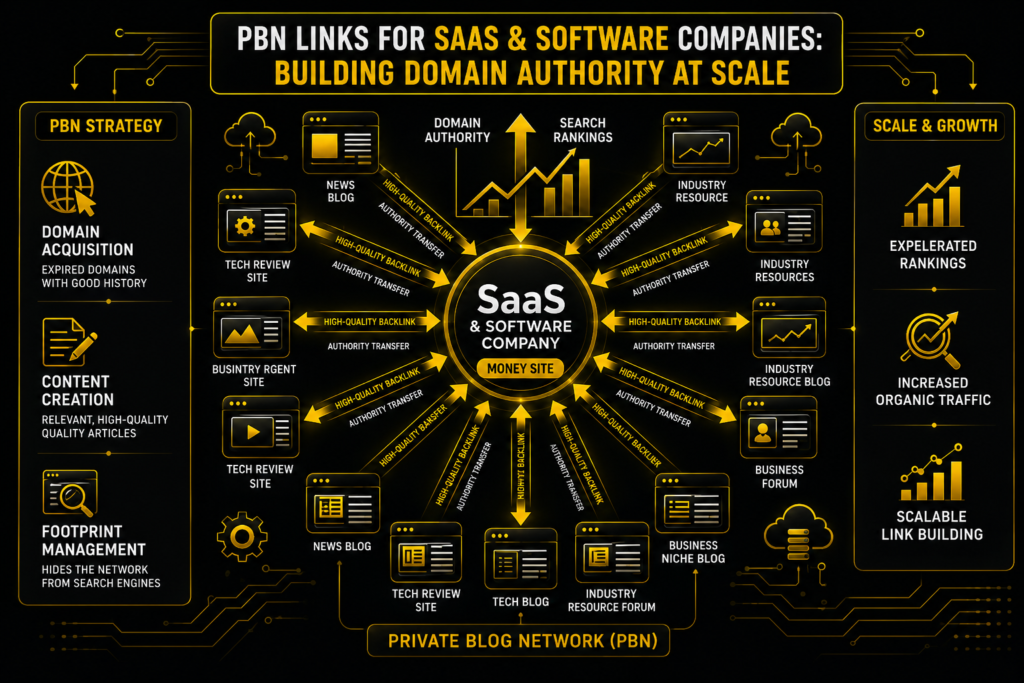
SaaS companies face a link building problem that is structurally different from e-commerce, media, or local businesses. Content marketing is the recommended solution for SaaS link building, and it genuinely works — but it takes 6–18 months to accumulate meaningful results. This guide explains why PBN links for SaaS serve a specific, time-bounded strategic purpose: bridging the authority gap between a new SaaS brand’s content investment and the competitive domain authority needed to rank the comparison pages, feature pages, and integration pages that generate pipeline. It covers the correct PBN targeting priority for SaaS (product and feature pages, not just blog posts), how to build a velocity strategy that looks natural for a new software brand, and how white label link building and outsource link building models work for agencies serving SaaS clients at scale.
Table of Contents
- Introduction: the SaaS link building structural problem
- Why SaaS companies struggle with link building
- The authority gap: where PBN links fit in the SaaS SEO timeline
- Targeting priority: PBN links to money pages vs content pages
- Velocity strategy for new SaaS brands
- White label link building services for SaaS agencies
- How to outsource link building for SaaS safely
- FAQ
- Conclusion
Key Takeaways
- SaaS companies face three simultaneous link building challenges: low content shareability for technical products, long sales cycles, and well-funded competitors with years of compounding authority.
- The authority gap is a time-bounded problem — PBN links bridge it while content marketing matures over 6–18 months.
- Feature pages, comparison pages, and integration pages are the highest-ROI PBN link targets in SaaS — not blog posts. These are the pages that convert pipeline.
- Pages ranking in position one have 3.8× more backlinks than pages in positions two through ten. A product page at position 11–20 is close enough that a concentrated PBN push can produce page-one movement.
- White label link building and outsource link building models allow agencies to deliver PBN campaigns at scale without client risk exposure.
Introduction: the SaaS link building structural problem
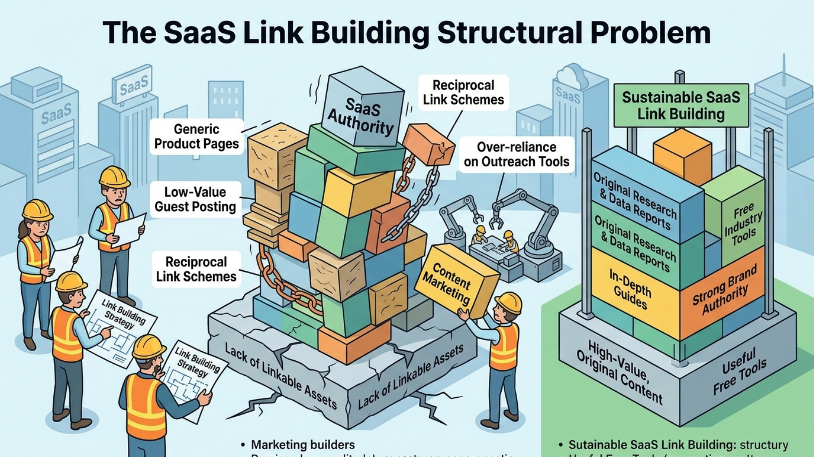
SaaS SEO exists at a uniquely uncomfortable intersection: the products are technically complex, the buyers are sophisticated, the competition is well-funded, and the most effective organic acquisition channel — content marketing and earned editorial links — takes longer to produce measurable results than most SaaS growth models can accommodate.
The link building services market for SaaS is enormous and almost entirely focused on white hat strategies — editorial outreach, digital PR, original research, guest posting. These strategies are correct and genuinely effective over 12–18 month horizons. They are also consistently insufficient for the 3–6 month window that Series A SaaS companies need to demonstrate organic traction. For a full overview of how PBN links work, see our complete PBN links guide and our full PBN FAQ.
This creates a specific strategic gap that PBN links for SaaS are designed to fill — not as a replacement for white hat content marketing, but as an authority acceleration layer that builds the referring domain count that comparison pages, feature pages, and integration pages need to rank while the content programme matures.
Why SaaS companies struggle with link building
Challenge 1: Technical products have low organic shareability
Consumer products naturally generate shares and references because people encounter them in social contexts. SaaS products are used professionally, evaluated over weeks by buying committees, and discussed in closed channels that produce brand awareness without traceable links. Most organic link earning in SaaS requires deliberate content creation — original research, benchmark reports, free tools — that takes time to create and additional time after creation to accumulate editorial links.
Challenge 2: Long sales cycles limit early content breadth
Early-stage SaaS companies lack the user data to generate the genuine insight that produces linkable content at scale. A CRM company with 50 customers does not have the usage data to produce a benchmark report that earns 200 editorial links. The content assets that produce organic editorial links — original research drawing on proprietary data, tools solving specific professional problems, case studies with credible outcome metrics — are disproportionately available to companies that have already achieved scale.
Challenge 3: Well-funded competitors have years of compounding authority
Pages ranking in position one have 3.8 times more backlinks than pages in positions two through ten. The top-ranking SaaS pages for commercially valuable keywords belong to companies that have been publishing content and earning links for 3–10 years. SaaS companies entering competitive categories in 2026 are not closing a static authority gap — they are trying to catch a moving target while simultaneously building the content infrastructure that would allow them to earn links at a competitive rate.
The authority gap: where PBN links fit in the SaaS SEO timeline
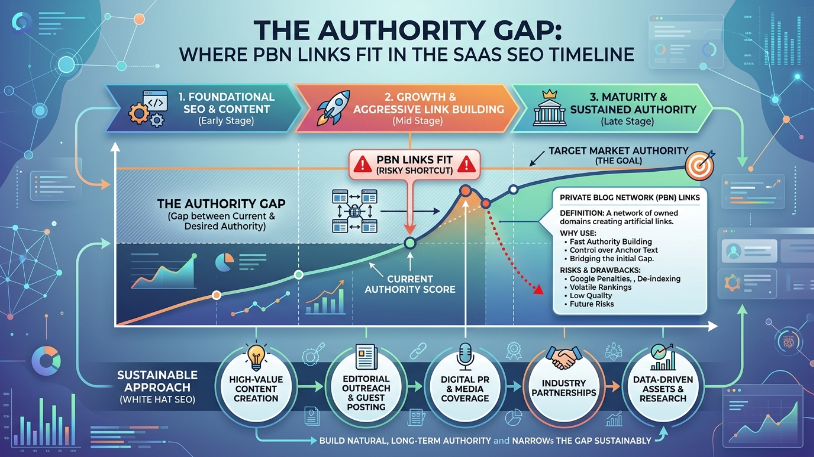
Without PBN links on an organic-only approach, SaaS companies typically see no significant organic traffic in months 1–6, first informational keyword rankings in months 6–12, first commercial keyword approaches to page one in months 12–18, and meaningful organic pipeline contribution in months 18–24+.
With PBN links as a bridge, that timeline compresses: PBN links to comparison and feature pages establish baseline authority in months 1–3, commercial keywords reach page two or top of page one by months 3–6, and the content programme matures to supplement PBN-built authority from months 6–12 onwards. The hybrid approach produces commercial keyword rankings within the window that matters for growth-stage SaaS. Our white hat vs grey hat SEO guide covers this hybrid strategy and the honest risk assessment SaaS marketing leaders should present to their leadership teams before committing to grey hat acceleration.
The correct exit strategy: use PBN links to establish competitive authority in months 1–12 while simultaneously building the white hat content programme. Over time, the proportion of PBN to organic earned links should shift toward organic. For comparison with how this approach works in other contexts, see our guide on PBN links for local SEO.
Targeting priority: PBN links to money pages vs. content pages in SaaS
The most common mistake in SaaS link building is building all links to blog posts — ignoring the feature and pricing pages that need link equity most. The highest-ROI link building invests in the pages that generate demo requests and trial sign-ups directly.
Tier 1 (highest ROI): Feature and product pages
Feature pages target the queries buyers use when evaluating a specific capability. These pages have the highest conversion value of any URL on a SaaS site. They almost never rank without targeted link building — they have no organic shareability, cannot earn editorial links through content marketing, and are typically thin pages that cannot rank on content quality alone. PBN links to feature pages should use contextual partial match anchors: “CRM pipeline management for sales teams,” “email automation platform for small business.” Target 5–15 PBN links per feature page depending on competitive keyword difficulty.
Tier 2 (high ROI): Comparison and alternative pages
Comparison pages target bottom-of-funnel queries from buyers in final evaluation stage. These pages have conversion rates that rival product pages because the buyer is already in decision mode. They can earn some organic editorial links but rarely enough to rank competitively for high-volume comparison terms. PBN links of 10–25 per comparison page, depending on competitor domain authority. The internal linking connection: PBN links to high-performing blog posts → blog posts internally link to feature and comparison pages → equity distributes to commercial pages without direct PBN links on every URL. See our backlink equity guide for the tiered equity distribution mechanics.
Tier 3 (supporting): Blog and content pages
5–10 PBN links to new high-value content pieces establish initial ranking positions that accelerate organic link discovery — a compounding effect where PBN links make the content findable to the people who would editorially link to it. This mirrors the collection-page strategy for ecommerce covered in our PBN links for ecommerce guide.
Velocity strategy for new SaaS brands
Inconsistent link velocity — burst campaigns followed by long gaps — looks unnatural to Google. A new SaaS brand building links correctly looks like steady monthly accumulation from diverse sources, growing gradually as the content programme matures.
Safe velocity benchmarks by SaaS brand age
Pre-launch to month 3: 5–8 PBN links per month maximum. Focus: 2–3 links to homepage (brand authority) + 2–3 links to main product page. Anchor text: 80%+ branded and generic — no commercial exact match anchors during this phase.
Months 3–9 (early stage, 10–50 referring domains): 8–15 PBN links per month. Distribution: 30% blog content, 40% feature and product pages, 30% comparison pages. Introduce partial match and long-tail commercial anchors; keep exact match below 5%.
Months 9–18 (growth stage, 50–200 referring domains): 15–25 PBN links per month. Distribution: 25% blog content, 50% feature and comparison pages, 25% integration pages. Safe distribution per our anchor text strategy guide — up to 8% exact match for established sites.
Red flags to avoid for new SaaS brands
Anchor text commercial too early: Using exact match commercial anchors on a 2-month-old domain looks manufactured. Link explosion on launch: Building 50 links simultaneously during product launch creates velocity spikes that flag algorithmic review — spread launch-phase link building over 6–8 weeks. Homogeneity in link sources: Links exclusively from technology domains look as coordinated as unrelated domains. Diversify across technology, business, productivity, and general content domains. See our PBN networks and domain selection guide for the full diversification framework.
White label link building services for SaaS agencies
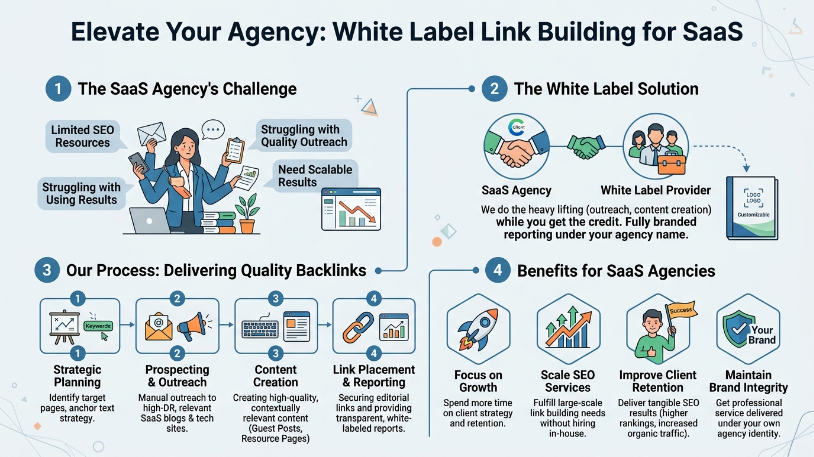
White label link building is the model where a link building provider delivers campaigns under the agency’s brand. This model is standard in the link building industry and is the mechanism through which most growth agencies serving SaaS clients manage link delivery without building in-house link building operations.
Building the in-house capacity to deliver quality link building at scale requires Ahrefs and Semrush subscriptions ($300–$500/month), a specialist SEO with 2–3 years of link building experience ($60,000–$90,000/year), months of publisher relationship building, and ongoing campaign management time. White label PBN link building services allow agencies to: deliver link campaigns at scale without in-house infrastructure investment; maintain full-service SaaS SEO agency positioning; offer competitive per-link pricing through provider volume advantages; and manage multiple SaaS client campaigns simultaneously.
For SaaS clients specifically, white label PBN specifications should include: technology and B2B content domain selection (domains with existing software, business, and productivity content histories); single outbound link per article (see our backlink equity guide for the dilution mathematics); gradual indexation across 2–4 weeks; and unbranded reporting format the agency can repackage under its own brand.
How to outsource link building for SaaS without risking the client account
Outsourcing link building for SaaS clients carries specific quality control and expectation management risks. Before accepting any link delivery from an outsourced provider, verify each placement against four criteria:
- Domain organic traffic: Check the linking domain in Ahrefs. Zero organic traffic on a high-DR domain is the clearest sign of a de-indexed or spam-risk PBN site.
- URL Rating of the linking page: Check UR of the specific article page, not just domain DR. Target placements with article page UR of 10+ for meaningful equity transfer.
- Content quality on the linking article: Read the article. Thin AI-generated filler content is detectable by Google quality assessment and carries elevated risk regardless of domain authority.
- Anchor text match to specification: Verify the anchor text matches what was specified. Anchor over-optimisation is the most common failure mode when outsourcing.
Quality link building for SaaS requires 3–6 months before rankings show consistent directional movement. Set accurate timeline expectations during onboarding and provide interim progress metrics (referring domain count, UR of target pages, indexation confirmations) to maintain client confidence during the period before ranking movement is visible. Our ranking timeline guide provides the data-backed framework that makes these client conversations specific rather than vague.
FAQ
What are link building services for SaaS and how do they work?
Link building services for SaaS are agencies or providers that build backlinks to a software company’s website on their behalf, ranging from editorial outreach to PBN link placement. Quality SaaS link building services focus on technology, B2B, and software-adjacent domains for topical relevance; specify anchor text distributions appropriate for the target keywords; manage link velocity to match natural acquisition patterns; and report on referring domain count, URL Rating improvement, and ranking movement on target pages.
What is white label link building and when should an agency use it?
White label link building is where a link building provider delivers campaigns under the contracting agency’s brand. Agencies should use it when: serving SaaS clients who need link building as part of a broader SEO retainer; lacking the in-house infrastructure to deliver link building at required volumes; and wanting to offer comprehensive SaaS SEO services without building a specialised link building team. The white label model allows agencies to maintain client relationships and margin while outsourcing delivery to specialists.
Should SaaS companies outsource link building entirely or build in-house?
Outsource link building during the first 12–18 months of a SaaS company’s SEO programme — the period before the content programme has matured enough to generate organic editorial links at meaningful volume. In-house link building makes economic sense only when earned editorial links are arriving regularly through content distribution. Most SaaS companies below $10M ARR are better served by outsourcing link building to a specialist provider or white label agency relationship.
Which pages should SaaS companies prioritise for PBN link building?
Feature and product pages first — these convert pipeline and almost never rank without targeted link building. Comparison and alternative pages second — high buyer intent, bottom-of-funnel traffic. Blog content and resource pages third — to accelerate initial ranking of new content pieces and enable internal linking equity distribution to commercial pages. Do not build all links to blog posts. The highest ROI SaaS link building invests in the pages that generate demo requests and trial sign-ups directly.
How many PBN links does a SaaS company need to rank for competitive keywords?
Audit the top 5 pages ranking for each target keyword in Ahrefs. The average referring domain count of those pages minus your current count is your authority gap. Build PBN links to close 70–80% of that gap, supplemented by organic editorial links for the remaining 20–30%. A SaaS product page competing for a long-tail feature keyword might need 20–40 referring domains. A comparison page competing against established review sites might need 150–300+ referring domains.
Conclusion
SaaS link building is a genuinely difficult problem that most generic link building advice does not solve. The structural challenges — low content shareability, long sales cycles, well-funded competitors with years of compounded authority — create an authority gap that organic outreach alone cannot close within the timelines that SaaS growth models require.
PBN links for SaaS are the correct answer to a specific question: how do you rank feature pages, comparison pages, and integration pages within 3–6 months when your content programme is still maturing? The answer is a carefully managed grey hat acceleration layer — targeted to the commercial pages that generate pipeline, managed at velocities that look natural for a new software brand, and structured to work alongside the white hat content programme rather than instead of it.
Build SaaS authority at the speed your growth timeline requires. PBN backlinks for SaaS — technology and B2B domain network, white label delivery available, all SaaS verticals accepted. Supporting guides: complete PBN SEO guide, backlink equity and feature page targeting, anchor text strategy for SaaS, how long PBN links take to rank, our white hat vs grey hat SEO breakdown, and our white label link building guide for agencies.

Ben Davis is a seasoned SEO strategist with over a decade of hands-on experience in off page SEO, link building, and private blog network management.
He has helped 600+ agencies and professionals achieve top rankings in competitive niches including iGaming, crypto, CBD, and finance through data driven PBN strategies.