


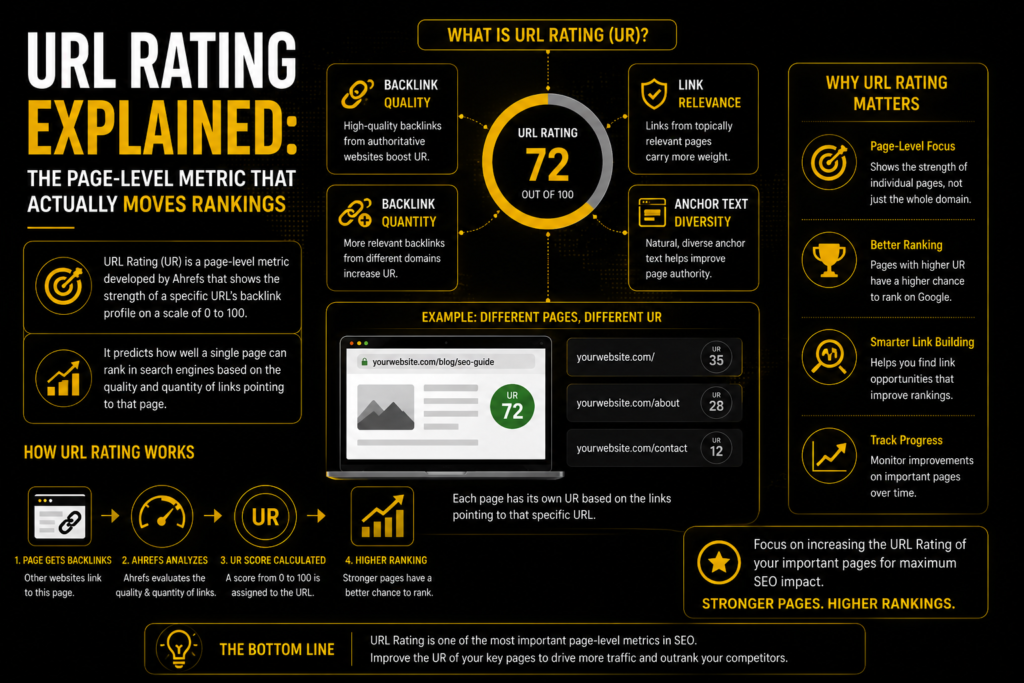
URL Rating (UR) is the Ahrefs metric that most link builders check least often and should check most often. Domain Rating (DR) dominates link buying conversations but DR measures domain-level authority, and links are placed on specific pages, not on domains. The page that actually links to your money site might have a UR of 3 on a DR 45 domain, passing almost no equity. Or it might have a UR of 28 on a DR 30 domain, passing substantial equity. Understanding URL Rating what it measures, how it differs from DR, and how to use it when evaluating link placements is the single most practical upgrade most link builders can make to their quality evaluation process.
Table of Contents
- What is URL Rating?
- URL Rating vs Domain Rating: the critical difference
- How URL Rating is calculated
- What URL Rating predicts — and what it does not
- What is a good URL Rating?
- URL Rating in PBN link evaluation
- How to improve the URL Rating of your pages
- URL Rating and Tier 2 link building
- FAQ
- Conclusion
Key Takeaways
- URL Rating (UR) is the Ahrefs metric measuring the link authority of a specific page URL — the page-level equivalent of Domain Rating (DR). A high-DR domain can have very low-UR article pages if internal linking is weak.
- For link building decisions, UR of the specific linking page matters more than DR of the domain. A UR 25 article on a DR 35 domain passes more equity per link than a UR 4 article on a DR 60 domain.
- UR is the most direct proxy for how much link juice (PageRank) a specific page has accumulated and can pass to pages it links to.
- Minimum recommended UR for PBN link placements: UR 8+ for standard campaigns, UR 15+ for competitive niches. Always check UR on the specific article URL, not just the domain.
- Tier 2 link building works by raising the UR of Tier 1 article pages — a UR increase on a linking page directly increases the equity it passes to your money site on every subsequent crawl.
What is URL Rating?
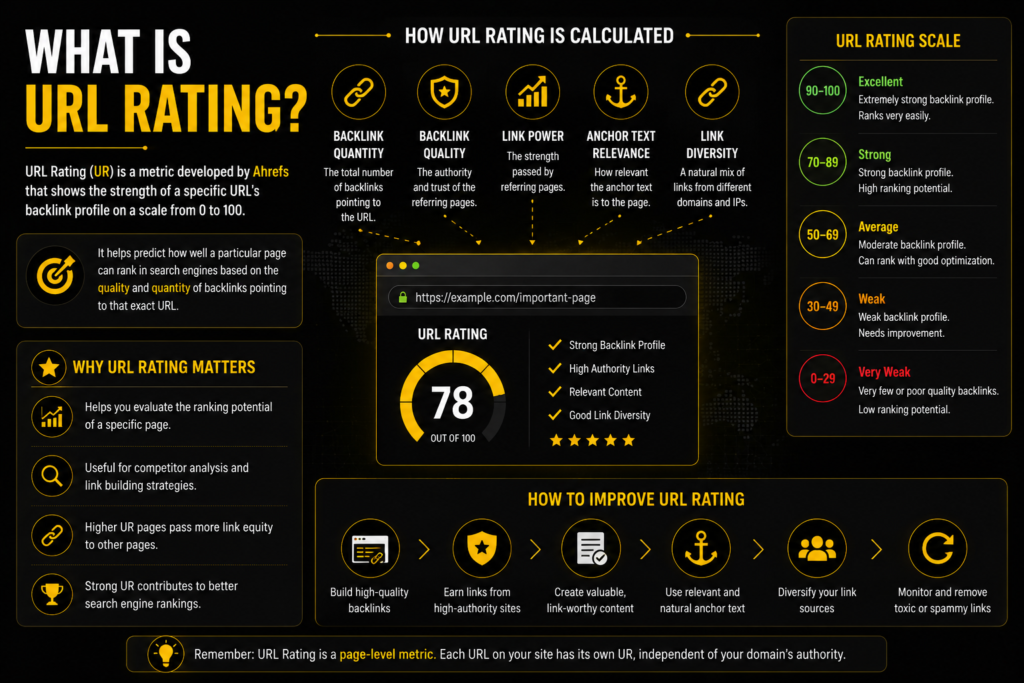
URL Rating (UR) is the Ahrefs metric that measures the link authority of a specific page URL — not a domain, not a website, a single page. It runs on a logarithmic scale of 0 to 100, where higher scores represent pages with stronger backlink profiles and more accumulated link equity. It is the page-level equivalent of Domain Rating (DR), which measures domain-level authority.
When a page has a high URL Rating, it means that page has accumulated significant link equity through the backlinks pointing to it — from both external domains and internal links. That accumulated equity is what the page can then pass to the pages it links to. A page with UR 30 has approximately 10 times more link equity than a page with UR 20, because UR uses a logarithmic scale where each point represents exponentially more equity.
URL Rating is Ahrefs closest approximation of Google PageRank at the page level. When a PBN article page links to your money site, the amount of link juice it passes is a function of its URL Rating — not its domain DR. This is the central insight that makes UR the most practically important metric in link building evaluation, covered in detail in our link juice guide and backlink equity guide.
URL Rating vs Domain Rating: the critical difference
The difference between URL Rating and Domain Rating is the single most important concept for anyone evaluating link placements. Most link buyers look at DR. The metric that actually determines how much equity the link passes is UR.
What DR measures
Domain Rating measures the strength of a domain entire backlink profile — the aggregate of all links pointing to all pages across the whole domain. A domain with DR 50 has a strong overall backlink profile. But DR tells you nothing about how that authority is distributed across individual pages within the domain.
What UR measures
URL Rating measures the strength of the backlink profile of a specific page URL. It is determined by: the number of unique domains linking directly to that page, the UR of those linking pages, and the internal links from other pages on the same domain pointing to that page. A page only accumulates high UR when it has either many external backlinks pointing directly to it or is well-supported by internal links from other high-UR pages.
Why the gap between DR and UR matters for link buying
A common PBN pattern: a domain has DR 45 because it acquired many links to its homepage and a few popular posts over years of operation. But the individual article pages on that domain — the pages where your link will actually be placed — have never received external backlinks and have no internal links from the strong homepage or popular posts. Those article pages may have UR 1 or UR 2, regardless of the domain DR 45.
The contrast makes the problem concrete: a link from a UR 2 page on a DR 45 domain passes almost no equity. A link from a UR 22 page on a DR 30 domain passes substantial equity. Buying the DR 45 placement because it looks more impressive on the delivery report is paying more for less ranking power.
| Scenario | DR | UR of linking page | Equity passed | Verdict |
|---|---|---|---|---|
| High DR, low UR article | 50 | 2 | Very low | Poor value — do not pay premium |
| Medium DR, medium UR article | 35 | 18 | Moderate-high | Good value |
| Lower DR, high UR article | 25 | 28 | High | Excellent — prioritise |
| High DR, high UR article | 50 | 30 | Very high | Best — premium justified |
How URL Rating is calculated
Ahrefs calculates URL Rating using a methodology modelled on the original PageRank algorithm. The inputs are: the URL Ratings of pages that link to this page, the number of unique dofollow links from each of those pages, the number of outbound links on each of those linking pages (which dilutes the equity each passes), and internal links to this page from other pages on the same domain.
The logarithmic scale
UR uses a logarithmic scale — the same as DR and Domain Authority. This means moving from UR 10 to UR 20 requires significantly more backlink equity than moving from UR 0 to UR 10. Moving from UR 20 to UR 30 requires even more. The practical implication: a page at UR 35 has not accumulated twice as much equity as a page at UR 17 — it has accumulated many times more. This is why high-UR pages are so much more valuable as link sources than their absolute number suggests.
How internal links affect UR
Internal links from other pages on the same domain contribute to a page UR. A PBN article page that is linked from the PBN domain homepage, the category page, and several other articles on the same site will have higher UR than an orphaned article page with no internal links — even at the same domain DR. This is why well-structured PBN sites with strong internal linking produce higher UR article pages and therefore more equity per link than poorly structured sites where each article is an island with no internal links.
How often UR updates
Ahrefs updates URL Rating as it crawls new links and recrawls existing ones. For most URLs, UR is recalculated within days to weeks of new links being discovered. This means that Tier 2 link building activity — building links to a Tier 1 article page — should produce measurable UR improvement on that page within 2–4 weeks of the Tier 2 links being indexed by Ahrefs crawl.
What URL Rating predicts — and what it does not
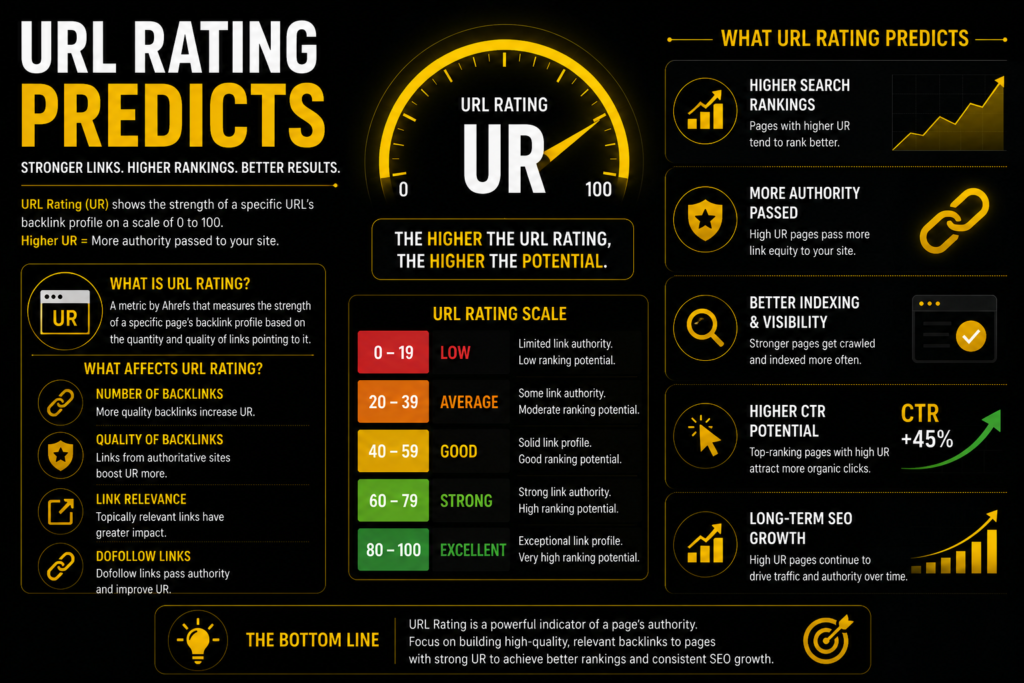
URL Rating is a proxy for Google PageRank at the page level. It is one of the most useful proxies available, but it has specific limitations that every link builder should understand.
What UR predicts well
Equity passed per outbound link: A page UR is the best available predictor of how much link equity it will pass through its outbound links. Higher UR means more equity passed to each page it links to, all else equal. This is the most directly useful prediction for link building decisions.
Indexation frequency: High-UR pages tend to be crawled more frequently by Google because they receive more links pointing to them. A link on a UR 25 page is likely to be discovered by Googlebot faster than the same link on a UR 3 page — which means faster indexation of your link and faster equity transfer to your money site.
What UR does not predict
Content quality or spam status: A page can have high UR from years of accumulated links while hosting thin or spammy content. High UR does not mean Google currently values the page content — it means the page has historically accumulated link equity. If the page content now fails Google Helpful Content standards, the equity it passes may be partially discounted. Always verify content quality alongside UR.
Organic traffic: UR and organic traffic are correlated but not identical. A page with UR 20 and zero organic traffic may have accumulated equity through links but be ranking for no queries — perhaps because the content is thin, the topic is too competitive, or the page was penalised. Organic traffic is the verification step that confirms Google actively values the page, not just that it has received links. See our domain authority vs domain rating guide for the full four-step evaluation sequence.
What is a good URL Rating?
| Context | Minimum UR | Target UR range | Notes |
|---|---|---|---|
| PBN article pages (standard campaigns) | UR 5 | UR 10–25 | UR 5 is a floor — some equity but limited |
| PBN article pages (competitive niches) | UR 10 | UR 15–30 | Higher UR needed to move competitive SERPs |
| Niche edit placements | UR 10 | UR 15–40 | Aged pages often have naturally high UR |
| Tier 2 link targets (after Tier 2 building) | UR 12 | UR 15–25 | Goal of Tier 2 campaign on Tier 1 pages |
| Money site target pages (goal) | UR 15 | UR 20–40 | Depends on SERP competition |
These benchmarks apply to the specific linking article page URL — not the domain. A delivery report showing “DR 40 domain” without the individual article page UR is insufficient for quality evaluation. Always request the specific article URL alongside its UR in any link building delivery report.
URL Rating in PBN link evaluation
URL Rating should be a mandatory check on every PBN link placement before payment is accepted. Here is the exact process.
How to check URL Rating in Ahrefs
In Ahrefs Site Explorer, paste the specific article page URL — not the homepage, not the domain. The Overview tab shows the URL Rating prominently alongside DR. The UR on this overview is the metric that matters for link equity evaluation. If the provider has given you only a domain URL, ask for the specific article page URL before checking.
The UR check workflow for each delivered link
- Get the specific article URL from the provider delivery report
- Paste into Ahrefs Site Explorer
- Check UR — reject if below your campaign minimum
- Check referring domains to the specific article URL — confirm at least some external links point directly to this page, not just to the domain
- Check organic traffic for the article URL — some traffic confirms Google values and crawls the page regularly
- Confirm outbound link count on the article — if many outbound links share the page, the equity per link is diluted
This six-step check takes approximately 90 seconds per link and prevents the most common link quality problem: paying for high-DR domain placements that deliver near-zero equity because the actual article pages have no UR. For the full quality evaluation framework see our outsource link building guide and our Trust Flow guide.
How to improve the URL Rating of your pages
Improving the URL Rating of your money site pages — or your PBN article pages — follows the same principles as improving any page backlink equity.
Build external backlinks directly to the target page
External backlinks pointing directly to a specific page URL are the most direct way to raise its UR. PBN links, niche edits, and editorial outreach links all contribute UR when they target the specific page URL. This is why targeting individual money pages in your link building brief — rather than just the homepage — is essential for raising UR on the pages that need to rank. Our ecommerce PBN guide covers this for collection pages, and our SaaS PBN guide covers it for feature and comparison pages.
Add internal links from high-UR pages
Internal links from pages that already have high UR contribute to the UR of the pages they link to. Find your highest-UR pages in Ahrefs (Site Explorer → Pages → Best by Links → sort by UR). Add contextual internal links from those pages to your target money pages. This redistributes existing UR from strong pages to pages that need it — free equity transfer within your own site.
Fix orphaned pages
A page with no internal links pointing to it receives no internal UR contribution. Even a UR 0 page can accumulate some UR from good internal linking, which can accelerate ranking movement when external links are also being built to it. Every money page should have at least 3–5 internal links from relevant pages in your site structure.
URL Rating and Tier 2 link building
URL Rating is the metric that makes Tier 2 link building measurable and trackable. The entire purpose of Tier 2 link building is to raise the UR of Tier 1 article pages — which then increases the equity those pages pass to your money site on every Google crawl cycle.
The measurement workflow is direct: check the UR of each Tier 1 article page in Ahrefs weekly after deploying Tier 2 links. A page that started at UR 5 and is at UR 18 four weeks later has received meaningful Tier 2 equity. That same page now passes roughly 3–4× more link juice to your money site per crawl than it did at UR 5. Ranking movement on your money site keywords typically appears 4–8 weeks after Tier 1 page UR improvement becomes visible in Ahrefs.
If UR on Tier 1 pages is not improving after 6 weeks of Tier 2 deployment, the Tier 2 links are not being indexed or are being discounted — investigate before investing more Tier 2 budget. The full Tier 2 measurement framework including the three-stage diagnostic process is in our second tier link building guide.
FAQ
What is URL Rating in Ahrefs?
URL Rating (UR) is the Ahrefs metric measuring the link authority of a specific page URL on a logarithmic scale of 0 to 100. It is the page-level equivalent of Domain Rating (DR) and represents the accumulated link equity on that specific page from both external backlinks and internal links. It is Ahrefs closest approximation of Google PageRank at the page level.
What is the difference between URL Rating and Domain Rating?
Domain Rating measures the strength of a domain entire backlink profile — the aggregate authority across all pages on the domain. URL Rating measures the strength of a specific page backlink profile. A domain can have high DR while individual pages have very low UR if those pages have not received external backlinks and are not well-supported by internal links. For link building decisions, UR of the specific linking page is more relevant than domain DR because links are placed on pages, not domains.
What is a good URL Rating for a PBN link placement?
UR 5 is the practical minimum for standard campaigns — below this, the equity passed is minimal. UR 10–20 is the target range for standard PBN placements. UR 15–30 is ideal for competitive niches. For niche edits on aged pages, UR 15–40 is achievable because established pages accumulate UR over years of external link earning. Always check UR on the specific article URL, not the domain — a DR 50 domain with UR 2 article pages is a poor placement regardless of the domain score.
How do I check URL Rating?
In Ahrefs Site Explorer, paste the full article page URL (not just the domain) into the search bar. The URL Rating appears prominently on the Overview tab. You can also check UR for multiple pages simultaneously using Ahrefs Batch Analysis tool — paste up to 200 URLs and get UR for all of them at once. This is useful for auditing a provider network or evaluating a list of potential niche edit placements efficiently.
Does URL Rating directly affect Google rankings?
UR does not directly affect rankings — it affects how much equity the page passes to the pages it links to. If a high-UR page links to your money page, your money page receives more equity, which contributes to its ranking potential. UR is a proxy for Google PageRank on the linking page, not a direct ranking factor for the page itself. The ranking benefit flows downstream: high-UR linking page → more equity to your money page → better ranking potential for your money page for target keywords.
Conclusion
URL Rating is the metric that link builders should be checking first and most often — and the one that most currently check least. The gap between DR and UR on PBN article pages is where most link building budget is wasted: paying for high-DR domain placements that deliver near-zero equity because the article pages themselves have no accumulated link authority.
The practical rule is simple: before accepting any link placement, check the UR of the specific article URL in Ahrefs. Apply your campaign minimum threshold. If the UR is below it, reject the placement regardless of how impressive the domain DR looks on the delivery report. A single UR 25 link from a DR 30 domain outperforms five UR 2 links from a DR 55 domain — every time.
For the broader metrics framework — how UR relates to Trust Flow, Domain Rating, and organic traffic in a complete link quality evaluation — see our domain authority vs domain rating guide, our Trust Flow guide, and our link juice guide.
Every placement checked for article-level URL Rating before delivery. Quality PBN backlinks — UR verified on every article page, not just domain DR. Supporting guides: backlink equity — UR and equity mechanics, Tier 2 links — raising UR on Tier 1 pages, link juice — what UR passes downstream, Trust Flow — the quality companion metric, niche edits — where aged page UR beats PBN.

Ben Davis is a seasoned SEO strategist with over a decade of hands-on experience in off page SEO, link building, and private blog network management.
He has helped 600+ agencies and professionals achieve top rankings in competitive niches including iGaming, crypto, CBD, and finance through data driven PBN strategies.