


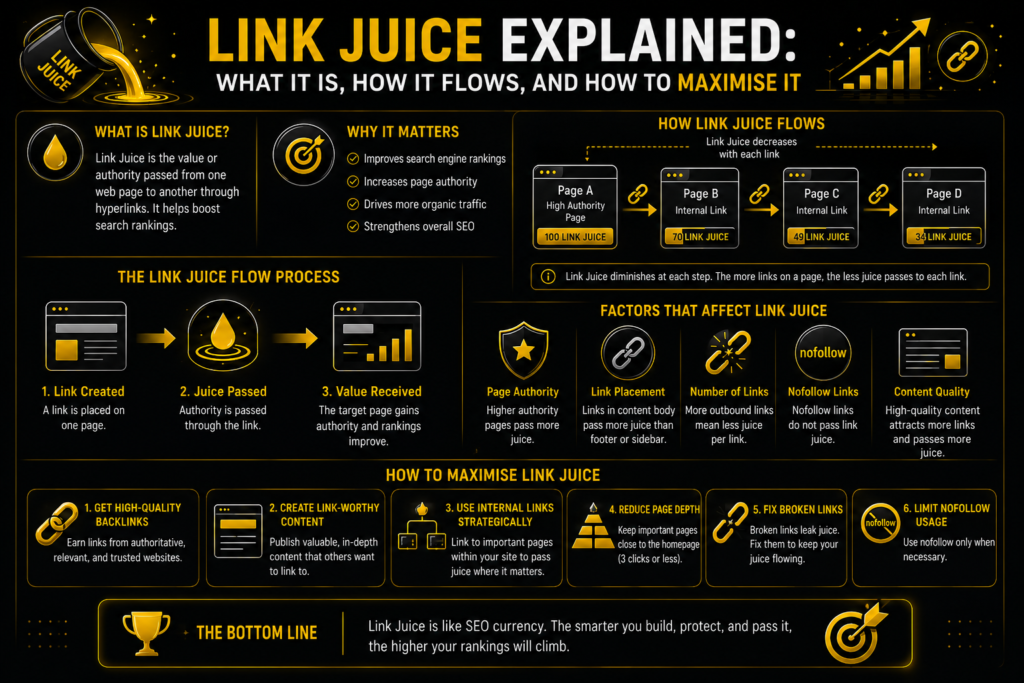
Link juice is one of the oldest terms in SEO — and still one of the most searched. The concept predates modern authority metrics by years, originating as an informal way to describe what Google founders originally called PageRank: the ranking power that flows from one page to another through hyperlinks. Google retired the public PageRank toolbar in 2016, but the underlying mechanism is more relevant than ever. This guide explains what link juice means in 2026, how it flows through both external backlinks and internal links, what dilutes it, and the specific tactics that maximise the ranking power reaching your most important pages.
Table of Contents
- What is link juice?
- Link juice and PageRank: the same thing
- How link juice flows through a website
- What dilutes link juice
- Maximising link juice from external backlinks
- Maximising link juice through internal linking
- Nofollow links and link juice
- Link juice and PBN links
- FAQ
- Conclusion
Key Takeaways
- Link juice is the informal SEO term for PageRank — the ranking authority that flows from one page to another through a dofollow hyperlink. Google still uses PageRank as a core ranking signal despite retiring the public toolbar in 2016.
- Link juice is divided equally among all outbound links on a page. A page with 1 outbound link passes 100% of its available juice to that page. A page with 10 outbound links passes approximately 10% to each.
- Nofollow links do not pass link juice. Every PBN link, niche edit, and editorial backlink must be dofollow to pass ranking power to your money site.
- Internal linking is the most underused link juice maximisation strategy — strategic internal links from high-authority pages to lower-authority target pages can produce ranking improvements equivalent to several external backlinks, for free.
- Link juice does not accumulate on a page and then “top up” — it is recalculated on every Google crawl cycle based on the current state of all links pointing to and from each page.
What is link juice?
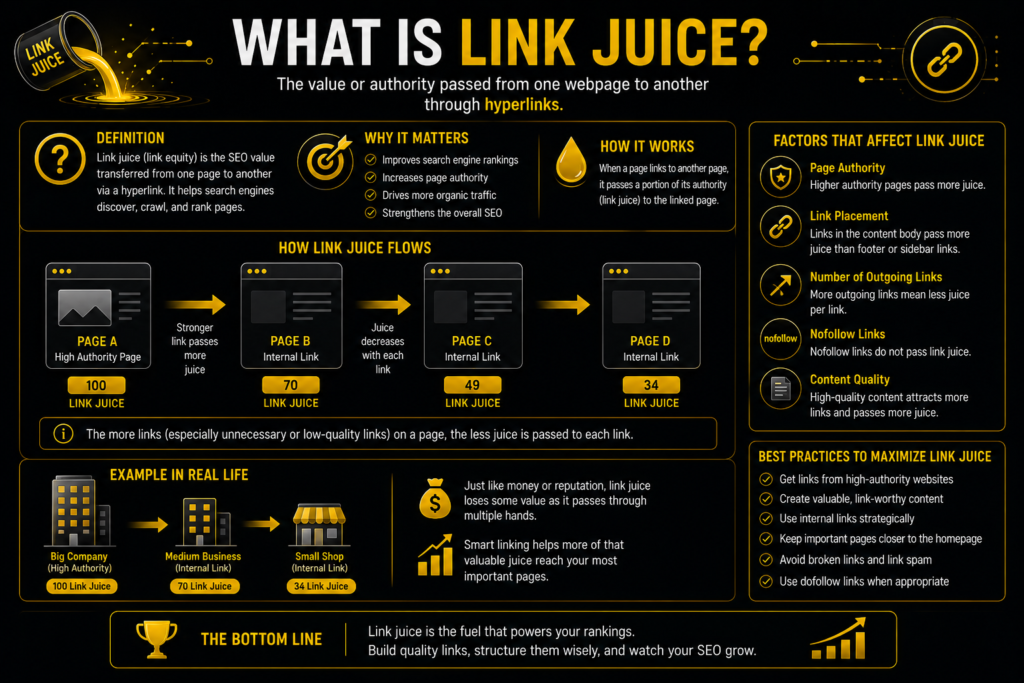
Link juice is the informal SEO term for the ranking authority that passes from one page to another through a hyperlink. It is not an official Google term — it emerged from the SEO community as a plain-language way to describe PageRank, the algorithm developed by Google founders Larry Page and Sergey Brin that forms the foundation of Google search ranking.
The concept is simple: when Page A links to Page B, it shares some of its authority — its link juice — with Page B. Page B becomes more authoritative in Google eyes as a result, which helps it rank higher for relevant queries. The more link juice a page receives from other authoritative pages, the stronger its ranking signal.
Link juice is sometimes also called link equity, link authority, or PageRank flow. These terms all refer to the same fundamental mechanism. Our backlink equity guide covers the modern mechanics of this in detail — link juice and backlink equity are the same concept described in different vocabularies.
Despite Google retiring the public PageRank toolbar in 2016, PageRank — and therefore link juice — remains one of the most important signals in Google ranking algorithm. Third-party tools like Ahrefs URL Rating (UR) and Majestic Trust Flow attempt to approximate the PageRank of individual pages and domains. When you check a page UR in Ahrefs, you are looking at a proxy measure for how much link juice that page has accumulated.
Link juice and PageRank: the same thing
PageRank is the algorithm that link juice describes informally. Understanding the original PageRank concept makes the practical link juice rules much easier to apply correctly.
The original PageRank model
In the original PageRank model, every page on the web starts with a base PageRank value. When a page links to another page, it passes a portion of its PageRank to the linked page. The more PageRank the source page has, and the fewer outbound links it has competing for that PageRank, the more PageRank (link juice) each linked page receives.
The process is iterative — after the initial calculation, the PageRank of each page is recalculated based on the PageRank of the pages linking to it, and then recalculated again, and again, until the values stabilise. This iterative calculation means that high-PageRank pages linking to a page raise that page PageRank more than low-PageRank pages — which is why a single link from an authoritative site can be worth more than hundreds of links from low-authority sites.
How PageRank works in 2026
Google has confirmed that PageRank still operates as part of its ranking algorithm, though it has been significantly evolved and supplemented with hundreds of additional signals. The core principle — that links pass authority between pages, and that the authority of the source page and number of outbound links determines how much is passed — remains valid. Third-party tools approximate this with URL Rating (Ahrefs) and Trust Flow (Majestic). When these tools show a page with UR 35, they are measuring an approximation of the PageRank / link juice that page has accumulated.
How link juice flows through a website
Link juice flows into a website through external backlinks and is then distributed throughout the site through internal links. Understanding both flows is essential for maximising ranking power across your most important pages.
External link juice flow
When an external website links to a page on your site, it passes link juice to that specific page — not to the domain as a whole. The homepage frequently receives the most external backlinks and therefore has the highest accumulated link juice. Product pages, blog posts, and category pages typically have less external link juice than the homepage unless they have been specifically targeted with link building campaigns.
The amount of link juice passed by each external link depends on: the URL Rating of the specific linking page, the number of other outbound links on that page competing for its juice, and whether the link is dofollow (passes juice) or nofollow (does not pass juice). A dofollow link from a page with UR 30 and 2 outbound links passes far more link juice than a dofollow link from a page with UR 30 and 25 outbound links.
Internal link juice flow
Once link juice enters your site through external backlinks, it flows through your internal linking structure. Every internal link on your pages passes a portion of that page link juice to the linked page. This means that a page with high external link juice (your homepage, your most-linked blog posts) can distribute link juice to pages that have few or no external backlinks — through strategic internal links.
This is the mechanism behind why internal linking is one of the highest-ROI SEO actions available. A money page with no external backlinks that receives an internal link from your homepage — which has accumulated significant external link juice — receives a meaningful amount of ranking power at zero cost. The same principle applies to any page with accumulated link juice linking to a page that needs it.
What dilutes link juice
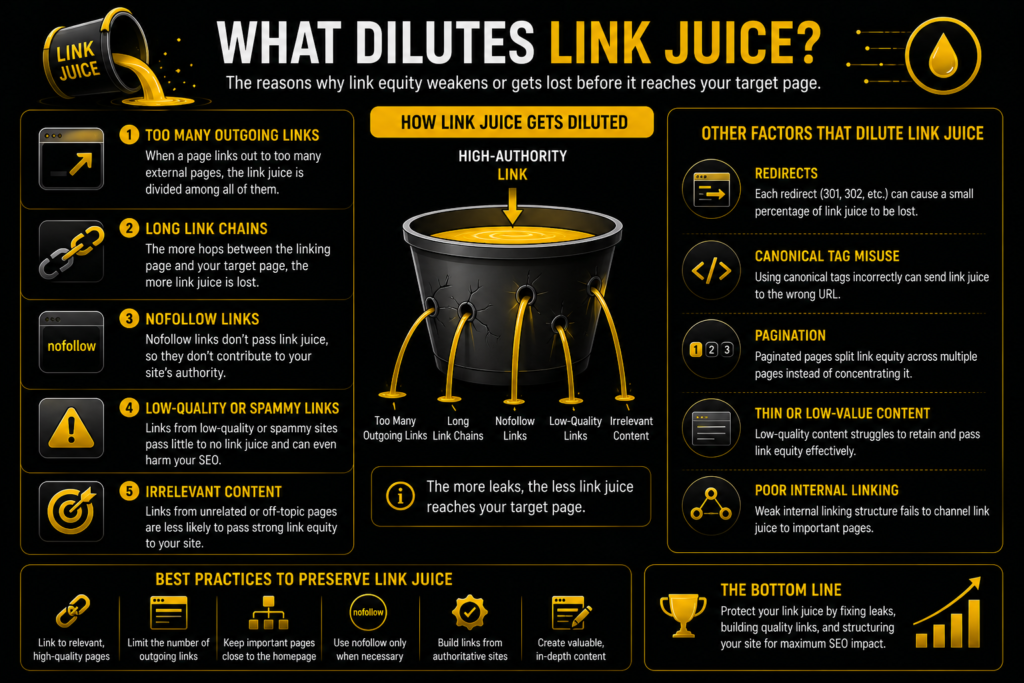
Several factors reduce the link juice that reaches your target pages. Understanding them helps you avoid accidental dilution and fix it when it exists.
1. Too many outbound links on the linking page
This is the most significant dilution factor. Link juice is divided among all outbound links on a page. A page that passes 10 units of link juice with 1 outbound link passes approximately 1 unit per link with 10 outbound links. For PBN link building, this is why single-outbound-link exclusive placements are significantly more valuable than shared placements on pages with many other links. A PBN article with 8 outbound links is passing roughly one-eighth the juice per link compared to the same article with a single outbound link.
2. Nofollow attributes
A link with rel=”nofollow”, rel=”sponsored”, or rel=”ugc” does not pass link juice. The juice that would have flowed through that link is lost — it does not redistribute to other links on the page. This is why verifying dofollow status on every PBN link and niche edit placement is essential. A nofollow link passes zero juice and is a wasted placement regardless of the authority of the linking page. See our dofollow vs nofollow guide for the full mechanics.
3. Redirect chains
A 301 redirect passes most but not all of the link juice from the original URL to the destination URL. Multiple redirects in a chain (A redirects to B which redirects to C) cause further juice loss at each hop. If your money site pages use redirects — for URL changes, HTTPS migrations, or URL restructuring — verify that redirect chains are minimal and that all external backlinks point to the current canonical URL wherever possible.
4. Canonicalisation issues
If multiple URLs serve the same content — the classic Shopify /collections/products/ duplicate URL problem, or www vs non-www variants — link juice that should concentrate on one canonical URL gets split across multiple URLs. Fixing canonicalisation issues consolidates link juice on the correct URLs. This is why solving Shopify canonical tag issues before building PBN links is essential — otherwise PBN link juice splits between the canonical and non-canonical versions of the same page. See our PBN links for ecommerce guide for the Shopify-specific canonical fix.
5. Deep page architecture
Pages that are many clicks away from the homepage receive less internal link juice because it has been diluted through multiple intermediate pages. A page at click depth 5 from the homepage has had link juice passed through five layers of internal links before reaching it — each layer diluting the juice slightly. Reducing click depth for your most important money pages through navigation links, breadcrumbs, and homepage mentions concentrates more juice on those pages.
Maximising link juice from external backlinks
Five practices maximise the link juice each external backlink passes to your money site.
1. Insist on single-outbound-link placement
For PBN links and niche edits, specify that the placement article contains a single outbound link — your link. This ensures 100% of the available link juice flows to your money site page rather than being divided among multiple outbound links. A single-placement article on a UR 20 page passes more juice than a shared-placement on a UR 40 page with 10 outbound links.
2. Target linking pages with high URL Rating
Domain Rating (DR) is a domain-level metric. URL Rating (UR) is a page-level metric. For link juice purposes, UR of the specific linking page is more important than DR of the domain. A UR 30 article page on a DR 35 domain passes more juice than a UR 5 article page on a DR 60 domain. Always check UR of the specific article page in Ahrefs, not just the domain DR. See our Domain Authority vs Domain Rating guide for the full metric hierarchy.
3. Build Tier 2 links to your Tier 1 article pages
A Tier 1 PBN article page that starts with UR 5 passes a limited amount of juice. Building Tier 2 links to that article page raises its UR — meaning it passes more juice to your money site on every subsequent Google crawl. This is the principle behind tiered link building: amplify the juice-passing ability of your existing Tier 1 pages rather than only adding new Tier 1 links. See our second tier link building guide for the full Tier 2 strategy.
4. Ensure all backlinks point to canonical URLs
Verify that every PBN link and niche edit points to the canonical version of the target page — the exact URL that the rel=”canonical” tag on that page identifies as the primary version. Links pointing to a non-canonical URL pass juice to the redirect destination, losing some in the process. Links pointing directly to the canonical URL pass full juice immediately.
5. Choose topically relevant linking domains
Google weights link juice more heavily when the linking domain is topically relevant to the linked page. A finance site linking to a finance page passes more ranking power than a cooking site linking to the same finance page — even at the same URL Rating. Topical relevance is a quality multiplier on the quantity of juice passed. This is why Topical Trust Flow (covered in our Trust Flow guide) is a critical domain selection criterion for PBN campaigns.
Maximising link juice through internal linking
Internal linking is the most underused link juice maximisation strategy in SEO. Every internal link on your site passes some link juice from the source page to the destination page — free juice that costs nothing beyond the effort of adding the link.
Identify your highest link juice pages
In Ahrefs Site Explorer, go to Pages then Best by Links. This shows your pages ranked by referring domain count — the pages with the most external backlinks and therefore the most accumulated external link juice. These are your link juice reservoirs. Any internal link from these pages to a target money page passes meaningful juice.
Link from high-juice pages to money pages
Add contextual internal links from your highest-juice pages (homepage, popular blog posts, well-linked category pages) to your most commercially important money pages. A natural, contextual internal link with descriptive anchor text passes both link juice and topical relevance signal. The anchor text of internal links should be descriptive and keyword-relevant — “our guide to PBN link building” passes more relevance signal than “click here.”
Fix orphaned pages
An orphaned page is a page with no internal links pointing to it — only accessible directly by URL or through the sitemap. Orphaned pages receive zero internal link juice regardless of how many external backlinks the domain has. In Ahrefs Site Audit, the Pages without internal links report identifies orphaned pages. Every money page on your site should receive at least 3–5 internal links from relevant pages in your content structure.
Reduce unnecessary outbound internal links on high-juice pages
Just as external link juice dilutes with more outbound links, so does internal link juice. A homepage with 200 internal links passes a tiny fraction of its juice to each linked page. Audit your most-linked pages for unnecessary internal links — navigation items, footer links, sidebar widgets — and reduce them where possible. The goal is to concentrate juice flow toward your highest-priority money pages rather than spreading it thin across hundreds of pages.
Nofollow links and link juice
Nofollow links do not pass link juice. This has been the case since Google introduced the nofollow attribute in 2005 — though the 2019 update changed nofollow from a strict directive to a hint, meaning Google may occasionally crawl nofollow links for indexation purposes. The key point remains: for ranking power purposes, nofollow links contribute no link juice to the linked page.
A common misconception: when a page has both dofollow and nofollow outbound links, the juice from the nofollow links does not redistribute to the dofollow links. The juice that would have passed through nofollow links is simply lost. Only the juice allocated to dofollow outbound links reaches their destination pages.
This makes the dofollow verification step before any link placement non-negotiable. See our dofollow vs nofollow guide for the four methods to verify link rel attributes on any placement.
Link juice and PBN links
PBN link building is fundamentally a link juice engineering exercise. Every decision in a PBN campaign — domain selection, content quality, placement structure, anchor text, Tier 2 support — affects the amount of link juice that ultimately reaches your money site pages. Understanding link juice mechanics makes these decisions clearer.
Why domain quality affects juice quantity
A PBN domain with high Trust Flow and URL Rating on its article pages has accumulated more PageRank through its own link profile — meaning it has more juice to pass to your money site through each placed link. A PBN domain with DR 40 but all article pages at UR 1–3 has domain-level authority that is not being distributed to its article pages — those pages have almost no juice to pass regardless of the domain score. This is why page-level UR check is the most important quality step in PBN link evaluation, not domain-level DR.
Why single-placement matters more than most practitioners realise
The difference in juice passed between a single-outbound-link article and a three-outbound-link article is not 33% — the dilution is more significant because links to unrelated pages also consume juice that could have gone to your money site. An article that links to your money site plus two other unrelated sites passes roughly one-third of available juice to your money site. For the same article cost, a single-placement article passes three times as much juice. Over a 20-link campaign, this difference is equivalent to building 40 links instead of 20 — without any additional cost.
The Tier 2 juice multiplication effect
Tier 2 links raise the URL Rating of PBN article pages — which means they raise the amount of juice those pages pass to the money site. A Tier 1 article page that starts at UR 5 and is boosted to UR 22 through Tier 2 links passes roughly 4× more juice per crawl cycle. This is the most cost-efficient juice amplification available — instead of buying new Tier 1 links, amplify the juice-passing ability of the Tier 1 links you already have. Full strategy in our second tier link building guide.
For the comprehensive technical framework covering link equity mechanics, PageRank dilution calculations, and tiered equity structures, see our backlink equity guide.
FAQ
What is link juice in SEO?
Link juice is the informal SEO term for PageRank — the ranking authority that flows from one page to another through a dofollow hyperlink. When a page links to your page, it shares a portion of its authority with you. The more authority the linking page has, and the fewer outbound links there are on that page, the more link juice your page receives. Google still uses PageRank as a core ranking signal despite retiring the public toolbar in 2016.
Does link juice still matter in 2026?
Yes. Google has confirmed that PageRank — the mechanism link juice describes — remains a core part of its ranking algorithm. Third-party tools like Ahrefs URL Rating and Majestic Trust Flow approximate PageRank at the page and domain level. The core principle that high-authority pages passing links to your pages improve your ranking potential has not changed, even as Google has added hundreds of additional ranking signals since PageRank was introduced.
Does nofollow pass link juice?
No. Nofollow links do not pass link juice (PageRank). Google changed nofollow from a strict directive to a hint in 2019, meaning it may occasionally follow nofollow links for crawling purposes — but this does not mean nofollow links pass ranking authority. For link building purposes, only dofollow links contribute meaningful link juice to the linked page.
How do you pass more link juice with the same number of links?
Three approaches maximise link juice per link without increasing link count: (1) insist on single-outbound-link placement on every PBN or niche edit — this eliminates dilution from competing outbound links; (2) target linking pages with high URL Rating rather than focusing only on domain-level DR; (3) build Tier 2 links to your Tier 1 article pages to raise their URL Rating before that juice flows to your money site — this multiplies the juice-passing ability of every existing Tier 1 link.
Can internal links pass link juice?
Yes — internal links pass link juice between pages on the same site. A high-authority page with many external backlinks (like a popular blog post or your homepage) can distribute some of its accumulated juice to other pages on your site through strategic internal links. This is why internal linking from high-authority pages to money pages is one of the highest-ROI free SEO actions available — it moves existing juice to where it is most commercially valuable without requiring new external link building.
Conclusion
Link juice — PageRank by another name — remains one of the most fundamental mechanisms in SEO. The practical implications are consistent and actionable: dofollow links pass juice, nofollow links do not; fewer outbound links on the linking page means more juice per link; page-level URL Rating matters more than domain-level DR for juice quantity; and internal linking is an underused free mechanism for directing existing juice to your highest-priority pages.
For link builders, the link juice framework clarifies what the goal actually is in any campaign: not to accumulate a link count, but to concentrate the maximum amount of quality PageRank on the specific pages that need it to rank. Every quality decision — single-placement exclusivity, high-UR article pages, Tier 2 amplification, topical domain relevance, canonical URL targeting — serves this goal. The link count is secondary to the juice engineering.
Every PBN placement engineered for maximum link juice transfer. Quality PBN backlinks — single-outbound-link articles, high-UR placements, dofollow verified. Supporting guides: backlink equity — the technical foundation, Tier 2 link building — multiply juice without new Tier 1 links, dofollow vs nofollow — what passes juice, Trust Flow — quality metric for juice-passing domains, DA vs DR vs TF — full metric guide, and our complete PBN SEO guide.

Ben Davis is a seasoned SEO strategist with over a decade of hands-on experience in off page SEO, link building, and private blog network management.
He has helped 600+ agencies and professionals achieve top rankings in competitive niches including iGaming, crypto, CBD, and finance through data driven PBN strategies.