


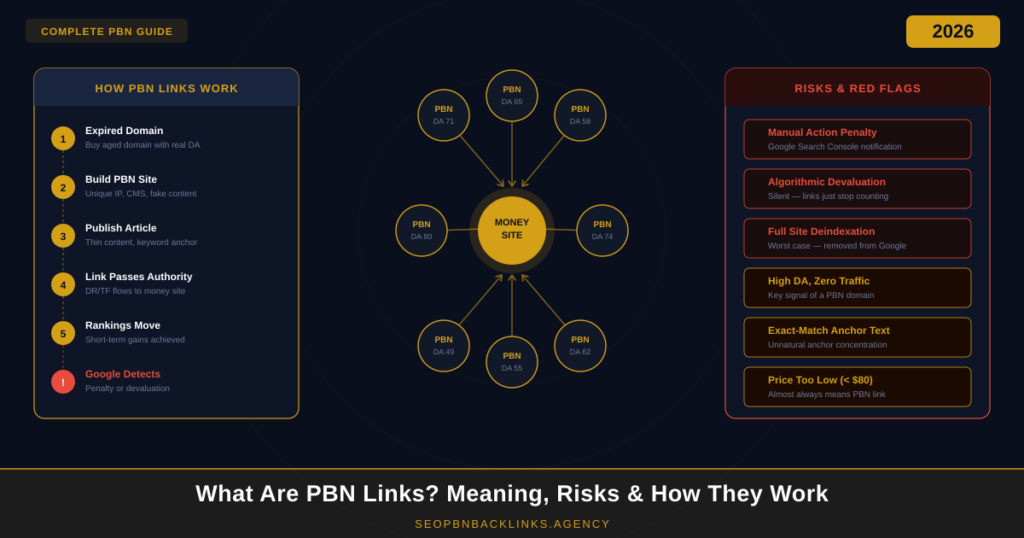
This article explains exactly what PBN links are, where they come from, and why they represent one of the highest-risk tactics in modern SEO. A PBN link is a backlink placed on a privately-owned network site a domain that exists not to serve an audience, but to artificially transfer ranking authority to a target website. The guide covers how these links are built step by step, including the expired domain acquisition process. It examines the underground marketplace where PBN links are bought and sold and how to recognize when a link seller is quietly placing your links on network sites rather than genuine editorial publications. You will also learn how to audit your existing backlink profile for suspected PBN links using industry-standard tools, what a Google penalty actually looks like when PBN links are detected, and the correct process for disavowing links you did not build yourself.
Table of Contents
- Introduction: what are PBN links and why should you care?
- PBN links meaning: a precise definition
- How PBN links are built: the process step by step
- Where PBN links are sold: the marketplace problem
- Why PBN links are dangerous for your site
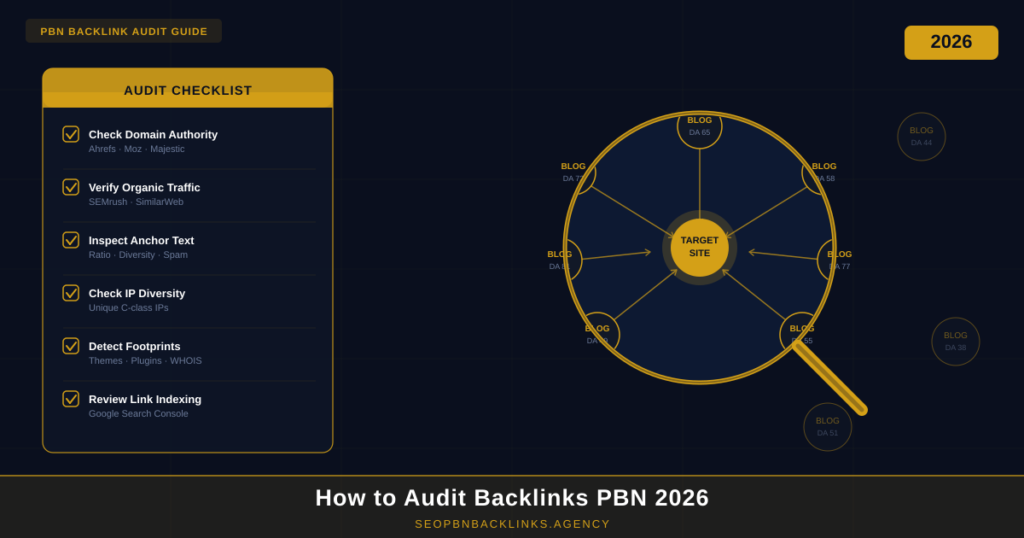
- How to check if you already have PBN links pointing to your site
- FAQ
- Conclusion
Key Takeaways
- A PBN link is a backlink from a site that exists solely to pass link authority to a target domain no real audience, no editorial independence, no genuine content purpose.
- PBN links are sold widely through link marketplaces and routinely passed off as legitimate outreach or guest post placements.
- Google can respond with a manual action, algorithmic neutralization, or full deindexation of both the network and money site.
- Even if no penalty is issued, Google may simply stop counting PBN links meaning you pay their cost with zero ranking benefit.
- A backlink audit using Ahrefs, Semrush, or Majestic can surface most PBN links through domain quality metrics and anchor text patterns.
Introduction: what are PBN links and why should you care?
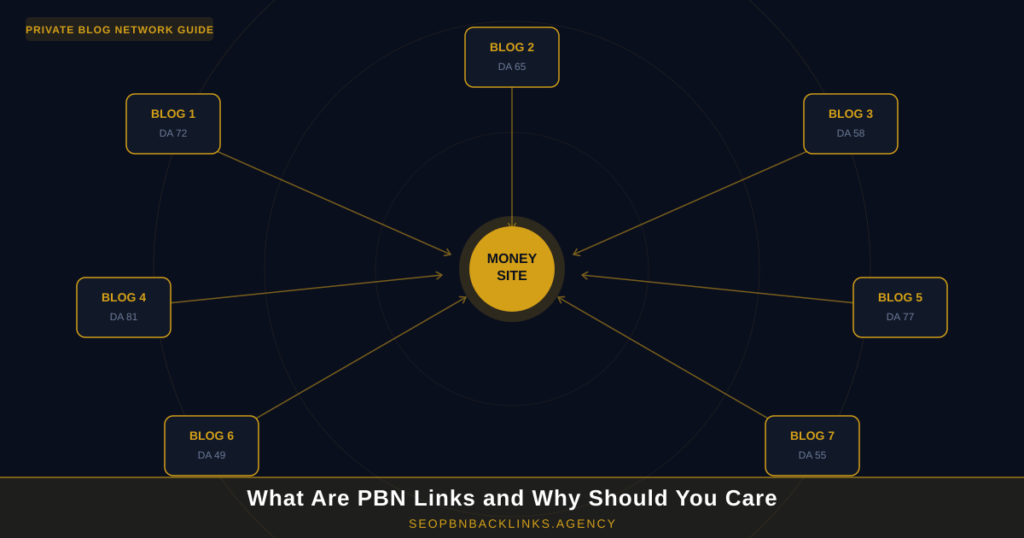
Here is a scenario that plays out constantly across the SEO industry: a site owner hires a link-building agency, pays for a package of editorial outreach links, and ranks well for several months. Then an algorithm update hits, rankings collapse, and a Google Search Console manual action notification arrives. The investigation reveals the agency placed every single link on a private blog network sites the agency owned, dressed up to look like real publications.
What are PBN links in this context? They are backlinks placed on websites that exist purely to transfer ranking signals, not to inform readers or create any genuine editorial value. The placement was not earned it was engineered by whoever controls the network.
This matters even if you would never intentionally build a private blog network yourself. The link-buying landscape is filled with sellers who offer what sounds like legitimate guest posting but deliver PBN links instead. Knowing how to identify them is a core SEO self-defense skill in 2026.
PBN links meaning: a precise definition
The pbn links meaning, at its most precise: a PBN link is a hyperlink placed on a website that is controlled by the same entity benefiting from the link. If you are new to this topic, our complete PBN SEO guide covers the full context of how these networks operate. where no independent editorial decision was made to include it. That last clause is everything. Google’s entire link evaluation framework is built on the premise that a link represents an independent editorial judgment. A PBN link removes that independence entirely.
What is a PBN link vs a normal backlink?
A normal backlink is awarded by an independent third party who found your content worth citing. You had no control over the anchor text, the placement, or even whether the link happened at all. A PBN link is awarded by yourself through a site you control. You determine the anchor text, the placement, and the timing. It looks like an independent endorsement but contains no actual independent judgment.
The difference between a PBN link and a paid link
Paid links and PBN links are closely related but not identical. A paid link is any link exchanged for money you pay a site owner to include a link to your site. PBN links are a specific type of paid link where the receiving site is part of a controlled network rather than an independent publication. Both violate Google’s link spam policies. The key question to ask about any link you are considering purchasing: does the site that would be linking to you have an editorial team that independently decides what content to publish and what to link to? If the answer is no, it is a PBN link regardless of what the seller calls it.
How PBN links are built: the process step by step
Understanding the construction process behind what is pbn links makes the footprints much easier to recognize. PBN links do not appear from nowhere they are the end product of a specific, repeatable process that leaves traceable marks at every stage.
Step 1: finding and buying expired domains with existing authority
The foundation of every PBN link is an expired domain — one that previously belonged to a legitimate website and accumulated genuine backlinks over years of real use. Our guide on PBN networks and domain selection covers exactly how operators evaluate and acquire these domains. Operators search for domains evaluating Domain Rating (DR), Trust Flow (TF), referring domain count, topical relevance, and clean penalty history. When a suitable domain is found, the operator purchases it through registrar drop auctions or aftermarket platforms.
Step 2: setting up the PBN site to avoid footprints
Once acquired, the operator builds a website on it designed to look legitimate while minimizing ownership footprints. Tactics include separate hosting accounts for different IP addresses, varied CMS setups, separate domain registrars and WHOIS details, and content population to pass a casual inspection. The amount of effort invested in footprint avoidance directly correlates with the cost of running the network.
Step 3: placing the backlink in content
An article is published on the PBN site containing a hyperlink to the money site typically with commercial or keyword-rich anchor text chosen by the operator. The article meets minimum plausibility standards: long enough not to look thin, covering a topic loosely related to the money site’s niche, with the link placed contextually in the body. In lower-quality operations this content is AI-generated or spun. In higher-quality operations it is genuinely written — which is why visual inspection alone is insufficient for PBN detection.
Where PBN links are sold: the marketplace problem
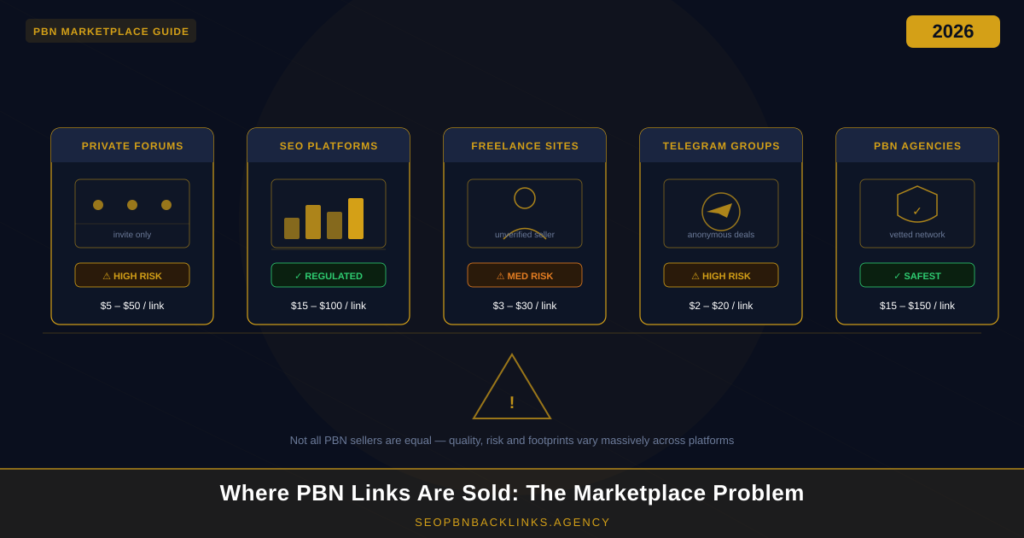
The most dangerous aspect of the PBN ecosystem for the average site owner is not that people build private blog networks it is that a thriving secondary market exists where those network links are sold to unsuspecting buyers who believe they are getting legitimate editorial placements. This is the seo pbn links marketplace problem.
How PBN link marketplaces operate
PBN link marketplaces function in two modes. Dedicated PBN networks sell placements directly the operator advertises link packages openly within SEO communities. Outreach agencies with concealed PBNs present themselves as legitimate link building services but place some or all links on sites they own. The second model is far more common and more dangerous the buyer has no visibility into where the links are actually being placed.
How to detect if a link seller is using a PBN
Before purchasing any link-building service: request a sample domain list before paying, check each sample domain independently in Ahrefs or Semrush for organic traffic (a real website has it PBN sites typically have almost none), look at the content publication history for consistency, and ask the agency directly whether they own any of the sites they place links on. Legitimate agencies will say no immediately.
Red flags when buying guest posts or outreach links
Price too low (below $80 almost always means PBN), delivery in days (real outreach takes weeks), high DA with near-zero organic traffic, no site examples provided upfront, and niche-agnostic placement across any industry these are the clearest signals that an offer involves PBN placements rather than genuine editorial outreach.
Why PBN links are dangerous for your site
Short-term ranking gains vs long-term penalty risk
PBN links can work in the short term that is precisely what makes them persistently tempting. When a site climbs from position 8 to position 2 after a round of PBN link building, the confirmation bias is powerful. What this framing obscures is the volatility embedded in those rankings. Sites built on PBN link profiles consistently show solid gains during quiet algorithm periods followed by sharp collapses during update cycles. The short-term gain is real but borrowed. At some point, the debt comes due.
Google’s link spam updates and PBN neutralisation
Google has run significant link spam updates in 2021, 2022, and with continued SpamBrain improvements through 2024-2025. More importantly, Google does not always punish a site for PBN links sometimes it simply stops counting them. This silent neutralization means your investment delivers zero return while you continue building your strategy around links that are doing nothing. According to Google’s Search Essentials documentation, links determined to be part of a link scheme may be discounted without a manual action being issued.
What a penalty actually looks like in Google Search Console
If Google’s spam team issues a manual action, you will see a notification in Google Search Console under Security and Manual Actions. The notification typically reads “Unnatural links to your site.” Your options are to disavow the links, submit a reconsideration request, and wait for Google’s review a process that can take several weeks and may not result in full reinstatement.
How to check if you already have PBN links pointing to your site
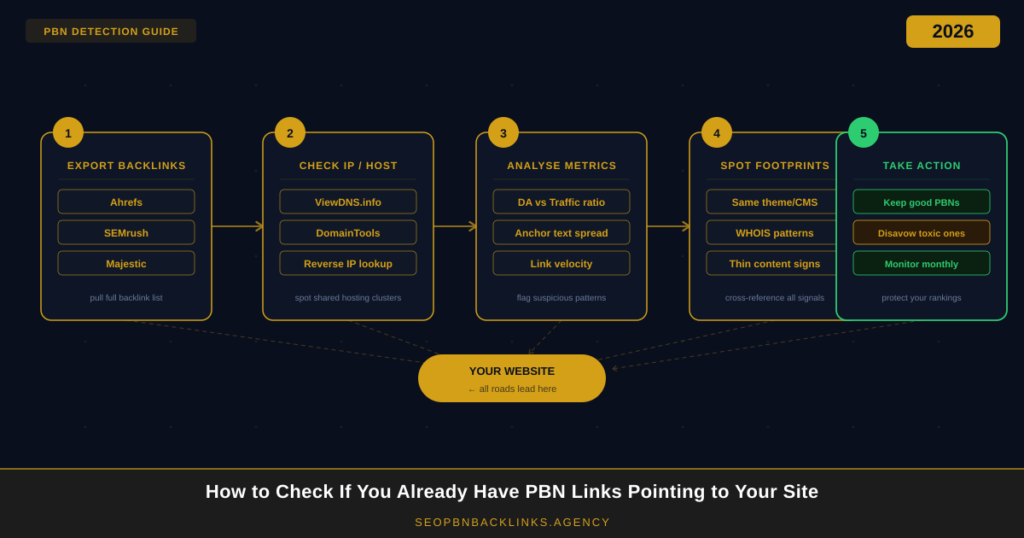
Using Ahrefs or Semrush to audit your backlink profile
Export your full referring domain list, filter by DR range (PBN links often cluster in the DR 20-50 range), then check organic traffic for each suspicious domain in Ahrefs Site Explorer. Any linking domain with near-zero organic traffic from Google warrants a closer look. Review your anchor text distribution concentrations of commercial or exact-match anchors from multiple different domains suggest manufactured placement. Manually inspect flagged domains: look for real bylined authors with professional histories, content that serves a genuine audience, and social media integration with real follower counts.
Manual signals that a linking domain may be a PBN
The site has authority metrics but no audience. Content topics are incoherent a domain previously registered for a law firm now publishing cryptocurrency and gardening articles. The article containing your link is thin (under 500 words with commercial anchor text). No date-bylined authors with verifiable identities. The site was recently rebuilt check the Wayback Machine to see the domain’s history. If the site looks completely different from its previous incarnation with thin post-rebuild content, you are likely looking at an expired domain repurposed as a PBN node. Read our full guide on PBN SEO for the complete picture on footprint identification.
FAQs
Are PBN links always bad for SEO?
Not always in the short term but reliably risky in the medium to long term. PBN links can generate ranking movement in less competitive niches and during periods between algorithm updates. The problem is not that they never work it is that the benefit is fragile and the downside risk is severe. For any site building toward long-term organic revenue, the risk-reward calculation strongly disfavors PBN links in 2026.
Can Google automatically devalue PBN links without issuing a penalty?
Yes and this is one of the most misunderstood aspects of how Google handles link spam. Google does not always issue a manual action when it identifies PBN links. Its algorithms may simply stop counting those links when calculating ranking signals a process called algorithmic neutralization. You will not receive a notification. Your rankings will drop, and without an audit you may not identify the cause for weeks or months.
How do I disavow PBN links I did not build myself?
Conduct a thorough backlink audit using Ahrefs or Semrush to identify suspected PBN domains. Attempt to contact site owners to request manual removal. Create a disavow file listing each domain in the format “domain:example.com” and upload it via Google’s Disavow tool in Search Console. Google will then ignore those domains when evaluating your site. Use the disavow tool specifically for links you are confident are manipulative.
What is the going rate for a PBN link in 2026?
Individual PBN link placements on openly-sold network sites typically run $30-$150 per link depending on domain authority metrics. Higher-quality PBN networks command $150-$300+ per link. Budget guest post packages from agencies secretly using PBN sites often fall in the $40-$100 range below market rate for genuine editorial placements, which typically cost $150-$500+. Price is one of the most reliable signals: if a link-building offer seems too cheap to be legitimate editorial outreach, it almost certainly is not.
Are nofollow PBN links less risky?
Significantly less risky from a direct penalty standpoint. Google’s guidance is that nofollow links are not counted as ranking signals so a nofollow PBN link neither helps rankings nor triggers a penalty for manipulative link building. However, a large volume of nofollow links from low-quality sources can still contribute to an unnatural-looking backlink profile that flags your site for closer algorithmic scrutiny. In practice, PBN operators typically use dofollow links because those are what clients pay for a nofollow PBN link has no market value.
Conclusion
Understanding what PBN links are is not just useful for people considering building a private blog network it is essential knowledge for anyone buying links, hiring a link-building agency, or auditing an existing backlink profile. The marketplace is full of sellers quietly delivering PBN placements under the label of editorial outreach, and the consequences of unknowingly accumulating those links can be severe and slow to recover from.
The technical process behind PBN link construction expired domain acquisition, footprint-minimized site setup, and controlled link placement creates identifiable signals at every stage. Those signals are detectable through basic backlink audit tools when you know what patterns to look for: near-zero organic traffic on referring domains, incoherent content histories, concentrated commercial anchor text, and authority metrics wildly out of proportion to actual site activity.
The safest approach is to work exclusively with link-building methods where every placement comes from a site that independently chose to link to you. That independence is what makes a backlink genuinely valuable and it is the quality no amount of domain authority score or anchor text engineering can replicate.
Want to go deeper? Read our complete guide on what is PBN in SEO, explore how PBN networks and domains are structured, check the PBN meaning and terminology glossary, browse our full PBN FAQ, see how PBN links work for affiliate sites, discover how long PBN links take to rank, master exact match anchor text strategy, understand backlink equity, read our white hat vs black hat SEO guide, and our white label link building guide for agencies.

Ben Davis is a seasoned SEO strategist with over a decade of hands-on experience in off page SEO, link building, and private blog network management.
He has helped 600+ agencies and professionals achieve top rankings in competitive niches including iGaming, crypto, CBD, and finance through data driven PBN strategies.