


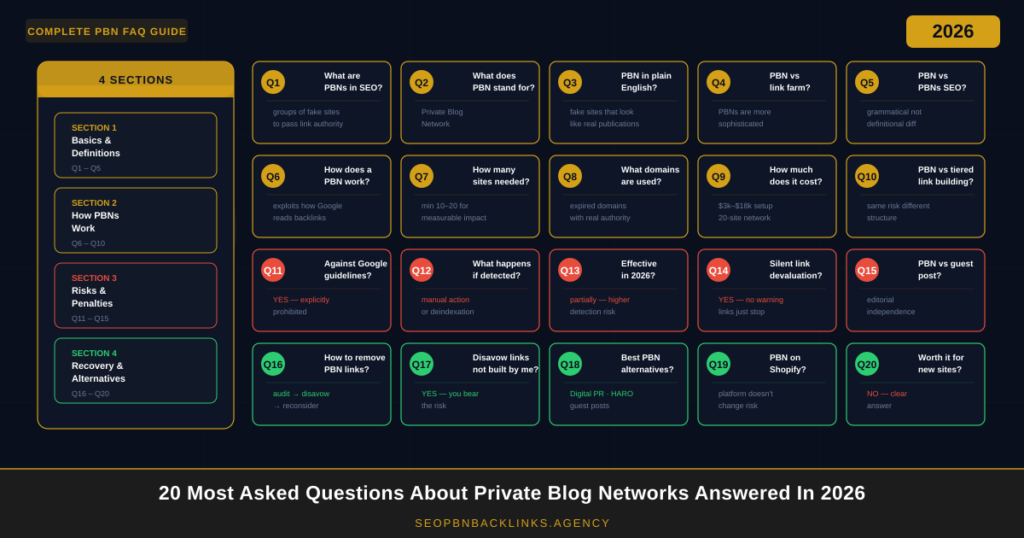
This article answers the 20 most commonly asked questions about private blog networks organized into four sections covering the basics and definitions, how PBNs work mechanically, the risks and penalties they carry, and how to recover and what to use instead. Each answer is written to stand alone: concise enough to provide immediate value, complete enough to give readers the full picture without requiring them to read other articles first.
The question set draws from Google People Also Ask results, the keyword cluster search intent signals, and the content gaps identified in competitor analysis covering topics that no other top-ranking article addresses comprehensively in a single resource. Whether you are a site owner asking what are pbns for the first time, an SEO professional auditing a client backlink profile, or a marketer evaluating a link-building proposal, this reference page is designed to give you fast, accurate, complete answers.
Table of Contents
- Introduction
- Section 1: Basics and definitions (Q1-Q5)
- Section 2: How PBNs work (Q6-Q10)
- Section 3: Risks and penalties (Q11-Q15)
- Section 4: Recovery and alternatives (Q16-Q20)
- More PBN resources
Key Takeaways
- PBNs (Private Blog Networks) are groups of websites controlled by one operator and used exclusively to manufacture artificial backlinks for a target money site.
- Google explicitly prohibits PBN use under its link spam policies penalties include manual actions, algorithmic ranking suppression, and full deindexation.
- Even if no formal penalty is issued, Google may silently neutralize PBN links meaning investment in them delivers zero return with no warning.
- Recovery from PBN-related penalties is possible but slow the disavowal and reconsideration process typically takes months and does not guarantee full traffic restoration.
- White-hat alternatives digital PR, strategic guest posting, broken link building consistently outperform PBNs over a 12-month horizon with no penalty risk.
Introduction: what are pbns and why so many questions?
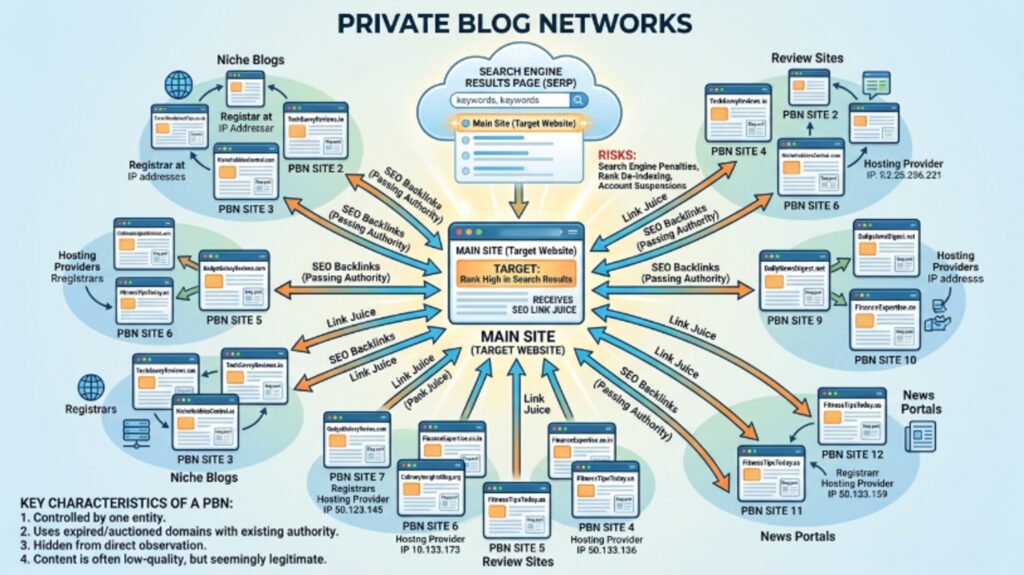
What are pbns? In short: Private Blog Networks groups of websites built or acquired by a single operator to create artificial backlinks pointing at a target site, with the goal of manipulating its Google search rankings. That is the one-sentence answer. But the full picture involves considerably more nuance which is why this topic generates so many questions.
The 20 questions below are organized into four logical sections. You can read straight through for a complete picture, or jump directly to the section most relevant to your situation using the table of contents above.
Section 1: Basics and definitions (Q1-Q5)
Q1: What are PBNs in SEO?
PBNs Private Blog Networks are groups of websites controlled by a single operator and used exclusively to generate backlinks pointing at a target money site. The goal is to artificially inflate the money site perceived authority in Google algorithm, which treats backlinks as votes of confidence from independent sources. The deception is the defining feature: a genuine backlink comes from an independent editorial decision. A PBN link comes from the same person or entity benefiting from it manufactured to look organic, but with no independent judgment behind it. For a full explanation of everything PBNs involve, read our complete PBN SEO guide. Google classifies PBN use as a link scheme that violates its link spam policies.
Q2: What does PBN stand for?
PBN stands for Private Blog Network. Private ownership is deliberately concealed through separate hosting accounts, different registrars, and varied WHOIS details to prevent Google from tracing all sites back to a single operator. Blog sites are structured as content websites, historically styled as blogs, to provide a natural vehicle for contextual backlink placement. Network the sites function as a coordinated system, all serving the shared purpose of directing link authority toward the money site. The combination of concealment, content vehicle, and coordinated artificial linking is what defines the tactic precisely.
Q3: What is a private blog network meaning in plain English?
In plain English: a private blog network is a group of fake websites that a single person controls, designed to look like real independent publications, that exist only to link to that person main website and push it up in Google search results. The sites are not real in any meaningful sense they do not have genuine audiences, they do not create content anyone wants to read, and they would not link to the money site if that decision were left to anyone other than their owner. They exist purely as a link delivery mechanism dressed in enough content to pass a casual inspection.
Q4: What is the difference between a PBN and a link farm?
A link farm is a simpler, cruder version of the same concept a cluster of sites that exist to link to each other and to target sites, with minimal content investment and no footprint management. PBNs are the evolved, more sophisticated form: they use expired domains with real historical authority, invest in content to create surface legitimacy, and actively manage technical infrastructure to conceal common ownership. Both are prohibited under Google guidelines. Link farms are trivially easy to detect. Higher-quality PBNs require more sophisticated detection systems which is exactly what Google has been building with SpamBrain since 2021.
Q5: What is pbns seo is there a difference between PBN and PBNs?
The difference is grammatical, not definitional. A PBN refers to a single private blog network one coordinated set of sites managed by one operator. PBNs plural refers either to multiple distinct networks or to the broader industry practice of private blog network-based link building as a category of tactic. The pbns seo usage specifically places the discussion in the strategic context of search optimization. There is no substantive SEO distinction between using a single network and using multiple both carry the same guideline violation status and the same penalty risk.
Section 2: How PBNs work (Q6-Q10)
Q6: How does a private blog network work?
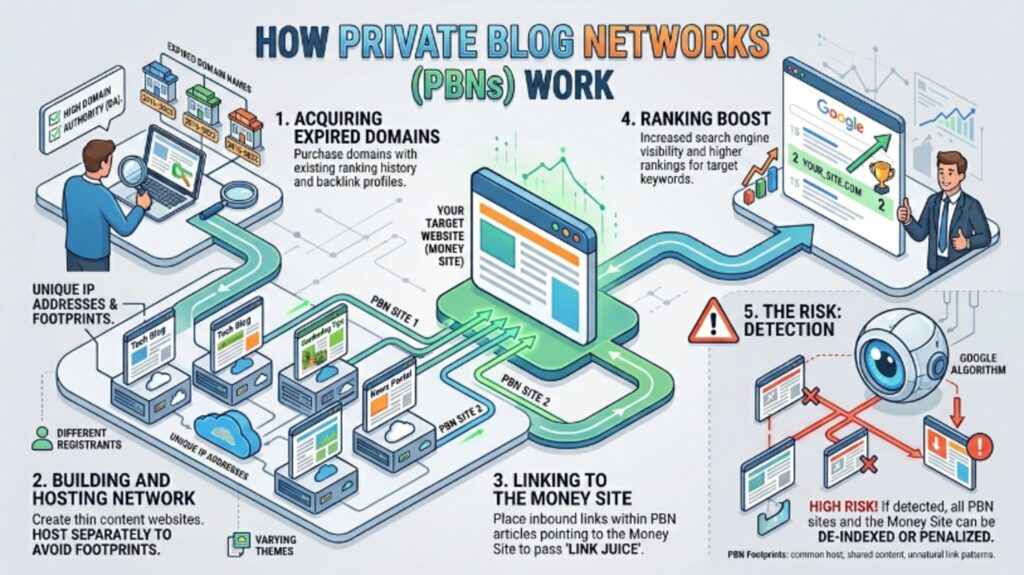
A PBN works by exploiting how Google evaluates backlinks. Google treats a link from Site A to Site B as an endorsement evidence that Site A editors found Site B content valuable enough to reference. More high-quality endorsements equals higher authority equals higher rankings. A PBN manufactures those endorsements artificially. The operator builds or buys a set of feeder sites, populates them with enough content to look legitimate, and places links within that content pointing to the money site. Google algorithm sees what appears to be multiple independent sites endorsing the money site but all of them are controlled by the same person. The tactic works temporarily because manufactured and genuine endorsements look identical in a link graph. The difference only becomes visible through the behavioral and technical pattern analysis that Google systems now perform at scale.
Q7: How many sites do you need for a PBN?
A single PBN site provides negligible benefit and near-certain detection if scrutinized. The practical minimum for measurable impact is typically 10-20 sites generating multiple unique referring domains. Most mid-scale operations targeting competitive keywords run 30-60 sites. Large commercial networks can operate hundreds of domains. Scale brings diminishing returns alongside exponentially higher management costs and detection risk — the larger the network, the more surface area exists for a single footprint to expose the entire structure.
Q8: What kind of domains are used in a PBN?
PBN operators almost universally build on expired domains domains that previously belonged to legitimate websites and accumulated genuine backlinks during their operational lives. Key evaluation metrics include Domain Rating (DR) or Domain Authority (DA) for link profile strength. Trust Flow (TF) for quality weighted authority, referring domain count, topical relevance to the money site niche, and penalty history whether the domain was previously penalized by Google, which can carry forward and reduce its value. Fresh domains are occasionally used in large, low-quality PBNs that prioritize volume over per-link authority.
Q9: How much does it cost to build a PBN?
Building a 20-site PBN of reasonable quality involves these costs. Setup (one-time): expired domain acquisition at $50-$500+ per domain equals $1,000-$10,000; initial content per site at $75-$300 equals $1,500-$6,000. site setup and configuration at $20-$100 per site equals $400-$2,000. Total setup: approximately $3,000-$18,000 depending on domain quality and content investment. Ongoing annual costs: hosting across 20 providers at $5-$15 per month equals $1,200-$3,600 per year. ongoing content equals $500-$2,000 per year; domain renewals equal $200-$400 per year. Total annual maintenance: approximately $2,000-$6,000 per year. Buying individual PBN links from marketplaces costs $30-$200 per link with no setup cost but no control over network quality or detection risk.
Q10: What is the difference between PBN and tiered link building?
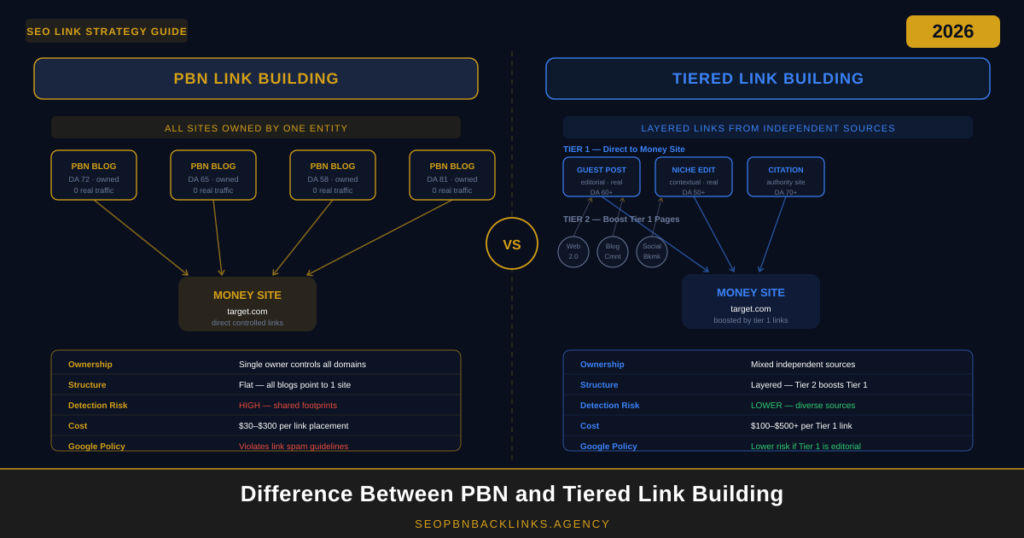
Tiered link building is a link architecture strategy where Tier 1 links point directly to the money site and Tier 2 links point to the Tier 1 links to amplify their authority. For a practical tiered linking strategy for affiliate sites specifically, see our PBN links for affiliate sites guide.. often where PBN or other manufactured links appear. Tier 3 links point to Tier 2 links. The theory is that PBN links in Tier 2 never directly touch the money site, creating apparent distance from the manipulation. In practice, Google link graph analysis can trace multi-tier structures, and the presence of PBN-style sites anywhere in the chain carries substantially the same detection risk as direct PBN links. Tiered link building using PBN components is a variation on the same tactic not a meaningfully safer alternative.
Section 3: Risks and penalties (Q11-Q15)
Q11: Is using a PBN against Google guidelines?
Yes unambiguously. Google link spam policies explicitly state that any links intended to manipulate a site ranking in Google Search results may be considered link spam. Private blog networks are specifically cited as a prohibited link scheme. There is no compliant version of PBN use. Unlike some SEO tactics that exist in interpretive gray areas, private blog networks are defined by their manipulative purpose a network that is not designed to manufacture artificial ranking signals is not a PBN. Google spam policies apply regardless of whether the site owner built the PBN themselves, purchased links from an existing network, or hired an agency that used PBN placements without disclosure.
Q12: What happens if Google detects your PBN?
Google can respond in two ways. A manual action means a member of Google Search Quality team reviewed your site and confirmed the link scheme violation visible in Google Search Console under Manual Actions. Rankings are suppressed until you disavow the links, submit a reconsideration request, and Google agrees to lift the action. This process typically takes weeks to months. Algorithmic neutralization is different Google systems identify the PBN links and stop counting them silently. No notification appears in Search Console. Rankings drop without explanation. In severe cases the network sites themselves are deindexed. Both outcomes share a common characteristic: the ranking signals you paid to build disappear.
Q13: Are PBN links still effective in 2026?
Partially, temporarily, and with significantly higher detection risk than three years ago. PBN links can still move rankings in less competitive niches and during quiet periods between algorithm updates. What has changed is the durability and safety of that movement. Google SpamBrain and link graph analysis have substantially improved PBN detection accuracy since 2022. Rankings built on PBN link profiles consistently show solid gains followed by sharp collapses during update cycles. For any business making long-term decisions about organic search investment, the answer is effectively no the risk-adjusted return of PBN link building in 2026 is negative when compared with white-hat alternatives that build compounding, durable authority without the constant threat of penalty-triggered collapse.
Q14: Can Google devalue PBN links without issuing a penalty?
Yes and this is one of the most practically important aspects of PBN risk that many site owners do not fully understand. Google systems can identify links as probable PBN placements and simply stop including them in ranking calculations without issuing a manual action, without sending a notification, and without any visible indication in Search Console. The site owner experiences this as a rankings drop that seems to have no clear cause. Technical audits come back clean. Content quality has not changed. The answer, visible only through a careful backlink profile analysis, is that Google quietly stopped counting the links that had been supporting those rankings. This silent neutralization can affect PBN links individually, in clusters, or across entire networks.
Q15: What is the difference between a PBN and a guest post?
The defining difference is editorial independence. A legitimate guest post is published by an independent website whose editorial team decided based on content quality and relevance that your article was worth publishing for their audience. You receive a link as a natural outcome of that editorial relationship. A PBN link comes from a site where no independent editorial decision exists you own the site or the link seller does, and the link appears because you placed it. This distinction is exactly what Google link spam policies protect: the integrity of backlinks as signals of genuine editorial endorsement. Paid guest posts where money changes hands for a link on an otherwise independent site also violate this principle and are prohibited by the same policies.
Section 4: Recovery and alternatives (Q16-Q20)
Q16: How do I remove PBN links from my backlink profile?
You cannot remove a backlink directly only the site hosting it can do that. The structured process:
Step 1 — audit your backlinks using Ahrefs, Semrush, or Majestic, flagging domains with near-zero organic traffic, authority metrics disproportionate to content quality, incoherent topical history, and concentrated commercial anchor text pointing at your site.
Step 2 — attempt manual removal by contacting flagged site owners to request link removal. Most PBN operators will not respond, but the attempt demonstrates good faith to Google during any subsequent reconsideration review.
Step 3 — create and submit a disavow file listing each flagged domain in the format domain:example.com and upload it through Google Disavow tool in Search Console.
Step 4 — submit a reconsideration request if a manual action was issued, explaining what you found and what corrective measures you have taken.
Q17: Should I disavow PBN links I did not build myself?
Yes if the links are identified and genuinely appear to be PBN placements, disavowal is the appropriate response regardless of whether you built them. If a link-building agency placed PBN links without your knowledge while billing them as editorial outreach, you bear the ranking risk. Auditing the delivered links, identifying PBN domains, and disavowing them is the correct remediation along with terminating the agency relationship. If a sudden influx of suspicious links coincides with a ranking drop (possible negative SEO), a disavow submission is a reasonable precaution. The disavow tool is powerful and should be used carefully disavowing legitimate links by accident can harm rankings. Be confident in your PBN identification before submitting.
Q18: What are the best alternatives to PBN link building?
The alternatives that consistently outperform PBN links over a 12-month horizon measured by rankings durability, penalty risk, and total return on investment are: Digital PR: creating original research or genuinely newsworthy content that journalists reference, earning links from major publications with full Google trust and brand authority as a byproduct. Strategic guest posting: writing genuinely valuable content for relevant independent publications in exchange for a natural author link no payment for the link, real readership required.
Broken link building: identifying dead links on authoritative sites and offering your content as a replacement, with high response rates because you are solving a real problem. HARO and media outreach: responding to journalist queries in your area of expertise to earn links from news publications free, credibility-building, and fully Google-compliant. Resource page outreach: pitching your content for inclusion on curated link pages in your niche. None of these are as immediately fast as buying PBN links. All of them are permanently durable and carry no penalty risk.
Q19: Can I use a PBN on Shopify or other platforms?
The platform your money site runs on Shopify, WordPress, Wix, Squarespace, or anything else has no bearing on whether PBN use is permitted or on the penalty risk involved. Google evaluates backlink profiles at the domain level, not the CMS level. A Shopify store with a PBN-backed link profile faces exactly the same detection risk and the same potential penalties as a WordPress site or any other technical implementation. The misconception that platform choice affects PBN risk occasionally appears in marketing for certain link-selling services. It has no basis in how Google systems work. Platform is irrelevant backlink manipulation is the violation, and it triggers the same consequences regardless of the underlying technology.
Q20: Is PBN link building worth it for a new website?
For a new website, the answer is a clear no and the reasons are compounding. New domains have no authority, no established content, and no track record with Google. Building early rankings on PBN-manufactured signals creates a foundation entirely dependent on those signals holding. When they are neutralized or penalized significantly more likely as Google detection systems mature the site has nothing to fall back on. New websites are also the category most likely to have PBN-backed rankings collapse quickly: Google systems are most skeptical of new domains with sudden authority spikes from multiple referring domains, which is exactly the profile a new site building a PBN link profile creates. The correct approach for a new website is to build genuine topical authority through content depth and earn initial links through outreach and digital PR.
Still have questions? More PBN resources
The 20 questions above cover the most commonly asked topics around private blog networks. For deeper coverage of specific aspects, the following guides go further:
- What is PBN in SEO? Complete guide to private blog networks — The full pillar article covering every aspect of PBNs: definition, mechanics, Google stance, penalty consequences, footprints, and white-hat alternatives. Start here for the complete picture.
- What are PBN links? Meaning, risks and how they work — A dedicated breakdown of PBN links specifically — how they are built, where they are sold, how to identify them in a backlink profile, and what a Google penalty looks like when they are detected.
- PBN networks and domains: how private blog networks are structured — The technical deep dive: expired domain selection and evaluation, network architecture, site setup, the complete footprint detection checklist, and how Google SpamBrain AI system identifies networks.
- PBN meaning in SEO: what PBN stands for and full terminology glossary — A complete reference glossary for every term used in PBN discussions — from money site and feeder site to algorithmic penalty, deindexation, and tiered link building.
- PBN links for affiliate sites: rank reviews and money pages faster — The complete strategy guide for using PBN links on affiliate content — page prioritization, anchor text ratios, link velocity, tiered linking, and EPC tracking frameworks built specifically for affiliate marketers.
- White label PBN link building: the agency guide to outsourcing backlinks — how to package PBN links under your agency brand, supplier evaluation criteria, margin structure, client communication, and case study reporting frameworks.
- How long does it take to rank on Google after building PBN links? — Honest timeline expectations for new and established domains, the 5 factors controlling ranking speed, and a 3-layer tracking framework to measure real progress.
- Exact match anchor text: when to use it and when it becomes a risk — Safe percentage thresholds, how to audit your distribution in Ahrefs, the PBN anchor rotation framework, and how to fix an over-optimised profile through dilution.
- Backlink equity explained: how to maximise the power of every PBN link — PageRank dilution explained, single-placement equity maximisation, tiered link structures, and a full Ahrefs equity audit workflow.
- White hat SEO vs black hat SEO: where does PBN link building actually sit? — An honest spectrum breakdown placing PBN links accurately in the grey hat zone, with a risk-adjusted ROI comparison across all three approaches.

Ben Davis is a seasoned SEO strategist with over a decade of hands-on experience in off page SEO, link building, and private blog network management.
He has helped 600+ agencies and professionals achieve top rankings in competitive niches including iGaming, crypto, CBD, and finance through data driven PBN strategies.