


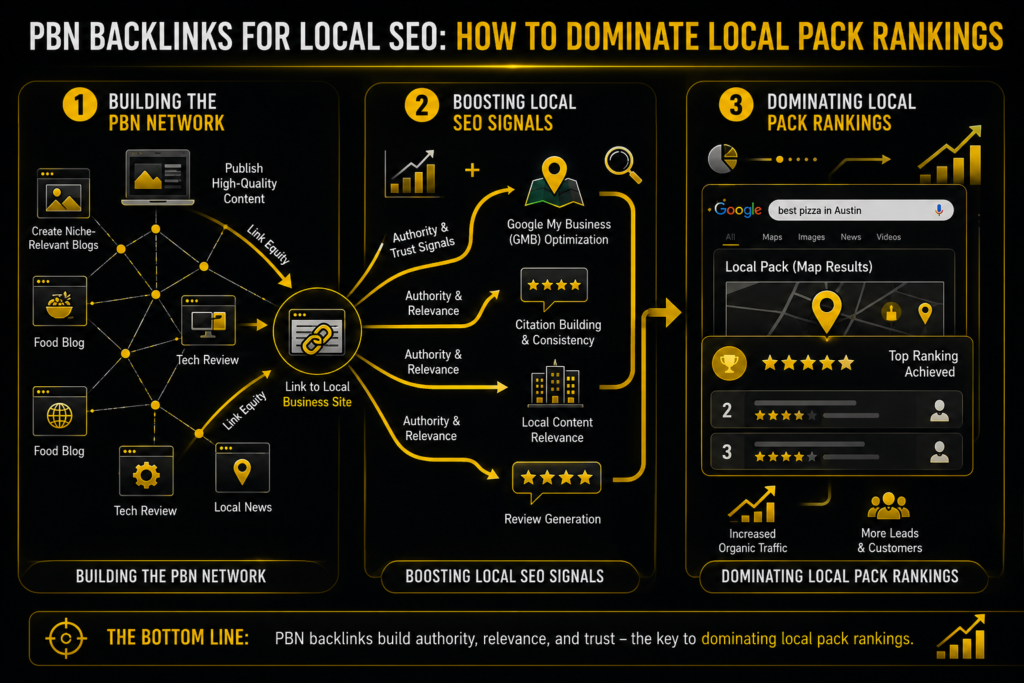
Local SEO is the most efficient use of PBN link building investment available in 2026. The reason is simple arithmetic: local SERPs have the lowest backlink threshold of any niche, and the Local Pack — the map block that drives the majority of local business leads — responds to link signals that national campaigns would consider negligible. This guide explains exactly why PBN links for local SEO produce such outsized results, how to build hyper-local PBN authority that generates geographic relevance signals, and how citations and backlinks work as complementary strategies. It also covers the specific risk profile differences between local and national PBN campaigns — including why local campaigns attract less detection scrutiny and why consequences are typically more recoverable.
Table of Contents
- Introduction: why local SEO is PBN link building’s best use case
- The local backlink threshold: the data that changes your strategy
- How link signals influence Local Pack rankings
- Building hyper-local PBN authority: the geographic relevance strategy
- Citations vs backlinks: the complementary strategy for local SEO
- Risk profile: local PBN campaigns vs national campaigns
- The link building agency advantage
- FAQ
- Conclusion
Key Takeaways
- Local SERPs require an average of just 125 referring domains to compete — compared to a national median of 907. This 7× lower threshold makes local the most efficient ROI context for PBN link building.
- Link signals carry 15% of total local ranking weight in 2026, sitting behind GBP signals (32%), on-page signals (19%), and review signals (16%) — but they are the most controllable factor.
- Hyper-local PBN domains — sites with previous coverage of the target city or region — pass geographic relevance signals that generic authority domains cannot replicate for Local Pack rankings.
- Citations (NAP consistency) and PBN backlinks serve different signals: citations build entity trust; backlinks build domain authority and prominence. Both are needed.
- Local PBN campaigns carry a lower detection risk profile than national campaigns because required link volumes are smaller, velocity is lower, and geographic signal diversity looks more organic.
Introduction: why local SEO is PBN link building’s best use case
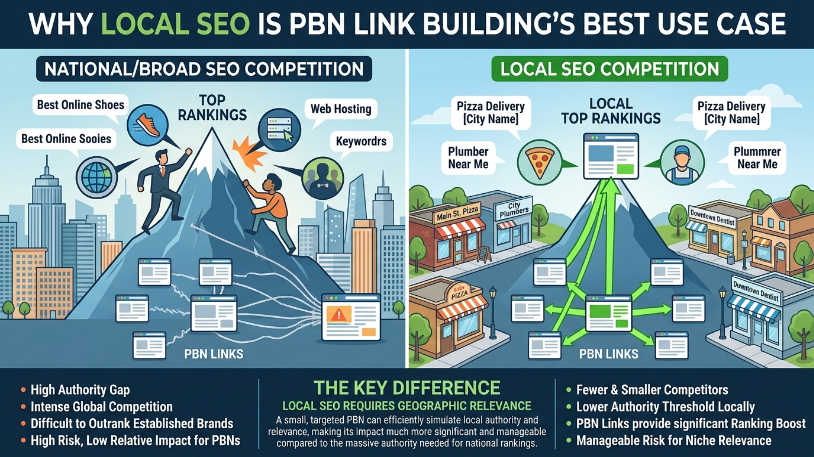
There is a persistent misconception in local SEO that backlinks matter less than citations, Google Business Profile optimisation, and reviews. This leads local businesses to underinvest in link building — and then wonder why they cannot displace entrenched competitors from the top three Local Pack positions despite an optimised GBP and hundreds of positive reviews. For a full overview of how PBN links work, see our complete PBN links guide. For the full PBN FAQ, see our PBN questions answered.
The truth is more nuanced. Link signals carry 15% of the total local ranking weight. Domain authority, anchor text relevance, and inbound link quality all feed local prominence directly. That 15% is the margin that separates businesses from their Local Pack competitors when all other signals are comparable. In competitive local markets where every top-three business has an optimised GBP and solid reviews, link signals frequently determine the final ranking order.
What makes PBN links for local SEO particularly effective is the scale relationship. The link volume needed to be competitive in local search is a fraction of what national campaigns require — meaning a modest, well-targeted PBN link campaign can produce Local Pack movement that would require ten times the investment to replicate in a national SERP context.
The local backlink threshold: the data that changes your strategy
The most important number in local SEO link building is 125. On average, 125 high-quality links from trusted regional sites are sufficient to rank competitively in local search results. This is dramatically lower than what national search competition requires.
Local vs national: the referring domain gap
According to a 2026 study of 1,462 domains across 15 industries, websites ranking on page one have a median of 907 referring domains, ranging from 76 in Apparel to 3,027 in Finance and Insurance. Comparing these benchmarks to local search requirements reveals the fundamental efficiency advantage of local link building:
| Context | Median referring domains needed | Monthly velocity needed |
|---|---|---|
| National — Finance | 3,027 | 101/month |
| National — cross-industry average | 907 | 48/month |
| National — Apparel (lowest) | 76 | 15/month |
| Local search — average | ~125 | 5–15/month |
The local threshold sits below the national Apparel minimum — the least competitive national niche measured. A dental practice, personal injury solicitor, or estate agent in a competitive UK city needs approximately the same number of referring domains as an apparel business competing in the least contested national category, but with a competition radius limited to a city or region. A budget that would barely move the needle nationally can produce dramatic Local Pack movement for a brick-and-mortar business.
Why local thresholds vary within local search
High-value service keywords in major urban markets command referring domain requirements of 200–500+. Lower-competition local service keywords in smaller markets may need as few as 20–40 referring domains to achieve first-page visibility. Always audit the top 3 businesses in your target Local Pack using Ahrefs to establish the exact referring domain benchmark for your specific market and keyword before committing link budget.
How link signals influence Local Pack rankings
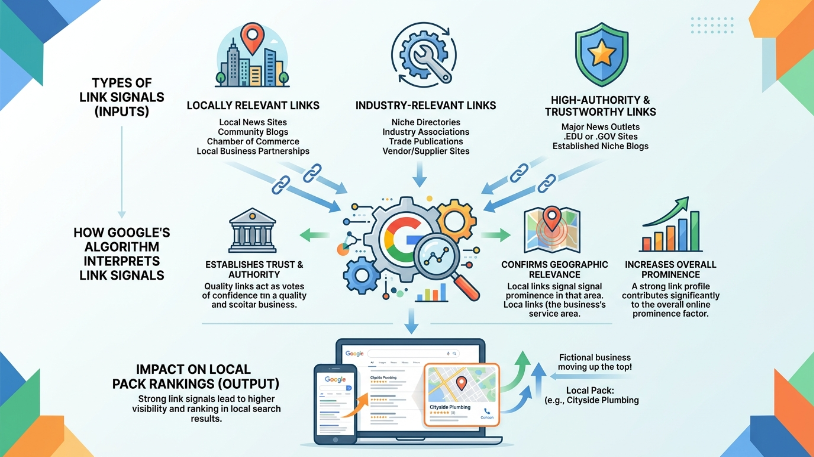
Local SEO ranking factors in 2026 break down into six signal groups: GBP signals (32%), on-page signals (19%), review signals (16%), link signals (15%), behavioral signals (8%), and citation signals (7%). The March 2026 Core Update pushed AI Overviews deeper into local search, and 46% of all Google searches now carry local intent.
The key insight from this distribution is that GBP signals dominate. Most businesses lose Local Pack positions not because of weak backlinks but because their GBP sits half-finished. PBN link building’s role is as the prominence accelerant — once GBP optimisation and review accumulation have been addressed, link signals become the primary variable that separates a business ranking in positions 4–7 from one ranking in the top 3.
The website’s role in Local Pack rankings
A common misconception is that Local Pack rankings are entirely determined by GBP signals. This is incorrect. Google’s Local Pack algorithm evaluates the website associated with the GBP as part of its prominence assessment. A business with a well-optimised GBP linked to a website with strong referring domain authority consistently outranks equivalent GBP profiles linked to low-authority websites. PBN links to the website’s homepage or local service pages directly improve the website’s domain authority, which feeds directly into the prominence signal.
Service area pages and PBN link targeting
For businesses serving multiple geographic areas, individual service area pages (/plumber-manchester/, /conveyancing-solicitor-london/) can be targeted with PBN links to generate ranking visibility for each geographic term. Each service area page should target a specific city + service keyword combination, contain 300+ words of genuinely useful local content, and receive 5–15 PBN links with geographic modifier anchor text.
Building hyper-local PBN authority: the geographic relevance strategy
The most effective PBN links for local SEO come from hyper-local PBN domains — sites with previous coverage of, or geographic association with, the target city or region. These domains pass geographic relevance signals that generic high-authority domains cannot replicate. For a full domain evaluation framework, see our PBN networks and domain selection guide.
What makes a domain hyper-local
A hyper-local PBN domain has one or more of these characteristics: local content history (previously operated as a local news site, community blog, or neighbourhood resource); UK or regional hosting infrastructure; a historical link profile including local directories, chamber of commerce sites, and regional publications; or geographic identifiers in the URL or domain name (manchesternews.co.uk, birmingham-business.com). Wayback Machine records showing previous coverage of the target city are the clearest verification signal.
The local news site opportunity
Expired domains from former local news and community sites are among the most valuable PBN assets for local SEO campaigns. These domains carry decades of genuine community links from local councils, schools, sports clubs, local businesses, and regional media — exactly the trust signals that local prominence algorithms value. Finding them requires monitoring domain drop lists for geographic terms, checking Wayback Machine for former news site designs, and verifying the link profile shows genuinely local referring domains. The acquisition cost is higher than generic expired domains, but the per-link effectiveness for Local Pack rankings justifies the premium in competitive markets.
Citations vs backlinks: the complementary strategy for local SEO
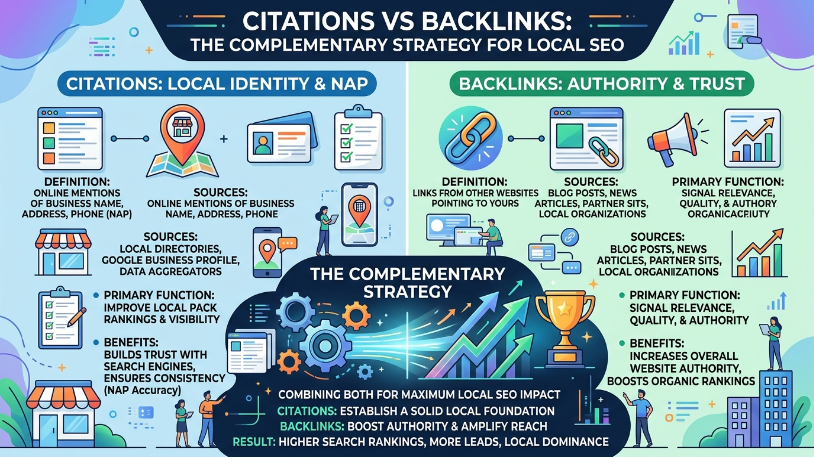
The citations vs backlinks debate is a false dichotomy. Citation signals carry 7% of total local ranking weight, while link signals carry 15%. Both contribute to local prominence through entirely different mechanisms.
What citations do (that backlinks cannot)
Citations are consistent mentions of a business’s name, address, and phone number (NAP) across directories and local platforms. They function as entity verification signals — Google uses NAP consistency across authoritative local data sources to verify that a business entity exists at the claimed location. A single address or phone number variation across directories triggers entity fragmentation. Google stops trusting your business data and your Local Pack visibility drops directly as a result.
What backlinks do (that citations cannot)
PBN backlinks build domain authority and prominence — signals that indicate a business website is trusted and referenced by multiple independent sources. Citations rarely contribute domain authority because most directory listings use nofollow links or have minimal link equity themselves. The combination that produces Local Pack dominance: clean NAP citations establishing entity trust + PBN backlinks building domain authority and prominence.
The practical build sequence
Weeks 1–4: Audit existing citations for NAP inconsistencies. Fix any variations in business name, address, or phone number. Submit to the top 30 local directories if not already present. Weeks 4–8: Begin PBN link building with the verified entity signal in place. Ongoing: Continue citation building at 5–10 new quality directories per month while maintaining PBN link velocity at 5–15 links per month. The social signals layer also supports brand recognition — see our social signals and SEO guide for how brand mentions feed local entity recognition.
Risk profile: local PBN campaigns vs national campaigns
Why local PBN campaigns are lower-risk
Lower link volumes required: The 125 average referring domain threshold for local search means campaigns operate at volumes where velocity spikes are less likely. A campaign of 20–30 PBN links represents the bulk of what a local service keyword needs — not the starting point for a national campaign.
Different algorithmic scrutiny: Google’s Local Pack algorithm has historically applied different spam detection mechanisms from its standard organic algorithm. Detection at local volumes is less sensitive than in standard organic SERPs, though this does not mean PBN use goes undetected.
Geographic signal diversity masks network patterns: A local campaign using hyper-local PBN domains from the target city naturally shows geographic diversity that looks more organic. The variety of local content types — news sites, directories, community organisations, local blogs — creates a more natural-looking link acquisition pattern.
Lower consequence severity: If a local business receives a manual action, the recovery path is typically cleaner. Local businesses often have smaller overall link profiles, making disavowal and reconsideration more straightforward. Alternative lead generation sources can sustain operations during organic recovery.
Risk factors that are the same as national
Quality control requirements are identical — genuine content, diverse hosting, gradual indexation, and appropriate anchor text discipline all apply equally to local campaigns. Cheap public PBN networks produce the same detection risk at local volumes as national. See our complete PBN SEO guide for the full quality framework. And our white hat vs grey hat SEO breakdown covers the honest risk assessment that local SEO agencies should present to their clients.
Safe local anchor text distribution: 5–8% exact match geographic commercial anchors (“personal injury solicitor Manchester”), 20–25% partial match with location and service modifiers, 15–20% branded, 50–60% generic and naked URLs. See our anchor text strategy guide for the full framework.
The link building agency advantage: why local SEO professionals use PBNs
For link building agencies and SEO consultants managing multiple local business clients, PBN links provide structural advantages over organic link building approaches that directly affect client ROI and agency margin. Local outreach can produce high response rates when targeting nearby businesses and organisations — but throughput is limited. A typical local outreach campaign produces 8–25 organic editorial links from months of relationship management, which is meaningful but rarely sufficient for competitive markets within agency delivery timelines.
PBN links serve as the acceleration layer that delivers the backlink building velocity organic outreach cannot match within client reporting cycles. A local SEO agency managing a solicitor client needing 80 referring domains cannot deliver that through organic outreach alone in 6 months. PBN links of 10–15 per month alongside 3–5 organic outreach links per month reaches the competitive threshold within the client’s realistic expectation window.
PBN link building also scales across a client portfolio in a way that organic outreach cannot. An agency managing 20 local business clients across different industries and cities can build links to each client simultaneously through a managed PBN relationship. This scalability directly affects agency profitability and determines whether link building can be delivered within a retainer model that works for both agency and client. See our backlink equity guide for how to maximise per-link authority for local placements. For another high-competition niche where agencies use similar approaches, see our casino backlinks guide.
FAQ
How many PBN links does a local business need to rank in the Local Pack?
The average local business needs approximately 125 referring domains to compete in local search. In low-competition markets, 20–40 quality PBN links may be sufficient to reach the competitive threshold. In high-value, high-competition markets (personal injury law, cosmetic medicine, commercial conveyancing in major UK cities), 100–300+ referring domains are typical for top-3 Local Pack positions. Audit the top 3 businesses in your target Local Pack using Ahrefs to establish the exact referring domain benchmark for your specific market.
Do PBN links help Google Business Profile rankings directly?
PBN links improve the website associated with the GBP rather than the GBP profile itself. Google’s Local Pack algorithm assesses website prominence as part of its prominence scoring. A business with a well-optimised GBP linked to a high-authority website consistently outranks equivalently-optimised GBPs linked to low-authority websites. The PBN links to the website feed the prominence signal indirectly, producing Local Pack ranking improvements even though the links do not point to the GBP listing itself.
Should I do citations or backlinks first for local SEO?
Citations first. Build a clean, consistent NAP profile across the top 30 local directories before investing in PBN link building. Citations establish the entity verification signal that makes Google confident the business exists at the claimed location. PBN links built on top of a verified entity signal are more effective than links built before entity clarity is established. The two-phase approach — citations in weeks 1–4, PBN link building from week 4 onwards — produces better results than either strategy alone.
What anchor text should I use for local SEO PBN links?
Use geographic modifier partial match anchors as your primary signal carrier: “personal injury solicitor in Manchester,” “emergency plumber Birmingham,” “estate agent Canary Wharf London.” These match natural search query patterns. Keep exact match geographic commercial anchors to 5–8% of total links, branded anchors to 15–20%, and generic anchors plus naked URLs to 50–65%.
Is PBN link building riskier for local SEO than for national campaigns?
Generally lower risk. Local campaigns require smaller link volumes (typically 20–80 total links), operate at lower velocity, and hyper-local domain selection creates more naturally diverse geographic link profiles. The Local Pack algorithm applies different ranking mechanics from standard organic algorithms, making link-pattern detection less sensitive at local volumes. Quality control requirements are identical but the scale of exposure is meaningfully lower.
Conclusion
Local SEO represents the highest-efficiency use case for PBN link building in any niche. The combination of a low referring domain threshold (average 125 vs 907 national median), a limited geographic competition radius, and a Local Pack algorithm that responds to relatively modest link investment makes local campaigns the best ROI context for grey hat link acceleration.
Build a clean citation profile first to establish entity trust, then deploy PBN links with geographic relevance to build domain authority and prominence signals. Use hyper-local PBN domains where possible to maximise geographic relevance. Maintain the anchor text discipline and quality controls that apply to any PBN campaign, calibrated to the lower velocity and volume that local markets require.
Build Local Pack authority that generates leads. PBN backlinks for local SEO — geographically targeted campaigns for local businesses and agencies across all service verticals. Explore our supporting guides: complete PBN SEO guide, anchor text strategy for local campaigns, backlink equity and per-link maximisation, how long PBN links take to rank, PBN links for ecommerce, our white hat vs grey hat SEO breakdown, and our white label link building guide for agencies.

Ben Davis is a seasoned SEO strategist with over a decade of hands-on experience in off page SEO, link building, and private blog network management.
He has helped 600+ agencies and professionals achieve top rankings in competitive niches including iGaming, crypto, CBD, and finance through data driven PBN strategies.