


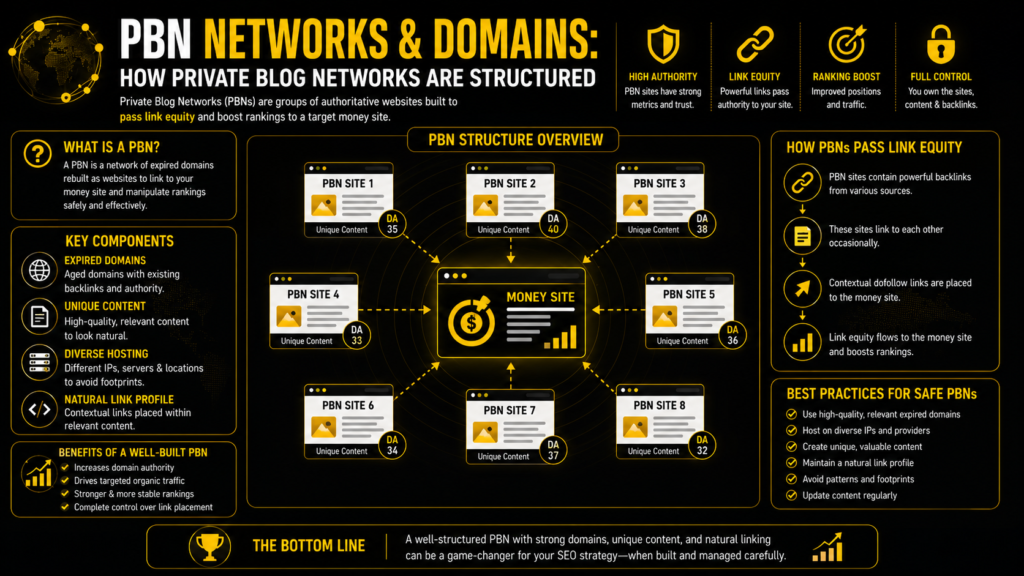
This article breaks down the full architecture of a pbn network from how operators select and evaluate expired domains, to how individual PBN websites are built and maintained, to the precise technical and content footprints that expose these networks to Google detection. Understanding PBN network structure is valuable in two directions: for SEOs who need to recognize whether a linking domain is a PBN node, and for site owners evaluating whether a past link-building campaign may have left them exposed. The guide covers domain authority metrics used in expired domain selection, hosting and IP diversification tactics, content strategy on PBN sites, and the full detection checklist that Google spam systems and human reviewers use to identify networks. The article also examines Google SpamBrain and link graph analysis the technologies driving a significant increase in PBN detection accuracy since 2022.
Table of Contents
- Introduction: what is a PBN network exactly?
- How a PBN network is structured: the anatomy
- PBN domains: how expired domains are selected and evaluated
- What a PBN website looks like: anatomy of a PBN site
- PBN footprints: the complete detection checklist
- How Google detects PBN networks in 2026
- FAQ
- Conclusion
Key Takeaways
- A PBN network is a collection of websites typically built on expired domains all controlled by one entity and used exclusively to manufacture backlinks for a target money site.
- Expired domain selection is highly systematic: operators evaluate Domain Rating, Trust Flow, referring domain count, topical relevance, and penalty history.
- Despite diversification tactics, PBN networks consistently leave detectable footprints in their technical setup, content patterns, and backlink profiles.
- Google SpamBrain AI analyzes entire link graphs at scale, identifying network clusters through behavioral patterns rather than individual site characteristics.
- The cost of running an undetectable PBN increases with every improvement Google makes to its spam detection making the long-term economics progressively less favorable.
Introduction: what is a PBN network exactly?
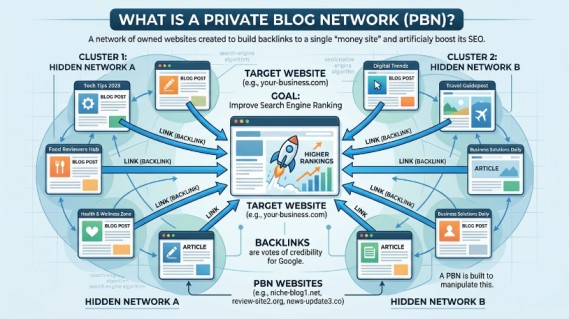
The term private blog network describes something more organized than the name might suggest. It is not simply a loose collection of websites. A pbn network is a deliberately architected system of domains, hosting infrastructure, and content operations. For a plain-English definition of what a PBN is, start with our complete PBN SEO guide. all designed to create the appearance of organic editorial links while concealing that a single operator controls every site in the chain.
This distinction matters because it shapes how detection works. You cannot identify a PBN by looking at any single website in isolation. The giveaways only emerge when you examine the patterns across multiple sites the shared infrastructure, the synchronized publishing behaviors, the coordinated anchor text strategies, and the link flow that always points in the same direction.
Think of it less like a collection of blogs and more like a supply chain. Each component domain acquisition, site setup, content production, link placement is a deliberate operational step with its own cost, risk profile, and detection surface.
How a PBN network is structured: the anatomy
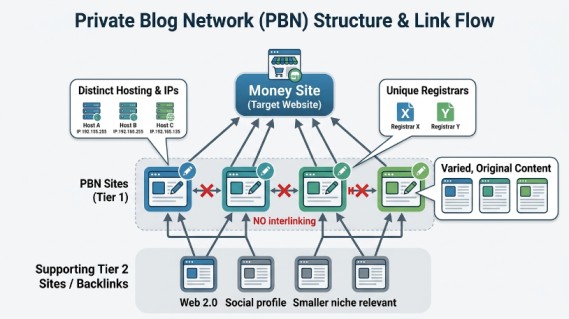
At its core, a private blog network follows a hub-and-spoke model. The spoke sites are the PBN nodes individual websites that generate and hold the backlinks. The hub is the money site the domain the operator actually cares about ranking.
How many sites make a PBN? Scale and complexity
Small networks built by individual site owners might have 5-15 sites. Mid-scale operations run by SEO agencies typically involve 20-60 sites. Large commercial networks selling placements to multiple money sites simultaneously can operate hundreds of domains. Scale brings more authority diversity but also more management overhead, higher costs, and a larger detection surface. A single domain whose ownership traces back to the money site operator can unravel an entire network.
The hub-and-spoke link structure within a PBN
The linking architecture is typically one-directional: PBN nodes link to the money site, but the money site does not link back to the network. More sophisticated operations use tiered structures Tier 1 PBN sites link directly to the money site while Tier 2 sites link to Tier 1 sites to amplify their authority. Within the network itself, cross-linking between PBN nodes is generally avoided any pattern of inter-linking creates a detectable cluster in Google link graph analysis.
Types: niche PBNs vs broad-topic PBN sites
Niche PBNs are built with tight topical focus every site covers topics related to the money site niche for stronger semantic relevance signals. Broad-topic PBNs publish across many topics to serve multiple clients simultaneously. They are easier to operate at scale but provide weaker topical relevance and are generally more obvious to both human reviewers and algorithmic detection systems.
PBN domains: how expired domains are selected and evaluated
The quality of a PBN network is almost entirely determined by the quality of its expired domains. This is why seo pbn domains selection is a highly analytical process. For a full explanation of what these links actually do once placed, see our guide on what PBN links are and how they work. operators evaluate multiple quality signals before committing to a purchase.
What metrics matter: DA, TF, DR, referring domains
Domain Rating (DR) Ahrefs measure of backlink profile strength on a 0-100 scale. A DR of 30+ is generally the minimum threshold. Trust Flow (TF) Majestic quality-weighted authority metric measuring how close a domain link profile is to trusted seed sites. A high TF relative to Citation Flow indicates earned authority from genuinely high-quality sources. Referring domain count the number of unique domains still linking to the expired domain. Topical relevance whether the domain historical content aligns with the money site niche. Penalty history whether the domain was previously penalized by Google, which can carry forward and reduce its value.
Where to find expired domains (the marketplaces)
Domain drop auctions run on platforms like GoDaddy Auctions and SnapNames when domains expire and owners do not renew. Aftermarket domain marketplaces like Flippa and Sedo list previously-registered domains with authority metrics displayed. Some operators use specialized PBN domain curation services that filter by authority metrics and clean penalty history. Others manually identify expired domains by monitoring niches for sites that go dark.
Red flags in an expired domain history
A domain previously penalized by Google may carry that history forward check via a site:domain.com search and Ahrefs organic traffic history. A link profile built through spam shows very low Trust Flow relative to Citation Flow. A sharp spike in backlinks followed by zero activity suggests prior spam or PBN use with links already discounted. An irrelevant niche history creates a topical mismatch that sophisticated detection systems can flag.
What a PBN website looks like: anatomy of a PBN site
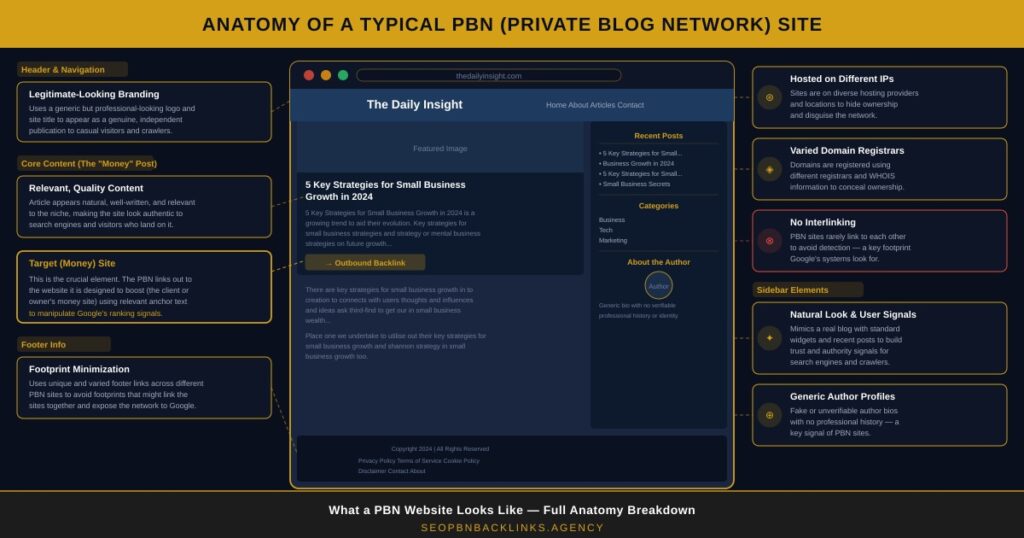
Hosting and IP diversification tactics
Competent PBN operators distribute their sites across multiple hosting providers, different C-class IP ranges, and different geographic server locations. Each additional hosting account adds monthly expense across 30+ sites the overhead of truly diversified hosting is significant, which is why budget PBNs often cut corners and end up on shared hosting environments with other network sites, creating an obvious footprint.
Content strategy on PBN sites
AI-generated content is now ubiquitous across low to mid-budget PBN operations fast, cheap, and grammatically correct but semantically shallow. Spun or scraped content is an older technique still used in volume operations. Some higher-budget operations invest in genuinely written articles, making individual pieces harder to identify as PBN content but site-level behavioral signals (no audience engagement, no organic traffic, no social following) still expose the network nature.
Internal linking patterns that mask the PBN structure
Within each pbn site, internal linking mimics legitimate content site structure home page linking to category pages, category pages linking to articles. This structure exists not for reader navigation but to pass internal PageRank and mimic legitimate site patterns. What is notably absent is the kind of natural internal linking that genuine editorial sites develop: links from older content to newer content, contextual references between related articles, and navigation that evolved in response to real audience behavior.
PBN footprints: the complete detection checklist
Technical footprints (IP, hosting, WHOIS, registrar)
- Multiple sites sharing the same server IP or hosting account
- Same nameservers across multiple domains from the same registrar
- Shared WHOIS registrant email addresses, phone numbers, or physical addresses
- Identical WordPress theme slug, plugin set, and CMS version fingerprint across multiple sites
- Same Google Analytics or Google Tag Manager ID used across network sites
- Same contact form endpoint routing submissions to the same email or processor
Content footprints (duplicate themes, low engagement, no social presence)
- Near-zero organic traffic despite high DR or DA authority metrics
- Incoherent topical history domain relaunched in unrelated niche without explanation
- No verifiable authors with professional backgrounds or external byline history
- Zero comments, social shares, or evidence of any real reader interaction
- AI content uniformity identical generic article structures across multiple sites on same topics
Backlink footprints (exact-match anchors, link velocity)
- High percentage of outbound links using identical commercial anchor text pointing at the same money site
- Link velocity gap large cluster of backlinks from 2015-2019 then nothing until relaunch
- Low referring domain diversity most links pointing to the PBN site come from a handful of sources
- No brand mentions real websites get cited by name outside their own network
- Links appearing on multiple sites with similar profiles same referring domains appearing repeatedly across a suspected cluster
How Google detects PBN networks in 2026
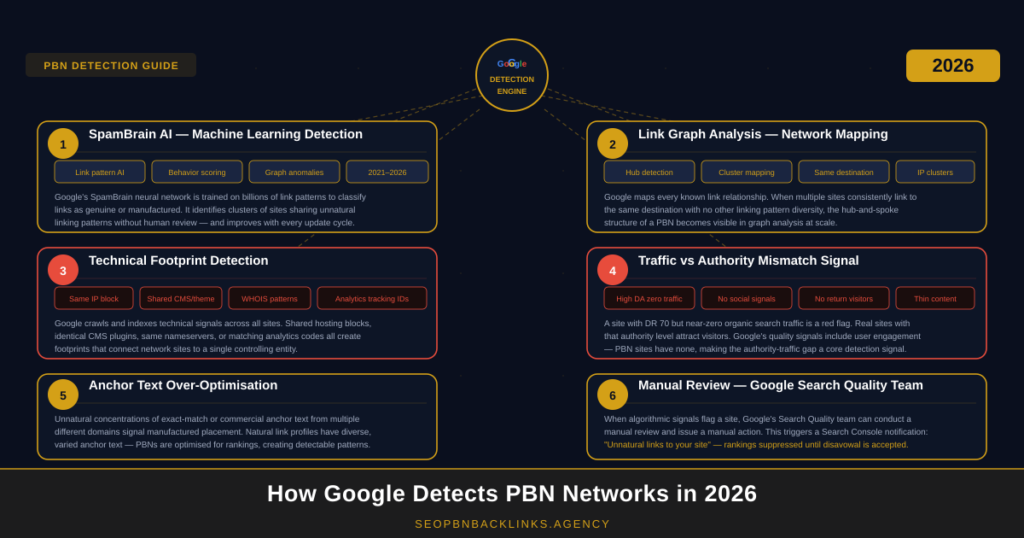
SpamBrain: Google’s AI spam detection model
SpamBrain is Google’s machine learning-based spam detection system, significantly expanded through 2022-2025. For a full glossary of PBN-related terminology used throughout this guide, see our PBN meaning and terminology guide. It uses neural network models trained on known spam patterns to classify sites and link profiles without requiring manual review of each individual case. For PBN detection specifically, SpamBrain identifies behavioral and structural patterns that are collectively improbable in legitimate link ecosystems sites with authority wildly inconsistent with content quality, domains existing primarily to hold outbound links to a narrow set of targets, and link profiles where anchor text distribution, velocity, and topical consistency all simultaneously deviate from organic editorial linking patterns.
Critically, SpamBrain does not need to trace every domain to a specific owner. It identifies the pattern of manufactured link behavior and classifies the cluster as a probable network regardless of whether it can confirm shared ownership. This is what makes footprint avoidance increasingly ineffective you can diversify hosting and registrars, but you cannot easily alter the behavioral signatures that reveal coordinated operation.
Link graph analysis and network pattern recognition
Google maintains a continuously updated model of relationships between every indexed domain the link graph. Within this graph, PBN networks create identifiable topological patterns: clusters of sites that all link to the same small set of targets, receive links from a similar pool of sources, publish content at similar intervals, and show no evidence of independent audience relationships. This structure does not require any single footprint to be exposed it emerges from the collective behavior of the network.
According to Google’s link spam policies, the company uses both automated systems and human review to identify and act on link schemes. The practical implication: the threshold for detection has dropped significantly. Networks that survived for years under pre-SpamBrain detection are increasingly being caught algorithmically and unlike manual penalties, algorithmic neutralization affects your link profile without warning and without any clear path to recovery.
FAQs
How many sites do you need for a PBN to work?
A single PBN site provides almost no benefit and very high risk if scrutinized. The practical minimum for measurable impact is typically 10-20 sites generating multiple unique referring domains. Most mid-scale operations targeting competitive keywords run 30-60 sites. The number needed depends heavily on the competitive landscape — a local service keyword might respond to 10-15 PBN links while a national competitive keyword might require far more, with cost and detection risk scaling accordingly.
Is it possible to build an undetectable PBN in 2026?
Significantly harder than in previous years, and arguably impossible at meaningful scale. Individual, carefully managed PBN sites with genuine content and fully diversified infrastructure may evade detection for extended periods. But undetectable becomes functionally impossible when operating the site count necessary to impact competitive rankings. The cost of genuine footprint avoidance across 30+ sites approaches or exceeds the cost of legitimate link building — eliminating the economic rationale for the tactic.
What is the difference between a PBN and a link farm?
A link farm is a simpler, cruder tactic a cluster of sites primarily existing to link to each other and to target sites, with minimal content investment and no attempt at footprint management. PBNs are a more sophisticated evolution: they use expired domains with real authority histories, invest in content to create plausibility, and employ active footprint avoidance. Both are prohibited under Google guidelines. Link farms are trivially detected and neutralized. Higher-quality PBNs require more sophisticated detection systems which is exactly what Google has been building.
Can a hosting provider detect PBN activity?
Most standard hosting providers do not actively look for PBN operations. However, hosting terms of service typically prohibit artificial link building schemes. More relevantly, certain hosting providers use shared infrastructure that creates identifiable footprints across sites making the choice of hosting provider an active detection risk. Some providers have taken action when networks on their infrastructure were flagged by third parties or caught in Google penalties.
What is PBN vs tiered link building?
Tiered link building is a link architecture strategy where Tier 1 links point directly to the money site and Tier 2 and Tier 3 links point to Tier 1 links to amplify their authority. PBNs are one type of link used in this structure typically in Tier 2 or Tier 3 positions. The tactic attempts to create distance between the money site and manufactured links. In practice, Google link graph analysis can trace multi-tier structures, and the presence of PBN-style sites anywhere in the chain carries essentially the same risk as direct PBN links.
Conclusion
Private blog networks are engineering problems as much as they are SEO tactics. Every design decision which domains to buy, how to host the sites, what content to publish, how to manage anchor text is made with detection avoidance in mind. Understanding that engineering logic is what makes PBN footprints readable.
The structural signals that expose PBN networks consistently fall into three categories. Technical signals reveal shared infrastructure. Content signals reveal the absence of real audience value. Backlink signals reveal the manufactured nature of the links. Google SpamBrain and link graph analysis have made these patterns detectable at a scale and speed that fundamentally changes the risk calculation for PBN operators. What once required manual review of specific sites can now be flagged algorithmically across millions of domains simultaneously.
The window between network setup and detection has narrowed and the consequences of detection remain severe whether they come as algorithmic neutralization or a formal manual action.
Want to continue building your PBN knowledge? Return to our complete PBN SEO guide, read our breakdown of what PBN links are and how they work, check the PBN meaning and terminology glossary, browse the full PBN FAQ, or see how PBN links work for affiliate sites, learn how long PBN links take to rank, master exact match anchor text strategy, maximise backlink equity from every link, and read our white hat vs black hat SEO breakdown, and our white label link building guide for agencies.
work for affiliate sites.
Ben Davis is a seasoned SEO strategist with over a decade of hands-on experience in off page SEO, link building, and private blog network management.
He has helped 600+ agencies and professionals achieve top rankings in competitive niches including iGaming, crypto, CBD, and finance through data driven PBN strategies.