


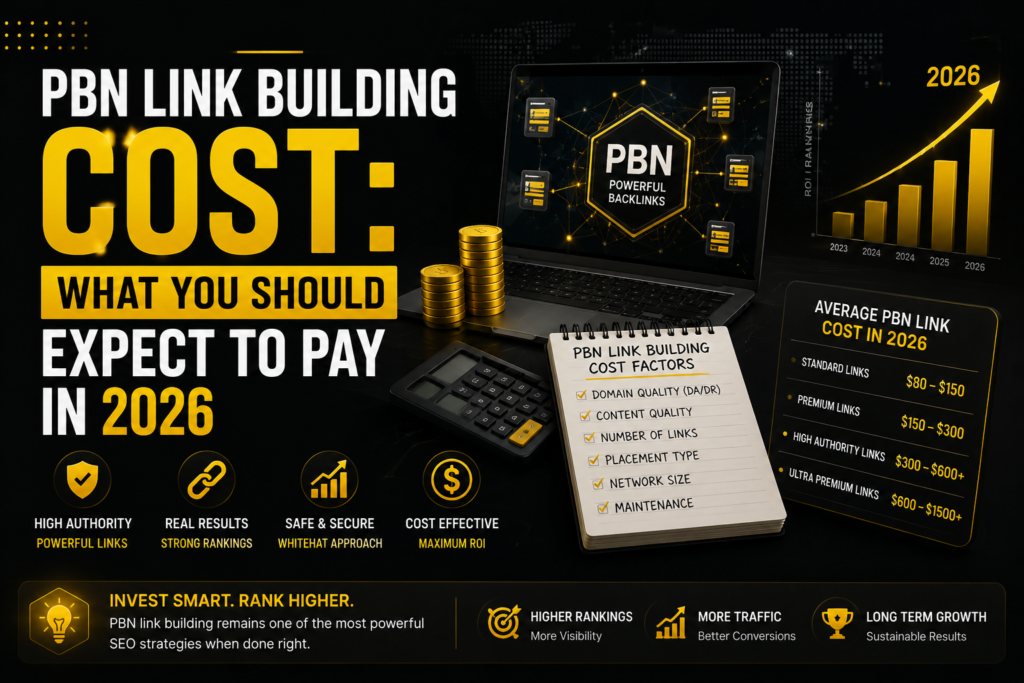
If you are researching PBN link building cost, you are probably comparing providers and trying to understand whether the price differences reflect genuine quality differences or just margins. The answer is both — and knowing which is which is what this guide is for. PBN link pricing in 2026 ranges from under £10 per link (link farms with shared infrastructure and AI filler content) to over £150 per link (premium niche-specific placements with high Trust Flow and single-outbound-link exclusivity). The difference is not arbitrary. This guide explains exactly what drives the price difference, what each tier actually delivers in terms of link equity and risk profile, how to calculate a realistic campaign budget for your specific ranking goals, and where the false economy of cheap links destroys more value than it creates.
Table of Contents
- PBN link price ranges in 2026
- What drives the cost difference
- The true cost of cheap PBN links
- How to calculate your campaign budget
- PBN link cost by niche
- Monthly retainer vs per-link pricing
- Thinking about PBN cost as ROI, not spend
- FAQ
- Conclusion
Key Takeaways
- Quality PBN link placements cost £20–£80 per link for standard campaigns in 2026. Sub-£15 links almost always indicate shared infrastructure or thin AI content — high risk, near-zero equity.
- The five factors that drive PBN link cost: Trust Flow of the domain, URL Rating of the specific article page, content quality and length, hosting infrastructure diversity, and single vs shared outbound link placement.
- Cheap PBN links do not just fail to help — they actively waste budget that could have bought fewer, better links that actually move rankings. The false economy of volume over quality is the most common PBN budget mistake.
- Campaign budget calculation: determine your referring domain gap (top 5 competitor average minus your current count), multiply by your target link cost, add 20% for Tier 2 amplification.
- PBN link cost varies significantly by niche — iGaming and YMYL niches require higher-quality domains commanding higher prices; local SEO can achieve results with mid-tier placements at lower total cost.
PBN link price ranges in 2026
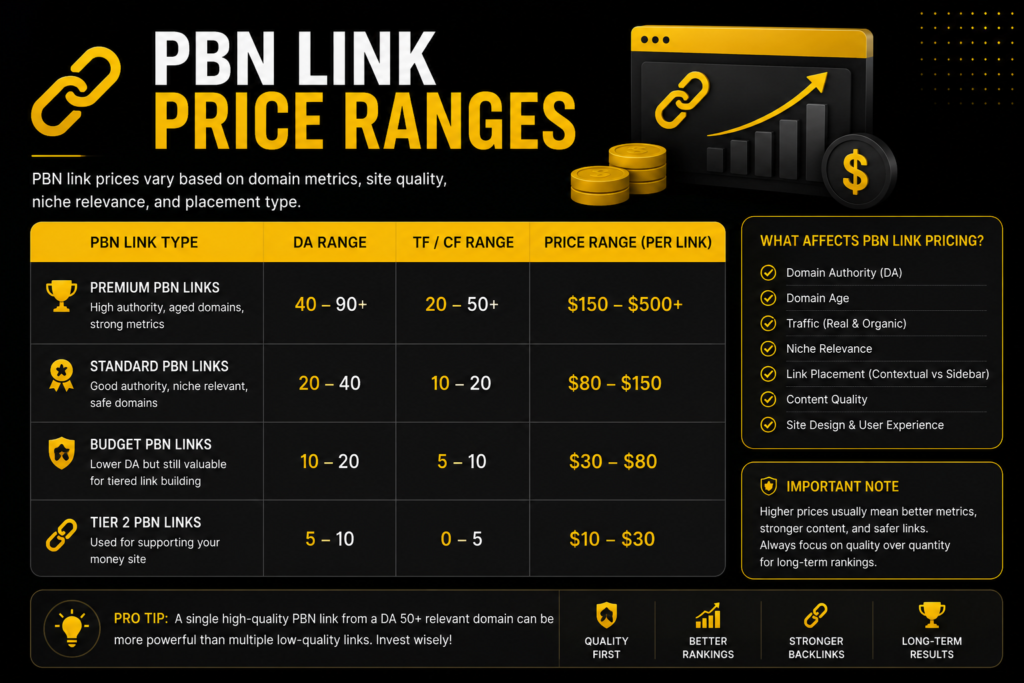
The UK and international PBN link market in 2026 falls into five clear quality and price tiers. Understanding what each tier actually delivers — beyond what the provider claims — is the practical foundation of any PBN budget decision.
| Tier | Price range | Trust Flow | URL Rating | Content quality | Verdict |
|---|---|---|---|---|---|
| Avoid (link farms) | Under £12 | TF 0–8 | UR 0–3 | Sub-200 words, AI spam | Near-zero equity, high detection risk. Never buy. |
| Budget | £12–£20 | TF 8–15 | UR 2–8 | 300–500 words, basic | Minimal equity. Acceptable only for Tier 2. |
| Standard | £20–£40 | TF 15–25 | UR 8–18 | 600–800 words, coherent | Good equity, manageable risk. Main campaign use. |
| Premium | £40–£80 | TF 25–40 | UR 15–30 | 800–1,200 words, expert | Strong equity, low risk. Competitive niches. |
| Niche-specific | £70–£150+ | TF 30–60 | UR 20–40 | Expert content, single outbound link | Maximum equity per link. High-value target pages. |
These ranges reflect the UK market in 2026. International providers (particularly those operating from lower-cost regions) may price 20–40% lower for equivalent quality tiers — but verify quality independently using the five checks from our buy PBN links guide before assuming equivalent quality at lower price.
What drives the cost difference
Five specific factors determine what a PBN link placement costs — and each factor has a direct impact on the equity it passes and the risk it carries. Understanding them lets you assess whether a quoted price reflects genuine quality or just margin.
Factor 1: Trust Flow of the domain
Trust Flow is the hardest quality signal to fake and the most expensive to build. Domains with TF 30+ have accumulated links from genuinely trusted sources across years — those domains cost significantly more to acquire or maintain than low-TF domains. A placement on a TF 35 domain costs more than a placement on a TF 12 domain because the underlying domain asset is more expensive and scarcer. This cost difference is justified: a TF 35 domain passes substantially more ranking-quality equity than a TF 12 domain, all else equal. See our Trust Flow guide for the quality mechanics.
Factor 2: URL Rating of the article page
A PBN site where article pages have been boosted to UR 20+ through internal linking and Tier 2 support costs more to operate than one where articles are orphaned with UR 1–3. Higher article-page UR passes more equity per link — and maintaining those UR scores requires ongoing investment in the PBN infrastructure. Providers charging premium prices for high-UR article placements are reflecting genuine operational cost, not just margin. As covered in our URL Rating guide, article-page UR is the most important single metric for link equity per placement.
Factor 3: Article content quality and length
A 1,000-word expert article written by a human specialist with genuine topical knowledge costs significantly more to produce than a 300-word AI-generated filler piece. Since the Google Helpful Content update integrated into the core algorithm in March 2024, article content quality on PBN sites directly affects both equity passed and detection risk. Providers charging more for quality content are passing on a real production cost that protects both equity and risk profile.
Factor 4: Hosting infrastructure diversity
Running a PBN network with genuine hosting diversity — different IP ranges, different hosting accounts, different registrars, different CMS configurations — costs more than running all sites on the same shared hosting account. The operational cost of diversity is real, and it directly reduces the footprint detection risk covered in our Google penalties guide. Networks that charge bottom-dollar prices are almost always running shared infrastructure — the cost savings come at the expense of the most detectable risk factor.
Factor 5: Single vs shared outbound link placement
A single-outbound-link article — where your link is the only outbound link in the entire article — costs more than a shared placement on an article linking to multiple sites. The cost difference reflects genuine equity value: a single-outbound-link article passes 100% of available link juice to your money site. An article with 5 outbound links passes approximately 20% to your site. As explained in our link juice guide, the equity difference between single and shared placement compounds significantly across a campaign.
The true cost of cheap PBN links
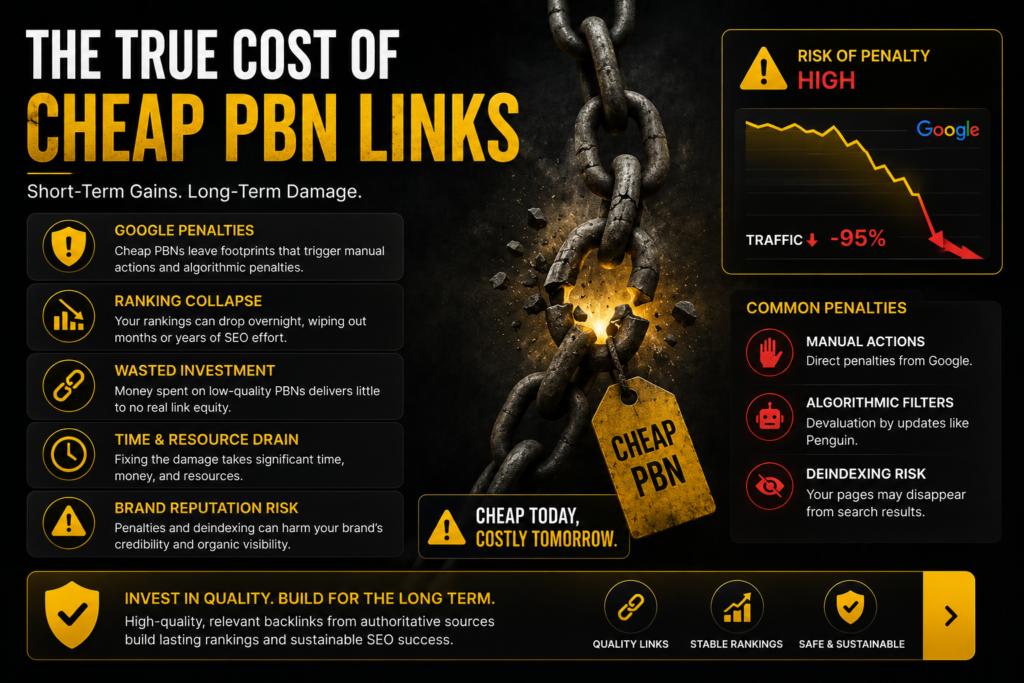
The appeal of sub-£15 PBN links is straightforward: more links for less money. 100 links at £10 each versus 25 links at £40 each — the same total budget produces four times the referring domain count. In theory. In practice, cheap PBN links produce three negative outcomes that make them more expensive than quality links on any honest accounting.
Negative outcome 1: Near-zero equity
A link farm domain with TF 3, DR 25, and UR 1 article pages passes almost no link equity. Buying 100 of these links produces the referring domain count number in Ahrefs but does not meaningfully raise the URL Rating of your target pages or produce measurable ranking movement. Budget spent on these links produces a vanity metric (referring domain count) rather than a ranking outcome. The money is not invested — it is spent on activity with no attributable result.
Negative outcome 2: Wasted anchor text allocation
Every link in your backlink profile — even a worthless one — uses anchor text from your safe distribution budget. If 100 cheap links consume commercial exact match anchors (as many cheap providers default to), they have over-optimised your anchor profile without contributing any ranking benefit. Now you cannot safely use any more exact match anchors without exceeding the detection threshold, and the excess anchors are sitting on links that pass no equity. The cheap links have actively damaged your ability to use quality links effectively.
Negative outcome 3: Elevated detection risk
Link farms with shared infrastructure are the most detectable PBN pattern. SpamBrain has mapped the footprints of the most commonly used cheap link networks — many of the domains in these networks are already identified and their links algorithmically discounted. Worse, building links from detected networks can create an association pattern that draws attention to your money site, increasing the probability of a manual review that would not otherwise have occurred.
The honest calculation: £1,000 spent on 25 quality standard links (£40 each) that each pass meaningful equity produces ranking movement. £1,000 spent on 100 cheap links (£10 each) that pass near-zero equity produces nothing — and may leave residual damage to the anchor profile and detection risk association. The quality option produces ROI. The cheap option produces costs.
How to calculate your campaign budget
Budget calculation starts from your SERP gap, not from an arbitrary monthly spend figure. Here is the process:
Step 1: Establish your referring domain gap
In Ahrefs, search your primary target keyword. Check the referring domain count for each of the top 5 ranking pages. Calculate the average. Subtract your current referring domain count on the target page. This is your gap — the number of additional referring domains needed to reach competitive parity.
Example: Top 5 pages average 85 referring domains. Your page has 22. Gap: 63 referring domains. You need approximately 50 referring domains from PBN links (80% of gap) plus 13 from organic sources over the campaign period.
Step 2: Calculate link cost at your target quality tier
Multiply your PBN link requirement by your target cost per link:
- 50 links × £30 (standard tier) = £1,500 total campaign cost
- 50 links × £50 (premium tier) = £2,500 total campaign cost
- 50 links × £80 (niche-specific) = £4,000 total campaign cost
Step 3: Add Tier 2 amplification budget
Tier 2 link building raises the URL Rating of your Tier 1 article pages, multiplying the equity they pass to your money site. Budget approximately 15–20% of your Tier 1 cost for Tier 2 amplification. On a £1,500 Tier 1 campaign, £225–£300 of Tier 2 activity can multiply the effective ranking impact significantly. See our Tier 2 link building guide for the full strategy.
Step 4: Spread across months for velocity management
A 50-link campaign should be spread across 4–6 months of gradual delivery rather than compressed into a single month. For an established site, 10–15 new referring domains per month is a natural-looking velocity. For a newer site, 5–8 per month in the first six months. Spreading the budget over months also allows for mid-campaign assessment — if the first 15–20 links produce no UR improvement on target pages, you can diagnose the issue before spending the remaining budget on the same provider.
PBN link cost by niche
Different niches have different quality requirements and different authority thresholds — which translate directly into different budget requirements for the same ranking goals.
| Niche | Recommended quality tier | Target cost per link | Typical links to page one | Estimated budget range |
|---|---|---|---|---|
| Local SEO (competitive city) | Standard | £25–£40 | 20–50 | £500–£2,000 |
| Affiliate / review sites | Standard to Premium | £30–£55 | 40–100 | £1,200–£5,500 |
| eCommerce / Shopify | Standard to Premium | £30–£60 | 50–150 | £1,500–£9,000 |
| SaaS / Software | Premium | £45–£80 | 80–200 | £3,600–£16,000 |
| iGaming / Casino | Premium to Niche | £60–£120 | 200–500+ | £12,000–£60,000+ |
| Finance / Crypto (YMYL) | Premium to Niche | £60–£150 | 150–400+ | £9,000–£60,000+ |
These ranges reflect campaigns targeting competitive keywords — lower-competition local or long-tail keywords within each niche will have smaller gaps and lower total costs. See the niche-specific guides for detailed strategies: iGaming and casino backlinks, finance and crypto PBN links, ecommerce PBN links, SaaS PBN links, and local SEO PBN links.
Monthly retainer vs per-link pricing
PBN link providers typically offer two pricing models. Understanding which suits your situation affects both cost and campaign management.
Per-link pricing
You pay per placement — each link ordered individually or in batches. Flexible, no commitment, easy to test a new provider with a small order before committing volume. Per-link pricing is typically 10–20% higher than equivalent retainer pricing because the provider has no volume commitment from you. Best for: testing new providers, campaign phases where link volume fluctuates, or one-off targeted campaigns for specific pages.
Monthly retainer
You commit to a fixed monthly link volume in exchange for volume-discounted per-link pricing. A 20-link-per-month retainer at £35/link saves £5–£10 per link compared to per-link pricing at equivalent quality. Retainers also give providers predictable workload, allowing them to source and prepare better domains rather than rushing single orders. Best for: established campaigns where you have validated the provider quality, sites with consistent monthly authority-building needs, and agency-managed accounts with predictable monthly deliverables. For the white label retainer model for agencies, see our white label link building guide.
Thinking about PBN cost as ROI, not spend
The most useful frame for PBN link cost is not “how much am I spending” but “what is this spend worth if it works.” A simple ROI calculation clarifies budget decisions significantly.
Simple PBN ROI calculation
Step 1: Estimate monthly traffic from a page-one ranking for your target keyword. Use Ahrefs click-through rate data or estimate 20–30% of monthly search volume for a position-1 ranking.
Step 2: Estimate monthly revenue from that traffic. For affiliate sites: monthly clicks × conversion rate × average commission. For ecommerce: monthly visitors × conversion rate × average order value. For lead gen: monthly visitors × lead conversion rate × average lead value.
Step 3: Calculate payback period. Total campaign cost divided by monthly revenue from the ranking equals the number of months to break even. A campaign costing £3,000 that produces a page-one ranking generating £1,500/month breaks even in 2 months — an extremely high ROI investment that justifies premium link quality.
This calculation reframes the cost question entirely. A £5,000 campaign that produces a ranking generating £5,000/month in perpetuity is not an expense — it is one of the highest-ROI capital investments available. The reluctance to invest in quality links often reflects a failure to calculate the revenue value of the ranking goal, not a rational cost assessment.
FAQ
How much do PBN links cost in 2026?
Quality standard PBN link placements cost £20–£40 per link in the UK market in 2026. Premium placements on high Trust Flow domains with expert article content cost £40–£80 per link. Niche-specific placements with maximum topical relevance, single outbound link exclusivity, and Trust Flow 30+ domains cost £70–£150+ per link. Sub-£15 links indicate link farms or AI-generated thin content — near-zero equity and elevated detection risk. The right price tier depends on the competition level for your target keywords and the commercial value of the ranking.
Why do some PBN links cost more than others?
Five factors drive PBN link cost: Trust Flow of the domain (harder to build, commands premium), URL Rating of the specific article page (higher UR passes more equity), content quality and length (expert 1,000-word articles cost more to produce than 300-word filler), hosting infrastructure diversity (diverse IPs cost more to operate), and single vs shared outbound link placement (exclusive single-link articles pass more equity and cost more). Higher-priced links are reflecting genuine operational costs that produce better equity per link and lower detection risk.
Are cheap PBN links worth it?
No, for two reasons. First, sub-£15 links typically pass near-zero equity because the domains have low Trust Flow, article pages have minimal URL Rating, and the content fails Google Helpful Content quality standards — meaning you are paying for activity with no ranking outcome. Second, cheap links still consume anchor text from your safe distribution budget and may create detection risk associations that affect quality links built later. The false economy of volume over quality consistently produces worse ROI than fewer, better links at the standard quality tier.
How much should I budget for a PBN link building campaign?
Start from your SERP gap: check the average referring domain count of the top 5 pages ranking for your target keyword, subtract your current count, and multiply 80% of that gap by your target link cost. Add 15–20% for Tier 2 amplification. For a competitive local keyword with a gap of 40 referring domains, a standard-quality campaign costs approximately £800–£1,600. For a competitive national keyword with a gap of 150 referring domains, a premium campaign costs approximately £6,000–£12,000. Spread over 4–6 months for natural velocity.
Is it cheaper to build a PBN yourself or buy links from a provider?
Building a quality PBN yourself costs significantly more than buying from a provider when you account for total cost of ownership. Domain acquisition at auction (£50–£500+ per domain for quality expired domains), diverse hosting across multiple accounts (£5–£15/month per domain), content production for each site and each article (£20–£80 per article), and ongoing maintenance and monitoring easily exceeds £200–£400 per domain in the first year. Buying from a provider at £30–£50 per link is almost always more cost-efficient unless you plan to use the PBN at sufficient scale (50+ links per month) to justify the infrastructure investment.
Conclusion
PBN link building cost is not a single number — it is a range from near-worthless to genuinely high-value, with the difference driven by measurable quality factors that you can verify independently before spending. The key discipline is calculating from your SERP gap upward rather than from an arbitrary budget downward, and investing in the quality tier that the competition level of your target keywords actually requires.
Cheap links do not just fail to help — they actively interfere with quality campaigns by consuming anchor text budget, creating detection risk associations, and producing referring domain counts that do not correspond to actual equity. The correct budget frame is not “how little can I spend” but “what is the page-one ranking worth, and what quality investment does that revenue justify.”
Get quality PBN links at the right price for your niche and competition level. PBN backlinks — standard, premium, and niche-specific tiers available, Trust Flow and URL Rating verified on every placement, white label and monthly retainer pricing for agencies. Supporting guides: how to buy PBN links — five quality checks, Trust Flow — the quality metric behind the price, URL Rating — page-level equity that drives rankings, Tier 2 links — amplify your Tier 1 investment, and our outsource link building guide for agency retainer models.

Ben Davis is a seasoned SEO strategist with over a decade of hands-on experience in off page SEO, link building, and private blog network management.
He has helped 600+ agencies and professionals achieve top rankings in competitive niches including iGaming, crypto, CBD, and finance through data driven PBN strategies.