


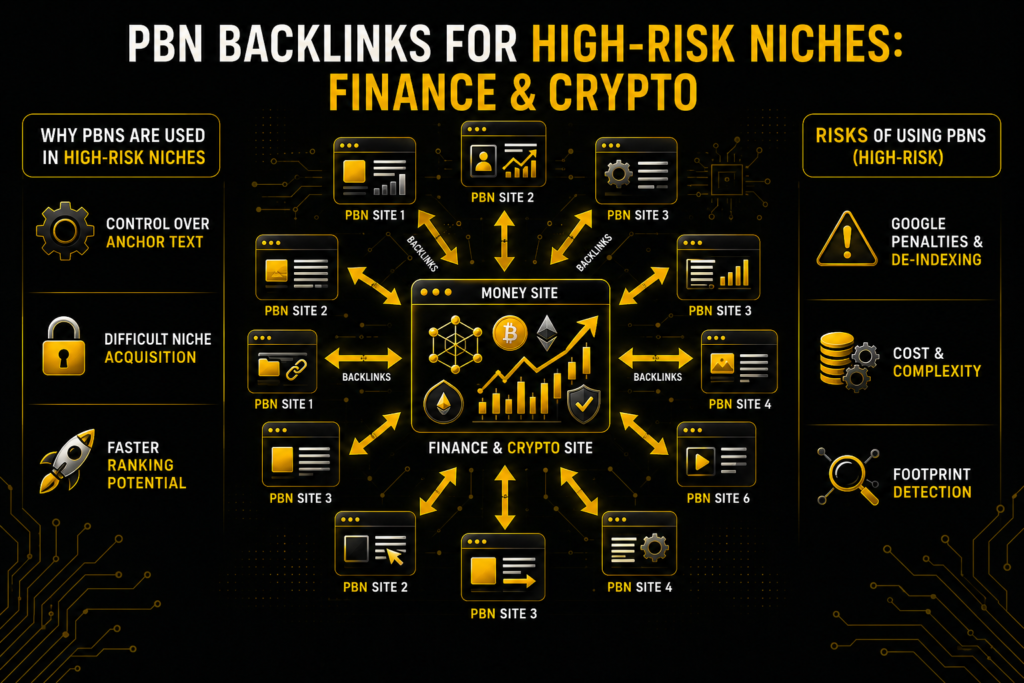
Finance and crypto SEO share the same fundamental problem as iGaming: the verticals that most need backlinks are the ones with the fewest organic editorial link opportunities. Advertising restrictions across Google Ads, Meta, and X make organic search the primary discovery channel for most crypto projects and many fintech platforms — and yet the same restrictions that close off paid acquisition also limit the editorial publishers willing to link. This guide explains exactly how PBN links for finance sites work in YMYL-classified niches, covering the heightened scrutiny that financial and crypto link profiles face, the specific use cases across token projects, exchanges, and fintech comparison sites, what E-E-A-T signals PBN links can and cannot contribute, the anchor text that must be avoided in financial niches, and the four-layer risk management framework that separates durable finance authority from profiles that collapse under core updates.
Table of Contents
- Introduction: the outreach gap in finance and crypto SEO
- YMYL classification and what it means for PBN link strategy
- How PBN links are used in crypto project marketing
- E-E-A-T signals: what PBN links can and cannot contribute
- Anchor text strategy for finance — what to avoid
- How to buy high DA PBN links safely in financial niches
- Risk management framework for YMYL PBN campaigns
- FAQ
- Conclusion
Key Takeaways
- Finance and crypto face the same editorial exclusion as iGaming — advertising restrictions on major platforms make organic search critical while limiting publishers willing to link.
- YMYL classification means Google applies its highest spam detection sensitivity to financial and crypto link profiles — domain quality thresholds are higher and penalty consequences more severe.
- PBN links contribute to authority and topical relevance in E-E-A-T — but cannot provide expertise, experience, and trustworthiness signals. Both are needed for durable finance rankings.
- Anchor text over-optimisation is the single most common cause of manual actions in finance PBN campaigns — commercial financial anchors must be kept to 3–5% maximum.
- High DA PBN links for financial niches should be sourced from finance, investment, and business domains with genuine Trust Flow — not generic high-DR domains.
YMYL classification and what it means for PBN link strategy
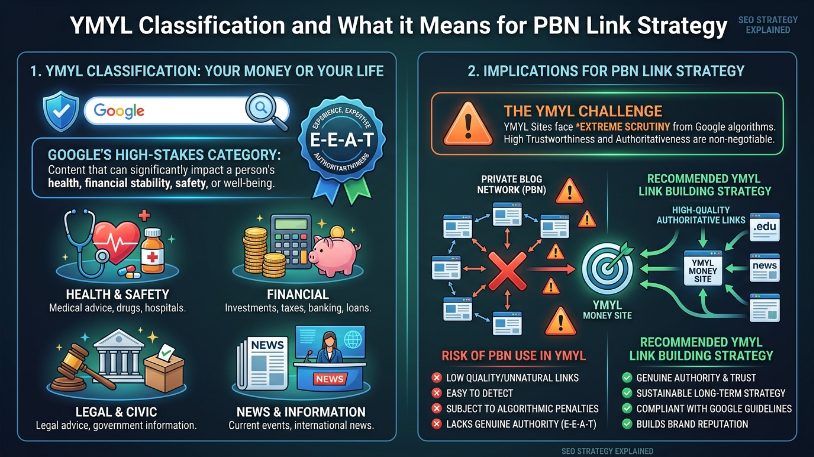
How YMYL classification affects link profile assessment
Higher spam detection sensitivity: Google SpamBrain applies more scrutiny to financial and crypto link profiles than non-YMYL niches. The same PBN domain quality that produces stable rankings in a lifestyle niche carries elevated detection risk in financial SERPs.
More severe penalty consequences: Manual actions in YMYL financial niches are handled by experienced quality reviewers with conservative reinstatement decisions. Recovery typically takes 6-18 months versus 2-6 months for non-YMYL niches.
A real 2026 case study: Cointelegraph top-3 keywords collapsed from 18,560 in September 2025 to just 27 by March 2026 despite retaining DR 89 and 78,817 referring domains. The cause was adding low-quality casino directory content. Google evaluates YMYL domains holistically – a single low-quality section can tank the entire domain. This means PBN content quality matters more in finance than any other niche.
How PBN links are used in crypto project marketing
Token and project launch pages
New token projects and DeFi protocols face the same cold-start problem as new SaaS companies (detailed in our PBN links for SaaS guide) but with additional volatility risk: crypto keyword search volume fluctuates dramatically with market cycles and the commercial window for a token launch is often weeks rather than months. PBN links for token launch pages serve as rapid authority establishment, building the referring domain count that allows project pages to rank for specific token-name queries before the launch window closes.
Crypto exchange comparison and review pages
Exchange comparison sites targeting commercial-intent queries (“best crypto exchange UK,” “Binance vs Coinbase fees”) have the same editorial link gap as finance comparison pages generally. PBN links combined with affiliate link network placements are the standard approach for exchange comparison content. These pages have the same structure as the ecommerce collection page problem – see our PBN links for ecommerce guide for the parallel.
DeFi protocol educational content
DeFi protocol sites targeting informational queries face the YMYL barrier: financial publishers are cautious about linking to DeFi content given regulatory and scam risk associations. PBN links to DeFi educational content establish initial rankings that allow content to rank well enough to attract editorial links through natural discovery. The PBN-built ranking position creates the precondition for genuine E-E-A-T link earning.
Fintech and financial comparison sites
Fintech platforms – robo-advisors, investment apps, mortgage calculators – face finance YMYL scrutiny in its most acute form. New fintech entrants competing with established platforms like MoneySavingExpert or Investopedia face authority deficits that editorial outreach cannot close in under 18 months. PBN links for fintech comparison sites should target category-level pages rather than individual product recommendation pages, which carry higher regulatory content risk.
E-E-A-T signals: what PBN links can and cannot contribute
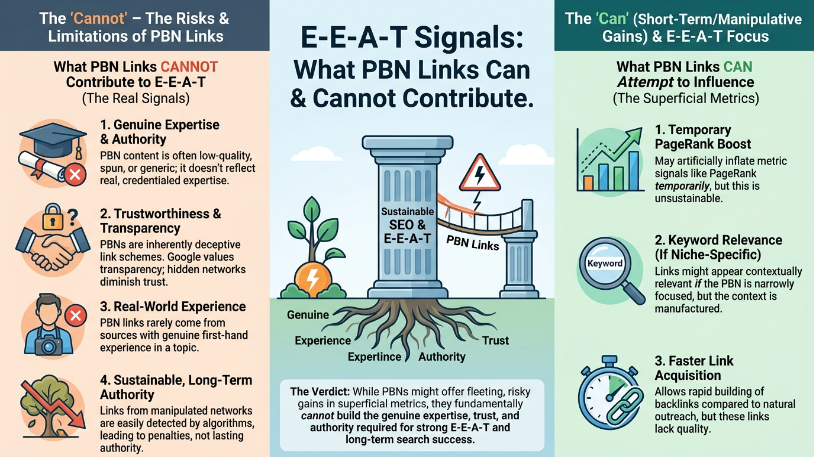
What PBN links DO contribute to E-E-A-T in finance
Authoritativeness: PBN links from finance-adjacent domains directly contribute to the authority signal that Google assesses through link profiles. A finance site with 200 referring domains from finance, investment, and business content domains demonstrates topical authority recognition even when those links are manufactured rather than editorially earned.
Ranking foundation for trust-generating content: When PBN links establish initial rankings for finance content, that content becomes discoverable by genuine editorial publishers and researchers who may then link to it legitimately. PBN-built ranking positions create the precondition for genuine E-E-A-T link earning – an indirect but real contribution.
What PBN links CANNOT contribute to E-E-A-T in finance
Expertise and experience signals: PBN links from sites with no verifiable financial expertise do not contribute to the expertise assessment that Google quality raters evaluate for YMYL content. This is where the distinction between E-E-A-T signals and referring domain count matters most in finance.
Trustworthiness signals: Trustworthiness for financial content is evaluated through content accuracy, transparent author credentials, regulatory compliance language, clear risk disclosures, and citations from regulatory and professional bodies. These are on-site signals that PBN links cannot provide.
The practical implication: The most resilient finance and crypto SEO profiles combine PBN-built authority (referring domain count and topical authority) with genuine E-E-A-T investment – named authors with financial credentials, accurate content with regulatory compliance language, genuine editorial links from financial publications. Each compensates for what the other cannot provide. See our white hat vs grey hat SEO breakdown for the full honest framework.
Anchor text strategy for finance – what to avoid
Anchor text over-optimisation is the single most common cause of manual actions in finance and crypto PBN campaigns. For the general anchor text framework, see our complete anchor text strategy guide – the following is specific to financial and crypto content.
Anchor text categories to avoid in finance
Direct financial advice anchors: “best investment platform,” “safest crypto exchange,” “highest interest savings account” – these over-optimise for commercial keywords AND signal potentially misleading financial guidance that YMYL quality reviewers specifically identify. Keep to a strict maximum of 3% of total links.
Regulatory grey area anchors: In jurisdictions where certain financial products require disclosure or are restricted, commercial exact-match anchors may attract regulatory attention alongside algorithmic scrutiny.
Excessive token name exact match: For crypto projects, using the token name as exact match anchor on every PBN link creates over-optimisation with higher detection risk in YMYL contexts. Token name anchors: 3-5% maximum.
Safe anchor text distribution for finance PBN campaigns
| Anchor type | Finance-safe % | Examples |
|---|---|---|
| Exact match commercial | 3-5% | “best investment app UK” |
| Partial match + modifier | 18-22% | “comparing investment apps for beginners” |
| Branded anchor | 15-20% | Brand name alone or brand + category |
| Naked URL | 15-20% | Full URL or domain only |
| Generic | 40-50% | “click here,” “read more,” “full review” |
| LSI / semantic | 8-12% | “digital asset platforms,” “algorithmic trading tools” |
The higher generic and naked URL allocation compared to non-YMYL niches is deliberate. In financial SERPs, the natural link profile of a credible finance site includes many institutional and citation links that use generic or naked URL anchors – matching this pattern reduces detection risk.
How to buy high DA PBN links safely in financial niches
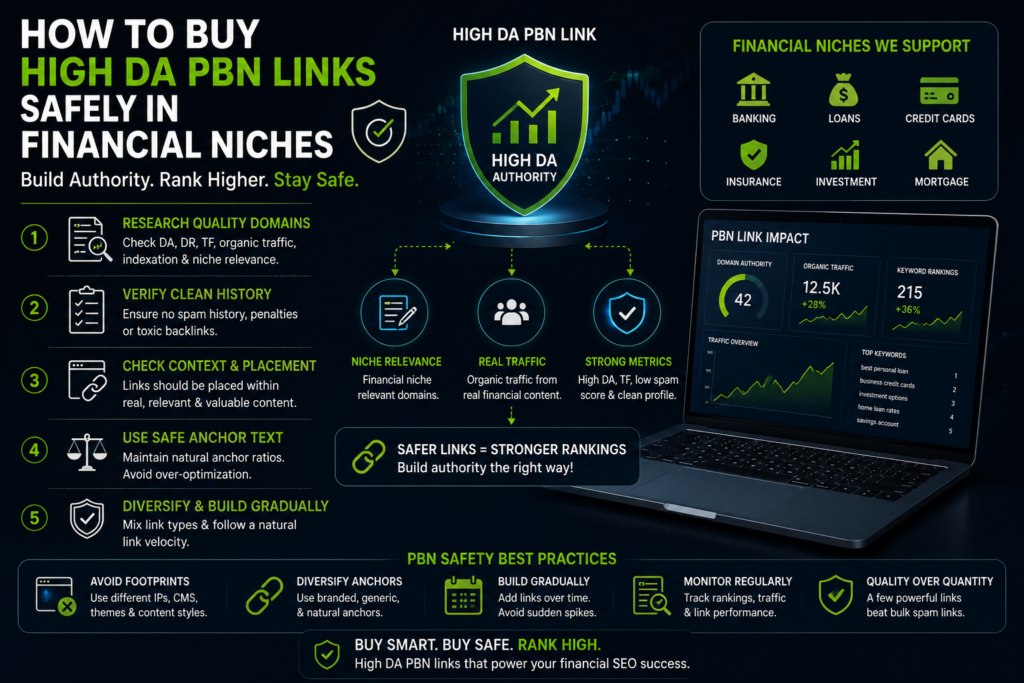
When practitioners search for ways to buy high DA PBN links or buy high PR links for finance clients, the primary risk is not that PBN links do not work in financial niches – it is that the domain quality required is significantly higher than in non-YMYL niches, and the supply of genuinely suitable domains is smaller.
What “high DA” actually means for finance PBN domains
Domain Authority and Domain Rating are aggregate metrics that do not distinguish between the types of links that built that authority. A finance-adjacent domain with DR 40 from genuine investment news citations and financial regulator references passes substantially stronger financial topical authority signals than a DR 60 general domain from mixed niches.
For finance PBN link building, Trust Flow is a more reliable quality proxy than DR alone: Target TF 20 minimum for standard finance campaigns, TF 30+ for competitive financial keywords. The TF category weighting toward finance, business, or investment in Majestic analysis is the key signal. See our PBN networks and domain selection guide for the full evaluation framework.
The 5-point verification checklist before any finance PBN purchase
- Domain organic traffic (Ahrefs): Some organic presence confirms active crawling and indexation
- Trust Flow topic weighting (Majestic): Finance/business topic weighting in the TF category analysis
- Historical content check (Wayback Machine): Finance-adjacent content history with no regulatory enforcement associations
- Article content quality: The placement article contains accurate financial information – no factual errors about rates, regulations, or product features
- Outbound link audit (Ahrefs): No existing links to known finance scam or fraud sites
This verification process takes approximately 15 minutes per domain and prevents the most common quality control failures in finance PBN campaigns. See our backlink equity guide for how domain Trust Flow and URL Rating interact with per-link equity in YMYL contexts.
Risk management framework for YMYL PBN campaigns
The four-layer risk management structure
Layer 1 – Domain quality gate: Every domain must pass the five-point verification checklist before link placement. No exceptions for urgency or cost pressure. In YMYL niches, one low-quality domain can create detection patterns that affect the entire client account.
Layer 2 – Content accuracy review: Every article placed on a finance or crypto PBN domain must be reviewed for financial accuracy before the link goes live. A single inaccurate financial claim creates both E-E-A-T risk for the hosting page and potential regulatory exposure for the linked financial brand.
Layer 3 – Velocity calibration by site age:
| Site type | Maximum monthly PBN links | Notes |
|---|---|---|
| New finance site (0-12 months) | 3-5 | Conservative – sandbox + YMYL scrutiny apply |
| Established finance site (1-3 years) | 8-15 | Moderate – anchor text discipline critical |
| Authority finance site (3+ years, 100+ RDs) | 15-25 | Higher tolerance but YMYL scrutiny remains |
Layer 4 – Diversification requirement: Finance PBN campaigns should not consist entirely of PBN links. The most resilient profiles mix PBN links (40-60%), niche editorial outreach from financial publications (10-20%), genuine directory and citation links from financial regulatory and professional bodies (10-15%), and social and brand mention signals (10-15%). For the agency white label context, see our white label link building guide.
The regulatory compliance overlay
UK (FCA): FCA-regulated firms must ensure financial promotions in any medium comply with FCA financial promotion rules. PBN article content that reads as a promotion for a regulated product may require FCA approval or exemption.
EU (MiCA): The EU Markets in Crypto Assets regulation came fully into force in 2024-2025 and imposes disclosure requirements on crypto marketing that may extend to paid content linking to crypto products.
US (SEC/FINRA/FTC): Securities promotion regulations, FTC disclosure requirements for paid endorsements, and state-level money transmission regulations all potentially interact with link building activity in financial niches. Compliance review of PBN content for US-targeted financial clients is strongly recommended.
FAQ
What makes PBN links harder to use in finance and crypto than other niches?
YMYL classification is the primary difference. Google applies its highest editorial scrutiny and most sensitive spam detection to financial and crypto content. Domain quality thresholds are higher, anchor text tolerance is lower (3-5% commercial exact match vs 5-8% for non-YMYL), velocity must be slower, and penalty consequences when detected are more severe – typically 6-18 months recovery versus 2-6 months for non-YMYL niches.
How do I buy high DA PBN links for finance sites that actually work?
Prioritise Trust Flow over Domain Rating. TF 25+ from finance-category domains outperforms generic DR 60 domains for financial keyword authority. Verify each domain content history via Wayback Machine, check topic weighting in Majestic Trust Flow category analysis, confirm organic traffic activity in Ahrefs, and review the placing article for financial accuracy before the link goes live. The verification process is more demanding than for non-YMYL niches but prevents the quality control failures that cause finance PBN campaigns to underperform or produce penalties.
What anchor text should I avoid when building PBN links for finance sites?
Three high-risk categories: direct financial advice anchors (“best investment platform,” “safest crypto exchange”), regulatory grey area anchors that read as unlicensed financial promotion in regulated markets, and excessive token name exact match for crypto projects. Keep commercial exact match anchors to 3-5% of total links – significantly lower than the 5-8% that non-YMYL niches can typically sustain. See our anchor text strategy guide for the full distribution framework.
Can PBN links hurt a regulated finance company compliance standing?
Potentially yes – beyond the algorithmic risk. UK FCA-regulated firms are responsible for all financial promotions in any medium including paid link placements. EU crypto companies operating under MiCA have disclosure obligations that may extend to paid content. US financial services firms face SEC, FINRA, and FTC oversight that can intersect with paid link activity. PBN campaigns for regulated financial entities should be reviewed by a compliance professional, not just an SEO specialist.
How do PBN links interact with crypto sites that face YMYL scrutiny?
PBN links contribute to the authority (referring domain count) and relevance (topical domain signals) components of E-E-A-T for crypto sites. They cannot contribute to the expertise, experience, and trustworthiness signals that come from genuine author credentials, accurate financial content, and regulatory compliance language. The most resilient crypto site profiles combine PBN-built authority with genuine E-E-A-T investment – named authors with verifiable credentials, accurate content with regulatory compliance language, and genuine editorial links from financial publications.
Conclusion
Finance and crypto SEO operates under conditions that make organic editorial link building structurally inadequate for competitive commercial keywords within commercially viable timelines. The advertising restrictions that make organic search so important for these verticals simultaneously limit the editorial publishers willing to link, creating the outreach gap that PBN links exist to fill.
What makes finance and crypto different is not whether PBN links work – they do – but the precision and quality discipline required to use them without triggering heightened YMYL scrutiny. Higher domain quality thresholds (Trust Flow over DR, finance-category domain histories), more conservative anchor text distribution (3-5% commercial exact match), slower velocity, and content accuracy requirements are the execution disciplines that distinguish finance PBN campaigns that build durable authority from those that collapse under core updates.
The E-E-A-T framework is the most important structural consideration: PBN links build authority, but they cannot build the expertise, experience, and trustworthiness signals that YMYL financial rankings ultimately require. The strongest finance site profiles use PBN links to establish the referring domain count foundation while investing simultaneously in the genuine E-E-A-T infrastructure that makes that authority coherent and sustainable.
Build finance and crypto authority the right way. PBN backlinks for finance sites — finance and investment domain network, all verticals accepted including crypto, DeFi, fintech, and regulated financial services. Supporting guides: complete PBN SEO guide, anchor text strategy for financial niches, backlink equity for YMYL link campaigns, casino backlinks – the iGaming parallel, white hat vs grey hat SEO in regulated industries, and our ranking timeline guide for high-scrutiny niches.

Ben Davis is a seasoned SEO strategist with over a decade of hands-on experience in off page SEO, link building, and private blog network management.
He has helped 600+ agencies and professionals achieve top rankings in competitive niches including iGaming, crypto, CBD, and finance through data driven PBN strategies.