



Digital PR SEO is the practice of earning editorial backlinks from authoritative publications — news sites, trade press, industry blogs with real audiences — through genuinely newsworthy content rather than paid placement. It is the highest-Trust-Flow link building method available and the one that most directly contributes the E-E-A-T signals that Google increasingly requires from sites in competitive and YMYL niches. This guide explains what digital PR is in the context of SEO, what types of content earn editorial coverage and links, how to measure the SEO value of digital PR campaigns, and how digital PR fits alongside quality PBN links and niche edits in a complete 2026 link building strategy.
Table of Contents
- What is digital PR in SEO?
- The SEO value of digital PR links
- Digital PR vs PBN links: complementary not competing
- What content earns digital PR links
- How to run a digital PR campaign for SEO
- How to measure digital PR SEO results
- How to integrate digital PR into your link building strategy
- FAQ
- Conclusion
Key Takeaways
- Digital PR links from national publications and established industry press carry Trust Flow that PBN links cannot replicate — because these publications are themselves close to Majestic trusted seed sites in the link graph.
- The SEO value of digital PR is not just PageRank — it is the E-E-A-T signals that editorial coverage from credible sources sends to Google, particularly for YMYL niches where third-party editorial endorsement is a core quality signal.
- Digital PR is high-variance: a successful campaign earns 20-80 links from DR 60+ publications at exceptional ROI; an unsuccessful campaign earns nothing for significant investment. Planning for campaign failure is part of the strategy.
- Digital PR cannot replace PBN links for commercial page authority building — most earned editorial links point to content rather than product pages. The two tactics serve different functions and work best in combination.
- The strongest competitive profiles in 2026 combine quality PBN links (commercial page authority at volume) with strategic digital PR (Trust Flow elevation and E-E-A-T signals) — each addressing the gap the other leaves.
What is digital PR in SEO?
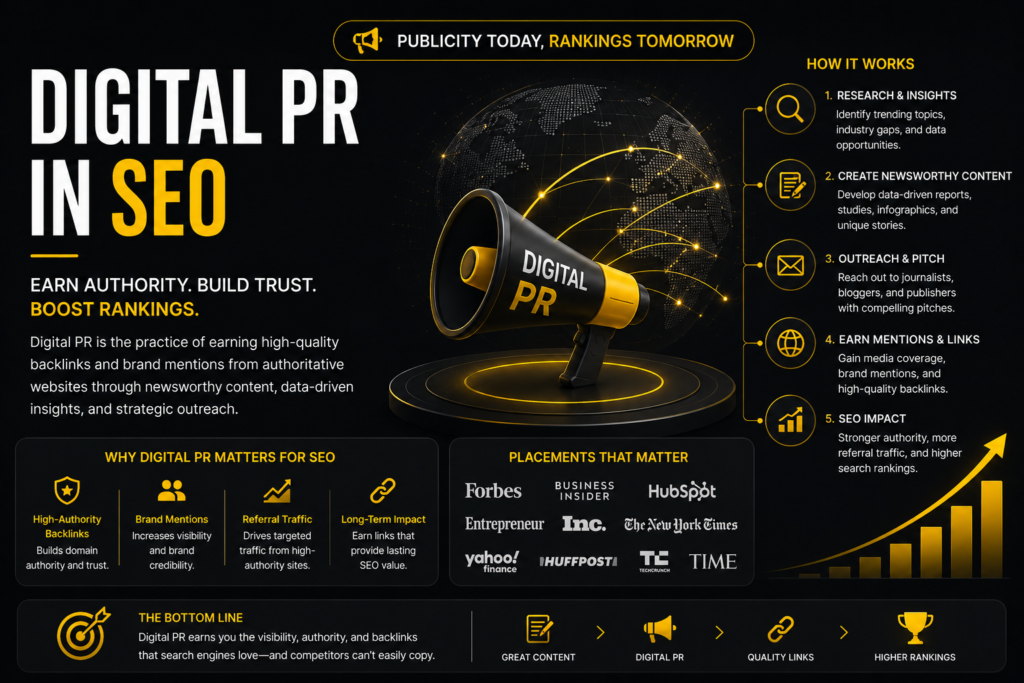
Digital PR is the practice of creating content — data studies, original research, surveys, interactive tools, newsworthy commentary — that earns editorial coverage and backlinks from publications that write about it because it is genuinely interesting to their readers. It is the intersection of traditional PR (getting media coverage) and SEO (earning backlinks from authoritative sources).
The distinction from traditional link building is fundamental: in digital PR, you do not pay for the link. The link is earned because a journalist, editor, or blogger decided your content was worth referencing to their audience. This editorial independence is what makes digital PR links carry signals that paid links — PBN links, guest posts, niche edits — cannot fully replicate.
Digital PR for SEO typically involves: identifying a newsworthy angle relevant to your industry, creating the content that proves the angle (survey data, research, a tool, an analysis), distributing it to relevant journalists and publications through targeted outreach, and measuring the editorial coverage and backlinks earned. A successful digital PR campaign earns links from publications that your target audience already reads — producing both SEO value (Trust Flow, domain authority) and direct commercial value (brand awareness, referral traffic).
The SEO value of digital PR links
Digital PR links provide three distinct SEO benefits that position them as the highest-quality link type available — even though they are typically fewer in number than PBN campaigns can produce.
Benefit 1: Maximum Trust Flow contribution per link
National news publications, major trade press, and established industry blogs are close to Majestic trusted seed sites — they are the publications that the seed site network was built around. A link from the BBC, Guardian, Forbes, or an established industry publication contributes more Trust Flow to your domain in a single placement than many standard PBN links combined. Our Trust Flow guide explains why proximity to seed sites — not link volume — is what Trust Flow measures. Digital PR earns exactly this type of proximity-based Trust Flow that is structurally unavailable through paid link placement.
Benefit 2: E-E-A-T signals for competitive and YMYL content
Google E-E-A-T (Experience, Expertise, Authority, Trust) framework assesses whether a site demonstrates genuine expertise and trustworthiness. For YMYL content — finance, health, legal, crypto — editorial coverage from credible third-party sources is one of the most direct E-E-A-T signals available. When a respected financial publication references your research or quotes your founder, Google can observe third-party editorial validation of your site expertise. PBN links raise URL Rating; digital PR raises the domain-level trust and authority profile that Google uses to evaluate how seriously to take the site for sensitive queries.
Benefit 3: Branded search and entity recognition
Press coverage in major publications drives branded search — people who see your brand mentioned in a national outlet search for it directly on Google. Branded search volume growth is a strong entity recognition signal that Google uses in its entity-based understanding of websites. A site that appears in national press regularly is processed differently by Google entity systems than one that exists only in its own domain without third-party media references. This entity recognition effect is not directly measurable through standard backlink metrics but contributes to ranking resilience and domain-level authority that benefits all pages on the site.
Digital PR vs PBN links: complementary not competing
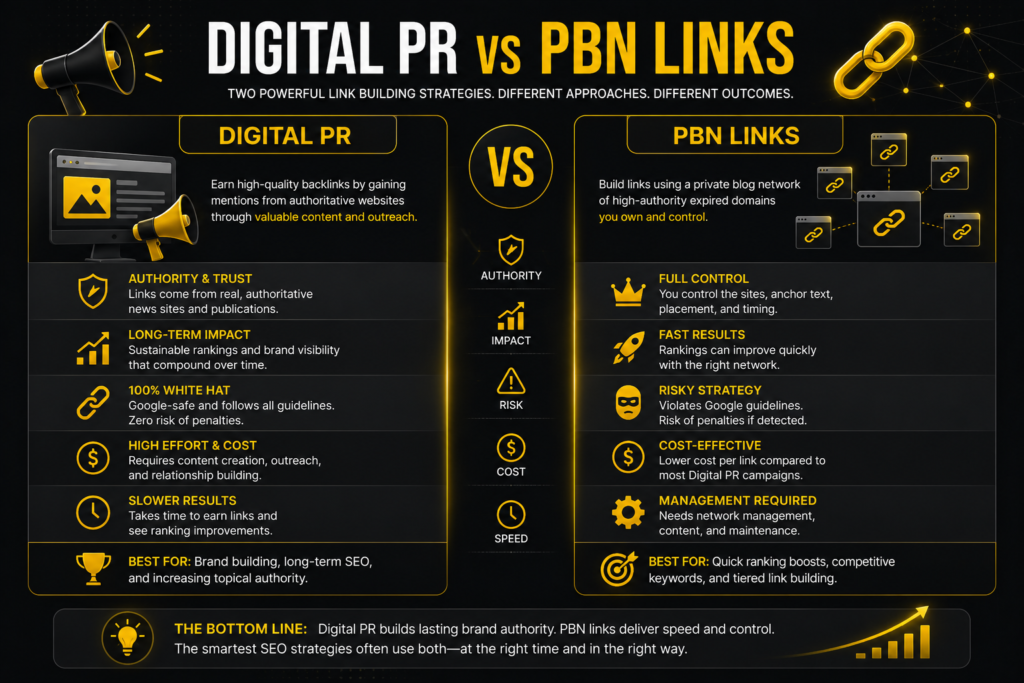
Digital PR and PBN links are frequently positioned as opposing approaches — white hat vs grey hat, earned vs bought. This framing obscures that they serve entirely different functions and that the strongest competitive profiles use both deliberately.
| Factor | Digital PR | PBN links |
|---|---|---|
| Primary SEO function | Trust Flow elevation, E-E-A-T signals, entity recognition | Commercial page URL Rating and authority building |
| Link targeting | Mostly content pages and homepage — rarely commercial pages | Precise — any page including product and category pages |
| Volume | Low-moderate — 5-80 links per successful campaign | High — 10-30 links per month consistently |
| Anchor text control | Minimal — journalist chooses anchor | Complete — specified per placement |
| Time to results | 3-12 months from campaign start | 4-8 weeks from placement to ranking movement |
| Cost per link | £50-500+ (campaign cost divided by links earned) | £25-90 per placement |
| Risk profile | Low penalty risk, high campaign failure risk | Moderate penalty risk, low campaign failure risk |
| Trust Flow per link | Very high (seed-site-adjacent publications) | Moderate (quality PBN domains) |
The gap this analysis reveals: digital PR cannot reliably build commercial page authority (it targets content, not product pages, and anchor text is uncontrolled). PBN links cannot build the seed-site-adjacent Trust Flow that digital PR provides. A site that relies exclusively on either will have a profile with a specific, predictable weakness. Combining them addresses both gaps simultaneously.
What content earns digital PR links
Journalists and editors link to content that is genuinely useful or interesting for their readers. Understanding what makes content newsworthy in your niche is the foundation of an effective digital PR campaign.
1. Original data and research
The most reliably linkable content type. Surveys, data analyses, and original research produce facts and statistics that journalists use as sources. When you publish “UK homeowners spent £2.3bn on kitchen renovations in 2025” based on original survey data, every journalist writing about home improvement has a reason to reference your research with a link. The key: the data must be original (not regurgitated from existing sources), the methodology must be credible, and the findings must be surprising or counterintuitive enough to be newsworthy rather than confirmatory of what readers already expect.
2. Index and tracker studies
Publishing regular data that tracks changes over time — a monthly cost-of-living index, quarterly salary data, annual industry benchmark reports — creates both initial coverage and ongoing reference links. Journalists working on related stories return to reference your tracker data repeatedly over months and years. A single well-designed index can earn hundreds of links over its lifetime from a single upfront production investment.
3. Reactive expert commentary
When a major news event occurs in your industry, journalists need expert quotes quickly. Being available with credible commentary at the right moment — when interest rates change, when a relevant regulation passes, when a major company in your sector makes news — earns links from news articles that would not exist without the timeliness. Reactive PR requires being signed up to HARO (Help a Reporter Out), Sourcebottle, or Qwoted, and responding quickly with genuine expertise rather than generic commentary that journalists will pass over.
4. Free tools and calculators
Genuinely useful free tools — mortgage calculators, salary benchmarking tools, carbon footprint estimators — earn editorial links because bloggers and journalists reference them as useful resources for their readers. The link relationship is evergreen: once a publication includes your tool in a “useful resources” article, the link persists indefinitely. Production investment is higher (requires development work) but ROI per link is excellent because a single well-designed tool continues earning new references years after launch.
5. Contrarian or myth-busting research
Data that challenges conventional wisdom generates significantly more coverage than data that confirms it. “Remote workers are actually more productive than office workers, study finds” earns more coverage than “Study finds remote work productivity comparable to office work” — the contrarian angle provides the editorial hook that makes a story worth publishing. When designing survey research, look for angles where common assumptions might be proven wrong by actual data.
How to run a digital PR campaign for SEO
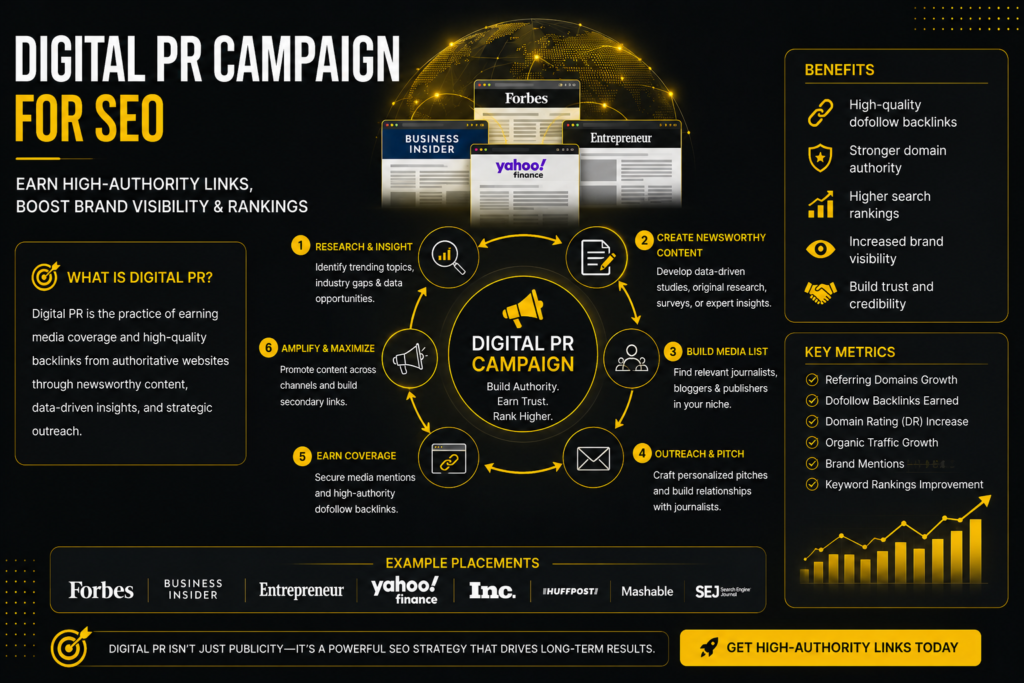
Step 1: Identify your campaign angle
Start with the publications you want links from, not with the content format. Who are the journalists that cover your industry at the DR 60+ publications you want links from? What stories have they written in the past 6 months? What data or research would provide a natural news hook for a story in their beat? Work backward from the journalist and publication to the content — not forward from content to finding publishers for it.
Step 2: Produce the asset
Whether a survey, a data analysis, a tool, or a research report — the production quality must be publishable without embarrassment. Survey data from a representative sample (300+ respondents for most purposes, 1,000+ for national claims) with clear methodology. Data analysis with transparent source attribution. Tools with actual functionality and mobile responsiveness. The asset must be strong enough that a journalist could reference it by name without their editor questioning the source quality.
Step 3: Build the media list
Identify the specific journalists and publications most likely to cover your story. Use tools like Muckrack, Cision, or manual search of publication bylines to find journalists who cover your topic area and have email addresses you can reach. Segment by tier: Tier 1 (national press, major trade publications — DR 70+), Tier 2 (established niche publications — DR 50-70), Tier 3 (blogs and regional media — DR 30-50). Target Tier 1 first; Tier 2 and 3 often cover stories that have already appeared in national press.
Step 4: Outreach and follow-up
Send personalised outreach emails — one paragraph describing the story, why it is relevant to the journalist beat, and a link to the embargo-released or published asset. The subject line is the most important element: it must communicate the news hook in under 8 words. Follow up once after 3-5 days if no response. Do not send generic mass emails — personalisation significantly increases response rate, and journalists remember lazy outreach from brands that deserve to be ignored in future campaigns.
Step 5: Monitor and collect coverage
Set up Google Alerts for your brand name, campaign asset name, and key statistics from your research. Monitor Ahrefs New Backlinks report daily for the 2 weeks following campaign launch. Collect every piece of coverage: the publication name, DR, URL, anchor text used, and whether the link is dofollow. This coverage log becomes your campaign ROI document and baseline for future campaign planning.
How to measure digital PR SEO results
Digital PR SEO results operate on a longer timeline than PBN campaigns — Trust Flow improvement and domain-level authority changes take months to manifest in Ahrefs metrics and keyword ranking data. Measure across three horizons.
Immediate metrics (weeks 1-4 post-campaign)
Number of dofollow links earned, DR range of linking publications, Trust Flow of linking publications (check in Majestic), total media reach (combined organic traffic of all linking publications), referral traffic to your site from campaign coverage (GA4 → Source/Medium → Referral), and branded search volume change (Search Console → Performance → Queries, filter for brand terms).
Medium-term metrics (months 2-4)
Domain-level Trust Flow improvement in Majestic (compare before/after campaign TF), Domain Rating change in Ahrefs, organic traffic to the campaign asset page, and keyword ranking movement on competitive head terms (Trust Flow improvements typically manifest in ranking movement on high-competition queries 2-4 months after link acquisition).
Long-term metrics (months 6-12)
Revenue attributed to improved organic rankings on head terms, branded search volume trend (sustained increase indicates entity recognition improvement), and links earned from the asset after the initial campaign outreach (evergreen assets continue earning passive links from new articles referencing the data). Compare against campaign investment for full ROI calculation — full framework in our link building ROI guide.
How to integrate digital PR into your link building strategy
Digital PR works best as a periodic, high-impact component of a broader link building strategy rather than as the sole or primary link building mechanism. Here is how to integrate it practically.
The recommended integration model
Monthly baseline: Quality PBN links (10-20 per month) for commercial page authority building and consistent velocity. This is the workhorse component that produces the week-on-week URL Rating improvements and ranking movement data. See our PBN link building strategy for the full monthly programme.
Quarterly campaigns: 1-2 digital PR campaigns per quarter designed to earn 15-50 links from DR 60+ publications. Budget: £2,000-8,000 per campaign depending on asset type (survey data is cheapest, interactive tools most expensive). Expected links if campaign succeeds: 15-50. Accept that 30-40% of campaigns will underperform and plan campaign failure into the annual budget — a campaign that earns 3 links from DR 80 publications may still contribute more Trust Flow than a campaign that earns 30 links from DR 40 blogs.
Annual investment split: For a competitive niche campaign, a reasonable annual investment might be: £18,000 on quality PBN links (150 links/year at £120 average, targeting commercial pages), £12,000 on 3-4 digital PR campaigns (Trust Flow elevation and E-E-A-T), £6,000 on niche edits for aged page authority and profile diversity. Total: £36,000/year — justified against the revenue value of page-one rankings for competitive commercial keywords, which typically produces 500-1,500% ROI over 24 months for keywords with meaningful commercial intent.
For YMYL niches (finance, health, legal) where Google specifically looks for editorial endorsement signals: increase the digital PR allocation to 40-50% of total budget and target publications with Finance, Health, or Legal Topical Trust Flow specifically. The E-E-A-T requirement in these niches makes digital PR less optional and more essential.
FAQ
What is digital PR in SEO?
Digital PR in SEO is the practice of earning editorial backlinks from authoritative publications by creating genuinely newsworthy content — original data, research, tools, or expert commentary — that journalists and editors choose to reference. Unlike paid link building, digital PR links are earned through editorial merit rather than placement fees. This distinction produces links from publications close to Majestic trusted seed sites, contributing Trust Flow and E-E-A-T signals that paid links cannot replicate.
How does digital PR help SEO?
Digital PR helps SEO in three specific ways: it contributes maximum Trust Flow per link from seed-site-adjacent publications; it produces E-E-A-T signals that editorial coverage from credible third parties sends to Google, particularly important for YMYL content; and it drives branded search volume growth that strengthens entity recognition. It cannot replace PBN links for commercial page authority building — editorial links rarely target product pages with controlled anchor text — but it provides the Trust Flow and editorial authority signals that PBN links alone cannot match.
Is digital PR better than PBN links?
Neither is categorically better — they serve different functions. Digital PR provides maximum Trust Flow and E-E-A-T signals but cannot reliably target commercial pages or deliver volume. PBN links deliver commercial page authority at volume and speed but cannot produce the seed-site-adjacent Trust Flow of national press coverage. The strongest competitive profiles combine both: PBN links for commercial page authority building (60-70% of budget) and strategic digital PR for Trust Flow elevation and editorial authority signals (20-30% of budget). Using one without the other leaves a specific gap in the link profile.
What content works best for digital PR link building?
In order of reliability for earning links: original survey data and research (journalists need sources for statistics), free tools and calculators (reference links persist indefinitely), index and tracker studies (regular data earns ongoing references), reactive expert commentary (timely quotes in news stories), and contrarian research that challenges conventional wisdom. The common thread: content that gives journalists a factual hook they can reference to improve their own articles, rather than content that primarily promotes your brand.
How much does digital PR cost for SEO?
Campaign costs vary by asset type: survey research (£800-3,000 including data collection), interactive tools or calculators (£3,000-15,000 including development), data analysis campaigns (£500-2,000), reactive PR programmes (£1,000-3,000/month for an agency or specialist). Cost per link earned depends on campaign success: a £3,000 campaign earning 30 links produces £100 per link — comparable to mid-tier PBN placement. A £3,000 campaign earning 5 links produces £600 per link — expensive, but if those links are from DR 80+ publications, the Trust Flow contribution justifies it.
Conclusion
Digital PR is the link building tactic that produces what all other methods cannot: editorial links from publications that are themselves trusted seed sites in the link graph, contributing Trust Flow at a rate that paid placements — PBN links, guest posts, niche edits — cannot match. For YMYL niches especially, where Google specifically looks for third-party editorial endorsement as an E-E-A-T signal, digital PR is less a nice-to-have and more a structural requirement for ranking at the highest competition levels.
The practical framework: use quality PBN links as the volume workhorse for consistent commercial page authority building month by month, and deploy digital PR strategically 2-4 times per year as the Trust Flow elevation mechanism. Accept that digital PR is high-variance — budget for campaign failure, celebrate campaign success, and measure over a 12-month horizon rather than expecting immediate ranking movement from individual campaign links. The combination of PBN volume and digital PR quality produces competitive profiles that are both effective and resilient to algorithm scrutiny.
Build the PBN link volume that anchors your broader link building strategy. Quality PBN backlinks — the consistent commercial page authority component that digital PR campaigns complement rather than replace. Supporting guides: Trust Flow — why digital PR links are the highest quality, guest posting SEO — the editorial middle ground, SEO link building 2026 — the complete landscape, link building ROI — measuring digital PR campaigns, complete PBN link building strategy, and our high authority backlinks guide.

Ben Davis is a seasoned SEO strategist with over a decade of hands-on experience in off page SEO, link building, and private blog network management.
He has helped 600+ agencies and professionals achieve top rankings in competitive niches including iGaming, crypto, CBD, and finance through data driven PBN strategies.