


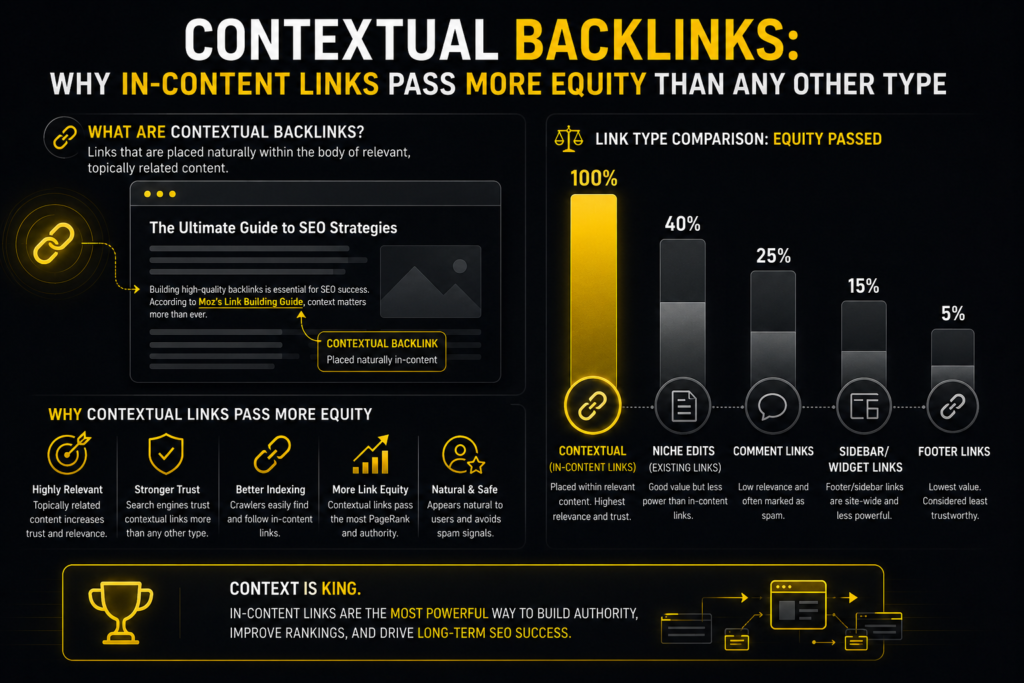
Not all backlinks are equal and the gap between a contextual backlink and a non-contextual link is larger than most SEOs account for. A contextual backlink is a dofollow link placed within the body content of a relevant article, surrounded by topically related text. This placement context the words around the link, the topic of the article, the relevance of the linking domain all combine to make contextual backlinks the most equity-efficient link type available. This guide explains what makes contextual backlinks more powerful than profile links, footer links, and sidebar links, how Google uses surrounding text to assess link relevance, how to acquire contextual backlinks through the main mechanisms in 2026, and how to verify that any paid placement is genuinely contextual.
Table of Contents
- What are contextual backlinks?
- Why contextual backlinks pass more equity
- Contextual vs non-contextual links
- How Google reads the context around a link
- How to get contextual backlinks in 2026
- Contextual backlinks in PBN link building
- How to verify a link is genuinely contextual
- FAQ
- Conclusion
Key Takeaways
- A contextual backlink is a dofollow link placed within the body content of a relevant article, surrounded by topically related text Google can use to assess link relevance and equity quality.
- Google uses the text surrounding a link — the anchor context, paragraph topic, overall article topic, and linking domain niche — to determine both the relevance signal and quality of equity transfer.
- Contextual backlinks consistently outperform non-contextual links of equivalent domain authority because the relevance context amplifies the equity contribution beyond raw PageRank transfer.
- The two primary sources of genuine contextual backlinks in 2026: quality PBN links (article written specifically to provide contextual relevance) and niche edits on aged editorial pages (insertion fitting naturally within existing topically relevant content).
- A forced contextual link — where article topic is unrelated to the linked page — provides neither the relevance signal nor the quality equity of a genuinely contextual placement.
What are contextual backlinks?
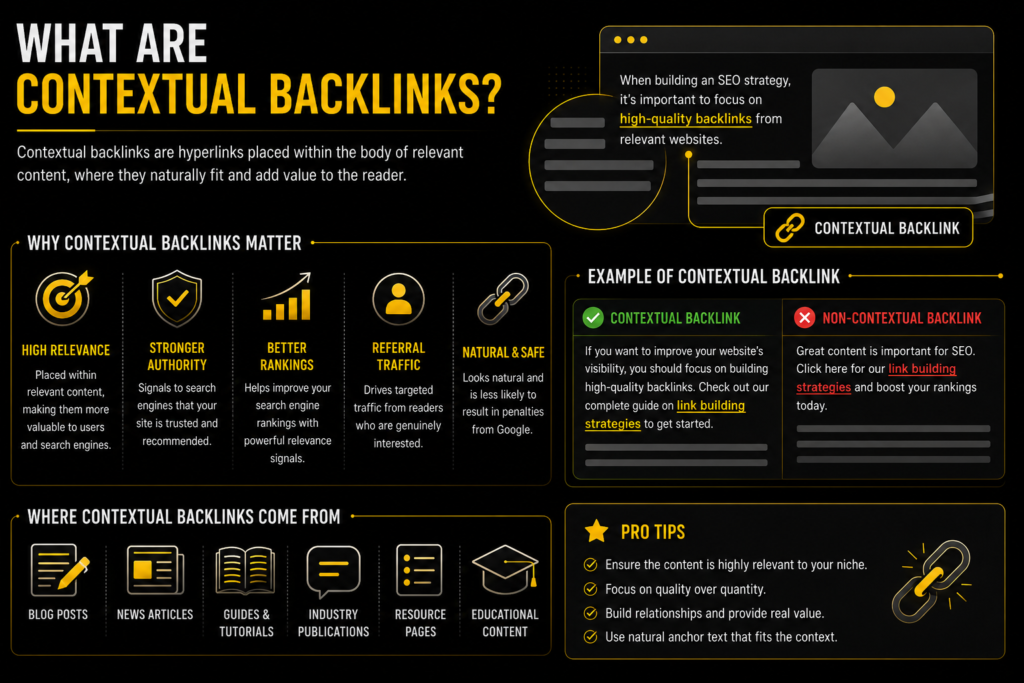
A contextual backlink is a hyperlink embedded within the body text of a relevant article or web page — surrounded by topically related content that provides meaningful context for both the linked page and the link placement itself. The defining characteristics are: the link is placed in article body content (not a footer, sidebar, profile, or navigation), the surrounding text is topically relevant to the linked page, and the link placement reads naturally within the flow of the article rather than being obviously inserted for SEO purposes.
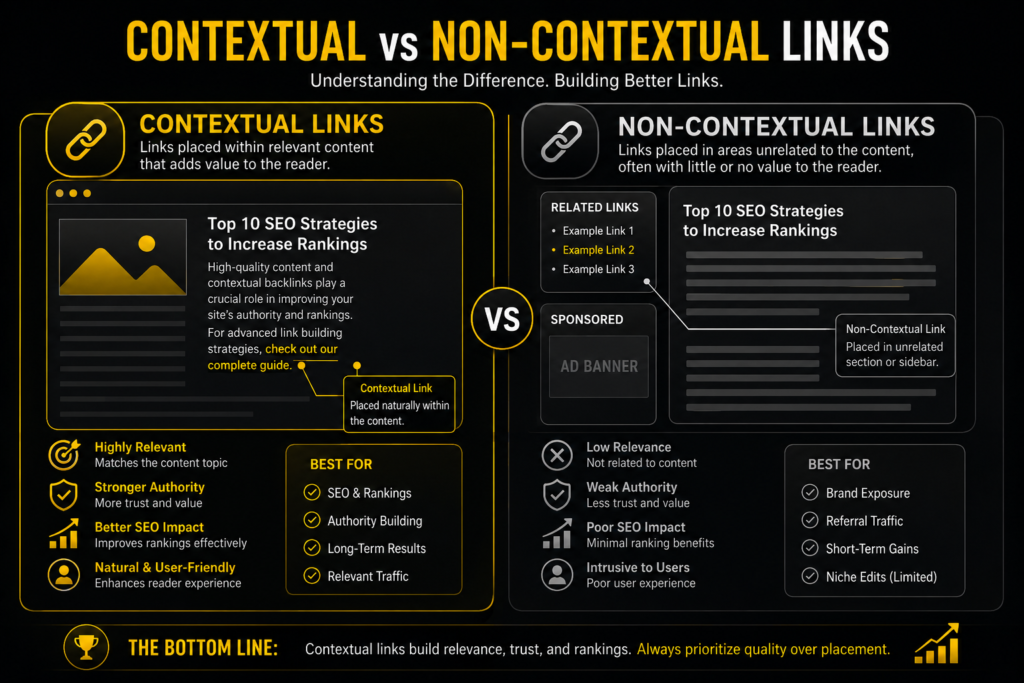
Contrast this with non-contextual link types: a profile link in a website URL field on LinkedIn sits in a form field with no surrounding text; a footer link appears below page content in a sitewide location; a sidebar widget link appears next to unrelated content; a blog roll link lists URLs without topical context. All of these may pass some PageRank, but none provide the topical relevance signal that accompanies a well-placed contextual backlink.
Examples of contextual backlinks in practice: a fitness blog article about marathon training that naturally references “using a quality running shoe comparison tool to find the right footwear” — the link sits inside a relevant article, surrounded by relevant text, on a relevant domain. A finance blog article about investment strategies that references “comparing brokers using an investment platform comparison” — again, contextually placed within relevant content on a relevant domain.
Why contextual backlinks pass more equity
The additional equity contribution of contextual backlinks over non-contextual links stems from two mechanisms that operate simultaneously.
Mechanism 1: Topical relevance amplification
Google does not treat all links as equally relevant. A link from a page discussing running shoes to a running shoe comparison site carries more topical relevance signal than a link from a cooking site to the same running shoe comparison site — even if both pages have identical URL Ratings. The topical relevance context tells Google that the linking source and the linked destination are conceptually related, which strengthens the authority transfer signal beyond what raw PageRank would produce.
This is why Topical Trust Flow (covered in our Trust Flow guide) is a more useful metric than generic DR for link quality assessment. A domain with Sports Topical Trust Flow of 22 passing a link to a sports betting site is passing topically amplified equity. A generic DR 50 domain with no topical relevance is passing only the base PageRank without the relevance multiplier.
Mechanism 2: Anchor context signals
Google reads not just the anchor text of a link but the surrounding text — the words and sentences immediately before and after the link. This surrounding context helps Google understand what the linked page is about and validates or contextualises the anchor text signal. A link with anchor text “project management software” surrounded by a paragraph discussing team productivity tools reinforces the relevance signal. The same anchor text appearing in a paragraph discussing cooking recipes would send conflicting signals.
This anchor context mechanism is one reason why exact match anchor text in contextually relevant body content is less risky than the same anchor text in an isolated profile link. The contextual environment provides the natural editorial framing that makes the anchor text plausible as a genuine editorial reference rather than a keyword-stuffed manipulation signal.
Contextual vs non-contextual links: the comparison
| Link type | Placement | Topical context | Equity passed | Relevance signal | Best strategic use |
|---|---|---|---|---|---|
| Contextual body link | Article body content | Strong — topically relevant text surrounds link | High | Strong | Primary link building — Tier 1 PBN and niche edits |
| Profile link | Website URL field | None — isolated field | Low-moderate | Minimal | Brand presence, Tier 2 diversity |
| Footer link | Sitewide footer | None — template placement | Very low (diluted sitewide) | Minimal | Avoid for link building |
| Sidebar widget link | Sitewide sidebar | None — template placement | Very low (diluted sitewide) | Minimal | Avoid for link building |
| Comment link | Comment section | Partial — if comment is topically relevant | Low (usually nofollow) | Low | Brand mention only |
| Author bio link | Post author section | Minimal — not within article content | Low-moderate | Low | Brand presence only |
The equity advantage of contextual body links compounds with topical relevance — a contextual link on a highly relevant page passes more equity than the same link on an unrelated page, even if the URL Ratings are identical. For the equity mechanics, see our backlink equity guide and link juice guide.
How Google reads the context around a link
Google uses several contextual signals around a link to determine its relevance and quality. Understanding these signals helps you write better contextual placements and evaluate whether purchased contextual links are genuinely contextual.
Signal 1: Surrounding anchor context (the local window)
Google reads approximately 50-100 words around each link — the sentences immediately before and after the anchor text. This local window provides the immediate context for the link: what is being discussed at the moment the link appears, and does it relate logically to the linked page? A good contextual placement has these words naturally discussing the topic of the linked page before and after the link appears.
Signal 2: Article-level topic relevance
Beyond the immediate anchor context, Google assesses the overall topic of the article containing the link. An article clearly about “best practices for marathon training” is topically coherent with a link to a running equipment review site. An article about “10 tips for home improvement” is topically incoherent with the same running equipment link — even if the immediate anchor context reads plausibly. The article-level topic must be relevant to the linked page for full contextual signal transfer.
Signal 3: Domain topical authority
The topical category of the entire linking domain provides the broadest context signal. A running-focused blog domain hosting an article about marathon training linking to a running equipment site sends three layers of aligned topical context: domain level (running niche), article level (marathon training topic), anchor context level (footwear discussion). Each layer reinforces the same topical relevance signal, amplifying the equity transfer beyond what any single signal alone would produce.
How to verify a link is genuinely contextual
Not every link sold as contextual is genuinely contextual. Four checks verify true contextual placement before paying.
Check 1: Is the link in the article body? View page source and find your domain. Is the link within paragraph tags inside the main content area, or is it in a widget, sidebar, footer, or author bio?
Check 2: Does the surrounding text relate to your linked page? Read 100 words before and after your link. Does the surrounding text discuss topics relevant to the page you are linking to? A forced contextual link appears in a sentence that awkwardly inserts a commercial keyword with no topical connection.
Check 3: Is the article topic relevant? Read the article title and introduction. Is the overall article about a topic that a reader of your linked page would also find relevant? Article-level topic match is the second layer of contextual relevance.
Check 4: Does the domain niche match? Check the domain Topical Trust Flow category in Majestic. For maximum contextual equity, the domain niche should align with both the article topic and your linked page topic. See our Trust Flow guide for Topical TF verification.
FAQ
What are contextual backlinks?
Contextual backlinks are dofollow links placed within the body content of a relevant article, surrounded by topically related text. They are the most equity-efficient link type because the topical context amplifies the PageRank signal beyond what the raw URL Rating of the linking page would produce in isolation. Contextual placement in relevant articles distinguishes quality PBN links and niche edits from profile links, footer links, and directory citations.
Why are contextual backlinks better than other link types?
Two reasons. First, they pass more equity per link because the topical relevance context amplifies the PageRank transfer — Google weights links from topically relevant content more heavily than links from topically unrelated sources of identical authority. Second, they provide anchor context signals — the words surrounding the link help Google understand what the linked page is about, strengthening the relevance signal beyond what the anchor text alone communicates.
What makes a PBN link contextual?
A PBN link is contextual when: the article it appears in is topically relevant to the linked page, the link appears within the article body content rather than in a bio or footer, the 100 words surrounding the link discuss topics related to the linked page, and the link placement reads naturally within the article narrative. PBN article about “choosing CRM software for small businesses” with a contextual link to a CRM comparison page is a genuinely contextual placement. A PBN article about an unrelated topic with a forced keyword link to the same CRM page is not.
Are niche edits contextual backlinks?
Yes — when done correctly, niche edits are among the strongest contextual backlinks available because they insert your link into pre-existing editorial content that was written organically about a relevant topic. The existing article provides genuine editorial context that a purpose-built PBN article must construct from scratch. The requirement is that the inserted link fits naturally within the surrounding text — forced insertions into unrelated content are not genuinely contextual regardless of the editorial history of the linking page. See our niche edits guide.
How do contextual backlinks affect anchor text strategy?
Contextual placement makes anchor text safer and more effective simultaneously. Safer because the surrounding relevant text provides natural editorial context that makes even partial match commercial anchors look less like manipulation. More effective because the anchor text signal is reinforced by the surrounding content — a commercial anchor in a contextually relevant article sends a stronger relevance signal to Google than the same anchor in an isolated profile field. This is why all quality PBN and niche edit placements should be contextual — it is the foundation of effective anchor text strategy. See our anchor text strategy guide.
Conclusion
Contextual backlinks are the highest-quality link type available for one fundamental reason: they combine PageRank transfer with topical relevance signals in a way that non-contextual links cannot replicate. The domain niche, article topic, and surrounding anchor context together send a coordinated relevance signal that amplifies the equity contribution of each link beyond its raw URL Rating would suggest.
For practical link building in 2026, “contextual” is not a marketing label — it is a specific technical requirement that should be verified before accepting any link placement. Every quality PBN placement, every niche edit, and every guest post should pass the four contextual verification checks: link in article body, topically relevant surrounding text, article-level topic match, and domain niche alignment. Placements that fail these checks are not contextual backlinks — they are profile-equivalent links with article-format wrappers.
Every PBN placement is contextual by specification — article topic matched to your linked page, link in article body, surrounding text topically aligned. Quality contextual PBN backlinks. Supporting guides: backlink equity — why context amplifies equity, niche edits — contextual links on aged pages, Trust Flow and topical relevance, anchor text strategy for contextual placements, complete PBN link building strategy.

Ben Davis is a seasoned SEO strategist with over a decade of hands-on experience in off page SEO, link building, and private blog network management.
He has helped 600+ agencies and professionals achieve top rankings in competitive niches including iGaming, crypto, CBD, and finance through data driven PBN strategies.