


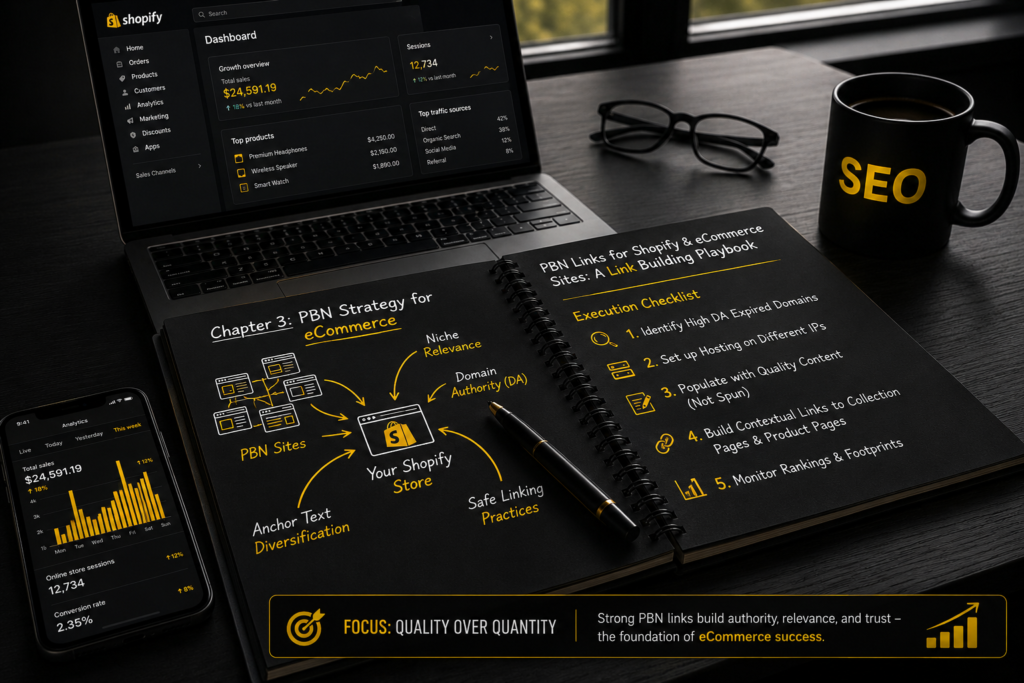
Ecommerce link building has a problem that most SEO guides dance around: the pages that generate revenue — collection pages like “women’s running shoes” and “organic skincare products” — are nearly impossible to build editorial links to at the volume needed to compete. Journalists and bloggers link to content. They rarely link directly to product category pages. This creates a persistent gap between where ecommerce businesses invest their SEO budget and where the commercial value actually sits. This guide is the complete playbook for using
PBN links for ecommerce to solve that problem — specifically on Shopify and Shopify Plus stores. It covers Shopify’s unique URL structure and the technical issues that limit ranking authority, why collection pages are the highest-value PBN link targets in any ecommerce store, how to structure internal links to amplify every PBN link placed, and the specific execution discipline that separates ecommerce PBN campaigns that produce durable rankings from those that waste budget on pages that will not benefit regardless of how many links are built.
Table of Contents
- Introduction: the ecommerce link building gap
- Shopify website SEO: the structural foundation before you build links
- The three page types in ecommerce and which deserve PBN links
- Why collection pages are your highest-value PBN link targets
- Internal linking structure that amplifies PBN link power
- PBN link execution for ecommerce
- FAQ
- Conclusion
Key Takeaways
- The fundamental ecommerce link building problem is that product and collection pages cannot be linked to editorially at the volume and velocity that competitive commercial keywords require.
- Collection pages are the highest-value PBN link targets in any Shopify store — they target category-level keywords with high commercial intent and funnel all downstream traffic to revenue-generating product pages.
- Before building a single PBN link, Shopify stores must fix the duplicate URL problem from the /collections/products/ structure — otherwise link equity splits across multiple URLs.
- Internal linking is the highest-leverage free SEO action available to Shopify stores — URLs with 40–44 internal links receive four times more traffic than those with 0–4.
- The correct PBN targeting sequence: collection pages first, top-selling product pages second, blog content that internally links to collection pages third.
Introduction: the ecommerce link building gap
Most ecommerce SEO guides recommend the same link building approach: create helpful content, earn editorial links through outreach, and let those links build authority that flows through internal linking to product and collection pages. This approach is theoretically sound and practically insufficient for most stores competing in established product categories.
The problem is the editorial link gap. Journalists and bloggers link to content — guides, research, tools, original data. They do not link to “Women’s Running Shoes — Shop Now” category pages. The pages that matter most for ecommerce revenue are structurally incompatible with the editorial link earning model that SEO guides recommend.
PBN links for ecommerce solve this gap by placing links directly on the pages that generate revenue — collection pages, category pages, and high-value product pages. For a full overview of how PBN links work, see our complete PBN links guide. For Shopify stores specifically, there is an additional layer: Shopify’s default URL structure creates technical issues that can silently split link equity and reduce the effectiveness of every link built, PBN or otherwise. Understanding and fixing these structural issues is the prerequisite that determines whether your PBN investment actually reaches the pages it is intended for.
Shopify website SEO: the structural foundation before you build links
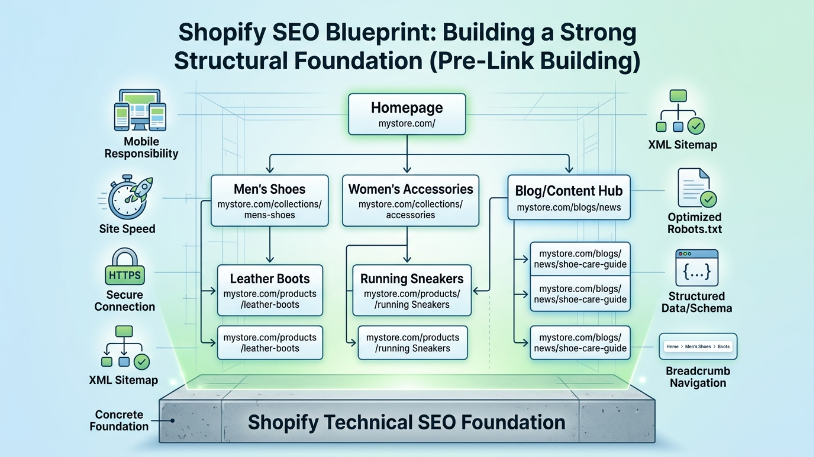
Understanding shopify website seo is essential before building any links because Shopify’s platform architecture creates specific issues that can split or waste link equity if not addressed. Building PBN links to a Shopify store with unresolved structural issues is like filling a bucket with holes.
The duplicate URL problem in Shopify
Shopify generates two valid URLs for every product page: the canonical product URL (yourstore.com/products/running-shoe-model) and the collection-nested URL (yourstore.com/collections/running-shoes/products/running-shoe-model). Both URLs are technically live and both can be indexed by Google. When your internal links or PBN links point to the collection-nested URL rather than the canonical product URL, link equity is split across two versions of the same page.
The practical rule for PBN link building: Always specify the canonical product URL format (/products/product-slug) when ordering PBN links to product pages — never the collection-nested format. For collection pages themselves, a single /collections/collection-slug URL exists with no duplication issue.
Collection page thin content
Almost every Shopify store does collections poorly. They are auto-generated pages with auto-generated titles, default content, and default URLs. Collection pages need descriptive copy — minimum 150–300 words of keyword-relevant content in the collection description field — before PBN links are built to them. A PBN link pointing to a collection page with no description text is pointing to a thin page that will struggle to rank regardless of referring domain count.
How to set up SEO for Shopify: the pre-link checklist
Before any link building campaign, run through this Shopify-specific SEO checklist: (1) verify product page canonical tags point to /products/ URLs not /collections/products/ URLs; (2) add 150–300 words of keyword-relevant descriptive copy to every target collection page; (3) set custom meta titles including target keyword in the first 60 characters; (4) link collection pages from homepage navigation and from relevant blog posts; (5) submit yourstore.com/sitemap.xml to Google Search Console and verify target collection pages are indexed; (6) ensure target collection pages are reachable within 2–3 clicks from the homepage.
The three page types in ecommerce and which deserve PBN links
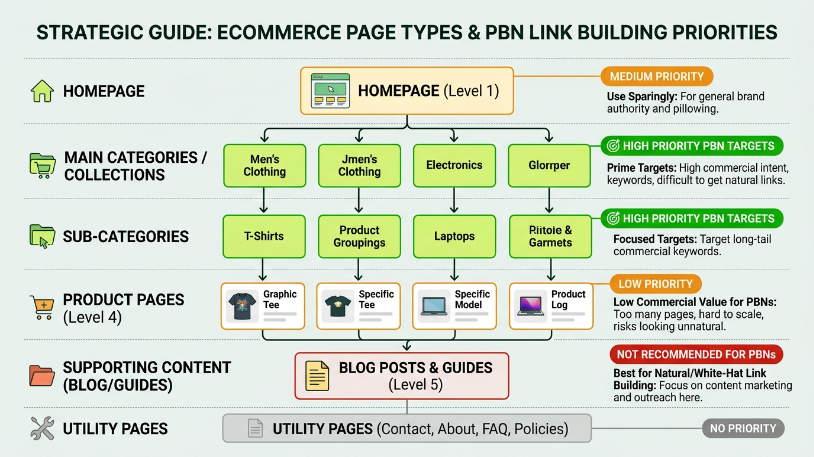
Collection pages — the money pages (primary target)
Collection pages at /collections/collection-slug target category-level keywords — “women’s running shoes,” “organic skincare for dry skin,” “handmade leather wallets” — that combine high commercial intent with significant search volume. A well-optimised collection page ranks for dozens of keyword variations simultaneously and funnels all downstream traffic to revenue-generating product pages. Collection pages are the primary PBN link target for every Shopify store. They have stable URLs that do not change with inventory updates and distribute authority to all product pages within them through collection grid links.
Product pages — selective targeting only
Product pages at /products/product-slug are appropriate PBN targets only for high-average-order-value products with stable, long-term inventory and flagship products representing primary revenue lines. Do not build PBN links to product pages that are likely to go out of stock or be discontinued within 12 months — you will lose the link equity when the page is removed or redirected.
Blog posts — link building intermediaries
Blog posts cannot be monetised directly but serve a critical role: they can receive PBN links, build topical authority, and internally link to collection pages — passing equity downstream to revenue pages without requiring direct PBN links to every collection. This indirect approach is particularly valuable for new Shopify stores — building PBN links to buying guides that internally link to collections creates a more natural-looking link acquisition pattern than building links directly to commercial collection pages from day one.
Why collection pages are your highest-value PBN link targets
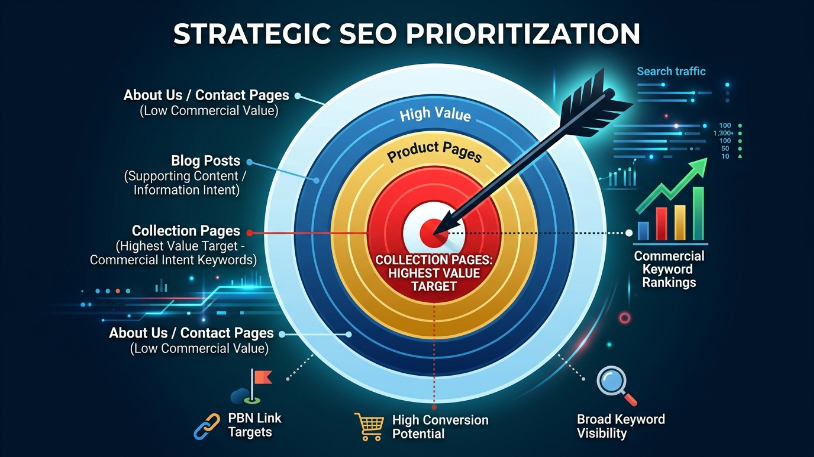
The commercial logic for targeting collection pages with PBN links is simple: a single collection page ranking on page one for its target keyword sends traffic to every product within the collection simultaneously. Consider a running shoe retailer. Their /collections/womens-running-shoes collection page contains 48 products across 12 brands. A top-3 ranking for “women’s running shoes” drives qualified, commercial-intent traffic to all 48 product pages simultaneously. The return on link investment is therefore dramatically higher than an equivalent investment in individual product page links.
Collection pages and keyword breadth
A well-structured collection page naturally ranks for dozens of keyword variations beyond its primary target. A collection page titled “Women’s Running Shoes” with relevant descriptive copy will appear in rankings for: “women’s running shoes,” “best running shoes for women,” “women’s trail running shoes,” “women’s road running shoes,” “running shoes women UK,” and brand-specific queries for the brands stocked. PBN links that build authority on this page create ranking uplift across the entire keyword cluster.
Sub-collections: the long-tail multiplier
Once a parent collection page has sufficient PBN-built authority, internal links from that collection to sub-collections distribute equity downstream, enabling sub-collection pages to rank for more specific long-tail terms without requiring their own dedicated PBN campaigns. Build PBN links to parent collection → parent internally links to sub-collections → sub-collections inherit equity and rank for long-tail variants → sub-collections link to individual product pages. PBN investment in 3–5 parent collection pages generates ranking impact across hundreds of product pages through this internal linking hierarchy. Our backlink equity guide explains the equity flow mechanics in detail.
Internal linking structure that amplifies PBN link power
Internal linking is the mechanism by which external PBN links create ranking impact across your store rather than just on the specific page the link points to. Most Shopify stores significantly underinvest in internal linking — product pages are isolated, blog posts exist in a separate silo with no connections to products, and collection pages link only to the products they contain. The result is a fragmented site where authority concentrates on the homepage instead of flowing to commercially valuable pages. URLs with 40–44 internal links receive four times more traffic than those with 0–4. A correct internal link structure amplifies every external PBN link placed.
Layer 1: Homepage to collection pages
Every primary collection page should receive a direct internal link from the homepage — either through the main navigation or through a featured collections section. Check your homepage internal links using Screaming Frog or Ahrefs Site Audit. If your Refund Policy or Contact page receives more homepage links than your highest-revenue collection pages, you have the most common Shopify internal linking problem — fix navigation and footer links to prioritise commercial collection pages over administrative pages.
Layer 2: Blog posts to collection pages
Every buying guide, category comparison, or product review published on your Shopify blog should include contextual internal links to at least 2–3 collection pages. These are the links that justify building PBN links to blog posts — each blog post that receives a PBN link becomes an internal linking hub that distributes equity to multiple collection pages simultaneously. A blog post titled “How to Choose Running Shoes for Flat Feet” receives a PBN link, then internally links to /collections/stability-running-shoes, /collections/motion-control-shoes, and /collections/running-insoles. Each collection page receives equity from the blog post without requiring its own separate PBN link.
Layer 3: Collection pages to sub-collections and related collections
Collection page description copy should include contextual links to 2–4 related or sub-collections. A women’s running shoes collection should link to: trail running shoes, road running shoes, running socks, and running accessories. This creates lateral equity distribution that builds ranking authority across the product range from a single PBN investment.
Layer 4: Product pages to parent collections and related products
Each product page should contain: a contextual link back to its parent collection (reinforcing collection topical authority), 3–5 related product links to other products in the same collection (distributing equity laterally), and links to relevant buying guides in the blog. Always link to the canonical /products/product-slug format — never the /collections/category/products/product-slug format — to focus equity on the page you want ranking. Our anchor text guide covers the internal vs external anchor text ratio distinctions in detail.
PBN link execution for ecommerce
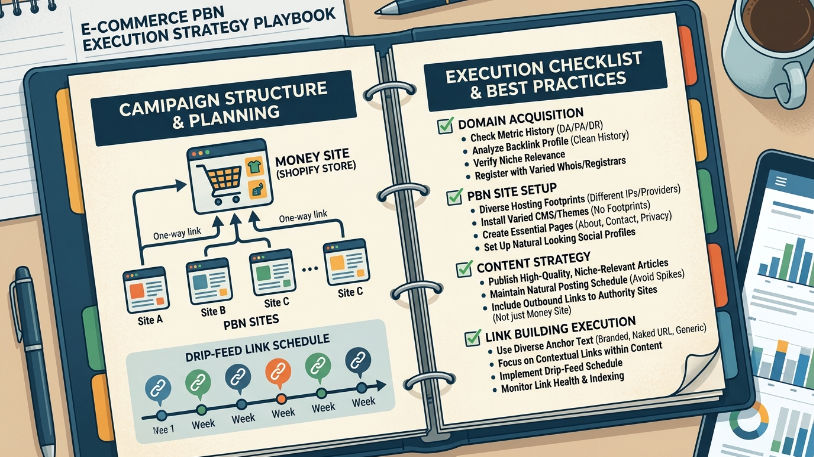
Phase 1: Fix structure and internal linking (weeks 1–3)
Complete the Shopify pre-link checklist from Section 2. Implement the four-layer internal linking framework. Do not begin PBN link building during this phase — allow 2–3 weeks for Google to re-crawl and process the structural improvements. Internal linking improvements alone often produce measurable ranking movement before any external links are built.
Phase 2: Blog content links (weeks 4–8)
Build the first PBN links to blog posts that internally link to collection pages. This is the most conservative entry strategy — editorial links to content are expected, it builds topical authority, and passes equity to collection pages through internal links. PBN link volume: 5–10 links per blog post across 2–3 key buying guides. Use informational anchor text (“running shoe selection guide,” “how to choose trail running shoes”) rather than commercial anchor text on blog post PBN links. For how long to expect before seeing results, see our ranking timeline guide.
Phase 3: Collection page direct links (weeks 8–16)
Once blog content links are indexed and internal equity has been flowing for 6–8 weeks, begin direct PBN link building to the top 3–5 collection pages by revenue priority.
| Market competition | Referring domain target | Monthly PBN build rate | Timeline |
|---|---|---|---|
| Low (top pages: 10–30 RDs) | 30–50 RDs | 5–10 links/month | 3–5 months |
| Medium (top pages: 50–150 RDs) | 100–150 RDs | 10–20 links/month | 5–8 months |
| High (top pages: 150–400 RDs) | 200–400 RDs | 15–30 links/month | 8–14 months |
Anchor text for collection page PBN links: 5–8% exact match commercial anchors, 20–25% partial match with descriptive modifiers, 15–20% branded, 50–60% generic and naked URLs — following the safe distribution in our anchor text strategy guide.
Phase 4: High-value product pages (ongoing)
After collection pages are showing consistent ranking improvement, allocate 20–30% of monthly PBN budget to flagship product pages — stable, high-AOV SKUs representing core revenue lines unlikely to be discontinued. Use specific long-tail partial match anchors: “[specific product name] review,” “[product] buy UK,” “[brand] [product model]” rather than broad category keywords, which are better targeted at collection level.
Domain selection for ecommerce PBN campaigns
PBN domains for ecommerce should have content histories in the product category’s adjacent lifestyle niches. A running shoe collection page benefits most from sports, fitness, outdoor activity, and health lifestyle domains — not generic authority blogs or unrelated niches. Topically relevant domains pass stronger authority than high-DR generic domains. See our PBN networks and domain selection guide for the full domain evaluation framework.
FAQ
What is the best SEO for Shopify websites in 2026?
The most impactful Shopify SEO actions follow a priority sequence. First, fix the technical foundation: canonical tags for the /collections/products/ duplicate URL issue, collection page descriptions with target keywords, clean sitemap submission to Google Search Console. Second, implement a strategic internal linking structure — homepage to collections, blog posts to collections, products back to collections. Third, build external links prioritising collection pages over product pages, starting with blog content links before direct commercial page links. PBN links accelerate this timeline significantly for stores in competitive product categories where organic editorial link building cannot deliver the referring domain count needed within a commercial timeline.
How do I set up SEO for Shopify collection pages?
Setting up SEO for Shopify collection pages involves five steps. In the Shopify admin under Collections, set a descriptive H1 title including your target keyword — “Women’s Running Shoes” not “Shop Shoes.” Write 150–300 words of keyword-rich descriptive copy in the collection description field. Set a custom meta title under 60 characters and meta description under 155 characters in the SEO section. Ensure the collection URL slug is clean and descriptive. Finally, link to the collection from the homepage navigation and from relevant blog posts to build internal link authority before adding external links.
Should I build PBN links to product pages or collection pages on Shopify?
Collection pages first, always. Collection pages target broader commercial keywords with higher search volume, rank for dozens of product variant queries simultaneously, and distribute authority to all products within them through collection grid links. A single well-ranked collection page produces revenue impact across an entire product range. Build PBN links to product pages only for stable, high-AOV flagship products that will remain in your catalogue long-term.
How many PBN links does a Shopify store need to rank its collection pages?
Check the average referring domain count of the top 5 pages ranking for your collection’s target keyword in Ahrefs. Your goal is to reach approximately 70–80% of that count. For low-competition niche product categories, 20–50 referring domains may be sufficient. For highly competitive categories in established markets, top-ranking collection pages may have 200–500+ referring domains. Start with a referring domain audit before committing link budget.
Does Shopify’s platform affect PBN link equity?
Yes — Shopify’s duplicate URL structure can split the equity value of PBN links if links are placed to the wrong URL format. Always specify the canonical /products/product-slug format for product page PBN links, not the /collections/category/products/product-slug format. For collection pages the /collections/collection-slug format has no duplication issue. Ensure canonical tags are correctly configured site-wide before building links so every link’s equity consolidates on the intended canonical URL.
Conclusion
The ecommerce link building gap is not a problem that better content or more outreach emails will solve. It is structural — the pages that generate revenue in ecommerce are not the pages that attract editorial links, and no amount of content marketing changes that fundamental incompatibility.
PBN links for ecommerce close this gap by placing authority directly on collection pages — the category-level hubs that rank for high-volume commercial keywords and distribute equity to every product within them. Fix Shopify’s structural issues first, implement the four-layer internal linking framework second, build PBN links to blog content before building to collection pages directly, then scale collection page link building according to competitive referring domain targets. The internal linking structure you build before touching external links determines how efficiently every PBN link’s equity is used once placed.
Ready to build collection page authority? Start with PBN backlinks for ecommerce at SEO PBN Backlinks. Then deepen your strategy with our complete PBN SEO guide, our backlink equity framework, our anchor text strategy for ecommerce, our guide on how long PBN links take to rank, our white hat vs grey hat SEO breakdown, and our PBN links for affiliate sites guide, and our white label link building guide for agencies.

Ben Davis is a seasoned SEO strategist with over a decade of hands-on experience in off page SEO, link building, and private blog network management.
He has helped 600+ agencies and professionals achieve top rankings in competitive niches including iGaming, crypto, CBD, and finance through data driven PBN strategies.