


Second tier link building is the most underused leverage point in PBN campaigns. Most practitioners focus entirely on Tier 1 — placing PBN links directly on money site target pages — and never invest in the supporting infrastructure that would multiply the authority each of those Tier 1 links passes. This guide explains the mechanics of tiered link building in precise, practical terms: what the tiers mean, how authority flows between them, which link sources produce the highest Tier 2 ROI, what elements of Tier 2 are safe to automate versus what requires quality control, and how to measure whether the tiered structure is actually amplifying Tier 1 effectiveness. This is advanced link building — written for practitioners already running PBN campaigns who want to get more out of them.
Table of Contents
- Introduction: why most PBN campaigns underperform their potential
- Tiered link building explained: the mechanics
- Tier 1 vs Tier 2: what each layer does and why
- Best sources for Tier 2 links
- What to automate at Tier 2 without risking Tier 1
- Building your backlink network structure
- Measuring whether Tier 2 is working
- FAQ
- Conclusion
Key Takeaways
- Second tier link building works by boosting the URL Rating of PBN article pages — higher UR on the linking page means more equity passed to the money site without requiring additional Tier 1 links.
- The mathematics are stark: a Tier 1 PBN article page boosted from UR 5 to UR 25 through Tier 2 links passes approximately 5× more equity to the money site.
- Best Tier 2 sources: secondary PBN links, contextual Web 2.0 posts, citation directories, social bookmarks, niche forum profiles, and Q&A platforms — all pointing to Tier 1 article pages, never to the money site.
- Automation is safe at Tier 2 for social bookmarks, citation building, and Web 2.0 profile creation — even if detected, they cannot create a manual action on the money site because they do not point to it.
- The measurement method: check URL Rating of each Tier 1 article page weekly in Ahrefs after deploying Tier 2 — UR improvement is the leading indicator, followed by money site ranking movement 6–10 weeks after Tier 1 deployment.
Introduction: why most PBN campaigns underperform their potential
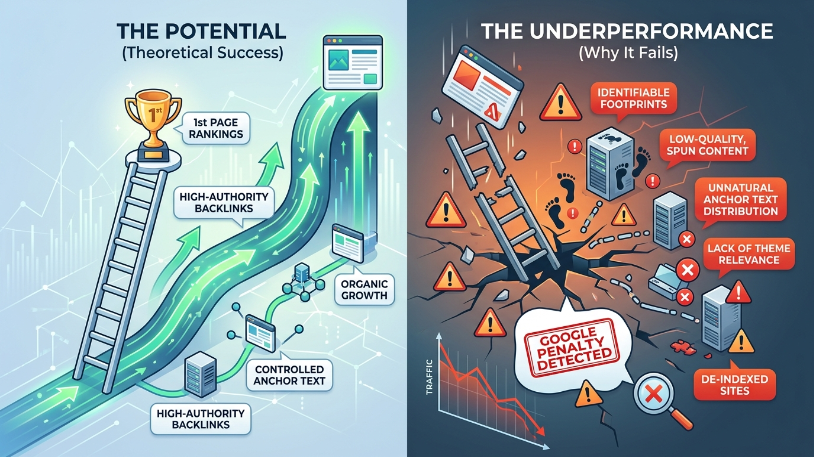
A PBN link value to your money site is not fixed at the moment of placement. It is determined by the URL Rating of the specific article page carrying the link — and that URL Rating can be actively improved after placement, without touching the money site at all.
This is the fundamental insight behind second tier link building: instead of asking “how do I build more links to my money site?”, you ask “how do I make my existing Tier 1 links pass more authority?” The answer is building links to the pages that link to you — your Tier 1 PBN article pages — thereby increasing their authority before it reaches your money site.
Most PBN linkbuilding campaigns treat Tier 1 placements as complete deliverables. The link goes live, indexes, and the campaign moves on. This leaves the majority of potential authority amplification on the table. A well-maintained Tier 2 structure can effectively double or triple the ranking impact of a fixed number of Tier 1 links. This guide assumes you are already running Tier 1 campaigns. If you are unfamiliar with how PBN links work or how backlink equity flows, start with our PBN links guide and backlink equity guide first.
Tiered link building explained: the mechanics
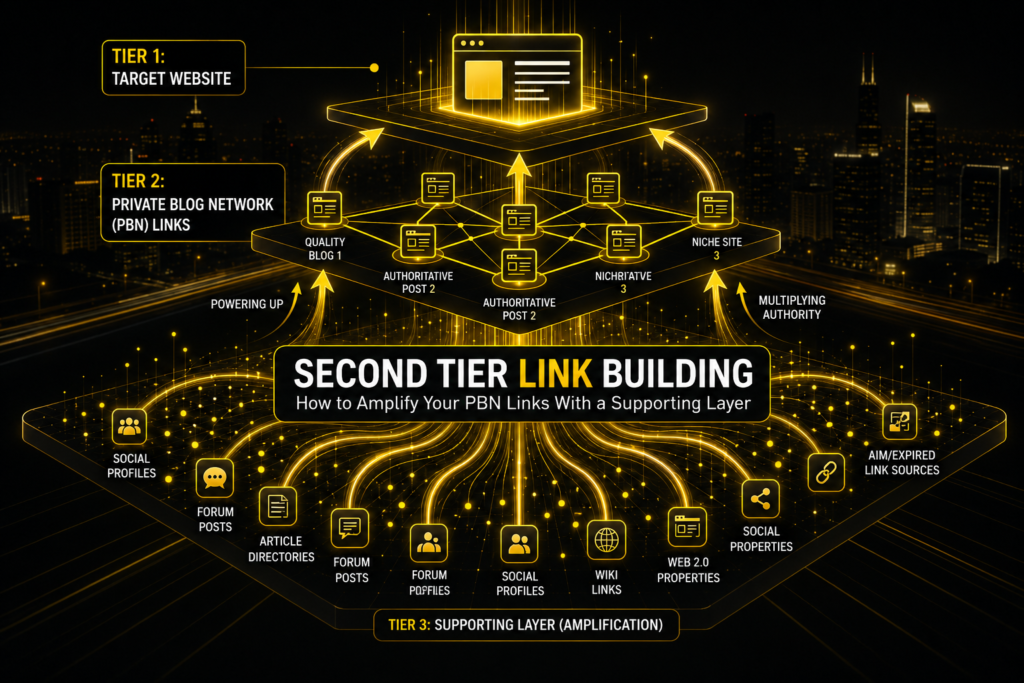
Tiered link building is an authority amplification structure, not simply a link quantity strategy. The three levels:
The money site: Your target website. Receives links from Tier 1 sources only.
Tier 1 (direct to money site): High-quality PBN links, editorial outreach links, and other authority-carrying links pointing directly to money site target pages. Every link at this level directly contributes to the money site authority. Full quality requirements from our complete PBN SEO guide apply without exception.
Tier 2 (pointing to Tier 1 pages): A supporting layer of links pointing to the Tier 1 article pages — not to the money site. These links boost the URL Rating of each Tier 1 article page, which increases the equity that page passes to the money site on every subsequent crawl cycle.
Tier 3 (optional, pointing to Tier 2): A lower-quality, higher-volume layer pointing to Tier 2 properties to maintain their activity signals. Largely automated, minimal quality requirements.
Why the mathematics favour tiered structures
When you add 10 more Tier 1 links, you increase equity flowing to the money site linearly — 10 more link contributions. When you boost the URL Rating of existing Tier 1 pages through Tier 2 links, every Tier 1 page passes more equity simultaneously — a multiplicative effect across your entire existing Tier 1 profile.
Concrete example: A Tier 1 PBN article page with UR 8 carries 1 outbound link to your money site. Build 15 Tier 2 links to this article page, boosting its UR from 8 to 22. The same article now passes approximately 2.5–3× more equity to your money site — without building a single new Tier 1 link. Repeat this across 10 Tier 1 article pages and the cumulative equity increase is equivalent to building 15–25 new Tier 1 links at a fraction of the cost.
Tier 1 vs Tier 2: what each layer does and why
Tier 1: the authority layer
Function: Passes authority directly to the money site. Every Tier 1 link directly affects your money site referring domain count, URL Rating, and keyword relevance signals. Quality requirements: Maximum — every quality failure at Tier 1 creates a risk directly attributed to the money site. Anchor text: Precisely controlled per the safe distribution from our anchor text strategy guide: 5–8% exact match maximum, heavy on branded and generic. Risk profile: High consequence. A quality failure at Tier 1 can trigger a manual action or algorithmic suppression directly on the money site — see our Google penalties guide for the full risk framework.
Tier 2: the amplification layer
Function: Passes authority to Tier 1 article pages, which then pass amplified authority downstream to the money site. Tier 2 links do not point to the money site and therefore cannot directly trigger penalties on it. Quality requirements: Moderate — sufficient quality to be indexed and contribute UR to Tier 1 pages, but not the same domain quality as Tier 1. Anchor text: Points to Tier 1 article pages, not the money site. Use the Tier 1 article URL, article title, or domain name — commercial money site keyword anchors at Tier 2 are unnecessary. Risk profile: Low consequence — even if Google discounts Tier 2 links, the worst case is that Tier 1 pages do not receive the UR boost.
The critical boundary rule
Tier 2 links must never point to the money site. This is the non-negotiable rule of tiered link building. Any link that reaches the money site is a Tier 1 link by definition and must meet Tier 1 quality standards. If you accidentally allow Tier 2 links to point to the money site, you are building bulk low-quality links directly to it — the opposite of what tiered strategy intends.
Best sources for Tier 2 links
Source 1: Secondary PBN links
The highest-quality Tier 2 source. A secondary PBN link from a separate network pointing to the Tier 1 article page passes real authority. Use secondary PBN links for your most important Tier 1 pages — the 3–5 article pages carrying links to your most commercially valuable money site target pages.
Source 2: Contextual Web 2.0 posts
Medium and long-form content published on Web 2.0 platforms — WordPress.com, Blogger, Medium, Tumblr, Weebly — that includes a contextual link to the Tier 1 article page. These platforms have meaningful base DR from their root domain authority. Web 2.0 posts work best when the content is topically related to the Tier 1 article topic and the link placement is contextually natural. Target 400–600 words per post.
Source 3: Niche forum profiles and posts
Forum profiles and posts on relevant niche forums where the Tier 1 article topic is naturally discussed. Focus on dofollow forum links on moderately authoritative forums in the niche. Topical relevance of the linking forum to the Tier 1 article topic is the key quality differentiator.
Source 4: Social bookmarks
Social bookmarking sites (Reddit, Mix, Pocket, Flipboard, Scoop.it) provide indexed links that contribute modest UR. Individual contributions are small but social bookmarks are deployable at high volume with minimal effort. They also accelerate indexation of Tier 1 article pages by creating additional crawl paths.
Source 5: Citation directories and Q&A platforms
Web directories and citation sites with topical focus on the niche provide low-to-moderate UR contributions at scale. Q&A platforms like Quora and Stack Exchange provide Tier 2 links when the link placement is genuinely contextual — answering a question related to the Tier 1 article topic with a reference link. These platforms have high base authority, making even nofollow links valuable for indexation and brand signal purposes.
What to automate at Tier 2 without risking Tier 1
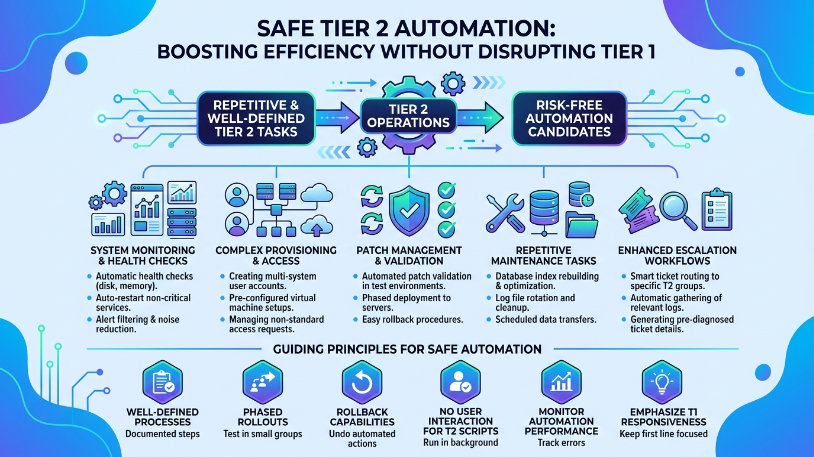
The key insight that makes Tier 2 automation safe is directional isolation: Tier 2 links point to Tier 1 article pages, not to the money site. Even in a worst-case scenario where Google identifies and discounts an automated Tier 2 campaign, the only consequence is that those links do not contribute UR to Tier 1 pages. The money site receives no direct penalty signal.
Safe to automate at Tier 2
Social bookmarking campaigns: Automated submissions of Tier 1 article URLs to 50–100 social bookmarking sites. Target: 50–100 social bookmarks per Tier 1 article page within 2 weeks of the Tier 1 link going live.
Web 2.0 profile creation: Automated creation of branded profiles on high-DR Web 2.0 platforms with a brief bio and a link to the Tier 1 article page in the profile. Contribute modest UR from platform DR and accelerate crawling.
RSS feed submission: Submitting the Tier 1 article page URL to RSS aggregators and feed directories creates additional crawl paths and signals content freshness.
Do not automate at Tier 2
Contextual Web 2.0 posts: The 400–600 word contextual Web 2.0 posts need genuine content to pass meaningful UR. Auto-spun content does not pass quality thresholds and may be removed by the platform. Secondary PBN links: Require the same quality controls as Tier 1 — genuine content, domain quality verification, anchor text specification. Forum profile link building: Meaningful forum links require genuine account participation — automated spam posts are removed and may flag the linked Tier 1 page.
The automation stack by Tier 2 source
| Source | Automatable? | Volume per Tier 1 page |
|---|---|---|
| Social bookmarks | Yes | 50–100 |
| Web 2.0 profiles | Partial (template-based) | 20–30 |
| RSS submissions | Yes | 30–50 |
| Contextual Web 2.0 posts | No (content required) | 5–10 |
| Secondary PBN links | No (quality placement) | 3–8 |
| Forum profiles | No (manual participation) | 5–15 |
Building your backlink network structure
A well-structured backlink network has a pyramid shape: high quality at the top (Tier 1), moderate quality and volume at the middle (Tier 2), and high volume with minimal quality requirements at the bottom (Tier 3 if used).
The standard tiered campaign structure per money site target page
Tier 1: 10–20 quality PBN links, anchor text per safe distribution, gradual indexation across 3–4 weeks, content quality review on each placement.
Tier 2 per Tier 1 article page (deployed 2–3 weeks after Tier 1 indexes): 3–8 secondary PBN links or contextual Web 2.0 posts (quality Tier 2); 20–30 Web 2.0 profile links (automated); 50–100 social bookmarks (automated); 30–50 RSS submissions (automated); 5–15 forum profile links (manual, niche-relevant).
Timing sequence for maximum effectiveness
- Week 1–2: Tier 1 PBN links go live, gradual indexation begins
- Week 3: Verify Tier 1 links are indexed (site:pbn-domain.com/article-page in Google)
- Week 3–4: Begin Tier 2 quality deployment (secondary PBN links, contextual Web 2.0)
- Week 4–5: Begin Tier 2 automated deployment (social bookmarks, Web 2.0 profiles, RSS)
- Week 5–6: Optional Tier 3 deployment to support Tier 2 Web 2.0 posts
- Week 6–10: Monitor Tier 1 article page UR improvement
- Week 8–12: Monitor money site ranking movement
The timing separation between Tier 1 and Tier 2 deployment is important. Deploying Tier 2 simultaneously with Tier 1 does not allow Tier 1 pages to establish their baseline UR — you cannot measure the UR improvement effect without a baseline. For how this timing interacts with ranking movement expectations, see our ranking timeline guide.
Measuring whether Tier 2 is working
The causal chain is direct: Tier 2 links → UR improvement on Tier 1 pages → equity increase to money site → ranking improvement. Measuring at each stage provides leading indicators (UR improvement) and outcome indicators (rankings).
Stage 1: Tier 1 page UR tracking (weekly)
After deploying Tier 2 links, check the URL Rating of each Tier 1 article page in Ahrefs Site Explorer weekly — enter the specific article URL, not the domain. A page starting at UR 5 should move to UR 12–18 after a quality Tier 2 campaign within 2–4 weeks. No UR improvement after 6 weeks indicates Tier 2 links are not being indexed or are being discounted — investigate before investing further.
Stage 2: Money site URL Rating tracking (monthly)
The money site target page UR should improve following Tier 1 + Tier 2 deployment, as Tier 1 pages with higher UR pass more equity downstream. Note: money site UR improvement lags Tier 1 page UR improvement by one crawl cycle — typically 2–4 weeks.
Stage 3: Keyword ranking movement (weekly)
Use Ahrefs Rank Tracker or Semrush Position Tracking. Healthy progression: Weeks 1–3 no ranking movement (links indexing); Weeks 3–6 Tier 2 deploying and Tier 1 page UR improving; Weeks 6–10 first measurable ranking movement; Weeks 10–16 rankings consolidate at new higher positions.
Diagnosing a Tier 2 campaign that is not working
Tier 1 page UR not improving: Check that Tier 2 links are indexed. Run a site:web2property.com search or check Ahrefs for new referring domains on the Tier 1 article URL. If no new RDs are appearing, Tier 2 links are not indexed.
Tier 1 page UR improving but money site UR not improving: The Tier 1 pages are receiving equity but not passing it downstream. Check the Tier 1 article page outbound link count — if the page has many outbound links, equity is being split. Solution: use single-outbound-link Tier 1 placements as described in our backlink equity guide.
Money site UR improving but rankings not improving: Authority is being received but ranking movement is blocked by another factor — content quality issues, anchor text over-optimisation, or insufficient authority for competition level. See our Google penalties guide for the full diagnostic framework.
FAQ
What is second tier link building and why does it matter?
Second tier link building is the practice of building links to your Tier 1 link sources — PBN article pages, guest post pages, editorial link pages — rather than directly to your money site. The purpose is to increase the URL Rating of those Tier 1 pages, which increases the amount of link equity they pass to your money site on every Google crawl cycle. It can multiply the effective authority of your existing Tier 1 link profile without requiring additional Tier 1 placements — the highest leverage move available once a Tier 1 campaign is in place.
What links should I build at Tier 2?
The highest-quality Tier 2 sources are secondary PBN links and contextual Web 2.0 posts (400–600 words, topically related to the Tier 1 article). Moderate-quality Tier 2 includes niche forum profile links and Q&A platform references. Volume Tier 2 includes social bookmarks, Web 2.0 profile links, and RSS submissions. Combine all three categories: 3–8 quality links per Tier 1 page, 20–30 moderate links, and 50–100 volume links.
Is it safe to automate Tier 2 link building?
Yes — social bookmarks, Web 2.0 profile creation, and RSS submissions are safe to automate at Tier 2. The key reason is directional isolation: automated Tier 2 links point to Tier 1 article pages, not to the money site. Even if Google identifies and discounts automated Tier 2 links, the money site receives no direct penalty signal. Do not automate contextual Web 2.0 posts which require quality content, secondary PBN placements, or forum profile links which require genuine participation.
How do I know if Tier 2 links are working?
Check the URL Rating of each Tier 1 article page in Ahrefs weekly after deploying Tier 2 links. UR improvement on those pages within 2–4 weeks is the leading indicator. No UR improvement after 6 weeks means Tier 2 links are not being indexed or are being discounted. Downstream: money site target page UR improves 2–4 weeks after Tier 1 page UR improves; keyword ranking movement follows 6–10 weeks after Tier 1 deployment.
What is the difference between a Tier 1 and Tier 2 backlink network?
A Tier 1 backlink network consists of the sites whose links point directly to your money site. A Tier 2 backlink network consists of the sites whose links point to your Tier 1 sites — the supporting layer that amplifies Tier 1 authority before it flows to the money site. The Tier 2 network has lower individual quality requirements than the Tier 1 network but can contain significantly more sites and links.
Conclusion
Second tier link building is the most underutilised leverage point in professional PBN campaigns. It costs less per equity unit gained than building additional Tier 1 links, it reduces the risk profile of the Tier 1 layer by making each placement look more authoritative, and it provides a safe environment for automated link building tactics that would be dangerous if deployed directly at the money site.
The structure is straightforward: deploy Tier 1 PBN links first, verify indexation, then build Tier 2 links to the Tier 1 article pages 2–3 weeks later. Use quality secondary PBN links and contextual Web 2.0 posts for the authority contribution, and automate social bookmarks, Web 2.0 profiles, and RSS submissions for volume and indexation acceleration. Measure UR improvement on Tier 1 pages weekly to confirm the Tier 2 layer is working before tracking downstream ranking movement.
For most practitioners running PBN campaigns who have not yet built a Tier 2 layer, adding one to existing Tier 1 placements is the single highest-ROI action available. The Tier 1 links you already paid for are underperforming relative to what they would deliver with a supporting Tier 2 structure.
Build a complete tiered authority structure. Tiered PBN backlinks — Tier 1 and Tier 2 campaigns, gradual indexation standard, all niches accepted. Supporting guides: backlink equity — the foundation of tiered link building, complete PBN SEO guide, anchor text strategy for tiered campaigns, ranking timelines for tiered campaigns, Google penalties — keeping tiered campaigns safe, PBN networks and domain selection guide, and our white hat vs grey hat SEO breakdown.

Ben Davis is a seasoned SEO strategist with over a decade of hands-on experience in off page SEO, link building, and private blog network management.
He has helped 600+ agencies and professionals achieve top rankings in competitive niches including iGaming, crypto, CBD, and finance through data driven PBN strategies.