


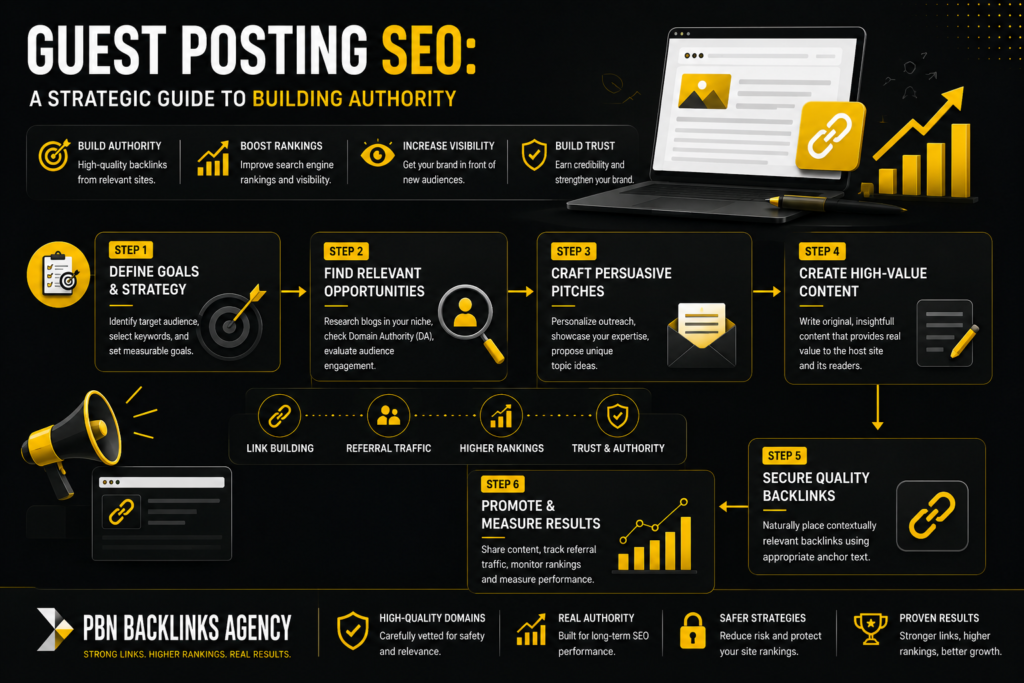
Guest posting SEO is simultaneously one of the most discussed and most misunderstood link building tactics. In 2026, the gap between effective guest posting and the guest post link schemes that Google has been steadily devaluing is wider than ever. The March 2026 Spam Update specifically targeted mass-produced guest posts placed primarily for link building. Yet genuine editorial contributions to relevant publications continue to produce high Trust Flow links that PBN campaigns cannot replicate. This guide explains what makes a guest post genuinely valuable for SEO in 2026, what Google changed that killed the old mass-outreach model, how guest posts compare to PBN links and niche edits across different use cases, and how to use all three tactics together in a link building strategy that is both effective and algorithmically resilient.
Table of Contents
- What is guest posting in SEO?
- The SEO value of guest posts in 2026
- What Google changed: from valuable to risky
- Effective guest posting vs a guest post link scheme
- Guest posts vs PBN links: when to use each
- How to use guest posts alongside PBN links
- How to find genuine guest posting opportunities
- FAQ
- Conclusion
Key Takeaways
- Guest posts on genuinely relevant, editorially-selective publications produce high Trust Flow links that raise a domain quality profile in ways that PBN links alone cannot — they contribute the E-E-A-T authority signals Google looks for in YMYL niches.
- The March 2026 Spam Update specifically targeted mass-produced guest posts placed primarily for link purposes — thin articles on low-quality sites accepted from anyone, with obvious keyword-stuffed anchor text.
- Effective guest posting in 2026 requires: genuine editorial standards on the accepting publication, topically relevant contribution to a real audience, and a placement that reads as editorial recommendation rather than paid promotion.
- Guest posts are complementary to PBN links — not alternatives. PBN links provide commercial page authority at volume and speed; guest posts provide editorial trust signals and Trust Flow that compounds over time.
- For most competitive niches, a 70-30 split (70% quality PBN links for volume and commercial targeting, 30% genuine editorial guest posts for Trust Flow and E-E-A-T signals) produces the strongest and most durable competitive ranking profile.
What is guest posting in SEO?
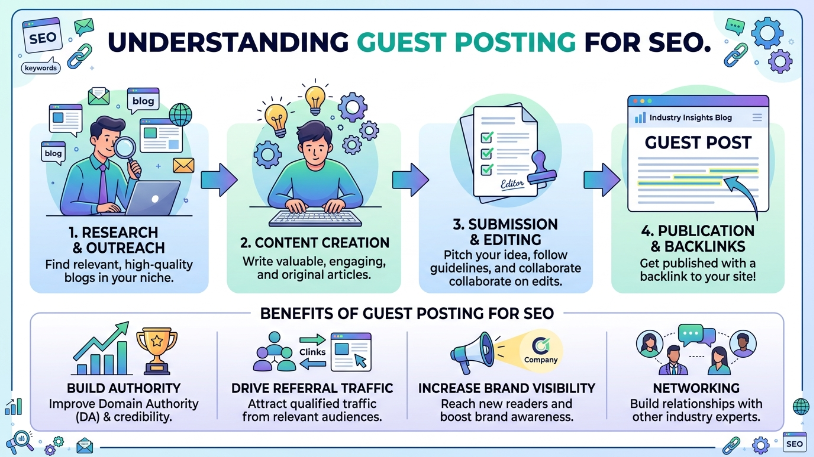
Guest posting (also called guest blogging) is the practice of writing and publishing an article on another website in exchange for an editorial link back to your own site. The linking relationship is the SEO purpose: the host publication benefits from free content, and the contributor benefits from a contextual backlink within a topically relevant editorial environment.
At its best, guest posting is genuine editorial contribution — an expert in their field writing a useful article for an audience that values their knowledge, with a natural reference link to their own site or a specific resource. At its worst, it is a thin 500-word article written by a contractor, placed on a low-quality site that accepts any submission, with an over-optimised commercial anchor text link that reads as advertising rather than editorial reference.
The difference between these two poles is everything in 2026. Google treats the first as genuine editorial endorsement and rewards it accordingly. Google increasingly identifies the second as a link scheme and either discounts the link or, where the pattern is systematic enough, applies algorithmic or manual action against the sites involved.
The SEO value of guest posts in 2026
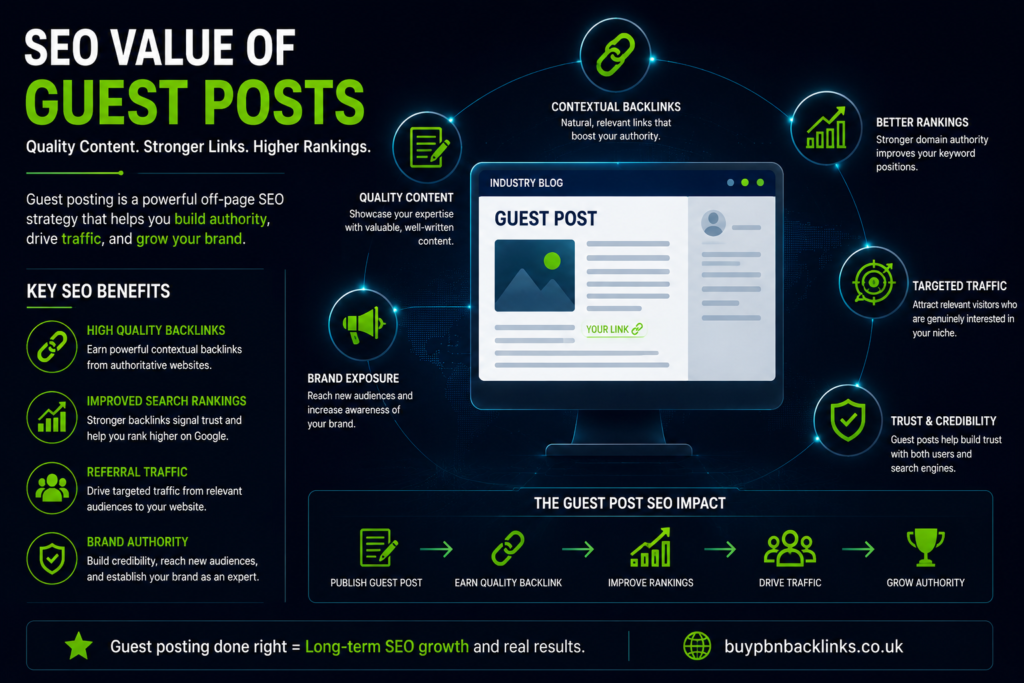
Genuine guest posts on topically relevant, editorially selective publications provide three SEO benefits that PBN links cannot replicate.
Benefit 1: Trust Flow from genuinely trusted sources
Major industry publications, established trade press, and respected independent blogs are close to Majestic trusted seed sites in the link graph. A link from a DR 70 publication with TF 45 contributes more Trust Flow to your domain in a single placement than dozens of standard PBN links. This Trust Flow contribution raises your domain quality profile in ways that affect how Google evaluates every page on your site — not just the specific page the link points to. Our Trust Flow guide covers why this quality-weighted authority matters beyond raw PageRank.
Benefit 2: E-E-A-T signals for YMYL content
For finance, health, legal, and crypto sites — niches where Google applies YMYL (Your Money or Your Life) quality scrutiny — editorial links from credible publications serve as E-E-A-T (Experience, Expertise, Authority, Trust) signals. A financial advice site that has been referenced by the Financial Times, Forbes, or an established fintech publication has demonstrated third-party editorial endorsement that Google factors into how it assesses the site authority for sensitive financial queries. PBN links raise page-level URL Rating; editorial guest post links raise the domain-level trust and authority profile that determines how seriously Google takes the site overall.
Benefit 3: Referral traffic with conversion potential
A guest post on a relevant publication with a genuine readership drives referral traffic that PBN links do not. A well-placed guest post in a respected industry publication can drive hundreds of qualified visitors who are exactly the audience for your product or service. This traffic has a fundamentally different conversion profile from PBN-assisted organic traffic — it arrives pre-qualified by the editorial context of the host publication, making it some of the highest-converting referral traffic available.
What Google changed: from valuable to risky
Google guidelines have always technically classified paid links — including links acquired through paid guest post placement fees — as a violation of their link scheme policies. But the practical enforcement has intensified through 2023-2026 as SpamBrain has improved its ability to identify guest post link schemes at scale.
The March 2026 Spam Update and guest posts
The March 2026 Spam Update targeted “scaled content abuse” and “site reputation abuse” — two patterns that encompass a large portion of the guest post link building industry. Scaled content abuse includes mass-producing guest posts using AI or low-cost contractors for placement across many sites simultaneously. Site reputation abuse includes established publications selling guest post slots under their domain authority while publishing content that does not meet their usual editorial standards.
Sites on both sides of these patterns saw ranking losses. Money sites that had built their profiles heavily on mass-produced paid guest posts saw equity from those links reduced. Publications that had been used as guest post farms for years saw their ability to pass equity diminished — the authority their domain score claimed was no longer fully converting into equity transfer for the commercial links hosted on their pages.
What specifically got devalued
The patterns most affected by the 2025-2026 update cycle: thin 500-word guest posts accepted from anyone without editorial review, sites that publish 10+ guest posts per week with inconsistent topical focus, guest posts with identical bylines appearing across dozens of unrelated publications simultaneously, articles where the only purpose is the commercial anchor text link (no genuine informational value for readers), and publications where every external link carries commercial keyword anchor text rather than branded or contextual anchors.
What was not affected: genuine expert contributions to established publications with real readerships, articles with genuine informational depth (1,500+ words, specific data, genuine expertise), publications with consistent editorial standards that accept a limited number of guest contributions, and natural anchor text that reads as editorial recommendation rather than SEO placement.
Effective guest posting vs a guest post link scheme
| Factor | Effective guest post (2026) | Guest post link scheme |
|---|---|---|
| Publication quality | Established DR 50+ with real readership and editorial standards | Any DR 20+ site that accepts submissions for a fee |
| Content quality | 1,000–2,000 word expert contribution with genuine depth | 500–800 word thin content written to fulfill placement |
| Anchor text | Branded or contextual — reads as natural recommendation | Exact match commercial keyword — obviously SEO-placed |
| Placement frequency | Occasional contributor to selective publications | Multiple placements per week across dozens of sites |
| Topical relevance | Author expertise and article topic clearly aligned with publication niche | Unrelated contributor, generic content on unrelated site |
| Fee transparency | No payment for placement — editorial merit determines acceptance | Explicit payment per post — purely transactional |
| Link placement | One natural contextual reference link within 1,500+ words | Two to three commercial links in 500-word article |
The practical test: could the article be published without the link and still provide value to the host publication readers? If yes, it is a genuine guest post. If removing the link would make the article pointless, it is a link scheme dressed as a guest post.
Guest posts vs PBN links: when to use each
Guest posts and PBN links are not competing alternatives — they serve fundamentally different functions in a link building strategy. Understanding when each excels clarifies how to allocate budget between them.
Use PBN links when:
- You need to build authority on commercial money pages (product, category, pricing, comparison pages) that will never earn organic editorial links
- You need controlled anchor text precision — exact and partial match anchors on commercial keywords at a specific ratio
- You need volume at a defined velocity — 10-20 referring domains per month on a predictable schedule
- Your campaign timeline requires ranking movement within 3-6 months rather than 12-18 months
- You are in a niche (iGaming, affiliate sites, some fintech) where mainstream editorial outreach is structurally unavailable
- You need targeted authority on specific pages rather than domain-level trust building
Use guest posts when:
- You need to raise your domain Trust Flow profile through links from genuinely authoritative publications
- You are in a YMYL niche where E-E-A-T signals are required alongside link volume — editorial endorsement from credible publications sends signals that PBN links cannot replicate
- You are building brand presence and referral traffic alongside authority — genuine guest posts on relevant publications drive qualified visitors
- You want to diversify your link profile with editorial links that provide the natural-looking variety that an all-PBN profile lacks
- You have genuine expertise to contribute and access to publications that will accept substantive contributions
How to use guest posts alongside PBN links: the 70/30 strategy
The strongest competitive link profiles in 2026 combine quality PBN links for volume and commercial targeting with genuine editorial guest posts for Trust Flow elevation and E-E-A-T signalling. The optimal allocation varies by niche but a 70/30 split is a useful starting framework for most competitive campaigns.
70% quality PBN links
The PBN component provides the volume, targeting precision, and velocity that commercial page authority building requires. Target your specific money pages with contextual links using your planned anchor text distribution. Build 10-20 referring domains per month at the velocity appropriate for your site age. Maintain Trust Flow minimums (TF 15+ standard, TF 25+ for YMYL). This component drives the bulk of measurable ranking movement for commercial keywords. Full strategy in our PBN link building strategy guide.
30% genuine editorial guest posts
The guest post component provides the editorial authority signals that make the profile look like a real brand with genuine industry recognition. Target DR 50+ publications in your niche with genuine readerships. Write substantive 1,200-2,000 word contributions with real depth. Use branded or natural contextual anchors — not commercial exact match. Aim for 2-4 quality guest post placements per month rather than 20 thin placements. This component raises Trust Flow, supports E-E-A-T in YMYL niches, and provides the profile diversity that makes the full link profile look like genuine editorial authority accumulation rather than manufactured authority.
Why this combination outperforms either alone
A profile built exclusively on PBN links accumulates URL Rating but may plateau on Trust Flow — the PBN links pass PageRank but do not provide the seed-site proximity that raises TF. At high competition levels, low TF despite high DR/UR is a detectably manufactured profile pattern. Adding genuine editorial links raises TF, making the profile look like a real brand that earns real editorial attention alongside its link building programme.
A profile built exclusively on editorial guest posts accumulates TF slowly and cannot be targeted precisely at commercial pages — most editorial links go to blog content rather than product pages. PBN links fill this targeting gap, delivering commercial page authority that editorial outreach cannot reliably produce.
How to find genuine guest posting opportunities
Finding genuinely editorial-standard guest posting opportunities requires more than a Google search for “write for us.” Four methods identify the publications worth targeting.
Method 1: Competitor backlink profile analysis
In Ahrefs, check the backlink profiles of your top-ranking competitors. Filter by anchor text containing the competitor brand name or common editorial anchor patterns (rather than commercial keyword anchors). Publications that have linked to multiple competitors in your niche are established guest posting targets in your industry. These are the publications that consider your topic area within their editorial scope.
Method 2: Trust Flow verification before outreach
For any publication you are considering, check Trust Flow in Majestic before investing outreach effort. Target publications with TF 30+ for maximum Trust Flow contribution per placement. A publication with DR 60 but TF 12 has inflated authority from link schemes — it will not provide meaningful Trust Flow to your domain. Prioritise TF over DR in publication selection for the same reason you prioritise TF over DR in PBN domain selection.
Method 3: Organic traffic verification
Check organic traffic on any target publication in Ahrefs. Publications with genuine readerships have substantial organic traffic. A publication with DR 55 and 500 monthly organic visitors has a primarily link-selling rather than reader-serving purpose — links from it will not provide the editorial endorsement signal that genuine guest posts contribute. Target publications with 5,000+ monthly organic visitors for meaningful Trust Flow and E-E-A-T contribution.
Method 4: Editorial standard assessment
Read 5-10 recent articles on the target publication. Are they substantive (1,000+ words), specific (not generic AI content), and authored by identifiable contributors with genuine expertise? Does the publication have consistent topical focus? Are the external links in articles contextual references rather than obvious commercial placements? A publication that passes this editorial quality assessment is a genuine guest posting target. One that fails it — generic content, inconsistent topics, obvious sponsored links — is a link farm operating under guest post framing.
FAQ
Is guest posting good for SEO in 2026?
Yes — for genuine editorial contributions to topically relevant publications with real readerships and editorial standards. No — for mass-produced thin content placed on any site that accepts paid submissions. The March 2026 Spam Update specifically targeted scaled content abuse and site reputation abuse patterns that encompass the majority of the paid guest post market. Genuine guest posts on selective publications with Trust Flow 30+ remain highly valuable.
Are guest posts better than PBN links?
They serve different functions rather than being directly comparable. Quality guest posts on high-authority publications provide Trust Flow contributions and E-E-A-T signals that PBN links cannot replicate. Quality PBN links provide commercial page authority at volume and speed that editorial guest posting cannot match. The strongest competitive profiles use both — PBN links for the bulk of commercial page authority building, genuine editorial guest posts for Trust Flow elevation and profile diversity. A 70/30 PBN to guest post split produces the most effective and resilient competitive ranking profile.
What happened to guest posting after the 2026 Google update?
The March 2026 Spam Update devalued mass-produced guest posts placed primarily for link building — thin content on sites that accept any submission, over-optimised anchor text, identical bylines across dozens of sites. Genuine editorial guest posts on selective publications with real audiences were not affected. The update widened the quality gap: effective guest posting became more valuable as a percentage of the total link building toolkit, while the low-quality mass-produced model became ineffective.
How do I know if a guest post site is legitimate?
Check four signals: Trust Flow 30+ in Majestic (genuine authority from trusted sources), 5,000+ monthly organic visitors in Ahrefs (real readership), editorial review process (they reject some submissions), and content quality (substantive articles from identifiable experts, not generic content from anonymous contributors). A site that scores well on all four is a legitimate guest posting target. A site that accepts any submission for a fee regardless of quality is a link farm.
How many guest posts do I need for SEO?
Quality over quantity. Two to four genuinely editorial guest posts per month on TF 30+ publications provides more Trust Flow contribution and E-E-A-T signalling than twenty placements on low-quality acceptance-only sites. For a competitive national keyword campaign, aim to build 20-30 genuinely editorial guest post referring domains over 12 months — supplemented by quality PBN links for the commercial page authority volume that editorial outreach cannot produce at the required scale.
Conclusion
Guest posting SEO in 2026 is not dead — the mass-produced, paid-placement, thin-content model that dominated the industry from 2018 to 2024 is dying. Genuine editorial contribution to topically relevant publications with real editorial standards and real readerships remains one of the most valuable link building actions available, particularly for YMYL niches where E-E-A-T signals are non-negotiable and for any site that needs Trust Flow elevation beyond what PBN links alone provide.
The practical framework for 2026: use quality PBN links for the bulk of commercial page authority building (faster, more targetable, more scalable), use genuine editorial guest posts selectively for Trust Flow elevation and E-E-A-T signalling, and avoid the mass-produced paid guest post market that the March 2026 Spam Update has increasingly devalued. The 70/30 split between PBN volume and editorial quality produces a link profile that is both effective for competitive rankings and resilient to future algorithmic scrutiny.
Build the PBN link volume that guest posting alone cannot deliver. Quality PBN backlinks — the commercial page authority component of a balanced 2026 link building strategy. Supporting guides: complete PBN link building strategy, Trust Flow — what editorial links contribute, niche edits — the middle ground between PBN and editorial, SEO link building 2026 — full update landscape, are PBN links safe — honest risk comparison with guest posts, and our white hat vs grey hat SEO guide.

Ben Davis is a seasoned SEO strategist with over a decade of hands-on experience in off page SEO, link building, and private blog network management.
He has helped 600+ agencies and professionals achieve top rankings in competitive niches including iGaming, crypto, CBD, and finance through data driven PBN strategies.