


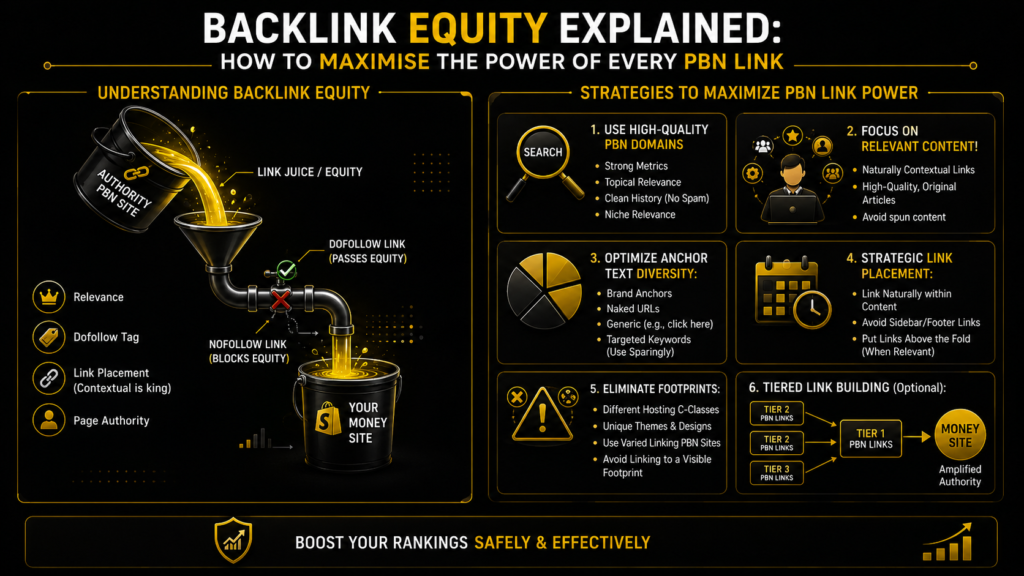
Backlink equity — the ranking authority that passes from one page to another through a hyperlink — is not a fixed quantity. It fluctuates based on the authority of the linking page, the number of other links competing for that equity on the same page, the topical relevance of the linking domain, and the structural relationship between the linking site and the target page. Most PBN link buyers focus on domain authority metrics and anchor text ratios. Far fewer understand that two links from identically-rated domains can pass dramatically different amounts of equity depending on how many other outbound links exist on the same page. This guide explains exactly how backlink equity works in the context of PBN link building: what PageRank dilution means in practical terms, how tiered linking structures preserve and amplify equity, and how to audit your current link equity distribution using Ahrefs.
Table of Contents
- Introduction: what backlink equity actually is
- PageRank dilution: why more outbound links means less equity per link
- How to maximise equity from each PBN link placed
- Tiered link building: multiplying equity through structure
- Building and using a backlink network for maximum equity flow
- How to audit your current link equity distribution
- Link buying strategy: getting more from fewer links
- FAQ
- Conclusion
Key Takeaways
- Backlink equity is not binary — a link from a DR 40 domain passes significantly more or less equity depending on how many other outbound links share the same page.
- PageRank dilution means equity is divided equally among all links on a page. A PBN article with 1 outbound link passes 100% of available equity. The same article with 10 outbound links passes approximately 10%.
- The most effective way to maximise PBN link equity is to ensure placement in articles with minimal outbound links — ideally one contextual link per article.
- Tiered link building multiplies the effective equity of Tier 1 links by building supporting links that boost the linking page own authority before it reaches your money site.
- Auditing link equity distribution using Ahrefs Best by Links report identifies which pages on your site are receiving authority and which are not.
Introduction: what backlink equity actually is
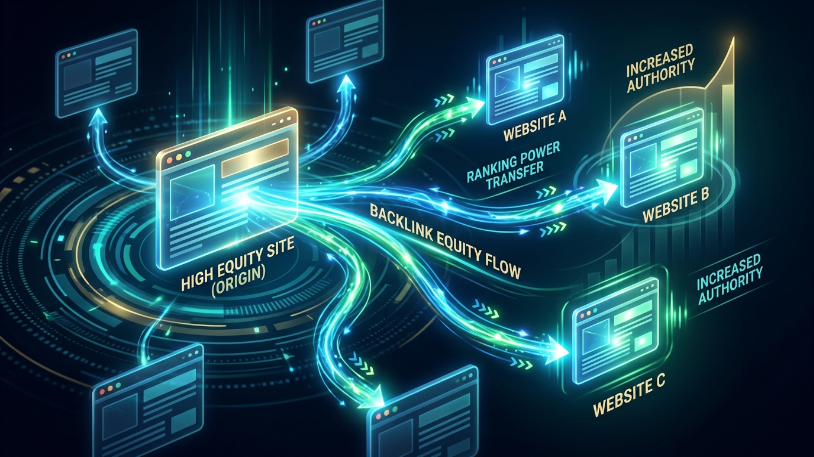
Backlink equity is the term used to describe the portion of a linking page authority that is passed to your page through a specific link. It is not a fixed number attached to a domain — it is a dynamic quantity that shifts every time the linking page adds or removes an outbound link, gains or loses its own backlinks, or changes its internal link structure.
Google original framework for this concept was PageRank — the algorithm created by Larry Page that evaluated every page on the internet based on the quantity and quality of links pointing to it. Although Google retired the public PageRank toolbar in 2016, the underlying principle is still fundamental to how Google evaluates link authority. Every credible third-party metric — Ahrefs DR, Moz DA, Majestic Trust Flow — is attempting to estimate the same underlying signal. For a full overview of how PBN links work within this framework, see our complete PBN SEO guide.
PageRank dilution: why more outbound links means less equity per link
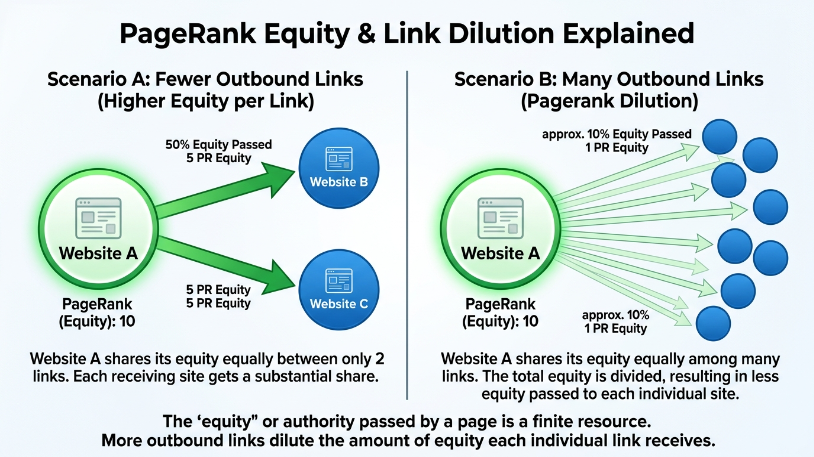
The concept of PageRank dilution is the most important idea in backlink equity — and the most consistently underestimated by people building PBN campaigns.
How PageRank dilution works
Every page distributes a portion of its PageRank to each outbound link, approximately equally. The formula: Equity per outbound link = Page total equity divided by Number of outbound links on the page.
A PBN article with equity equivalent to 10 units that links to a single external page passes approximately 10 units to your money site. The same page with 10 outbound links passes approximately 1 unit to each linked page — including yours. The same page with 50 outbound links (common on low-quality PBN sites that monetise by selling multiple placements per article) passes approximately 0.2 units to your page.
This is not theoretical. It is the primary reason why a link from a DR 30 domain in a lean, single-outbound-link article consistently outperforms a link from a DR 50 domain in a link-saturated article page.
What this means in practice for link buying
Before placing a PBN link, ask your provider one question: how many outbound links are on the page where my link will be placed? An article with a single contextual link to your site passes the maximum available equity. An article that sells three additional placements alongside yours passes 25% of the same equity to each. Over a 20-link campaign, consistently choosing single-placement articles versus multi-placement articles can produce the equivalent of 40-60% more total link equity — without paying for a single additional link.
How to maximise equity from each PBN link placed
1. Insist on single contextual link placement
The most impactful instruction you can give a PBN provider is: one outbound link per article, contextually placed in the body content. This eliminates dilution from competing outbound links and ensures your link receives the full available equity from that placement. Paying a premium for exclusive single-placement articles is almost always worth it.
2. Target PBN pages with strong internal link equity
A PBN article page that is well-linked internally — featured on the homepage, in a sidebar, or in a category page — carries more equity than an orphaned article. A linked-from-homepage article typically passes 3-5x more equity than an orphaned article on the same domain.
3. Check URL Rating on the specific linking page
Using Ahrefs, check the URL Rating (UR) of the specific article page — not just the domain DR. UR measures the authority of the individual page. A high DR domain with low UR article pages passes less equity than a moderate DR domain with high UR article pages that have received direct backlinks themselves.
4. Ensure dofollow link placement
A nofollow or sponsored tag on your PBN link removes the equity transfer entirely. Confirm dofollow placement with no rel attributes that would suppress PageRank flow. Verify in Ahrefs after links are placed by checking the rel attribute column in the Backlinks report.
5. Choose topically relevant PBN domains
A link from a PBN domain in the same niche as your money site passes a stronger quality signal than the same equity quantity from an unrelated domain. Our guide on PBN networks and domain selection covers how to evaluate topical relevance alongside authority metrics.
Tiered link building: multiplying equity through structure
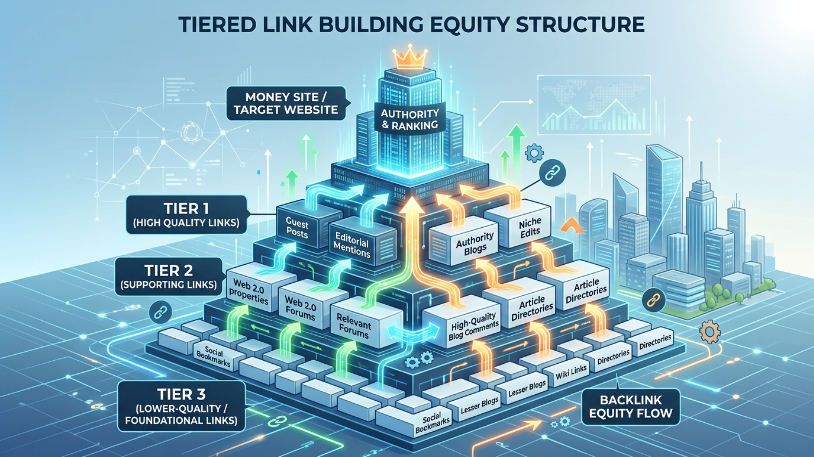
Tiered link building multiplies backlink equity without simply adding more Tier 1 links. It works by strengthening the pages that link to your money site rather than only strengthening the money site directly.
How tiered equity multiplication works
Tier 1 links point directly to your money site. Tier 2 links point to the Tier 1 linking pages — not your money site. By building links to the pages that already link to your money site, you increase those pages URL Ratings, which increases the amount of equity they pass to your money site on every subsequent crawl cycle.
A Tier 1 PBN article page with a UR of 12 passes a certain amount of equity to your money site. Build 5 Tier 2 links to that article page, raising its UR to 28, and it now passes significantly more equity — without requiring any new Tier 1 link. See our guide on PBN links for affiliate sites for how this tiered structure applies to commercial content specifically.
Practical tiered structure for PBN campaigns
Tier 1 (direct to money site): 10-20 high-quality PBN links from topically relevant domains, single contextual placement, strong internal linking on the PBN domain.
Tier 2 (pointing to Tier 1 pages): 20-50 links pointing to your Tier 1 article pages. These can be lower-cost link types — web 2.0 blog posts, social bookmarks, wiki citations, or additional PBN links. Their purpose is to boost the URL Rating of your Tier 1 linking pages, not to rank your money site directly.
Building and using a backlink network for maximum equity flow
A backlink network generates maximum equity when treated as an interconnected system rather than a collection of independent placements. Equity flows most efficiently when the path from linking domain to money site is short and unobstructed. A Tier 1 PBN link from a domain with 300 referring domains, strong internal linking, topically relevant content history, and a single contextual outbound link represents a near-optimal equity path.
A backlink network built entirely from PBN links concentrates both equity contribution and risk profile in one link type. Mixing PBN links with editorial outreach links, digital PR placements, and authoritative directory citations distributes risk while maintaining equity flow. A genuine editorial link on a DR 60 publication can be equivalent to 5-10 PBN links from mid-tier domains depending on topical relevance and article page UR.
How to audit your current link equity distribution
Step 1: Run the Best by Links report
In Ahrefs Site Explorer, navigate to Pages then Best by Links in the left sidebar. Sort by Referring Domains to see your most-linked pages. This is your equity concentration map. In most sites, 80% of external link equity is concentrated in 10-20% of pages.
Step 2: Identify equity gaps on priority pages
Compare your most-linked pages against your most commercially important pages. If your highest-converting product pages or affiliate review pages rank poorly in the Best by Links report, you have an equity gap. These gap pages are your primary PBN link building targets.
Step 3: Audit internal link equity distribution
Use Ahrefs Site Explorer then Pages then Best by Internal Links to see which pages receive the most internal link equity from within your own site. If your homepage receives 200 external backlinks but your key money pages have only 2-3 internal links from the homepage, most equity is being dissipated rather than concentrated on priority pages. Adding 5-10 strategic internal links from your highest-equity pages to priority money pages can produce ranking improvements equivalent to building 5-10 additional PBN links — for free.
Step 4: Check URL Rating on specific target pages
For each page you are planning to build PBN links to, check its current URL Rating in Ahrefs. Pages with UR 0-10 are starting from almost nothing and need a significant volume of links before they will be competitive. Pages with UR 20-35 are in a stronger position and will respond faster to a smaller link campaign.
Link buying strategy: getting more from fewer links
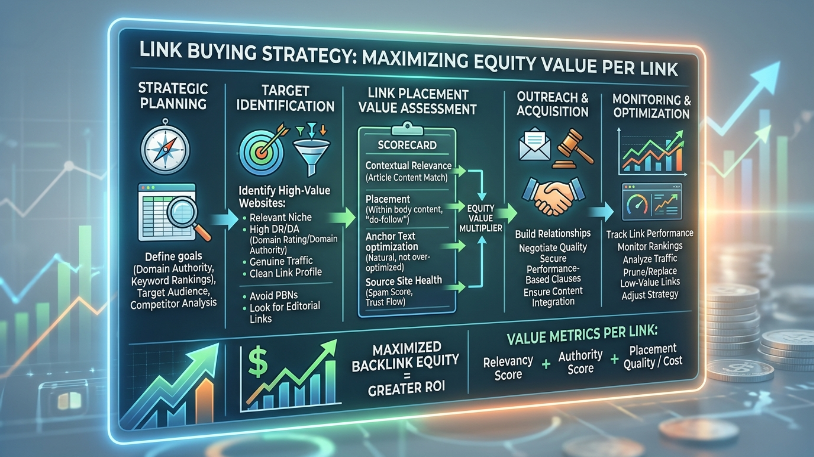
Link buying is more effective when treated as an equity investment than a volume exercise. Consider two scenarios with the same budget: 30 PBN links at budget pricing with 5-8 outbound links per article versus 12 PBN links at premium pricing with single outbound link per article, homepage internal linking, and strong topical relevance. At the same total spend, Scenario B typically produces stronger ranking results because it optimises for equity per link rather than link count per pound.
When placing a link buying order, specify: single outbound link per article (most important), homepage internal link to the article, topical relevance, and dofollow placement confirmed. The equity differential from these four specifications more than compensates for any cost premium over a full campaign.
FAQ
What is backlink equity and why does it matter for PBN links?
Backlink equity is the portion of a linking page authority that passes to your page through a specific backlink. It matters for PBN links because placements are controlled — you can directly influence the equity each link passes by specifying single outbound link placement, choosing article pages with strong internal linking, and selecting topically relevant domains. Understanding equity lets you get more ranking power from each link without increasing your link count or budget.
What is a backlink network and how does it relate to equity?
A backlink network is the full collection of external sites and pages linking to your domain. Equity flows through this network to your money pages. The efficiency of that flow depends on how many outbound links compete for equity on each linking page, how strongly those pages are supported by their own backlinks, and how well your internal link structure routes received equity to priority pages. A well-structured backlink network delivers more equity per link than a randomly assembled one of the same size.
How does PageRank dilution affect the equity from a PBN link?
A linking page divides its available equity equally among all outbound links. A PBN article with one outbound link passes 100% of available equity to your page. The same article with five outbound links passes 20% to each. This is why a single exclusive contextual link placement consistently outperforms a shared placement on the same page even when domain authority metrics are identical.
How do I check backlink equity and distribution in Ahrefs?
In Ahrefs, use: Site Explorer then Pages then Best by Links (shows which pages have the most referring domains), Site Explorer then Backlinks with UR column visible (shows URL Rating of specific linking pages), and Site Explorer then Pages then Best by Internal Links (shows how internal equity is distributed across your site). Check the URL Rating of each article page linking to you for page-level authority transfer assessment.
Is link buying always worth it for equity building?
Link buying is worth it when the equity per link justifies the cost. A smaller number of high-equity placements with single outbound links, homepage internal linking, and topical relevance consistently outperforms larger volumes of diluted links with multiple competing outbound links and low URL Rating. Calculate equity quality rather than link quantity when evaluating link buying decisions.
Conclusion
Backlink equity is the variable that separates a link building campaign that moves rankings from one that spends budget with no visible return. Two links from identically-rated domains can produce dramatically different ranking outcomes — and the difference comes down entirely to factors that are visible, auditable, and controllable before a single link is placed.
Minimise dilution by insisting on single outbound link placements. Amplify per-link equity by targeting article pages with strong internal linking and measurable URL Rating. Multiply equity flow through tiered structures. Audit your current distribution to identify equity gaps and internal linking inefficiencies that link building alone cannot fix. Treat link buying as an equity investment rather than a volume exercise.
Ready to build a smarter link structure? Start with PBN link equity at SEO PBN Backlinks — then deepen your strategy with our complete PBN SEO guide, our breakdown of exact match anchor text strategy, our guide on how long PBN links take to produce rankings, the full PBN links explainer, our PBN terminology glossary, the full PBN FAQ, our guide on PBN links for affiliate sites, our white hat vs black hat SEO breakdown, and our white label link building guide.

Ben Davis is a seasoned SEO strategist with over a decade of hands-on experience in off page SEO, link building, and private blog network management.
He has helped 600+ agencies and professionals achieve top rankings in competitive niches including iGaming, crypto, CBD, and finance through data driven PBN strategies.