


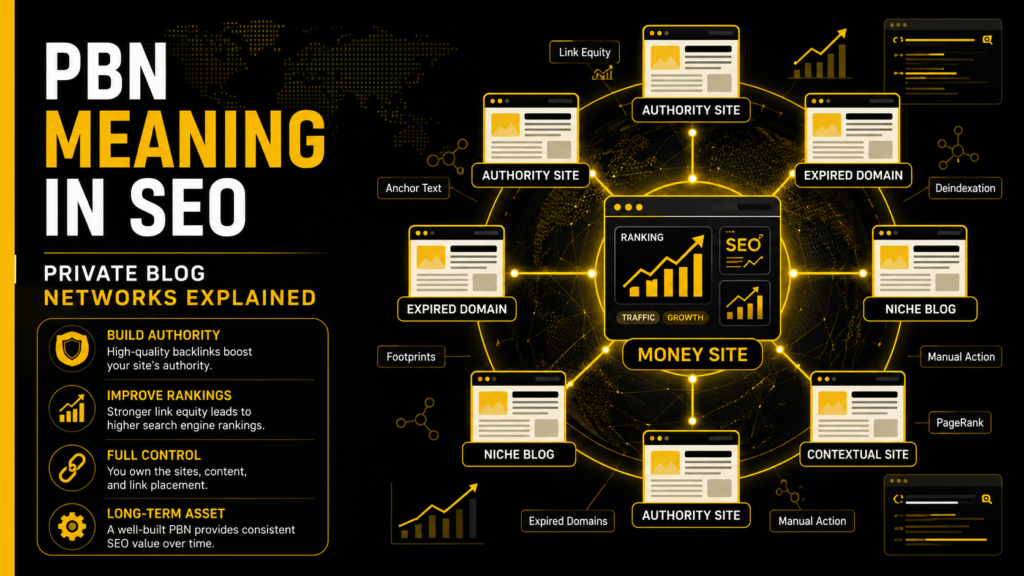
This article explains the pbn meaning seo professionals, marketers. Site owners need to understand starting with the most direct answer (PBN stands for Private Blog Network). Expanding into every related term, concept, and phrase that appears in conversations about this tactic. Beyond the basic definition, the guide examines why each word in the name matters, how the SEO-specific meaning differs from casual usage. What distinguishes a single PBN from the broader industry practice of PBN-based link building.
A 15-term glossary covers every concept from money site and feeder site to deindexation. Tiered link building giving readers a complete reference for understanding any discussion of private blog networks. Whether you have just encountered the term for the first time in an SEO audit, seen it in a penalty notification, or are evaluating a link-building proposal, This guide provides the precise vocabulary to engage with the topic confidently.
Table of Contents
- Introduction: the PBN meaning SEO professionals need to know
- What does PBN stand for?
- What does PBN mean in SEO context?
- What does PBNs mean? (the plural form)
- PBN terminology glossary: 15 terms every SEO should know
- FAQ
- Conclusion
Key Takeaways
- PBN stands for Private Blog Network a collection of websites controlled by one entity used exclusively to generate artificial backlinks for a target domain.
- The word private in the name is the most operationally significant: it refers to deliberate ownership concealment, not simply personal use.
- PBNs (plural) refers both to individual networks and to the broader industry practice context determines which meaning applies.
- Understanding the full vocabulary of PBN-related terms is essential for auditing backlink profiles, evaluating link-building proposals, and interpreting Google penalty notifications accurately.
Introduction: the PBN meaning SEO professionals need to know
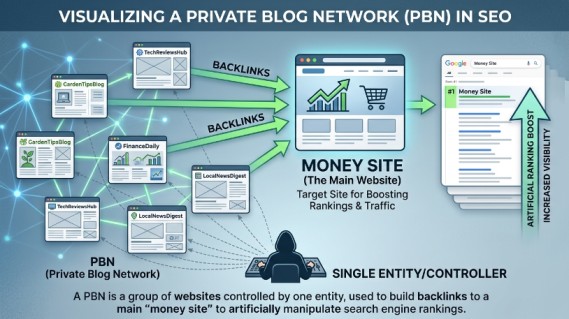
If you have recently encountered the term pbn meaning seo whether in an audit report. A link-building proposal, a penalty notification, or an SEO forum discussion you have arrived at the right place. PBN is one of those SEO terms that gets used freely in industry conversations, often without explanation, in contexts where misunderstanding it can have real consequences. For the full strategic context, our complete PBN SEO guide covers everything from definition to penalty recovery.
An account manager who does not know what a PBN is might approve a link-building strategy that triggers a Google penalty. A site owner unfamiliar with the term might miss a critical signal in a backlink audit. A marketer evaluating agency proposals might unknowingly pay for links that violate Google guidelines. This guide solves the vocabulary problem completely starting with the full form and clearest definition, then working through every related concept.
What does PBN stand for?
PBN stands for Private Blog Network.
PBN full form: Private Blog Network
Each word in the pbn stands for breakdown carries specific meaning. Private the ownership of sites in the network is deliberately concealed. Operators use separate hosting accounts, different domain registrars, varied. WHOIS contact details, and other infrastructure measures to prevent Google from tracing the sites back to a common owner. Private does not mean personal in the casual sense it means hidden. Blog historically, network sites were structured as blogs. content-driven websites that published articles regularly, providing a natural vehicle for contextual backlink placement. Modern PBN sites may look like any type of content website. Network the sites function as coordinated units serving a shared purpose: funneling link authority toward the money site.
Breaking down each word: private, blog, network
Understanding why each word was chosen helps distinguish genuine PBNs from superficially similar arrangements. A company that owns multiple legitimate content websites each with real audiences and independent editorial goals is not running a PBN even if some of those sites occasionally link to each other. The private and network qualifiers both require deliberate concealment and coordinated artificial linking, not merely common ownership. The combination of all three words is what defines the tactic precisely.
What does PBN mean in SEO context?
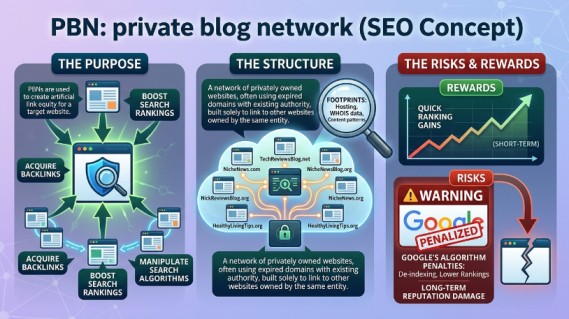
The pbn seo meaning goes beyond the literal definition of the words. In SEO practice, PBN carries a specific set of connotations, risk associations, and strategic implications that shape how it is used and discussed.
The SEO definition vs the general meaning
In general usage, private blog network could describe almost any group of privately-owned blogs. In SEO, it means something specific: a coordinated link-building infrastructure designed to artificially inflate a target site search rankings by manufacturing the appearance of organic editorial endorsement. This SEO-specific meaning implies black-hat classification PBN use is explicitly prohibited under Google link spam policies. In SEO conversations, saying something is PBN-powered is shorthand for using tactics that violate Google guidelines and carry significant penalty risk.
Why the term private matters ownership and concealment
The operational heart of what PBN means in SEO is the concealment implied by private. A link from a site you openly own and publicly associate with your brand is not a PBN link it is a link from your own property. Which Google understands and evaluates accordingly. The PBN tactic only works when the ownership connection is hidden. The active concealment of ownership is not just a Google guideline violation it is precisely what distinguishes PBN use from simply owning multiple websites.
What does PBNs mean? (the plural form)
PBNs vs a PBN: single network vs industry practice
When someone says a PBN, they typically mean a single private blog network. One coordinated set of sites operated by one entity. When someone says PBNs in the plural, the meaning expands in one of two directions. Multiple distinct networks operated by different parties, or the broader phenomenon of private blog network-based link building as a category of SEO tactic. This distinction matters when interpreting audit findings. This site has PBN links means specific links from a specific network were identified. This agency uses PBNs means the agency methodology involves private blog networks as a category.
How SEOs talk about PBNs in the industry
Within SEO practice, the pbns seo usage combining plural with the SEO qualifier specifically places the discussion in the strategic context of search optimization. Audit language: suspected PBN links identified in referring domain profile means a backlink auditor has flagged domains exhibiting PBN characteristics. Risk discussion: PBN-heavy link profile describes a backlink portfolio where a significant proportion of referring domains show PBN characteristics. Strategy discussion: PBN-assisted rankings acknowledges that a site current position depends partially on PBN backlinks and therefore those rankings are more fragile than they appear.
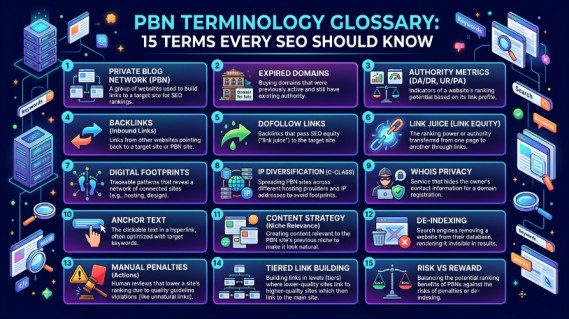
PBN terminology glossary: 15 terms every SEO should know
Money site
The primary target domain that a PBN is built to support typically the one generating revenue through e-commerce, affiliate marketing, lead generation, or advertising. All link equity generated by the PBN flows toward the money site. The money site itself typically has no visible connection to the network sites pointing at it.
Feeder site / satellite site
An individual website within a PBN that exists to generate and hold backlinks pointing at the money site. Sometimes called a satellite site or PBN node. A feeder site typically has some superficially legitimate content and a historical backlink profile inherited from the expired domain it was built on. But its primary purpose is as a link delivery vehicle rather than a genuine content destination.
Link equity / link juice
The ranking authority that passes from one website to another through a hyperlink. The entire premise of PBN link building is that high-authority feeder sites can transfer their accumulated link equity to the money site through dofollow backlinks. See our guide on what PBN links are and how they work for a full breakdown of this transfer mechanism. Google systems evaluate the quality, relevance, and naturalness of this equity transfer manufactured link equity from PBN sites is increasingly discounted or neutralized.
Expired domain
A domain that was previously owned by a legitimate website. Accumulated genuine backlinks and authority over its operational life, and became available for purchase when the original owner stopped renewing it. Expired domains are the foundational asset of most PBNs because they carry inherited authority that a fresh registration would take years to accumulate.
Footprint (SEO context)
Any traceable signal that reveals common ownership, operation, or coordination across multiple sites in a PBN. Footprints can be technical (shared IP addresses, same CMS plugins, identical Google Analytics IDs). Content-based (similar writing styles, same author names, incoherent topic shifts). Or backlink-based (concentrated anchor text, coordinated link velocity patterns). PBN operators invest significant effort in eliminating footprints; Google detection systems are specifically designed to find them.
Manual action
A formal penalty issued by a human reviewer at Google Search Quality team after personally reviewing a site and determining it violates Google webmaster guidelines. For PBN-related violations, manual actions typically appear in Google Search Console as Unnatural links to your site. Manual actions suppress rankings until the issue is addressed, a disavow file is submitted, and Google reviews a reconsideration request.
Algorithmic penalty
A ranking suppression applied automatically by Google algorithm specifically its SpamBrain system without human review or formal notification. Unlike manual actions, algorithmic penalties do not appear in Search Console. The site owner experiences an unexplained ranking drop and must conduct an audit to identify the probable cause.
Deindexation
The removal of a website from Google search index entirely meaning the site produces no results for any query. Deindexation is the most severe consequence of PBN detection. And can affect both the PBN network sites themselves. The money site if it is found to be the beneficiary of the manufactured link scheme.
Anchor text (exact-match vs natural)
The visible, clickable text of a hyperlink. Anchor text tells Google what the linked page is about. Exact-match anchor text uses the precise keyword the operator wants the money site to rank for. Natural anchor text includes branded references, generic phrases, and contextual descriptions. PBN link profiles typically show an unnatural concentration of exact-match. Or commercial anchor text a pattern Google algorithms flag as a manipulation signal.
Tiered link building
A link architecture strategy where Tier 1 links point directly to the money site. Tier 2 links point to the Tier 1 links to amplify their authority. And Tier 3 links point to Tier 2 links. This tiered approach is covered in detail in our PBN links for affiliate sites guide. PBN-style sites are often used in Tier 2 or Tier 3 positions to boost upper-tier link authority without directly connecting low-quality links to the money site. Google link graph analysis can trace these multi-tier relationships.
Black hat / grey hat / white hat SEO
A classification system describing the risk and guideline compliance status of SEO tactics. Black hat refers to tactics that explicitly violate Google guidelines and are used to manipulate rankings PBN link building falls here. White hat refers to tactics that comply fully with guidelines and focus on creating genuine value. Grey hat is a contested middle ground. Google explicit statements place private blog networks firmly in black hat territory.
PageRank
Google original algorithm for evaluating the authority of web pages based on the quantity and quality of links pointing to them. Named after Google co-founder Larry Page. Google no longer publicly reports PageRank scores (the public toolbar was retired in 2016). But link authority signals based on the same fundamental principles remain a significant ranking factor which is precisely what PBNs are designed to manipulate.
Domain Rating (DR) / Domain Authority (DA)
Third-party metrics estimating a domain link authority. Domain Rating (DR) is Ahrefs metric scored 0-100. Domain Authority (DA) is Moz equivalent. Neither is a Google metric Google does not use DR or DA in its ranking algorithm. However, both are widely used by PBN operators to evaluate expired domains and price link placements. A high DR or DA with low organic traffic is one of the clearest signals that a domain may be a PBN node.
Trust Flow (TF)
Majestic quality-weighted authority metric, measuring how close a domain link profile is to a curated set of trusted seed sites. Trust Flow is considered a more meaningful quality signal than raw link counts because it weights link quality rather than just quantity. A domain with high Trust Flow relative to its Citation Flow (CF) has earned authority from genuinely high-quality sources making it more valuable as a PBN node but also more expensive and harder to acquire.
Web 2.0 links
Backlinks created on free, user-generated content platforms Blogger, WordPress.com, Tumblr, Medium. Web 2.0 link building is a lower-cost alternative to PBN link building that shares some characteristics: the links are manufactured by the site operator rather than earned editorially. Web 2.0 links carry significantly less authority than PBN links built on quality expired domains and are generally more easily discounted by Google algorithms.
FAQs
What is the PBN abbreviation in full?
PBN stands for Private Blog Network. The full form describes a collection of websites (network) that publish content (blog) under concealed common ownership (private), used to generate artificial backlinks for a target domain. In SEO contexts, the term specifically implies a black-hat link-building tactic that violates Google link spam policies. The abbreviation PBN appears in backlink audit reports, SEO strategy discussions, Google penalty notifications, and industry commentary about manipulative ranking tactics.
Is PBN the same as a link farm?
No — they are related but distinct. A link farm is a cruder, older tactic: a cluster of sites that exist purely to link to each other and to target sites. With no meaningful content investment and no attempt at legitimate appearance. PBNs are a more sophisticated evolution. They use expired domains with real historical authority, invest in content to create surface plausibility. Employ active footprint avoidance tactics. Both are prohibited under Google guidelines, but higher-quality PBNs require more sophisticated detection systems than link farms.
What does money site mean in PBN terms?
The money site is the target domain that a PBN is built to support — typically the primary website that generates revenue and that the operator wants to rank higher in Google Search. All backlinks from PBN feeder sites flow toward the money site. The money site is typically kept visually and structurally separate from the network sites to avoid a visible ownership footprint. If the network is detected and penalized, the money site is the domain whose rankings collapse and whose recovery process begins.
What is the difference between PBN and web 2.0 links?
PBN links come from independently-hosted websites built on expired domains with real authority histories — more powerful and more expensive but also more detectable through domain analysis tools. Web 2.0 links come from free hosted platforms like Blogger and WordPress.com. Web 2.0 links carry substantially less authority because the platforms are known to Google as user-generated content environments. Both are manufactured link tactics rather than editorially earned links — the primary difference is quality, cost, and detectability profile.
How is PBN different from a content network?
A legitimate content network a group of publications owned by a media company has editorially independent sites that serve real audiences and make genuine content decisions. Links between properties in a real content network reflect genuine editorial relevance judgments, not coordinated link manipulation. A PBN has none of these qualities. The sites exist only to transfer ranking signals. They have no genuine audiences, and their content serves no purpose except to provide a vehicle for the planted backlink.
Conclusion
The pbn meaning in SEO is precise, consequential, and worth understanding clearly whether you are encountering the term for the first time or sharpening your existing knowledge. PBN stands for Private Blog Network: a concealed, coordinated collection of website. Used to manufacture artificial backlinks for a target domain an approach explicitly prohibited by Google and associated with significant ranking risk.
The vocabulary around private blog networks money sites, feeder sites, footprints, manual actions, tiered link building. Domain authority metrics forms a complete conceptual framework for understanding how the tactic works, why it fails, and what the consequences of failure look like. The 15-term glossary in this guide covers that framework completely, giving you the language to engage accurately with audits, penalty notifications, and strategic discussions.
Most importantly, understanding the full meaning of PBNs helps you recognize them in disguise. When a link-building proposal promises fast results from editorial placements, when an audit surfaces high-DR domains with near-zero organic traffic. When a Search Console notification references unnatural links the vocabulary in this guide is what allows you to read those signals correctly and respond appropriately.
For complete coverage of everything PBN-related: Read our main PBN SEO guide, explore what PBN links are and how they work, check our complete PBN networks guide, browse our full PBN FAQ, or learn how PBN links work for affiliate sites, discover how long PBN links take to rank, build a safe exact match anchor text strategy, understand backlink equity, read our white hat vs black hat SEO guide, and our white label link building guide for agencies.

Ben Davis is a seasoned SEO strategist with over a decade of hands-on experience in off page SEO, link building, and private blog network management.
He has helped 600+ agencies and professionals achieve top rankings in competitive niches including iGaming, crypto, CBD, and finance through data driven PBN strategies.