


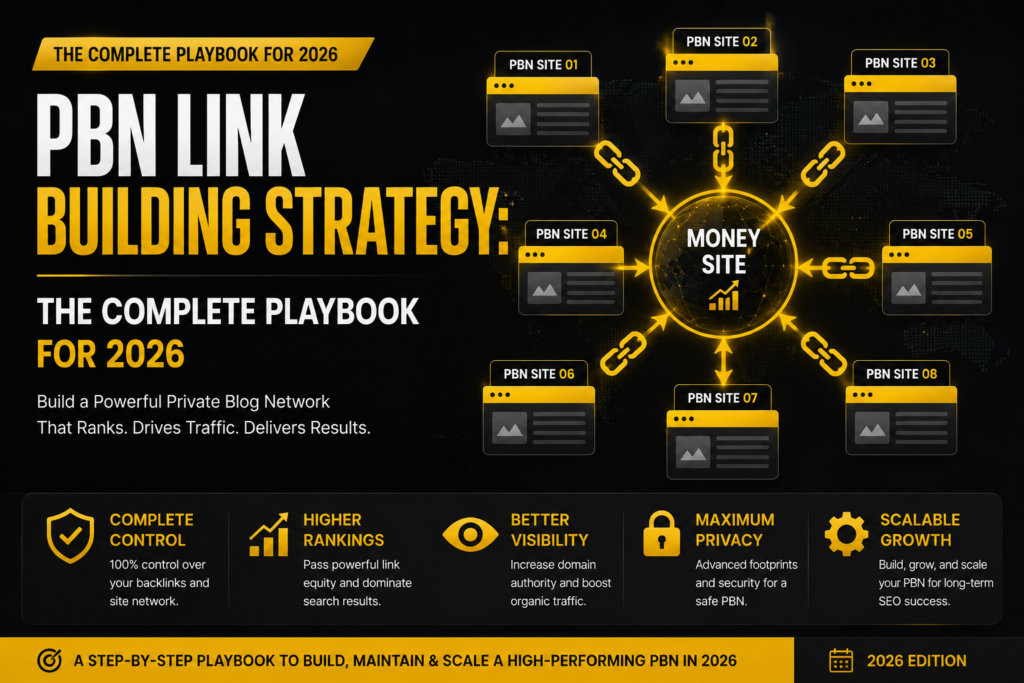
A PBN link building strategy is not just a list of links to build. It is a sequenced plan that starts from a SERP audit, identifies the specific pages that need authority and the specific authority gap that needs closing, designs an anchor text distribution that will not trigger over-optimisation, manages link velocity to match the site age and baseline, layers Tier 2 amplification onto Tier 1 placements, and tracks progress against measurable leading indicators. This guide is the strategic framework that connects all the tactical knowledge across this site into a coherent, executable campaign plan covering every decision from the initial SERP benchmark to the month-by-month execution sequence that produces first-page rankings without triggering penalties.
Table of Contents
- Phase 1: The SERP audit and authority gap analysis
- Phase 2: Page targeting — where to send links
- Phase 3: Anchor text planning
- Phase 4: Velocity management and campaign sequencing
- Phase 5: Tier 2 amplification strategy
- Phase 6: Measurement and iteration
- Advanced strategy considerations
- FAQ
- Conclusion
Key Takeaways
- Every PBN campaign should start with a SERP audit — checking the referring domain count, URL Rating, and anchor text distribution of the top 5 competitors for each target keyword — not from a generic monthly link budget.
- Page targeting priority: commercial money pages first (product, category, comparison, feature pages), then content pages to build the internal link equity structure that feeds commercial pages.
- Anchor text planning must happen before the first link is ordered — not retrospectively. Over-optimised anchors from early links cannot be undone and constrain every subsequent placement.
- Velocity management is site-age dependent: new sites (0–12 months) should not exceed 5–8 new referring domains per month; established sites can sustain 15–25 per month without triggering velocity concerns.
- The complete strategy integrates Tier 1 PBN links, Tier 2 amplification to raise Tier 1 page URL Rating, internal linking to distribute equity to commercial pages, and regular measurement against URL Rating and ranking movement — not just link count.
Phase 1: The SERP audit and authority gap analysis
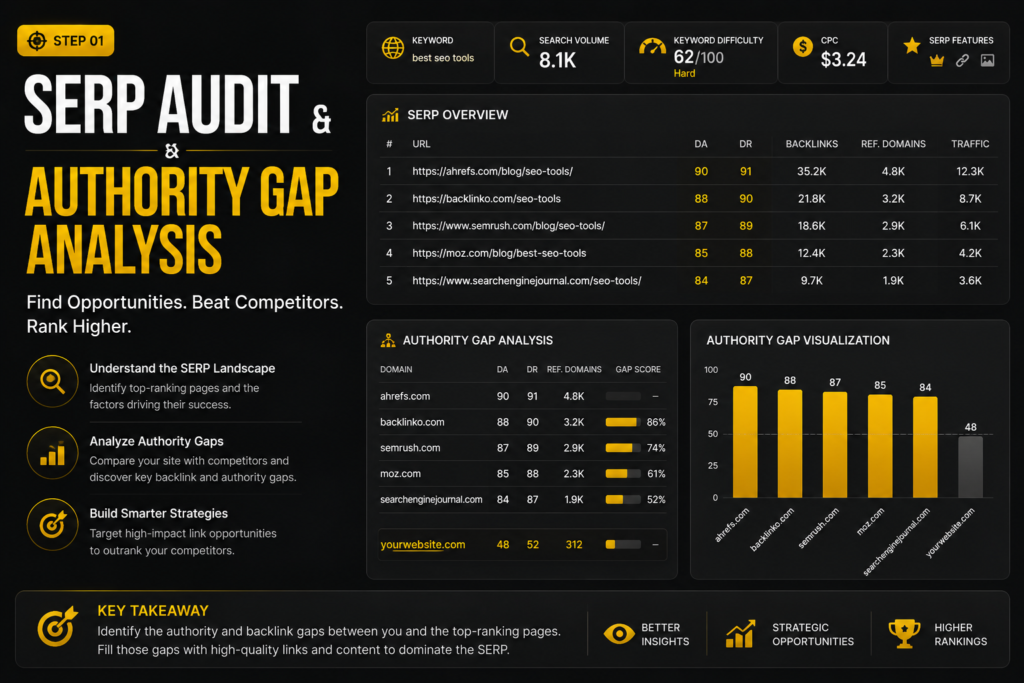
Every effective PBN link building strategy begins with a SERP audit, not with a budget. The budget follows from the audit — not the other way around. Starting from a predetermined budget and building links until the money runs out is activity without strategy. Starting from the SERP and calculating what the competition requires produces a purposeful campaign with a measurable target.
The SERP audit process
For each target keyword, run this audit in Ahrefs:
- Search the keyword in Ahrefs Keyword Explorer
- Open the SERP overview for the top 10 results
- Note the referring domain count for each of the top 5 pages
- Note the URL Rating of each of the top 5 pages
- Check the Ahrefs Anchors report for each top 5 page — note the exact match anchor percentage
- Calculate: average referring domains across top 5, average URL Rating across top 5
- Compare your target page against these averages
The output is your authority gap: how many referring domains you need to acquire, what URL Rating your target page needs to reach, and what anchor text distribution is normal in your specific SERP. Every decision in the strategy that follows is calibrated against these numbers.
Reading the competitive anchor text distribution
The anchor text distribution of the top-ranking pages for your target keyword tells you what Google has already determined looks natural in that specific SERP. A comparison keyword like “best CRM software 2026” may show top-ranking pages with 15–20% partial match anchors and 5–8% exact match — higher than a brand-name keyword would tolerate. A local keyword like “plumber London” may show top-ranking pages with almost no exact match anchors — heavily branded and generic. Your anchor plan must match the competitive normal, not a generic safe distribution guideline. The full anchor text framework is in our anchor text strategy guide.
Phase 2: Page targeting — where to send links
The most common strategic mistake in PBN campaigns is sending all links to the homepage or all links to blog content. The pages that most need direct PBN links are commercial money pages — and those are typically the pages that receive the fewest links in poorly planned campaigns.
The page targeting priority framework
Tier A — Direct commercial pages (primary targets): These are the pages that generate revenue directly — product pages, category pages, pricing pages, comparison pages, feature pages, service pages. They almost never earn organic editorial links, yet they are the pages that need the most authority to rank. PBN links to these pages produce the highest commercial ROI per link because every visitor who lands on them is already in the conversion funnel.
Tier B — Content and resource pages (secondary targets): High-quality guides, comprehensive resource pages, and cornerstone content pieces that target informational keywords with high search volume. These pages can earn some organic editorial links through content promotion, and PBN links accelerate their initial ranking to the point where organic link earning becomes possible. They also serve as internal link equity donors to Tier A pages once they rank.
Tier C — Homepage and brand authority (supplementary): The homepage benefits from links that build domain-level authority rather than page-specific authority. A percentage of PBN links (15–25% in most campaigns) should target the homepage with branded anchors to build the general domain trust signal that benefits all pages on the site.
The internal link bridge strategy
Build PBN links to Tier B content pages, then use strong internal links from those Tier B pages to Tier A commercial pages. This approach achieves two goals simultaneously: the Tier B content pages accumulate their own URL Rating through PBN links, which they then pass to Tier A pages through internal links. The Tier A commercial pages receive indirect equity without requiring every PBN link to target them directly. This reduces the detectable concentration of commercial anchor text on money pages. Full mechanics in our backlink equity guide and link juice guide.
Phase 3: Anchor text planning
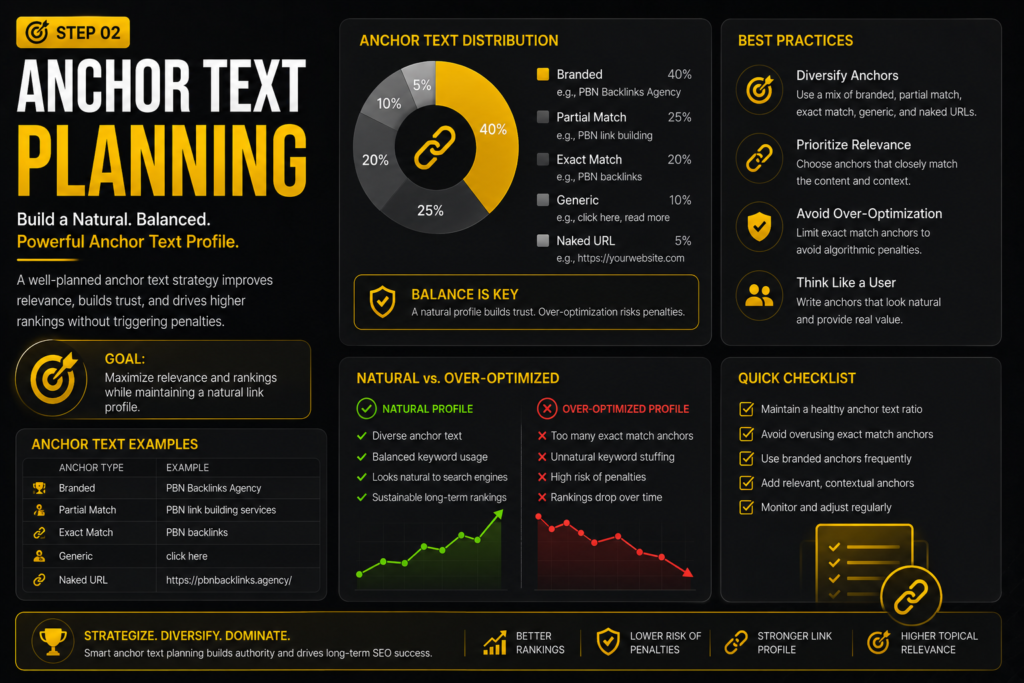
Anchor text planning must happen before the first link is ordered. Over-optimised anchors from early in a campaign create constraints that cannot be undone without building many more links to dilute the ratio — an expensive fix for an avoidable problem. The anchor plan is a pre-campaign document that specifies the exact anchor text for every link in the campaign before any link is placed.
Building the anchor text plan
Step 1: Check the current Ahrefs Anchors report for the target page. Export and categorise every existing anchor into: exact match, partial match, branded, naked URL, generic. Calculate the current percentage in each category.
Step 2: Check the competitive anchor distribution from the Phase 1 SERP audit. What percentage of exact match anchors do top-ranking pages carry?
Step 3: Calculate your anchor budget. If the competitive norm is 8% exact match and your current profile is already at 6%, you have budget for 2 more percentage points of exact match before hitting the competitive threshold. If you plan to build 50 total new links, that is approximately 1 new exact match link per 50 built.
Step 4: Distribute the remaining 49 links across partial match (10–12 links), branded (8–10 links), naked URL (8–10 links), and generic (18–20 links) — calibrated against what the SERP competitive analysis showed is normal.
Step 5: Write out the specific anchor text for each link before ordering. For a 20-link first month, list 20 specific anchor texts. Generic anchors might be: “read more here,” “full guide,” “visit this page,” “more information.” Partial match: “best CRM for small teams,” “CRM software comparison UK.” Branded: your exact brand name, your brand name plus a descriptor.
This anchor plan document is then submitted with every link order — not “use relevant anchor text” but the specific anchor for each specific link. The full distribution science is in our exact match anchor text guide.
Phase 4: Velocity management and campaign sequencing
Link velocity — the rate at which new referring domains appear in your backlink profile — is one of the most important risk signals in any PBN campaign. Both too fast and unnaturally uneven velocity create detection flags. The goal is steady, predictable, gradual accumulation that mirrors organic growth patterns.
Velocity benchmarks by site profile
| Site profile | Monthly new RD target | Campaign structure |
|---|---|---|
| New site (0–6 months, under 20 RDs) | 3–6 | 2–3 Tier 1 + social signals and citations |
| Early site (6–18 months, 20–80 RDs) | 5–10 | 5–8 Tier 1 + 2–3 Tier 2 batches on existing pages |
| Growing site (18 months–3 years, 80–300 RDs) | 10–20 | 10–15 Tier 1 + structured Tier 2 on all Tier 1 pages |
| Established site (3+ years, 300+ RDs) | 15–30 | Mixed Tier 1 + niche edits + Tier 2 amplification |
| Authority site (500+ RDs, competitive niche) | 25–50 | Full tiered programme + editorial outreach supplement |
The monthly campaign sequence
Within each month, links should be spread across weeks rather than ordered and delivered simultaneously. A 15-link monthly campaign delivered in three weekly batches of 5 links each looks significantly more natural than 15 links appearing simultaneously. Instruct providers to deliver across weeks 2–4 of each month, not in a single batch at the start of the month.
The sequence across months should also vary — some months slightly heavier, some slightly lighter. A precisely consistent 15 links every month for 12 consecutive months looks more mechanically manufactured than a natural variation of 10, 18, 12, 15, 8, 20, 14, 16, 11, 17, 13, 15 across the same period.
Phase 5: Tier 2 amplification strategy
Tier 2 link building is the most underused leverage point in PBN strategy. Most practitioners focus entirely on Tier 1 and never invest in the supporting infrastructure that multiplies the equity each Tier 1 link passes. The strategic case for Tier 2 is simple: it is the cheapest way to get more equity from existing Tier 1 links without building new ones.
When to deploy Tier 2
Deploy Tier 2 links to Tier 1 article pages approximately 2–3 weeks after each batch of Tier 1 links are confirmed indexed. This delay allows you to establish a baseline URL Rating for each Tier 1 article page before Tier 2 activity begins — which is necessary for measuring whether Tier 2 is working.
Tier 2 deployment priority: focus Tier 2 budget on the Tier 1 article pages linking to your highest-priority commercial money pages. If 15 Tier 1 links were placed this month and 5 of them point to your most valuable money page, those 5 article pages get the bulk of the Tier 2 activity — social bookmarks, Web 2.0 posts, forum profile links, and optionally secondary PBN links.
For the complete Tier 2 source mix, automation guidance, and measurement framework, see our second tier link building guide.
Budget allocation between Tier 1 and Tier 2
A healthy budget allocation for a full tiered strategy is approximately 75–80% Tier 1 and 20–25% Tier 2. On a £1,000 monthly link building budget: £750–£800 for Tier 1 PBN placements (15–20 quality standard links at £40–£50 each), £200–£250 for Tier 2 amplification across the Tier 1 article pages from the current and previous months.
This allocation produces compound results — each month Tier 1 links are placed, Tier 2 activity raises their URL Rating, which increases the equity they pass to money pages, which produces ranking movement that accumulates month over month.
Phase 6: Measurement and iteration
Measurement is where most PBN campaigns fail strategically — not because the links are not working but because the wrong metrics are being tracked and the wrong conclusions are drawn from early data.
The correct measurement hierarchy
Week 1–3 after each Tier 1 batch: Indexation confirmation. Verify each Tier 1 article page is indexed using a site: search for each URL in Google. Unindexed links pass no equity. If links are not indexing within 3 weeks, investigate — the PBN sites may have crawl frequency issues or the content may have quality problems preventing indexation.
Week 3–6 after each Tier 1 batch: Tier 1 article page URL Rating. Check UR on each Tier 1 article URL in Ahrefs weekly. UR improvement on these pages is the leading indicator that equity is flowing. No UR improvement after 6 weeks means the links are being discounted — diagnose before investing more budget in the same provider.
Week 4–8 after each Tier 1 batch: Money page URL Rating. Check UR on each money site target page monthly. UR improvement on target pages lags Tier 1 page UR improvement by one crawl cycle — typically 2–4 weeks. This is the confirmation that equity is flowing through the full chain from PBN article to money page.
Week 6–12 after each Tier 1 batch: Keyword ranking movement. Track weekly keyword positions for all target keywords using Ahrefs Rank Tracker or Semrush. First measurable ranking movement typically appears 6–10 weeks after Tier 1 deployment on established sites. Consistent directional improvement across multiple weeks is the signal the strategy is working. A single position improvement followed by regression is noise; three consecutive weeks of improvement is signal.
Diagnosing a campaign that is not working
If after 10–12 weeks of consistent Tier 1 deployment the money page UR has not improved and rankings are flat, work through the diagnostic hierarchy: Are Tier 1 links indexed? (site: check each URL). Are Tier 1 article pages showing UR improvement? (Ahrefs article URL check). Is the money page canonical URL correct — are links going to the canonical version? Is the anchor text distribution within safe parameters? Are there on-site technical issues preventing equity accumulation? The full penalty and diagnosis framework is in our Google penalties guide.
Advanced strategy considerations
Mixed link profile strategy
The strongest competitive link profiles in 2026 are not exclusively PBN — they combine PBN links (60–70% of total volume) with niche edits from aged editorial pages (15–20%), organic citation and directory links (5–10%), and some genuine editorial links from content promotion (5–10%). PBN links provide the controlled velocity and anchor text precision that pure outreach cannot match. Niche edits provide aged page authority and profile diversity. Organic citations provide the brand presence signals that make the profile look like a real brand. Together they create a profile that is both effective and algorithmically resilient.
For the niche edits integration, see our niche edits guide. For the white hat vs grey hat mix rationale, see our white hat vs grey hat SEO guide.
Niche-specific strategy adjustments
Local SEO: Lower authority thresholds (20–80 referring domains for page one), geographic relevance signals from local domain histories, NAP citation signals alongside PBN links. See our local SEO PBN guide.
YMYL niches (finance, health, legal): Higher domain quality requirements (TF 25+), lower exact match anchor tolerance (3–5%), slower velocity, content accuracy review on all PBN articles. See our finance and crypto PBN guide.
iGaming: Higher acceptable exact match tolerance (8–12%), niche-specific sports and entertainment domains critical, aggressive volume acceptable for established sites. See our casino backlinks guide.
eCommerce: Collection pages as primary targets, Shopify canonical URL discipline, product page link equity flow through collection pages. See our ecommerce PBN guide.
FAQ
What is PBN link building strategy?
A PBN link building strategy is a sequenced plan for acquiring private blog network links that closes a specific authority gap for specific target pages, within a velocity and anchor text framework calibrated against competitive norms, with Tier 2 amplification to multiply equity and a measurement framework to track progress against leading indicators (URL Rating, indexation) rather than lagging indicators (rankings alone).
How do I start a PBN link building campaign?
Start with a SERP audit: check the referring domain count and URL Rating of the top 5 pages ranking for each target keyword, calculate your authority gap, and benchmark the competitive anchor text distribution. From that audit, determine which pages to target (commercial money pages first), calculate the anchor text budget, set the monthly velocity appropriate for your site age, and write the anchor text plan for the first 3 months before ordering a single link.
How many PBN links should I build per month?
Site-age dependent: new sites 0–6 months should not exceed 3–6 new referring domains per month; established sites 18+ months can sustain 10–20 per month without triggering velocity concerns. Always spread delivery across 3–4 weeks within each month rather than ordering everything simultaneously. Vary monthly totals slightly rather than maintaining perfectly consistent numbers, which look mechanical.
What pages should I target with PBN links?
Commercial money pages first — product pages, category pages, comparison pages, feature pages, service pages. These pages almost never earn organic editorial links but generate revenue when they rank. Content and resource pages second — to build URL Rating on pages that can then internally link to commercial pages. Homepage third with branded anchors to build domain-level trust. Avoid sending all links to the homepage or exclusively to blog content.
How do I know if my PBN strategy is working?
Check these four indicators in sequence: Tier 1 links are indexed (site: search each article URL in Google), Tier 1 article page URL Rating is improving in Ahrefs (leading indicator), money page URL Rating is improving (2–4 weeks after Tier 1 page UR improves), and keyword rankings are moving directionally upward over 3+ consecutive weeks. Track URL Rating improvement before ranking movement — UR is the leading indicator, rankings are the lagging outcome.
Conclusion
A PBN link building strategy is distinguished from ad hoc link buying by one characteristic: every decision — which pages to target, which anchors to use, how many links per month, when to deploy Tier 2, which metrics to check — is derived from the SERP audit rather than from habit or convenience. The SERP tells you what competition level you are entering, what authority threshold you need to cross, and what link profile patterns Google has already determined look natural for that specific keyword and niche.
The six phases — SERP audit, page targeting, anchor planning, velocity management, Tier 2 amplification, and measurement — form a complete, integrated framework. Each phase builds on the previous one. Skipping any phase produces predictable failures: campaigns that build the wrong pages, over-optimise anchor text, create velocity spikes, waste budget on Tier 1 links that pass minimal equity for lack of Tier 2 support, or run for months without measuring whether the links are actually working.
Ready to execute a strategy built around your specific SERP and target pages? PBN backlinks — campaign strategy consultation available, all niches, white label for agencies. Supporting guides: anchor text strategy, backlink equity mechanics, Tier 2 amplification guide, ranking timeline guide, niche edits for mixed profile strategies, and our Google penalties guide for risk management.

Ben Davis is a seasoned SEO strategist with over a decade of hands-on experience in off page SEO, link building, and private blog network management.
He has helped 600+ agencies and professionals achieve top rankings in competitive niches including iGaming, crypto, CBD, and finance through data driven PBN strategies.