



Niche edits also called link insertions or curated links are one of the most misunderstood link building tactics in SEO. They are not the same as PBN links, they are not the same as guest posts, and they are not inherently safer or riskier than either. They are a distinct link type with their own mechanics, quality signals, and appropriate use cases. This guide explains exactly what niche edit links are, how they work technically, what makes a good one versus a bad one, when to buy niche edits instead of PBN links, and when to use both together for a diversified link profile that outperforms either approach alone.
Table of Contents
- What are niche edits?
- How niche edit links work technically
- Niche edits vs PBN links: the honest comparison
- Niche edits vs guest posts
- How to buy niche edits — what to check before paying
- When to use niche edits, when to use PBN links, when to use both
- Risks and red flags
- FAQ
- Conclusion
Key Takeaways
- Niche edits are backlinks inserted into existing, already-indexed articles on real websites — not new content created specifically to host a link.
- Because the linking page is already indexed and has its own referring domains and URL Rating, niche edits can pass equity faster than new guest posts or new PBN articles that need to index from scratch.
- The key quality difference from PBN links: with niche edits, the website owner retains editorial control of their site and is paid for access to existing content — with PBN links, the network operator controls the entire domain and places links as required.
- Buying niche edits safely requires verifying that the linking page has genuine organic traffic, real topical relevance, and was not built specifically to sell links.
- The strongest link profiles combine niche edits (aged page authority, fast equity transfer), PBN links (controlled placement, velocity management), and editorial outreach (trust signals). Each serves a different function.
What are niche edits?
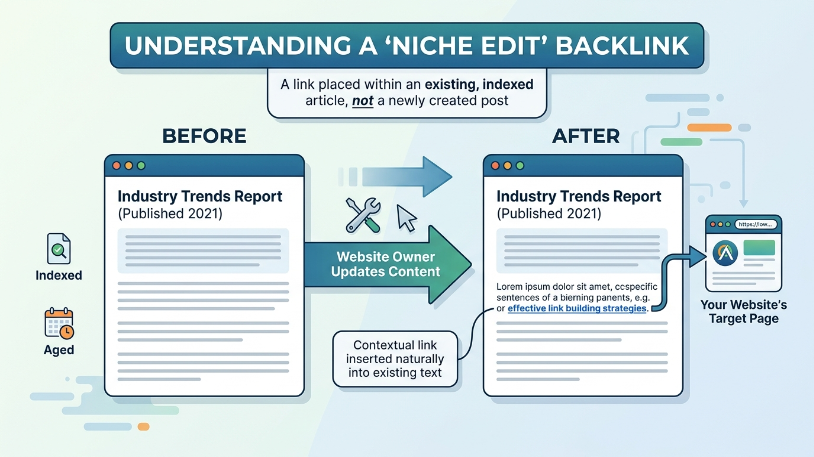
A niche edit is a backlink placed inside an article that already exists on a website — not inside a new article written specifically to host your link. The website owner updates an existing, indexed piece of content by inserting a contextual link to your target page somewhere within the body of the article.
The defining characteristic is that the linking page already exists, already has its own backlinks, and already has a URL Rating. You are buying access to an established page authority rather than waiting for a new page to accumulate authority after publication. This is what separates niche edits from both guest posts (new content) and PBN links (controlled network content).
Other names for the same tactic: link insertions, curated links, curated backlinks, contextual link insertions. The terms are used interchangeably across the industry.
A simple example
A fitness blog published an article about “best recovery tools for runners” in 2022. That article has since accumulated 45 referring domains and ranks on page one for several related queries. A sports nutrition brand pays the blog owner to insert a contextual link to their protein supplement page within the existing article — something like “adequate protein intake is as important as recovery tools, and a quality whey protein supplement accelerates muscle repair.”
The sports nutrition brand now has a link from an established, ranking, trusted page that already has authority — without waiting months for a new article to accumulate the same signals.
How niche edit links work technically
The technical advantage of niche edits comes from a simple fact of how Google evaluates pages: an article that has been indexed for two years, has 45 referring domains pointing to it, and ranks for several queries carries significantly more URL Rating than a brand new article published yesterday. When that established page links to your site, it passes equity drawn from two years of accumulated authority.
A new guest post or a new PBN article starts with near-zero URL Rating. It has to accumulate its own backlinks before it passes meaningful equity to the money site. A niche edit on an aged, linked-to page passes equity immediately because the page already has it.
The equity mechanics — how URL Rating determines the amount of authority passed per link — are covered in detail in our backlink equity guide. The short version: a niche edit on a page with UR 35 passes significantly more equity than a new PBN article with UR 5, even if the PBN domain has a higher DR overall.
The indexation speed advantage
New content — whether a guest post or a PBN article — takes 1–3 weeks to be indexed by Google before its link starts passing equity. A niche edit on an already-indexed, frequently-crawled page can appear in Google Search Console as a new referring page within 24–72 hours of the edit being made. For time-sensitive campaigns with ranking windows (seasonal content, product launches, competitive pushes), this indexation speed advantage is significant.
Niche edits vs PBN links: the honest comparison
This is the comparison most link building guides avoid making honestly. Here it is without the marketing spin from either side.
| Factor | Niche edits | PBN links |
|---|---|---|
| Who controls the site | Independent owner paid for access | Network operator (same entity as link buyer) |
| Content on linking page | Pre-existing, often ranking content | New article created for the placement |
| URL Rating of linking page | Often high — page has aged and accumulated links | Variable — depends on how well the PBN article is supported |
| Indexation speed | Fast — page already indexed and crawled regularly | 1–3 weeks — new content needs to be discovered and indexed |
| Anchor text control | Limited — owner may restrict exact match anchors | Complete — operator places exactly what you specify |
| Detection risk type | Pattern of paid editorial access — less systematic | Network infrastructure footprints — more systematic |
| Cost per link | £50–£200 typical for quality placements | £20–£80 typical for quality PBN placements |
| Scalability | Limited by available inventory on real sites | High — network can produce volume on demand |
| Content quality | Pre-existing real content — typically high | Variable — depends entirely on PBN operator standards |
Where niche edits win
Niche edits typically outperform PBN links in three situations. When the linking page has very high URL Rating from genuine organic link accumulation — the per-link equity passed is higher than most PBN articles can provide. When you need fast indexation — a niche edit on a high-traffic, frequently-crawled page shows up in your backlink profile within days. And when your link profile already shows high PBN concentration — adding niche edits from genuinely independent sites diversifies the profile and reduces concentration risk, as covered in our complete PBN SEO guide.
Where PBN links win
PBN links outperform niche edits in three situations. When you need to specify exact anchor text precisely — niche edit sellers often resist exact match commercial anchors because they are aware of the risk. When you need volume quickly — PBN networks can produce 50 links in a month; niche edit inventory at quality thresholds is much more limited. And when you need single-outbound-link placement — PBN articles can be set up with one outbound link, maximising the equity passed; niche edit pages already have multiple outbound links competing for PageRank.
Niche edits vs guest posts
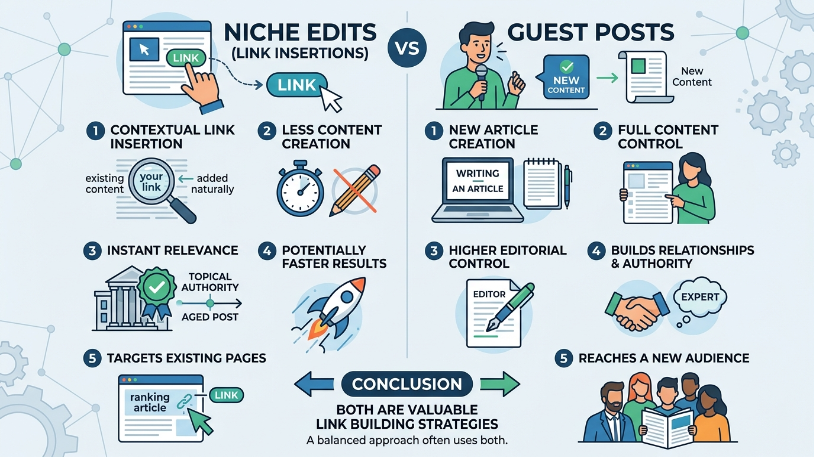
The comparison between niche edits and guest posts is cleaner than the PBN comparison because both involve real, independent websites — the difference is purely in whether the linking content is new or existing.
Guest posts: You write (or commission) a new article that gets published on a website. The article starts with near-zero URL Rating and takes weeks to index and months to accumulate its own backlinks. The new article can be crafted specifically to make your link placement feel natural. The linking page is entirely new — it has no authority to pass until it earns some.
Niche edits: Your link gets inserted into an article that already exists, already ranks, and already has URL Rating. The equity transfer is immediate and often larger per link than a new guest post. However, you are inserting into content that was written for a different purpose — your link needs to fit contextually or it looks awkward and may attract quality reviewer attention.
Which is better depends on the specific page available. A guest post on a high-DR domain where your article gets internal links from high-UR pages outperforms a niche edit on a low-traffic, low-UR page. A niche edit on a genuinely ranking, high-UR article outperforms a guest post that will sit as an orphaned new article with no internal links for months.
How to buy niche edits — what to check before paying
The niche edit market contains more low-quality inventory than the PBN market, because the barrier to entry is lower — anyone with a website can sell a link insertion, and many sites are built specifically for this purpose while presenting themselves as genuine content sites. When you buy niche edits, these five checks protect you from paying for links that deliver no value.
Check 1: Does the linking page have genuine organic traffic?
Open the specific article URL — not the domain — in Ahrefs Site Explorer and check its organic traffic estimate. A quality niche edit page should show organic traffic from Google, not just direct or referral traffic. A page with zero organic traffic is either not indexed, not ranking, or exists purely as a link-selling vehicle. All three make it a low-value placement regardless of domain metrics.
Check 2: Is the page topically relevant to your money site?
Relevance at the page level matters more than domain level. A fitness blog with an article specifically about running recovery is more relevant for a sports nutrition link than a general marketing blog with an article that mentions sports once. Check the article topic, the surrounding paragraph where your link will be placed, and whether the anchor text can fit naturally in that context.
Check 3: How many outbound links does the page already have?
Every outbound link on a page competes for the page equity. A page with 2 outbound links passes roughly half the equity per link versus the same page with 1 outbound link. A page with 15 outbound links is sharing its equity 15 ways. Check the outbound link count in Ahrefs before buying. More than 5–6 outbound links on a niche edit page significantly reduces per-link value. This PageRank dilution principle is explained in our backlink equity guide.
Check 4: Was the site built to sell links?
Sites built specifically to sell niche edits often show these signals: a broad range of unrelated topics all published within a short time window, no social media presence or community engagement, bylines attributed to generic names with no verifiable online presence, and a contact page or sidebar advertising link placements. Check the site age in Wayback Machine and look at whether the content history reflects a genuine editorial evolution or a sudden burst of topic-diverse content.
Check 5: Is the link dofollow and contextual?
Confirm dofollow placement in the body content of the article — not in a footer, sidebar, or author bio. Links in body content pass significantly more equity and carry stronger topical relevance signals than sitewide or navigational links. Verify after placement by checking the rel attribute in Ahrefs Backlinks report.
When to use niche edits, when to use PBN links, when to use both
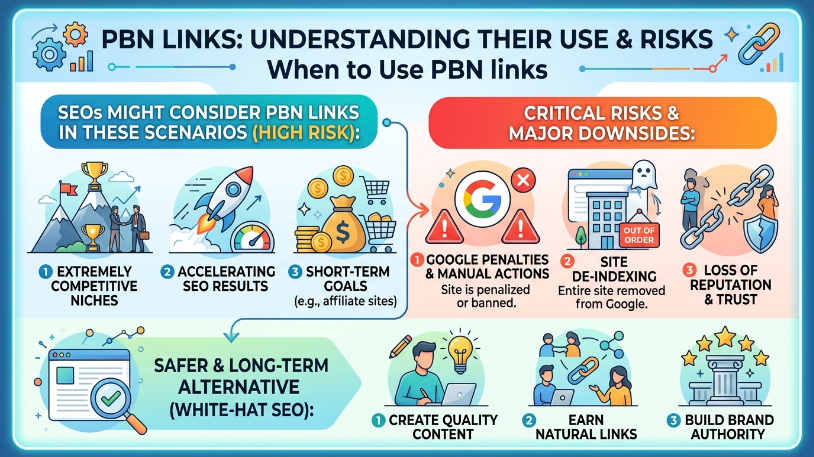
Use niche edits when:
- You need fast indexation — a product launch, seasonal window, or competitive push where 3 weeks of PBN indexation delay is commercially costly
- Your PBN concentration is already high and you need profile diversity — niche edits from genuinely independent sites balance a profile that has become too PBN-dependent
- The available inventory includes high-UR pages (UR 25+) that pass more equity per link than your typical Tier 1 PBN articles
- The target keyword has informational search intent — niche edits inside relevant existing editorial content reinforce topical relevance signals more naturally than commercial PBN article placements
PBN links when:
- You need to specify exact anchor text — niche edit sellers typically resist exact match commercial anchors
- You need volume quickly — PBN networks can produce 20–50 links per month; quality niche edit inventory is more limited
- You need single-outbound-link placement for maximum equity transfer per link
- You are targeting commercial pages (product, category, pricing) that need direct authority injection — see our PBN links for ecommerce guide for specific commercial page targeting
Use both together when:
The strongest link profiles are mixed. A typical high-performing campaign might use PBN links for 60–70% of total volume (controlled anchor text, predictable velocity, commercial page targeting) and niche edits for 30–40% (aged page authority, profile diversity, fast indexation on priority pages). This combination delivers both the authority count that PBN links build efficiently and the topical credibility signals that established editorial content provides. Our outsource link building guide covers how to brief an agency to deliver this mixed approach correctly.
Risks and red flags
Niche edits carry similar risk profiles to PBN links — they are paid link placements that violate Google webmaster guidelines — but with different detection mechanisms. Google detects PBN networks through infrastructure footprint analysis. It detects paid niche edits through pattern analysis: pages with high numbers of outbound links to unrelated domains, sites with histories of consistent paid link selling, and anchor text patterns across multiple purchased placements.
The biggest red flag to avoid: sites that sell niche edits at high volume with no quality control on who they link to or in what context. These sites accumulate so many diverse outbound links across unrelated niches that Google identifies them as link-selling operations — and links from identified link sellers can be discounted or trigger quality reviews on the recipient site.
The anchor text risk: because niche edits are placed in pre-existing content written for a different purpose, forcing exact match commercial anchors creates an obviously unnatural insertion. The safest anchor text for niche edits is partial match, branded, or generic — exactly the types that read naturally in an existing sentence. Over-optimised anchors on niche edits are at least as risky as on PBN links — see our anchor text strategy guide.
For the full penalty risk framework including how Google detects paid link patterns across both niche edits and PBN links, see our Google penalties guide.
FAQ
What are niche edits in SEO?
Niche edits are backlinks inserted into existing, already-indexed articles on real websites. Unlike guest posts (new content written specifically to host a link) or PBN links (links placed on network-controlled domains), niche edits leverage the existing URL Rating of an established page. The website owner is paid to update their existing content with a contextual link to your target page.
Are niche edits better than PBN links?
Neither is universally better — they serve different functions. Niche edits offer faster indexation, aged page authority, and profile diversity. PBN links offer complete anchor text control, higher scalability, and single-placement equity maximisation. The strongest link profiles use both: PBN links for controlled volume and commercial page targeting, niche edits for high-UR page authority and profile diversification.
How do I buy niche edits safely?
Verify five things before any niche edit purchase: the specific article URL has organic traffic in Ahrefs (not just domain-level metrics), the page topic is genuinely relevant to your money site, the page has fewer than 5–6 existing outbound links, the site was not built primarily to sell links (check Wayback Machine), and the placement will be dofollow in body content not footer or sidebar.
How much do niche edits cost?
Quality niche edits on genuinely established, ranking pages typically cost £50–£200 per placement in the UK market. Lower prices (£10–£30) typically indicate sites built specifically for link selling with low-quality or no organic traffic. Higher prices (£200–£500) may be justified for placements on high-UR pages with significant topical authority in competitive niches like finance, health, or legal.
Do niche edits work in 2026?
Yes — niche edits on genuinely established, topically relevant, organically-trafficked pages remain one of the most effective link building tactics available. The Google Helpful Content Update and SpamBrain improvements have reduced the effectiveness of low-quality niche edits on sites built to sell links, but high-quality placements on real editorial sites continue to produce strong ranking impact. The quality bar has risen, not the fundamental effectiveness.
Conclusion
Niche edits are a legitimate and effective link building tactic when executed with the same quality discipline that separates effective PBN campaigns from risky ones. The aged page authority advantage is real — a genuinely ranking, high-UR page passes more equity per link than most new PBN articles — and the indexation speed advantage is meaningful for time-sensitive campaigns.
The decision between niche edits and PBN links is not about which is safer or better in the abstract. It is about what each provides that the other cannot: niche edits provide aged editorial authority and fast indexation; PBN links provide controlled anchor text, volume, and commercial page targeting precision. Used together, they create a link profile that delivers both faster results and better algorithmic resilience than either tactic alone.
Build a mixed link profile that combines the best of both approaches. PBN backlinks and link building services — quality-controlled PBN placements, white label delivery, all niches accepted. Supporting guides: complete PBN SEO guide, backlink equity — aged pages vs new placements, anchor text strategy for niche edits and PBN, Google penalties — paid link detection patterns, outsource link building — briefing for mixed campaigns, and our white label link building guide.

Ben Davis is a seasoned SEO strategist with over a decade of hands-on experience in off page SEO, link building, and private blog network management.
He has helped 600+ agencies and professionals achieve top rankings in competitive niches including iGaming, crypto, CBD, and finance through data driven PBN strategies.