


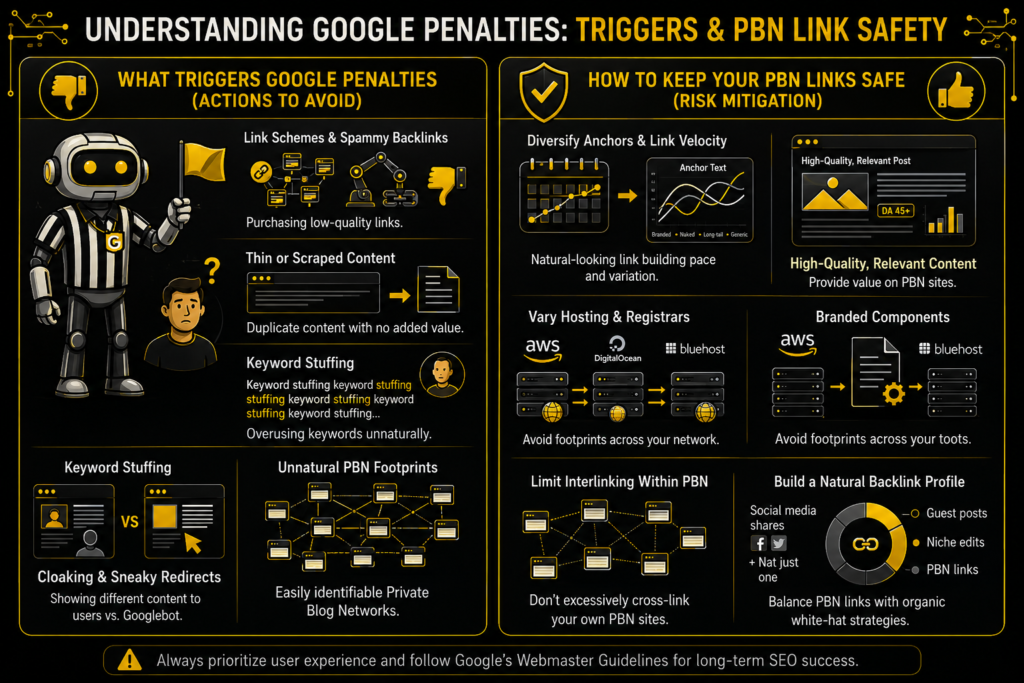
Google penalties are one of the most feared outcomes in SEO — and one of the most misunderstood. Most SEOs cannot reliably distinguish between a genuine manual action, an algorithmic suppression, and a normal ranking fluctuation following a core update. Making the wrong diagnosis leads to the wrong remediation: disavowing perfectly good links that hurt rather than help, or attributing a content quality problem to link issues and rebuilding the wrong signal. This guide provides the clearest available 2026 explanation of what Google penalties actually are, how they differ, what specific link-related patterns trigger them, and what execution disciplines keep a grey hat link profile from crossing into penalty territory. It also covers what the Google Helpful Content Update means for PBN content quality, and the complete recovery strategy for sites that have already received a link-related penalty.
Table of Contents
- Introduction: why most SEOs diagnose penalties wrong
- Algorithmic vs manual penalties: the critical distinction
- Link-related patterns that trigger Google penalties in 2026
- How well-built PBN links avoid the patterns Google targets
- The Google Helpful Content Update: what it means for PBN content
- Disavow file strategy: when to use it and how
- Recovery strategy after a link-related penalty
- SEO expert advice: the pre-campaign audit that prevents most penalty risk
- FAQ
- Conclusion
Key Takeaways
- Google penalties fall into two categories: manual actions (human reviewer, Search Console notification, defined recovery process) and algorithmic demotions (automated, no notification, requires fixing the underlying issue).
- Penguin has been running continuously as part of Google core algorithm since 2016 — there is no “next Penguin update” to wait for. Penalty and recovery happen as Google recrawls.
- The six link-related patterns that trigger penalties: simultaneous bulk link indexation, over-optimised anchor text, shared hosting infrastructure footprints, thin PBN article content, network concentration, and coordinated linking patterns.
- The Google Helpful Content Update, integrated into core algorithm in March 2024, directly affects PBN effectiveness — thin AI filler content on PBN sites fails the classifier and reduces equity contribution.
- Disavow is not a first resort — only appropriate for confirmed manual actions on unnatural links and verified negative SEO attacks. Incorrect disavow use causes ranking damage that takes months to reverse.
Introduction: why most SEOs diagnose penalties wrong
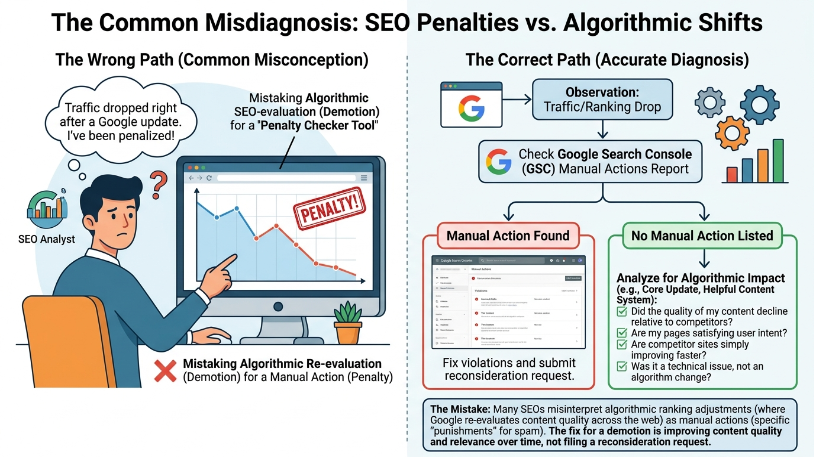
The word “penalty” is used loosely in SEO to describe any significant ranking drop. This imprecision causes real harm: if you treat an algorithmic content quality suppression as a link penalty and disavow your link profile, you compound the problem. If you treat a manual action as a temporary algorithm fluctuation and wait it out, you miss the defined recovery window.
The correct diagnostic process is precise. A Google penalty in the formal sense is a ranking loss caused by violating Google search quality guidelines. The key question is whether the violation was identified by a human reviewer (manual action) or by an automated system (algorithmic demotion). These have fundamentally different remediation paths. The first tool to open is not Ahrefs — it is Google Search Console. Log in, go to Security and Manual Actions, and click Manual Actions. If the page says “No issues detected,” you do not have a manual action. Everything else is an algorithmic signal. For background on how PBN links interact with Google systems, see our complete PBN SEO guide and PBN links explainer.
Algorithmic vs manual penalties: the critical distinction
Understanding this distinction is the most important SEO expert advice in this entire guide. Getting it wrong is the single most common error in penalty recovery work.
Manual actions: what they are and how they work
A manual action happens when a human reviewer at Google Search Quality team examines your site and determines it violates spam policies. You receive a notification in Search Console under Security and Manual Actions with the specific violation and which pages are affected. Common triggers: unnatural inbound links, thin content with little value, cloaking or sneaky redirects, pure spam violations, and user-generated spam that the site owner has not moderated. Recovery follows a defined process: fix the specific violation, submit a reconsideration request through Search Console, and wait (typically 2-4 weeks for standard cases).
Algorithmic demotions: the major systems in 2026
SpamBrain: Google AI system for detecting link spam and other manipulative practices. Handles the majority of automated link scheme detection. In 2026, SpamBrain processes billions of links cross-referencing patterns at machine speed. The window between “PBN built” and “PBN detected” continues to narrow with each algorithm update.
Penguin (continuous core algorithm): Originally launched 2012, Penguin targets unnatural backlink profiles. Critically — Penguin has been running continuously as part of the core algorithm since 2016. There is no “next Penguin update” to wait for. Penalty and recovery happen as Google recrawls and reindexes affected pages. Fixing a Penguin-flagged link profile produces gradual recovery as Googlebot recrawls rather than requiring a specific update cycle.
Helpful Content System (continuous core algorithm): Integrated into the core algorithm in March 2024, evaluating content quality continuously. Covered in detail in Section 5.
Core Updates: Broad reassessments occurring as discrete major events. The March 2026 Spam Update being the most recent significant one. Unlike Penguin and Helpful Content which run continuously, core updates happen on cycles.
Link-related patterns that trigger Google penalties in 2026
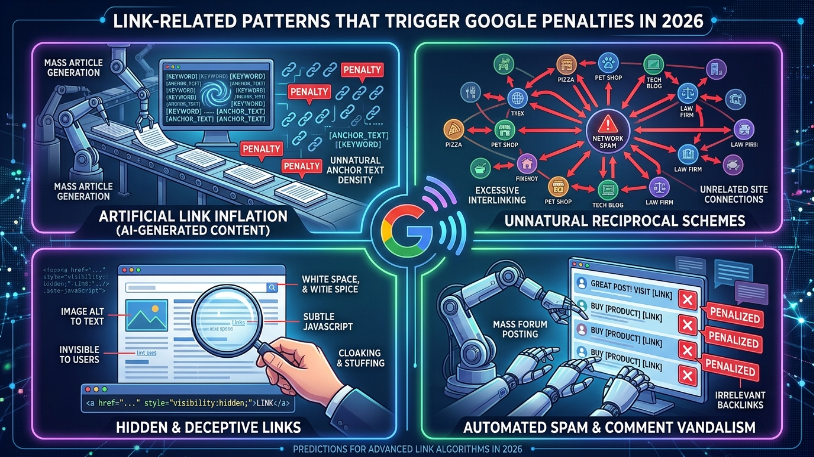
In 2026, Google SpamBrain is highly effective at detecting link manipulation patterns even when disguised across multiple domains and IP addresses. Understanding which patterns trigger detection is the practical knowledge that separates PBN campaigns that hold rankings from those that collapse under spam updates.
Pattern 1: Simultaneous bulk link indexation
When 50, 100, or 500 links appear in Google index on the same day or within a few days, the velocity spike triggers algorithmic review regardless of individual link quality. Natural link profiles accumulate links gradually across weeks and months. The prevention: gradual indexation across 3-4 weeks for any link building campaign.
Pattern 2: Over-optimised anchor text distribution
Exact match commercial anchor text representing 20-40% of a site total referring domains creates the pattern that Penguin was specifically built to detect. The overwhelming majority of organic editorial links use branded anchors, generic anchors, or naked URLs. A link profile where 30% of anchors are “buy running shoes online” is statistically impossible to generate organically. Full safe distribution framework: see our exact match anchor text guide. Short version: 5-8% exact match maximum, 20-25% partial match, 15-20% branded, 50-60% generic and naked URLs.
Pattern 3: Shared hosting and infrastructure footprints
Multiple PBN sites hosted on the same server, using the same IP range, registered through the same registrar with same WHOIS information, or using the same theme fingerprint represent the most technically detectable PBN pattern. Public PBN networks that advertise their existence openly have already been partially mapped by Google systems.
Pattern 4: Thin PBN article content
A 200-word PBN article with keyword mentions and a single outbound link passed Google content quality threshold in 2016. In 2026, after the integration of the Helpful Content system into the core algorithm, the same article fails the content classifier that now evaluates every indexed page. Thin PBN content creates two simultaneous problems: the hosting page is flagged as low-quality, reducing equity it passes, and the linking domain accumulates quality signals that make it a less credible link authority over time.
Pattern 5: Network concentration
A site that has 800 of its 1,000 backlinks from the same PBN network has a detectable concentration pattern. Even if individual links look clean, the statistical footprint of 80% of referring domains from a single provider creates an implausibly narrow link acquisition pattern. See our backlink equity guide for the diversification structure.
Pattern 6: Coordinated linking timing
SpamBrain analyses billions of links looking for coordination signals — groups of sites that behave more like a coordinated network than independent editorial publishers. Multiple sites consistently linking to the same money sites using similar anchor text patterns within similar time windows creates detectable coordination. The prevention: vary timing of link placement, allow 2-4 week gaps between link batches to break coordination timing signals.
How well-built PBN links avoid the patterns Google targets
The six penalty-triggering patterns above are all detectable and all avoidable with correct execution. The quality controls that distinguish safe PBN campaigns from risky ones map directly onto each detection mechanism.
- Against velocity spikes: Gradual indexation across 3-4 weeks. Specify gradual delivery as a hard requirement with any provider.
- Against anchor over-optimisation: Plan anchor text before each campaign. Never delegate to provider defaults. Maintain a running anchor log for each client domain. Audit Ahrefs Anchors report monthly.
- Against infrastructure footprints: Use providers with verified hosting diversity — different IP ranges, different hosting accounts, different registrars. Verify by checking Ahrefs referring domains for IP range concentration.
- Against thin content: PBN articles must meet the Helpful Content standard — minimum 600 words of substantive, topically coherent content. See next section for full implications.
- Against concentration: Use multiple PBN providers. Supplement with niche editorial links, directory citations, and social signals. No single source should represent more than 40-50% of links built in any period.
- Against coordination patterns: Vary timing across campaigns. Never place all links for a site in the same week across multiple providers.
For a full quality evaluation framework when selecting a PBN provider or white label service, see our white label link building guide.
The Google Helpful Content Update: what it means for PBN content
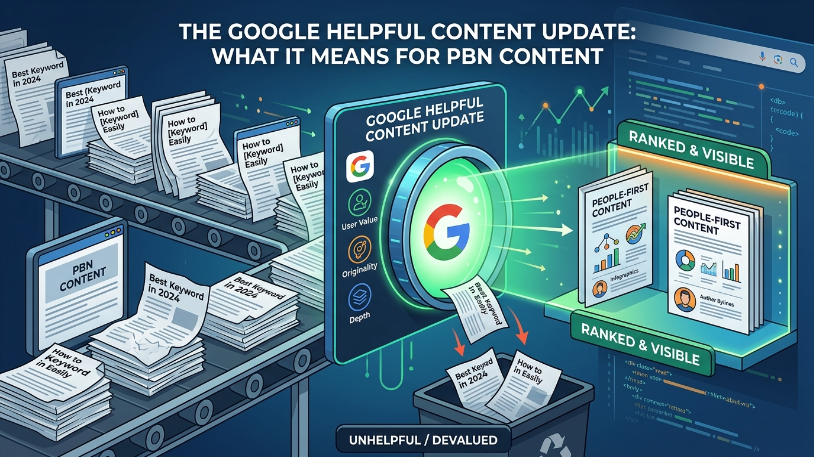
The Google Helpful Content Update is the most significant change to PBN content quality requirements in years. Not as a separate update to manage — but as a permanent integrated algorithm component running continuously on every indexed page.
What the Helpful Content Update actually is in 2026
The Helpful Content system began as a standalone update in August 2022. In March 2024, Google integrated it into the core ranking algorithm as a permanent, continuous classifier. The system generates a site-wide signal: if a website has a relatively high amount of unhelpful content, even its helpful pages may perform worse in search results. This site-wide assessment is the most important implication for PBN networks — a domain that has accumulated thin, unhelpful content across many pages reduces the quality classification of the entire domain, including pages carrying your client links.
An analysis of the December 2025 core update found that completely unedited AI output published at scale resulted in 85-95% traffic losses. Even lightly edited AI content with minimal human input saw 60-80% drops. This is the scaled content abuse the Helpful Content system targets — not AI use per se, but AI use without quality oversight.
What the Helpful Content Update does NOT penalise
AI-generated content is not automatically penalised. An Ahrefs study of 600,000 pages found an AI-ranking correlation of just 0.011. Google penalises behaviour patterns, not AI use. “If a page feels helpful, specific, and genuinely written to answer a question, it passes. If it feels automated, generic, or padded just to rank, it does not.” The September 2023 revision dropped “written by people” — shifting to content created “for people.” Machine-generated content is not penalised solely for being machine-generated if it brings real value to readers.
What fails and what passes the Helpful Content classifier on a PBN site
Fails: 200-400 word filler articles with keyword mentions and a link, no substantive information; AI articles published without editing, fact-checking, or genuine added insight; articles that are topically incoherent (a fitness domain hosting a crypto article because a client needed a link); generic content that could have been generated by any tool for any audience.
Passes: 600-1,000+ word articles covering a topic in genuine depth relevant to the domain niche; content with specific details or practical information not easily found elsewhere; articles where the link placement is contextually appropriate; human-edited content, even if AI-drafted, that reflects genuine topical knowledge.
Disavow file strategy: when to use it and how
The critical principle: disavow is not a first resort. Disavow only works when you have a manual penalty on unnatural links or when your spam attack is so large and unquestionable that disavowal is clearly indicated. This tool is also easily abused and will damage your rankings even more if used incorrectly. When you have been struck by a Core Update or a Helpful Content filter, the issue is your content — not your backlink profile. Disavowing links will not fix a content quality demotion.
Correct and incorrect use cases
Correct: Confirmed manual action for unnatural inbound links (disavow is part of the reconsideration request process); verified large-scale negative SEO attack with clearly toxic links at scale. Incorrect: Preemptively disavowing good links to “clean up” the profile before a perceived penalty; disavowing after a core update or Helpful Content algorithmic demotion; disavowing PBN links you built yourself that are performing well.
How to build a disavow file correctly
- Export the full backlink profile from Ahrefs, Semrush, and Search Console
- Identify clearly toxic links: spammy directories, paid link networks, irrelevant foreign-language links, links from hacked sites
- Attempt removal first — contact webmasters for the most obvious toxic links before disavowing
- Disavow domains, not individual URLs (use domain:example.com format)
- Never disavow brand or topically relevant links — if in doubt, leave it
- Submit through Search Console at search.google.com/search-console/disavow-links
Recovery strategy after a link-related penalty
Manual action recovery (7 steps)
Step 1: Diagnose accurately. Confirm the manual action in Search Console. Read the exact violation language.
Step 2: Audit the backlink profile. Export from Ahrefs, Semrush, and Search Console. Identify the link patterns that likely triggered the manual action.
Step 3: Attempt link removal. Contact webmasters for the most obvious toxic links. Evidence of cleanup effort is required before a successful reconsideration request.
Step 4: Build the disavow file. Disavow remaining toxic links at domain level.
Step 5: Write the reconsideration request. Explain what caused the violation, what you have done to fix it, and what processes prevent recurrence. Be specific and honest — generic requests are rejected.
Step 6: Wait and monitor. Manual penalty removal typically 2-4 weeks after an approved reconsideration request. Confirmation appears in Search Console.
Step 7: Rebuild carefully. The first 3-6 months post-recovery should prioritise white hat editorial links, brand building, and content quality before reintroducing grey hat link building.
Algorithmic demotion recovery
No formal reconsideration mechanism — fix the underlying issue and wait for Google to recrawl and re-evaluate. For link-related algorithmic suppressions: audit and improve anchor text distribution, ensure no velocity spikes in recent history, verify PBN article content meets Helpful Content standard, reduce concentration if a single network dominates. For Helpful Content demotions: the issue is content quality, not the link profile. Identify low-quality pages, rewrite or consolidate them, and wait for the next crawl cycle. Recovery typically aligns with the next major crawl cycle — see our ranking timeline guide.
SEO expert advice: the pre-campaign audit that prevents most penalty risk
The most practical SEO expert advice for practitioners using PBN links is not about recovery — it is about the pre-campaign audit that makes recovery unnecessary. These five checks, performed before any link building campaign begins, prevent the patterns that trigger penalties.
The 5-check pre-campaign audit
Check 1: Baseline anchor text audit (Ahrefs Anchors report). Calculate the current exact match anchor percentage. If already at 8%+ exact match, do not add any more commercial anchors — next links should be generic and branded only until the profile rebalances.
Check 2: Existing PBN concentration audit. If more than 40% of referring domains already come from an identifiable network type (same hosting infrastructure, same theme fingerprints), the site is already at concentration risk. New link building should diversify before adding volume.
Check 3: Manual action check. Confirm no existing manual actions in Search Console before starting any link building campaign. Links built during an unresolved manual action are assessed in the context of a flagged profile.
Check 4: Velocity baseline check. Pull the Ahrefs referring domains trend for the past 12 months. New PBN link building should not exceed 150-200% of the existing baseline in any single month — velocity spikes above this threshold look unnatural regardless of individual link quality.
Check 5: Helpful Content baseline assessment. Review the client site content quality against the Helpful Content standard. A site with pervasive thin content issues that receives PBN links is building authority on a foundation that the Helpful Content system is simultaneously reducing. Fix content quality before investing in link building for structurally weak sites. Our guide on the white hat vs grey hat SEO spectrum covers the full strategic context.
FAQ
What is the difference between a Google manual action and an algorithmic penalty?
A manual action is applied by a human reviewer at Google Search Quality team and appears as a notification in Search Console under Security and Manual Actions with a specific violation description and defined recovery process. An algorithmic demotion is applied automatically with no Search Console notification. Recovery requires identifying and fixing the underlying issue (content quality, link quality, or both) and waiting for the algorithm to re-evaluate during the next crawl cycle or update.
What link patterns most commonly trigger Google manual actions?
The most common triggers are: over-optimised anchor text distribution with exact match exceeding 15-20% of referring domains, bulk link indexation in a short time window, links from sites with identical hosting infrastructure fingerprints, and thin low-quality content on linking pages. Manual actions require a human reviewer to have investigated and confirmed a violation. SpamBrain handles the majority of link quality assessments automatically without producing a manual action.
How does the Google Helpful Content Update affect PBN links?
The Helpful Content system, integrated into core algorithm in March 2024, evaluates every indexed page continuously as a site-wide signal. PBN articles that are thin, generic, or unedited AI output may fail the content classifier — reducing equity the linking page passes and degrading the quality classification of the entire PBN domain over time. Well-written PBN articles of 600+ words with genuine topical depth are not affected by the Helpful Content system.
When should I use the Google disavow tool?
Use the disavow tool only when you have a confirmed manual action for unnatural inbound links or a verified large-scale negative SEO attack. Do not disavow preemptively, do not disavow after algorithmic content quality demotions which are not link-related, and do not disavow good links you deliberately built that are performing well. Incorrect disavow use causes ranking damage that takes months to reverse.
How long does recovery from a Google link penalty take?
Manual action recovery typically takes 2-4 weeks after an approved reconsideration request. Algorithmic suppression recovery typically shows improvement within 4-12 weeks of remediation as Google recrawls affected pages (since Penguin runs continuously). Core update impacts can require waiting for the next major update cycle. Complex cases involving both link issues and content quality issues may take 3-6 months to fully recover.
Conclusion
Google penalties are preventable — not because PBN links are risk-free, but because the patterns that trigger penalties are detectable, understood, and avoidable with correct execution discipline. The six detectable patterns (velocity spikes, anchor over-optimisation, infrastructure footprints, thin content, concentration, coordinated timing) map directly onto six execution practices that prevent them.
The Helpful Content Update is the most significant operational change for PBN content quality in years. Thin PBN article content now has immediate and ongoing consequences via the continuous content classifier — not just periodic update-based ones. This makes content quality on PBN donor sites a first-order concern, not an afterthought.
Recovery from penalties is possible and documented. Manual actions have defined recovery processes. Algorithmic demotions respond to genuine remediation. The SEOs and agencies that manage grey hat link profiles durably are those who understand the specific risk profile of each tactic and manage it with the precision that intelligent risk management requires.
Keep your link profile safe and effective. Safe PBN SEO backlinks — quality-controlled network, gradual indexation standard, content quality reviewed on every placement. Supporting guides: anchor text strategy to avoid over-optimisation, backlink equity and profile diversification, white hat vs grey hat SEO breakdown, ranking timelines and recovery expectations, YMYL niche penalty risk guide, and our full PBN FAQ.

Ben Davis is a seasoned SEO strategist with over a decade of hands-on experience in off page SEO, link building, and private blog network management.
He has helped 600+ agencies and professionals achieve top rankings in competitive niches including iGaming, crypto, CBD, and finance through data driven PBN strategies.