


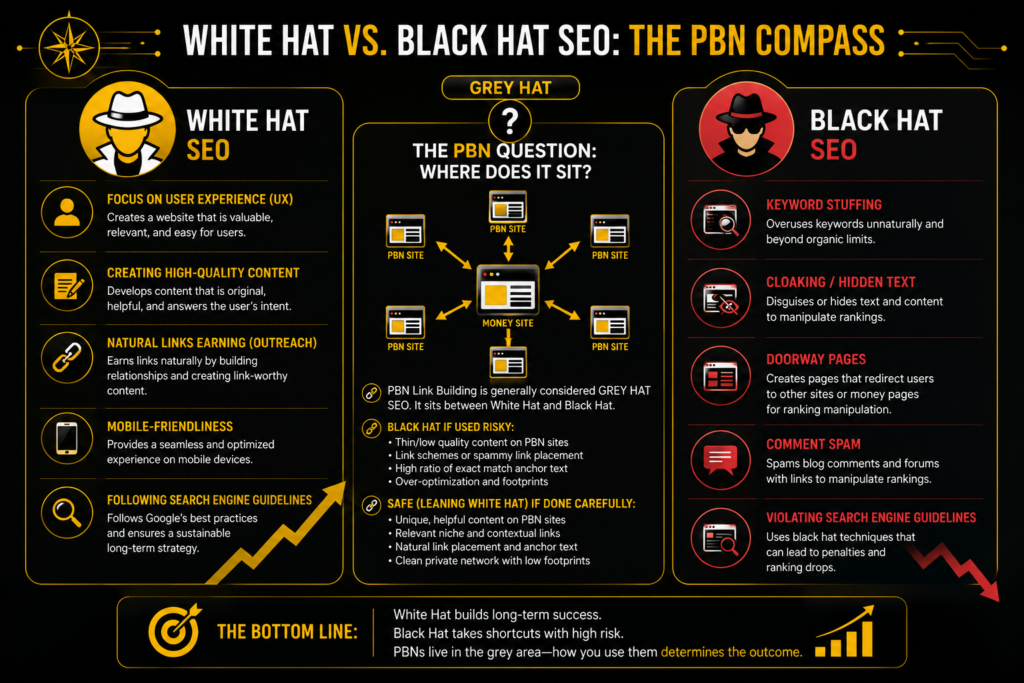
The white hat vs black hat SEO debate is older than most people working in digital marketing. And it is more complicated than either side typically admits. This article takes an honest, practical look at all three positions on the spectrum — white hat, grey hat, and black hat — defines each with real examples, and places PBN link building in its accurate position: not black hat, not white hat, but grey hat, with a specific risk profile that experienced practitioners weigh consciously.
The guide covers what whitehat SEO techniques actually involve and why they are both the safest and the slowest approach, what genuinely black hat SEO looks like and why it is categorically different from grey hat, and where the grey zone is — the area where the real world of competitive SEO actually operates. It also covers the risk-adjusted ROI case for each approach and the specific client scenarios where white hat alone fails to deliver on the timeline that matters. This is not a promotional piece for any particular tactic. It is the honest analysis that intermediate and advanced SEOs need to make informed strategic decisions.
Table of Contents
- Introduction: why the three-hat framework still matters
- What is white hat SEO? Definition and techniques
- What is black hat SEO? The real definition
- Grey hat SEO: where the real world operates
- Where PBN link building actually sits on the spectrum
- Risk-adjusted ROI: comparing all three approaches honestly
- When white hat alone is not fast enough
- Whitehat backlinks: building a sustainable foundation alongside PBN
- FAQ
- Conclusion: the honest verdict
Key Takeaways
- White hat SEO follows Google guidelines completely — sustainable, compounding, and slow. Black hat SEO deliberately deceives search engines — fast gains with high probability of catastrophic often unrecoverable penalties.
- Grey hat SEO occupies the space between them: tactics not explicitly prohibited but not fully guideline-compliant, carrying calculable risk rather than certain penalty.
- PBN link building is grey hat, not black hat — it uses real websites with real content to pass real authority signals, which distinguishes it from link farms, cloaking, and other tactics that are deceptive by design.
- The risk profile of grey hat SEO is manageable — it is not zero and anyone claiming otherwise is overselling — but it is meaningfully different from the near-certain penalties associated with black hat tactics.
- For clients with competitive timelines in established niches, a hybrid approach — white hat content and technical foundation, grey hat link acceleration — consistently outperforms either strategy alone over a 6-18 month horizon.
Introduction: why the three-hat framework still matters
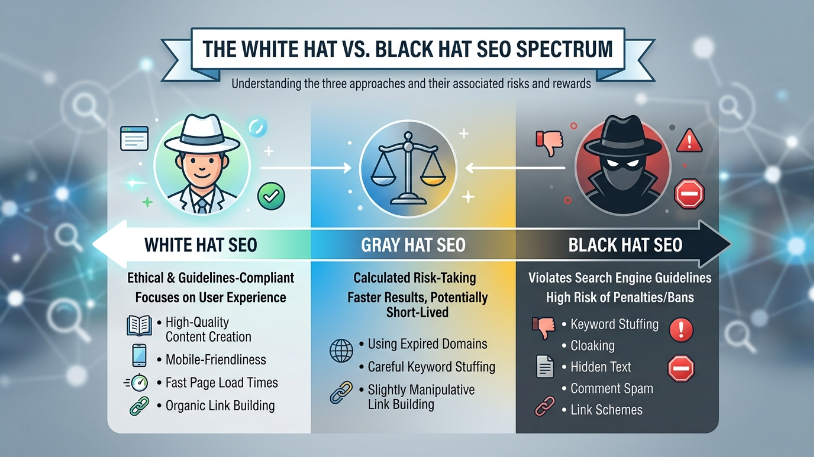
The terminology comes from American Western films: white hats for the heroes, black hats for the villains. The SEO industry borrowed it in the early 2000s to describe the difference between practitioners who follow search engine guidelines and those who deliberately circumvent them. In 2026, the framework remains useful — but only if applied honestly.
The problem with most white hat vs black hat discussions is that they are written by people with a commercial interest in one position. This guide is written from neither. It defines each category clearly, explains what distinguishes them from each other at a conceptual level, and places whitehat seo and its alternatives in honest comparative context. For a quick reference on PBN terminology used throughout, see our full PBN FAQ.
What is white hat SEO? Definition and techniques
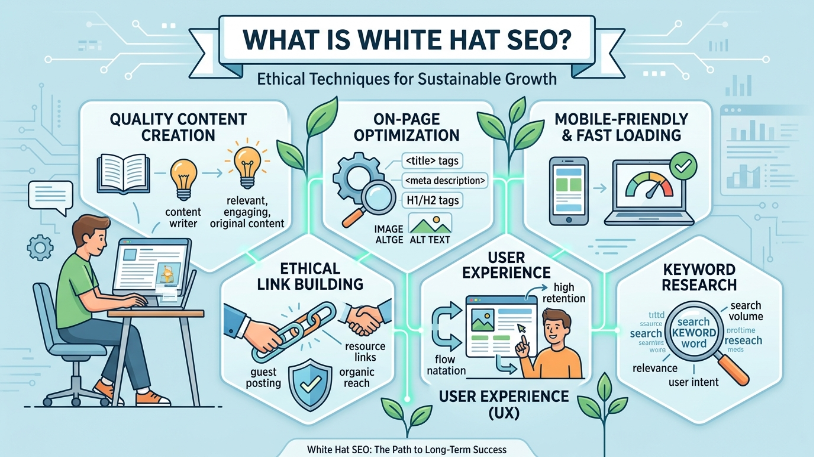
Whitehat SEO is the practice of optimising a website by following Google Search Essentials completely. Every tactic employed would survive Google explicit review without penalty, because every tactic is oriented toward improving genuine user value rather than manipulating ranking signals. The core principle is not just rule-following — it is intent alignment.
What is white hat SEO in practice?
White hat SEO techniques fall into three categories:
Content: Creating genuinely expert, original content that satisfies the full search intent of a query better than any competing page. Not optimised content — content that is the best available resource on a topic. Google Helpful Content System now evaluates content quality continuously.
Technical SEO: Ensuring the site is technically accessible, fast, mobile-optimised, and structurally sound. Correct canonical tags, structured data markup, clean internal link architecture, Core Web Vitals scores that match or exceed competitors. Technical SEO is the purest form of white hat — it improves user experience directly and has no ethical complexity.
Earned link building: Acquiring backlinks through editorial merit — digital PR campaigns, original research that journalists reference, tools and resources that naturally attract links, strategic outreach to relevant publications. The defining characteristic is that an independent editorial decision was made to link to you based on the quality of your content.
The honest limitations of white hat SEO
Time: Building genuine topical authority, earning links through outreach, and accumulating trust signals takes time. For established sites in low-competition niches, meaningful results appear in 3-6 months. For new sites in competitive niches, first-page rankings through white hat alone can take 12-24 months of sustained investment.
Competitive ceiling in specific niches: In online gambling, supplements, financial services — new entrants competing with white hat alone face a structural disadvantage. The time required to close the authority gap through earned links alone may be commercially impractical for a business with a 12-month runway.
What is black hat SEO? The real definition
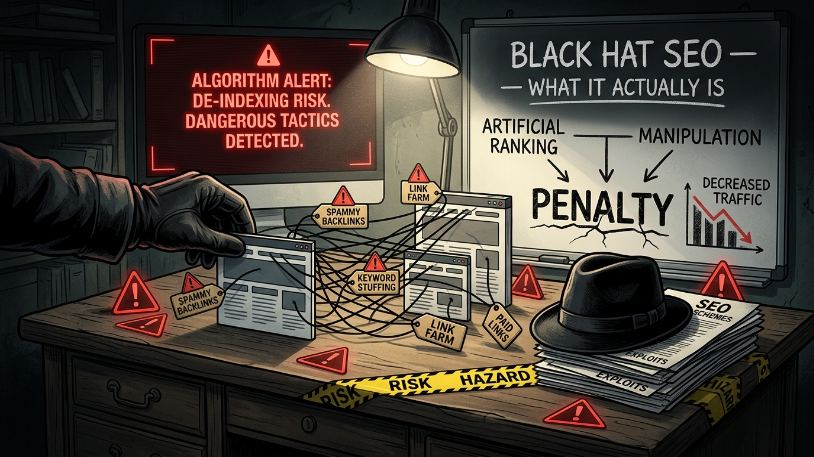
Black hat SEO is a specific category of practices defined by their intent to deceive search engines — showing them something different from what users see, or manufacturing signals that are entirely fabricated rather than earned in any sense. The defining characteristic is deception, not just rule-violation. This distinction matters enormously when placing PBN links on the spectrum.
Black hat link building and core techniques
Cloaking — Showing Googlebot different content from what human visitors see. Explicitly prohibited and detected with high reliability. Results in immediate deindexation.
Link farms — Clusters of low-quality sites that exist exclusively to generate backlinks with no content investment whatsoever. Unlike PBNs, link farms do not attempt to create legitimate-looking content or topically relevant domains.
Keyword stuffing — Overloading page content with target keywords at a density meaningless for human readers. The content serves no user; it exists purely to game a signal.
Hidden text and links — Placing white text on white backgrounds, links with 0px font sizes, or other technical concealment of ranking signals from users while exposing them to Googlebot.
The common thread: black hat tactics are not just risky — they are architecturally deceptive. When detected, the consequence is typically a manual action and deindexation, which is effectively irreversible for the affected domain.
Grey hat SEO: where the real world operates
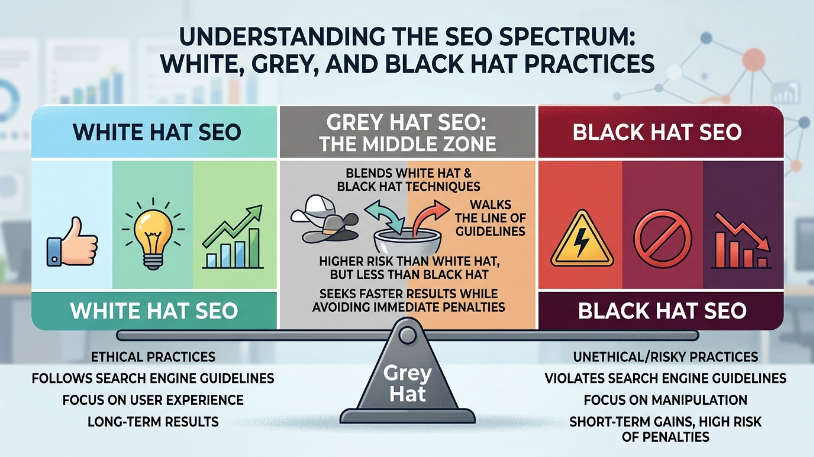
Grey hat SEO consists of tactics that are not explicitly prohibited by Google guidelines, are not architecturally deceptive, but are designed primarily to influence rankings rather than purely to improve user experience. They exist in interpretive territory — not illegal, not endorsed, but in the operational space that professional SEOs navigate daily.
What genuinely belongs in grey hat: paid editorial placements where money compromises editorial independence, link exchanges and partnerships where reciprocal linking removes editorial independence, aggressive anchor text optimisation at the high end of safe thresholds, and PBN links — which we address in the next section. The grey hat zone is not a stable position. As detection improves, techniques once considered grey hat can shift into black hat territory. What is grey today can become black tomorrow with a guideline update. Our guide on PBN networks and domains covers the footprint signals Google uses to identify these patterns.
Where PBN link building actually sits on the spectrum
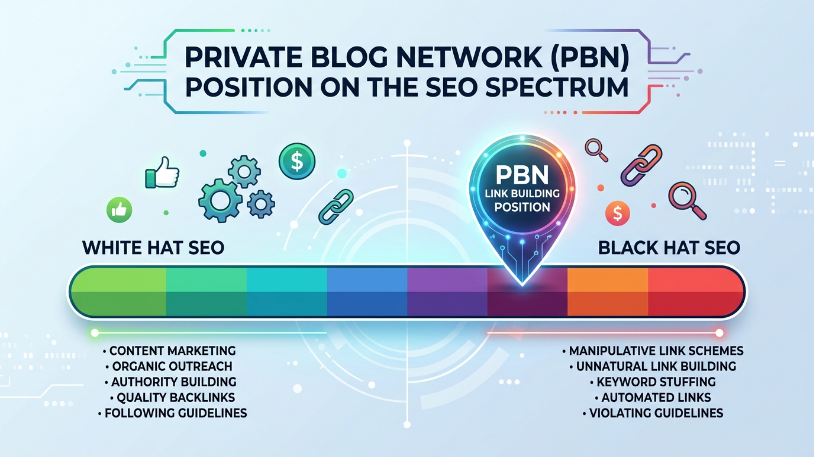
The honest placement: PBN link building is grey hat SEO, not black hat SEO.
Why PBN links are not black hat
Black hat SEO is defined by architectural deception: showing Google something that does not exist for users. PBN links do not meet this definition. A PBN link sits on a real website with real content that is publicly visible to any user who visits it. The article hosting the link is readable, indexable, and present in the same form for both Googlebot and human visitors. No deception of the search engine is occurring in the technical sense.
What is occurring is the manufacture of editorial independence — the link exists because an operator placed it, not because an independent editorial decision was made. That is a guideline violation and it carries real penalty risk. But it is categorically different from cloaking or hidden text, where the fundamental architecture is built to deceive.
Why PBN links are not white hat
White hat link building requires an independent editorial decision by a third party who is not financially compensated for the link and who chose to link based on content merit alone. PBN links fail this test entirely — the link exists because the same entity controls both the linking site and the money site, or because payment was made for placement. Google guidelines explicitly prohibit PBN links as a link scheme. Any SEO who tells clients that PBN links are safe or fully compliant is misrepresenting the risk.
The accurate grey hat positioning
PBN links sit firmly in grey hat territory: not architecturally deceptive, not editorially earned, technically prohibited, practically detectable with increasing but imperfect accuracy. Experienced practitioners manage this through quality control — real domains, real content, topical relevance, footprint minimisation, appropriate anchor text ratios, and careful link velocity management. These practices do not move PBN links from grey to white — the fundamental nature remains guideline-violating. But they substantially reduce detection probability and severity of consequences if detection occurs.
Risk-adjusted ROI: comparing all three approaches honestly
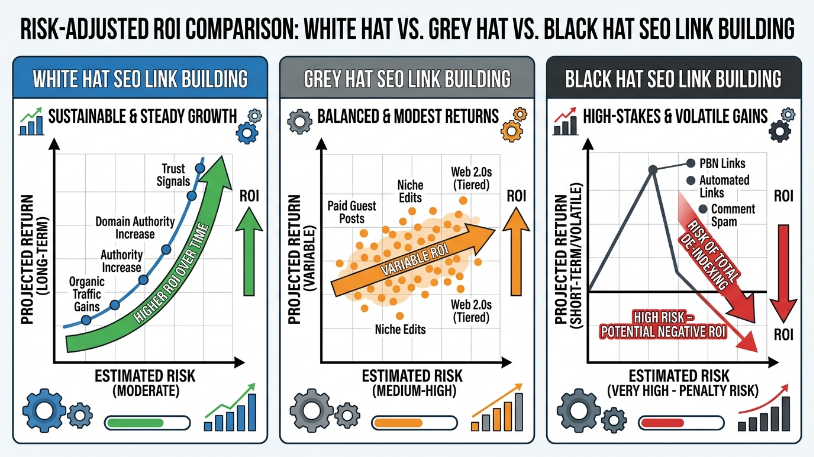
| Approach | Speed | Durability | Penalty risk | Best for |
|---|---|---|---|---|
| White hat SEO | Slow | Very high | Very low | Long-term brand building, 12+ month horizon |
| Grey hat (PBN/managed) | Fast-medium | Medium | Moderate | Competitive timelines, acceleration layer |
| Black hat | Very fast | Very low | Very high | Not recommended for any serious business |
White hat: Strongest long-term return, lowest risk, commercially impractical for businesses that cannot sustain 12-24 months without revenue contribution from organic search.
Grey hat (PBN links, managed paid placements): Best short-to-medium term return for clients with competitive timelines and sufficient budget for quality link building. Risk is manageable with proper execution but cannot be eliminated and must be disclosed to clients. See our guide on how long PBN links take to rank for realistic timeline expectations.
Black hat: Negative expected value over any horizon longer than a few months. The initial gains are real; the eventual loss typically exceeds them. Building a business on black hat foundations is building it on infrastructure with a known expiry date.
When white hat alone is not fast enough
White hat SEO is the correct long-term foundation for any serious online business. But “correct long-term foundation” and “sufficient for a specific client situation” are different things. Genuine scenarios where white hat alone fails to deliver on the timeline that matters:
- Seasonal opportunity windows: A business with an 8-week revenue window cannot wait 14 months for white hat to produce rankings. For affiliate sites specifically, see our guide on PBN links for affiliate sites.
- Highly competitive established niches: New entrants into personal finance, insurance, or supplements face established competitors with 5-15 years of white hat authority accumulation. Closing that gap through white hat alone is a 3-5 year project.
- Recovery from competitor negative SEO campaigns: Rebuilding authority while simultaneously managing a disavowal campaign is a scenario where controlled link acceleration can stabilise positions more quickly than waiting for organic recovery.
- Client reporting cycles demanding quarterly results: White hat strategies may show minimal measurable results in the first two quarters, creating client retention risk regardless of the strategy long-term validity.
None of these scenarios make grey hat SEO the right answer in an ethical sense. They make it the most commercially practical answer for specific situations — which is a different kind of rightness that most honest practitioners recognise even if they do not always say so publicly.
Whitehat backlinks: building a sustainable foundation alongside PBN
The strongest SEO strategies in competitive niches are hybrid approaches that use each type of link building for what it does best. Whitehat backlinks — genuine editorial links earned through digital PR, original research, and authentic relationship-based outreach — provide the trust signals that PBN links cannot replicate. A handful of links from major publications and industry associations creates a backlink profile that reads as genuinely authoritative. PBN links — used as an acceleration layer on top of this white hat foundation — provide the referring domain volume needed to compete on commercial keywords within a realistic timeline.
The practical combination: build 3-5 genuine editorial links per quarter through digital PR or journalist outreach, use 10-20 quality PBN links per month to build referring domain volume on priority pages, and maintain proper anchor text ratios throughout the combined profile. Understanding how backlink equity works helps you allocate both types of links for maximum ranking impact.
FAQ
What is white hat SEO in simple terms?
White hat SEO is the practice of improving a website search engine rankings by following Google guidelines — creating genuinely useful content, earning links through editorial merit, and ensuring the technical infrastructure is sound. No manipulation, no deception, no tactics that would be penalised if reviewed directly by Google. The approach is slower than alternatives but produces compounding, durable results that are resistant to algorithm updates and carry near-zero penalty risk.
What are white hat SEO techniques that actually move rankings?
The most effective white hat SEO techniques are: creating expert-level content that genuinely outperforms competitors on search intent, building editorial backlinks through digital PR and original research, optimising Core Web Vitals and technical site health, and implementing strategic internal linking that routes authority to high-priority pages. These techniques compound over time — a white hat site that has been building genuine authority for three years is extremely difficult to outrank through shortcuts alone.
What is the difference between grey hat and black hat SEO?
The critical difference is architectural deception. Black hat SEO shows Google something that does not exist for users — cloaking, hidden text, fabricated pages. Grey hat SEO uses real websites with real content but manufactures signals that are supposed to be earned naturally. Black hat violations are detected through technical pattern analysis that is extremely reliable, while grey hat violations require more complex behavioral pattern assessment. Detected black hat typically results in deindexation; grey hat typically produces a manual action that can be recovered from.
Are whitehat backlinks enough to compete in competitive niches?
In most niches with moderate competition, yes — given sufficient time. Ultra-competitive niches like personal finance, insurance, and supplements, established competitors have years of accumulated white hat authority. In these cases, white hat backlinks remain essential as the foundation but reaching competitive positions within a commercially viable timeline may require supplemental strategies that compress the authority gap.
How should I explain PBN links to a client?
Be direct: PBN links are a grey hat tactic that accelerates ranking timelines by building referring domain count faster than organic outreach can. They carry a real penalty risk — not theoretical, not negligible, but manageable with quality execution. Google explicitly prohibits them. When detected, they can trigger a manual action that temporarily suppresses rankings until links are disavowed and a reconsideration request is processed. Present the risk honestly, document the disclosure, and let the client make an informed decision.
Conclusion: the honest verdict
White hat SEO is the correct long-term foundation for any serious online business. It builds genuine authority, compounds over time, and survives algorithm updates because it is aligned with what Google is actually trying to measure.
Black hat SEO is not a viable business strategy by any sensible analysis. The short-term gains are real; the eventual consequences are near-certain, typically severe, and structurally difficult to recover from.
Grey hat SEO — including well-executed PBN link building — is a calculated risk with a known probability distribution, manageable through quality controls. The penalty risk is real and must be disclosed honestly to clients. The return, when execution is sound, is a 3-5x compression of ranking timelines compared to white hat alone. The practitioners who produce the best results in competitive niches are almost always those who use white hat foundations and grey hat acceleration — each for what it actually does well, with no pretence that grey hat is something other than what it is.
Want to explore a grey hat PBN SEO strategy built on quality fundamentals? Start with our complete PBN SEO guide, understand exact match anchor text strategy, review how backlink equity works, check our PBN terminology glossary, read our full PBN links explainer, and our white label link building guide for agencies before making any decisions.

Ben Davis is a seasoned SEO strategist with over a decade of hands-on experience in off page SEO, link building, and private blog network management.
He has helped 600+ agencies and professionals achieve top rankings in competitive niches including iGaming, crypto, CBD, and finance through data driven PBN strategies.