


Exact match anchor text using the precise keyword you want to rank for as the clickable link text is one of the most powerful and most dangerous tools in a link builder’s arsenal. This guide covers what exact match anchor text is, how it differs from partial match, branded, and generic anchor types, what safe percentages look like across different site ages and competition levels, and how real penalty cases play out when these thresholds are crossed. Critically, it explains how to check your current anchor text distribution in Ahrefs and how to fix an over-optimised profile without building toxic links in reverse. Whether you are planning a PBN campaign, auditing an existing link profile, or trying to understand why rankings dropped after building links, this guide gives you the precise framework to use anchor text as an asset rather than a liability.
Table of Contents
- Introduction: why anchor text is the most misunderstood variable
- The 6 anchor text types and when to use each
- How to check anchor text distribution in Ahrefs
- What safe exact match percentages actually look like
- Anchor text distribution strategy for PBN campaigns
- How to vary anchors without losing keyword relevance
- Fixing an over-optimised anchor text profile
- FAQ
- Conclusion
Key Takeaways
- Exact match anchor text should represent no more than 5-8% of a page’s referring domain count — exceeding this is the single most common cause of manual actions on PBN-heavy sites.
- The safe percentage depends on site authority, niche competition, and what the top-ranking competitors’ anchor profiles look like — always benchmark against your SERP, not generic guidelines.
- Ahrefs Site Explorer Anchors report is the fastest way to audit your full anchor text distribution — it takes under 5 minutes.
- Partial match anchors carry 70-80% of exact match’s keyword signal with a fraction of the penalty risk and should form the backbone of any PBN anchor strategy.
- Fixing an over-optimised profile requires dilution, not removal — adding generic and branded anchors is safer than trying to remove existing links.
Introduction: why anchor text is the most misunderstood variable in link building
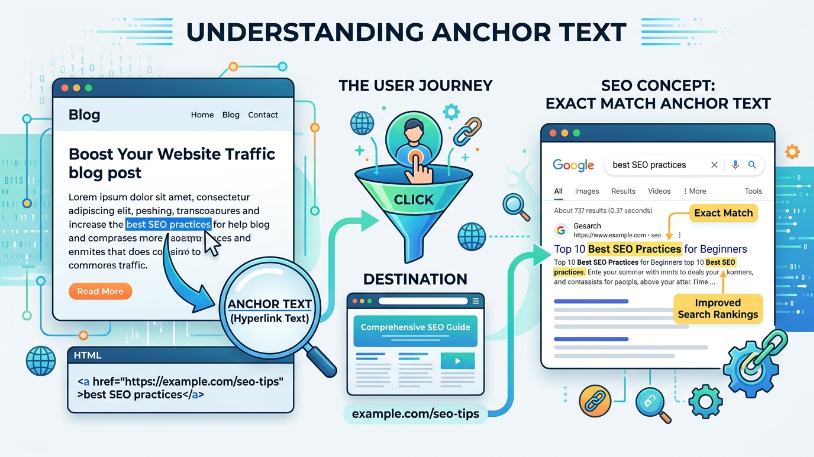
Most SEOs understand that backlinks matter. Fewer understand that the text used in those backlinks — the anchor text — matters nearly as much as the link itself, and in some circumstances more. Exact match anchor text is the specific case where the clickable link text is exactly the keyword you want to rank for. Google reads this as a particularly strong signal that the linked page is relevant to that keyword.
The problem is that this same strength is what makes over-use dangerous. Natural editorial link profiles accumulate a mix of anchor types. When a link profile shows 30%, 40%, or 50% of its anchors using the same commercial keyword, the pattern is obviously artificial. Google’s Penguin algorithm and SpamBrain AI are specifically tuned to detect this. The consequence is often a significant penalty that reverses all the gains those links were meant to produce. For a full overview of how PBN links work and how anchor text fits in, see our PBN links guide.
The 6 anchor text types and when to use each
1. Exact match anchors
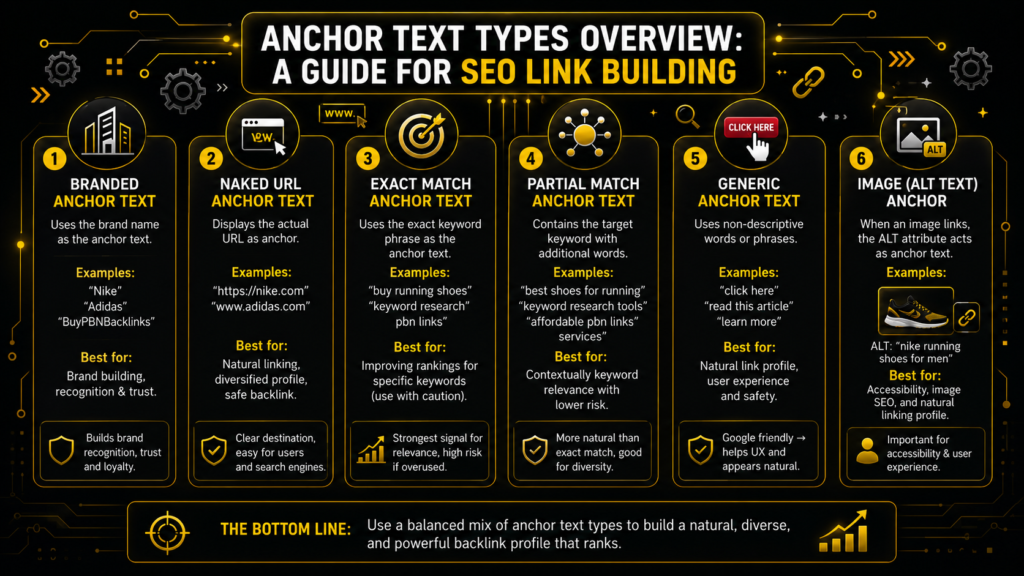
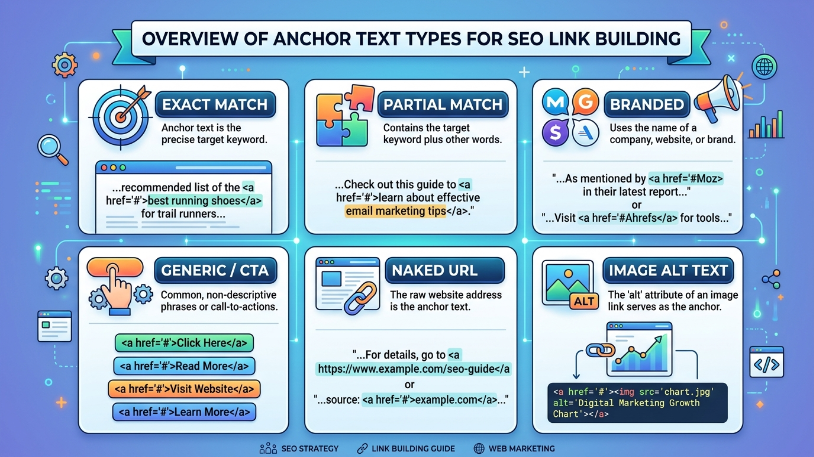
The anchor uses your precise target keyword with no modification. Examples: “best blenders,” “SEO link building,” “buy PBN links.” Use sparingly — 5-8% of total referring domains. Never use the same exact match anchor on more than one PBN link per month.
2. Partial match anchors
The anchor contains your target keyword plus additional words or uses a closely related phrase. Examples: “best blenders for smoothies,” “effective SEO link building strategies.” Use freely — 20-30% of your link profile. These are the workhorse of any PBN anchor strategy.
3. Branded anchors
The anchor uses your brand name, domain name, or a combination of both. Should form 15-20% of any established site’s link profile. They signal to Google that people reference your site specifically.
4. Naked URL anchors
The anchor is simply the raw URL. Include naked URL anchors in 15-25% of your PBN link builds. They look natural because genuine editorial linkers use them constantly.
5. Generic anchors
Non-descriptive click-prompts with no keyword information: “click here,” “read more,” “check this out.” Target 20-30% of your profile here as dilution. They mimic the behaviour of genuine editorial linkers.
6. LSI / semantic anchors
Semantically related terms or synonyms rather than the exact keyword. Examples for “best blenders”: “high-performance kitchen appliances,” “blending machines for home use.” Google’s NLP understands topical context — these anchors contribute to ranking for the target keyword without exact match risk.
How to check anchor text distribution in Ahrefs
Ahrefs is the industry-standard tool for anchor text analysis. Here is the exact workflow — whether auditing your own site or analysing a competitor. This takes under 5 minutes.
Step 1: Open Ahrefs Site Explorer
Log in to Ahrefs and click Site Explorer in the top navigation. Enter the domain or specific page URL. For PBN campaign analysis, always audit at the page level — anchor distributions are calculated per page, not per site.
Step 2: Navigate to the Anchors report
In the left sidebar, click Anchors. This lists every anchor text variation pointing to the page or domain, sorted by the number of referring domains using that anchor. Always sort by Referring Domains, not total backlinks — a single PBN domain might place the same anchor in multiple articles, which would skew the count.
Step 3: Export and categorise
Export the full Anchors report as a CSV. In a spreadsheet, categorise each anchor row into one of the six types above. Calculate the percentage each type represents of your total referring domain count.
Step 4: Compare against your top 3 competitors
Run the same Anchors report for the top 3 pages ranking for your target keyword. Look for consensus in the anchor profiles. If the top-ranking pages all have 60%+ branded anchors and barely any exact match, the SERP rewards conservative anchor profiles. Your goal is to match the competitive norm for your specific keyword — not a generic percentage guideline.
Step 5: Identify the gap
Compare your current distribution against the competitive norm. If your exact match percentage is significantly higher than your top competitors, you are over-optimised. If it is significantly lower while competitors rank above you with higher exact match ratios, you have room to build more targeted anchors.
What safe exact match percentages actually look like
The baseline safe ranges
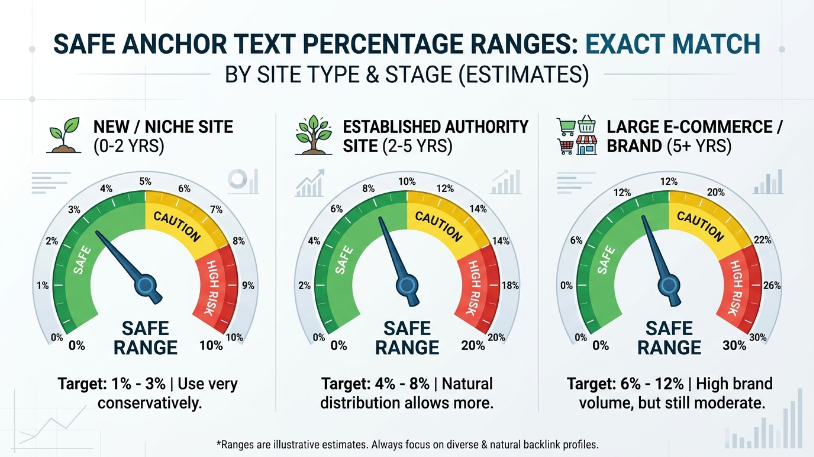
New sites (0-12 months, under 50 referring domains): Exact match should not exceed 3-5%. New sites have no established authority baseline — over-optimisation on a thin existing profile is far more detectable.
Established sites (1-3 years, 50-200 referring domains): Exact match can safely reach 5-8%. The site has existing authority signal and more diverse link profile.
Authority sites (3+ years, 200+ referring domains): Up to 10% may be sustainable, but only if the surrounding profile is genuinely diverse. A documented case study shows a SaaS company experienced a 62% increase in organic traffic after reducing their exact match anchor percentage from 45% to 22%.
The threshold is not a cliff edge — it is a slope. At 10% exact match, rankings start to plateau. And 20%, they often stall. At 30-40%, penalties become likely. At 50%+, a manual action is almost certain for any site under DR 60 in a competitive niche.
Anchor text distribution strategy for PBN campaigns
| Anchor type | Recommended % | Notes |
|---|---|---|
| Exact match | 5-8% | Max 1 per 15-20 links. Never same phrase twice in a row. |
| Partial match | 20-25% | Primary keyword signal vehicle. Rotate 4-6 phrase variations. |
| Branded + modifier | 15-20% | Brand name alone and brand + keyword combinations. |
| LSI / semantic | 10-15% | Topically related phrases without the target keyword directly. |
| Naked URL | 15-20% | Full URL or domain-only format. Rotate between page URL and homepage. |
| Generic | 20-25% | “Click here,” “read more,” “this guide.” Rotate phrases. |
Never use the same anchor text twice consecutively regardless of type. Build an anchor rotation list before starting any campaign. For anchor text strategy for affiliate content specifically, see our guide on PBN links for affiliate sites.
How to vary anchors without losing keyword relevance
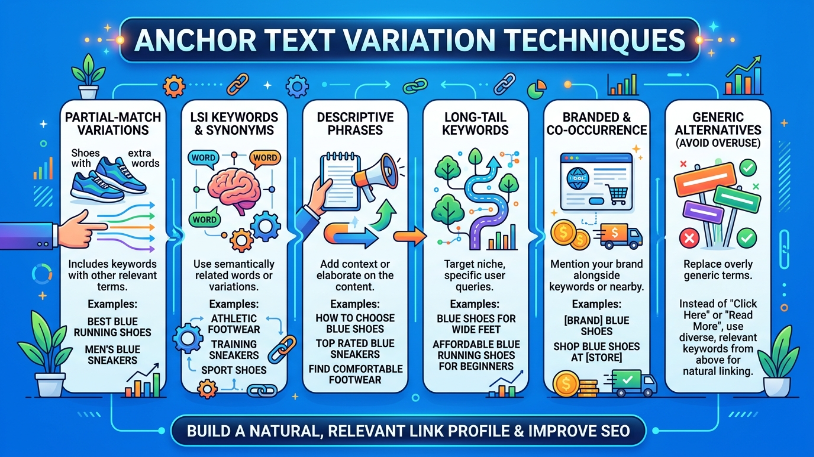
Partial match, LSI, and semantic anchors carry significant keyword relevance because Google’s understanding of language goes far beyond literal keyword matching.
Partial match variation technique
Take any exact match keyword and generate 6-8 partial match variants: “exact match anchor text strategy,” “how to use exact match anchors safely,” “anchor text optimisation for link building,” “best anchor text practices for SEO,” “anchor text distribution guide,” “keyword anchor text examples.” Each passes keyword relevance for the core topic while adding sufficient variation that no two look coordinated.
The modifier method
Add a year, qualifier, or action verb: “best blenders 2026,” “buying the best blenders,” “blenders worth buying this year.” The modifier method produces natural-looking anchor variations that still contain the core keyword.
Using anchor text Ahrefs data to build competitor-matched distributions
Input the URLs of competitors ranking at the top of Google into Ahrefs Site Explorer. The Anchors report shows you the exact anchor text blueprint Google has already determined looks natural in your niche. Export the top 3 competitor Anchors reports, categorise them by the six anchor types, and build your PBN anchor rotation to mirror that distribution.
Fixing an over-optimised anchor text profile
The correct response to an over-optimised profile is dilution, not removal. Attempting to remove existing links creates its own unnatural pattern.
The dilution method
To bring exact match percentage down, add a sufficient volume of safe anchors. Example: if a page has 50 referring domains and 15 (30%) use exact match, to reach 8% you need 187 total referring domains (15 ÷ 0.08 = 187) — meaning 137 more links with no exact match anchors. Add a mix of generic PBN links, web 2.0 citations, social bookmarks, and directory links all with branded, naked URL, and generic anchors.
Emergency dilution for imminent penalty risk
If rankings are already dropping and you suspect over-optimisation, build 20-30 generic and naked URL links as quickly as possible within safe velocity parameters. Rankings often begin recovering within 4-8 weeks of sufficient dilution. Pull your Anchors report in Ahrefs monthly after beginning the dilution process and watch the exact match percentage trend downward.
FAQ
What is an anchor text Ahrefs report and how do I find it?
In Ahrefs, the anchor text report is found under Site Explorer then Anchors in the left sidebar. It shows every anchor text variation pointing to your domain or page, sorted by referring domain count. Always sort by Referring Domains rather than total backlinks to avoid inflated counts from a single site linking multiple times. Export as CSV and categorise into the six anchor types to calculate your exact match percentage.
What are some anchor text examples that work well for PBN links?
A healthy PBN anchor rotation for a page targeting “best blenders” would include: exact match used sparingly (1 per 15 links), partial match variants (“best blenders for smoothies”), branded anchors, naked URLs, LSI phrases (“top-rated kitchen appliances”), and generic anchors (“click here,” “read the full guide”). No single type should dominate and exact match should stay under 8% of total referring domains.
How much exact match anchor text is too much?
For new sites under 12 months, more than 5% is risky. For established sites 1-3 years old, over 8-10% becomes problematic. Having the same exact phrase across 30%+ of referring domains is a near-certain penalty trigger regardless of site age. Always benchmark against your competitors anchor profiles rather than generic guidelines — the SERP consensus tells you what Google has already determined looks natural in your niche.
What is generic anchor text and when should I use it?
Generic anchor text uses non-descriptive phrases like “click here,” “read more,” or “this guide” with no keyword information. It should represent 20-30% of your link profile and is used as a safe anchor type for new pages, as a dilution tool for over-optimised profiles, and as a natural-looking component of every PBN campaign.
Can I use the same anchor text across multiple PBN links?
Yes, but with strict limits. Using the same exact match anchor across more than 2-3 PBN links per campaign creates a detectable coordination pattern. Rotate anchor phrasing even within the same anchor type so each link uses a distinct phrase covering the same topical ground from a different angle.
Conclusion
Exact match anchor text is not the enemy of rankings — misuse of it is. Used at the right percentage, on the right page type, from the right domain authority, it passes one of the strongest keyword relevance signals available through link building. The problem is that it also triggers one of Google’s most actively monitored manipulation patterns when overused.
Keep exact match to 5-8% of referring domains. Build your anchor rotation around partial match and LSI anchors as the primary keyword signal vehicles. Use branded, naked URL, and generic anchors to create the diversity pattern that makes your profile look organic. Audit the distribution in Ahrefs monthly and dilute immediately if the exact match ratio climbs past the safe threshold.
Build your anchor text strategy for PBN backlinks with our full-service PBN link building at SEO PBN Backlinks. Explore our complete guides: what PBN links are and how they work, the full PBN SEO guide, how long PBN links take to rank, our strategy for using PBN links on affiliate sites, our PBN networks and domain guide, the PBN terminology glossary, the full PBN FAQ, backlink equity explained, our white hat vs black hat SEO guide, and our white label link building guide for agencies.

Ben Davis is a seasoned SEO strategist with over a decade of hands-on experience in off page SEO, link building, and private blog network management.
He has helped 600+ agencies and professionals achieve top rankings in competitive niches including iGaming, crypto, CBD, and finance through data driven PBN strategies.