


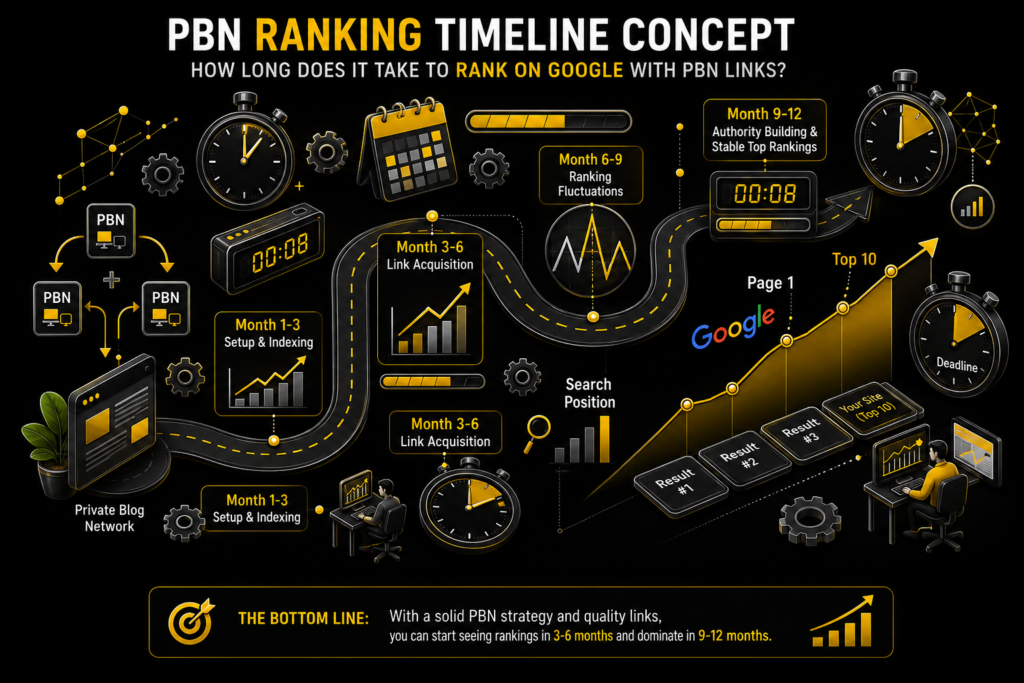
This article gives honest, data-grounded answers to one of the most common questions in PBN link building: how long does it take to rank on Google after PBN links go live? The answer depends on five variables — domain age, niche competition, number of links built, anchor text diversity, and whether the links have been indexed by Google yet. The guide breaks down realistic timelines for new domains (typically 3-6 months for measurable movement) versus established domains (2-6 weeks for noticeable shifts), explains exactly what PBN links accelerate compared to organic outreach strategies, and covers what to do when rankings are not moving after 8 weeks of link building. A practical tracking framework is included covering Google Search Console, rank tracking tools, and index verification so you can measure real progress rather than waiting and hoping.
Table of Contents
- Introduction: why PBN ranking timelines vary so much
- How long to rank on Google: the honest baseline
- New domain vs established domain: very different timelines
- The 5 factors that determine how fast PBN links move rankings
- What PBN links accelerate vs slow-burn strategies
- How to track ranking progress after building PBN links
- When rankings are not moving: what to investigate
- FAQ
- Conclusion
Key Takeaways
- For most sites, PBN links begin influencing rankings within 2-6 weeks of being indexed by Google — not the moment they go live.
- New domains (under 12 months old) typically need 3-6 months to see meaningful ranking movement even with PBN support; established domains can move in 2-4 weeks.
- The five biggest factors controlling ranking speed are: domain age, niche competition, link count relative to competition, anchor text distribution, and index speed of the PBN links themselves.
- PBN links compress the organic timeline by 50-70% compared to slow-burn outreach — but they do not eliminate the sandbox period for new domains.
- If rankings have not moved after 8 weeks of confirmed indexed links, the issue is almost always content quality, anchor text over-optimization, or insufficient link count for the competition level.
Introduction: why PBN ranking timelines vary so much
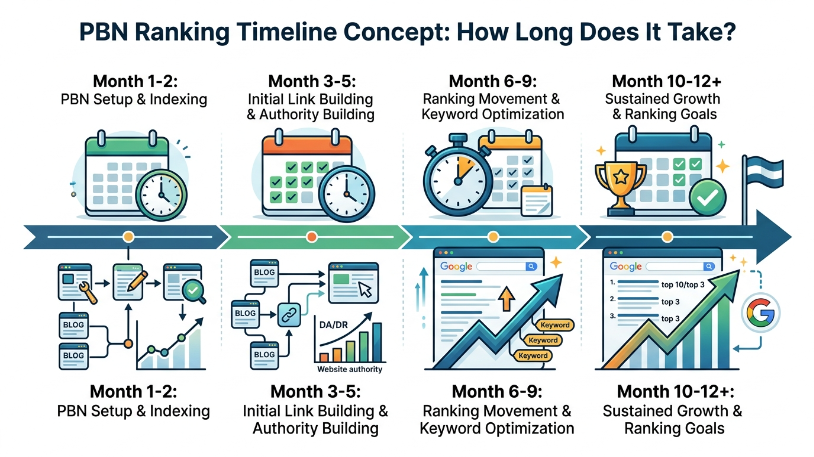
The most common question after someone builds their first round of PBN links is some version of: “I built 10 links two weeks ago and my rankings have not moved — did it work?” How long does it take to rank on Google after building PBN links is genuinely one of the hardest questions in SEO to answer precisely — not because nobody knows, but because the honest answer has five dependencies that vary significantly between sites.
The frustration most site owners experience comes from two misconceptions. First, that PBN links work the moment they go live — they do not. Google needs to crawl and index the linking page first, which can take anywhere from a few days to several weeks. Second, that PBN links bypass the normal ranking evaluation process entirely — they do not. They compress the timeline by providing authority signals faster than organic outreach, but they do not skip the process. For a full explanation of how PBN links work, see our full PBN FAQ.
How long to rank on Google: the honest baseline
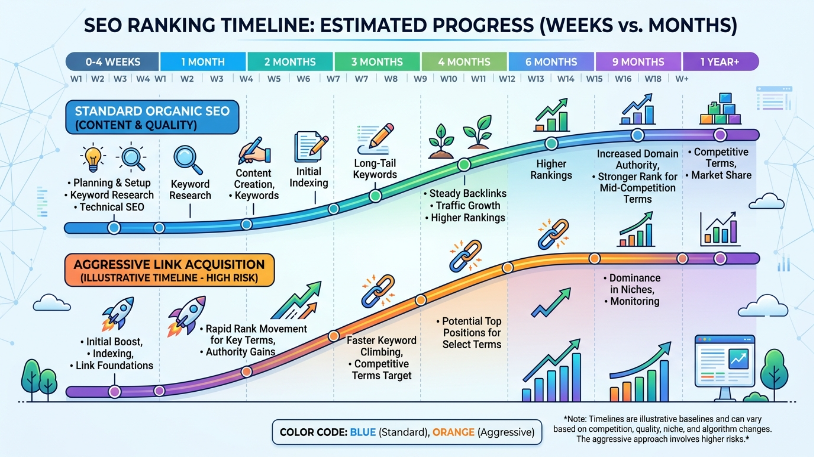
Before PBN links enter the equation, the organic baseline shows that the average time for a new page to rank in the top 10 without any link building is 2 to 6 months for low-competition keywords and 6 to 18 months for competitive ones. PBN links compress this window, not eliminate it.
The PBN ranking timeline by phase
Days 1-14: Link indexation phase. Nothing visible in rankings happens here. Your PBN links are live but may not yet be indexed by Google. Check indexation by searching site:pbn-domain.com/specific-page in Google.
Weeks 2-4: First signal processing. Once indexed, Google begins processing the authority signals. You may see minor fluctuations — small ranking bumps followed by drops. This is normal. Do not interpret small negative movements as failure.
Weeks 4-8: Measurable movement window. Established domains typically begin showing consistent upward movement. A site at position 15-20 will often move into the 8-14 range if the link profile is appropriate.
Months 2-4: Consolidation and ranking lock. For established domains, rankings consolidate. For new domains, first meaningful movement begins appearing.
Months 4-6: Full impact window. Both new and established domains should be showing their post-link-building ranking equilibrium by this point.
The 5 factors that determine how fast PBN links move rankings
Factor 1: Domain age and authority
The dominant variable. A 5-year-old domain responds to PBN links 3-4x faster than a 6-month-old domain. Nothing accelerates this factor except time.
Factor 2: Niche competition level
Competition determines how many PBN links are required. Pull the top 10 ranking pages in Ahrefs and check average referring domain count to assess accurately. Low-competition local service keywords may respond to 5-8 PBN links in 3-6 weeks. Ultra-competitive national keywords may require 40-80+ links and still take months.
Factor 3: Link count relative to competitors
If your target page has 12 referring domains and the top-ranking competitor has 80, you need to close that gap. Our guide on PBN networks and domains covers domain selection to maximise per-link value.
Factor 4: Anchor text distribution
Over-optimized anchor text actively slows ranking progress. If 40% of your PBN links use exact-match commercial anchors, the links are either discounted or trigger a penalty. Safe ratios: 5-8% exact match, 15-20% branded modifier, 25-30% long-tail, 45-50% generic.
Factor 5: PBN link indexation speed
An unindexed PBN link does not exist from a rankings perspective. Verify index status for every link within 14 days of placement by searching the exact page URL in Google.
What PBN links accelerate vs slow-burn strategies
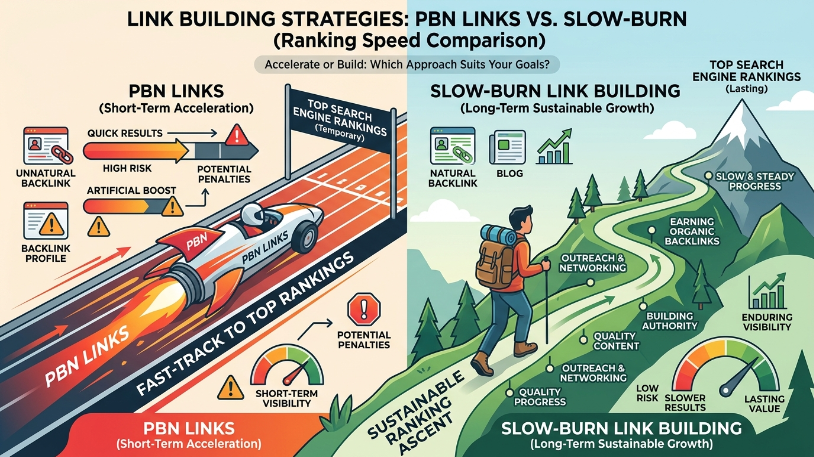
PBN links genuinely accelerate: authority establishment on new pages (3-4 months faster than organic outreach), pushing pages from position 11-20 to page one in 4-8 weeks vs 3-6 months organically, recovering from competitor-driven ranking drops, and achieving seasonal rankings within the buying window. Read our complete PBN SEO guide for full context on how these links work.
PBN links do NOT accelerate: the sandbox period for new domains, content quality deficiencies (PBN links amplify strong content but cannot compensate for weak content), or technical SEO problems.
| Scenario | PBN timeline | Organic outreach timeline | Time saving |
|---|---|---|---|
| New domain, low KD | 4-6 months | 6-12 months | ~50% |
| New domain, medium KD | 6-9 months | 10-18 months | ~45% |
| Established site, low KD | 2-6 weeks | 2-4 months | ~70% |
| Established site, medium KD | 4-10 weeks | 3-6 months | ~60% |
| Established site, high KD | 3-5 months | 6-12 months | ~50% |
How to track ranking progress after building PBN links
Layer 1: Verify link indexation (Week 1-2)
Before tracking rankings, confirm your links have been indexed. Search the specific article URL in Google or use Ahrefs Site Explorer to check when new backlinks were first detected. Set a reminder for Day 14 after each round of link building.
Layer 2: Track keyword positions (Weekly)
Use Semrush Position Tracking, Ahrefs Rank Tracker, or SERPWatcher. Track every target keyword for every page that received PBN links weekly. Watch for upward movement of 1-5 positions during weeks 2-6 as a healthy early signal. Zero movement after 8 weeks with confirmed indexed links is a signal to investigate.
Layer 3: Monitor organic traffic in Google Search Console (Monthly)
Use the Performance report filtered to the specific pages that received PBN links. Track total clicks, average position, and impressions. Rising impressions before rising clicks indicates Google is evaluating the page for more queries — a positive sign that precedes traffic growth.
When rankings are not moving: what to investigate
Eight weeks after confirmed indexed PBN links with no ranking movement is a diagnostic signal, not a reason to immediately build more links. Work through this checklist before spending more budget:
- Check 1: Are the links actually indexed? Run the site check on every linking page.
- Check 2: Is your anchor text profile over-optimized? If exact-match commercial anchors exceed 10-12% of your total link count, dilute with generic anchors first.
- Check 3: Is the competition too strong for the current link count? Check average referring domains of top 5 ranking pages.
- Check 4: Is the content strong enough? Links amplify strong content — they cannot substitute for weak content.
- Check 5: Is there a technical issue? Check Google Search Console for crawl errors on the specific page.
FAQ
How long does it take for PBN links to show up in Google?
PBN links typically appear in Google index within 7-21 days of going live, depending on how frequently the PBN site is crawled. Active PBN domains with regular content updates index new pages faster than dormant sites. Verify indexation by searching the exact URL of the linking page in Google.
Can PBN links get a new site to page one in 30 days?
Very rarely, and only for extremely low-competition long-tail keywords. New domains operate under a sandbox dampening effect during their first 3-4 months. PBN links reduce the total time to rank but cannot fully bypass this early-phase restriction. For most new sites in most niches, 30 days is not a realistic expectation regardless of link quality.
How many PBN links do I need to rank on page one?
Pull the average referring domain count for the top 5 results for your target keyword in Ahrefs. Aim to reach roughly 70-80% of that number through a combination of PBN links and existing organic links. For low-competition keywords (top results averaging 10-20 referring domains), 5-15 PBN links may be sufficient. For competitive keywords (top results averaging 100-200+ referring domains), 40-80+ links are typically needed.
Why did rankings improve then drop after building PBN links?
Short-term ranking gains followed by drops are common and do not necessarily indicate a problem. Google frequently bumps pages temporarily during its re-evaluation phase before settling them at a new equilibrium. If rankings recovered to a higher position than before the drop, the links are working. If rankings dropped below the pre-campaign baseline and stayed there, investigate anchor text over-optimization first.
Does link velocity affect how quickly PBN links work?
Yes — both too slow and too fast creates problems. Building too fast risks velocity flags that cause Google to scrutinize the link profile more aggressively. The safe approach is a consistent monthly cadence scaled to site age: 2-5 links per month for new sites, 10-25 per month for established ones.
Conclusion
The honest answer to how long it takes to rank on Google after building PBN links is: faster than organic outreach, but not overnight. Established domains typically see measurable movement within 4-8 weeks of confirmed indexed links. New domains need 3-6 months before PBN links produce first-page results.
The five variables that control speed — domain age, competition level, link count, anchor text distribution, and indexation speed — are all measurable and manageable. Track every campaign in three layers: verify link indexation first, monitor weekly ranking positions second, and confirm organic traffic growth in Search Console monthly.
PBN links remain one of the fastest tools available for compressing ranking timelines. Used with realistic expectations, correct anchor text ratios, and appropriate link velocity, they consistently deliver results that organic outreach alone cannot match on the same timeline.
Ready to start building? Learn how to speed up rankings with PBN backlinks at SEO PBN Backlinks — or deepen your knowledge with our complete PBN SEO guide, our breakdown of what PBN links are and how they work, and our strategy guide for using PBN links on affiliate sites, check our PBN terminology glossary, browse the full PBN FAQ, master exact match anchor text strategy, see our white label link building guide, understand backlink equity, and read our white hat vs black hat SEO breakdown.

Ben Davis is a seasoned SEO strategist with over a decade of hands-on experience in off page SEO, link building, and private blog network management.
He has helped 600+ agencies and professionals achieve top rankings in competitive niches including iGaming, crypto, CBD, and finance through data driven PBN strategies.