


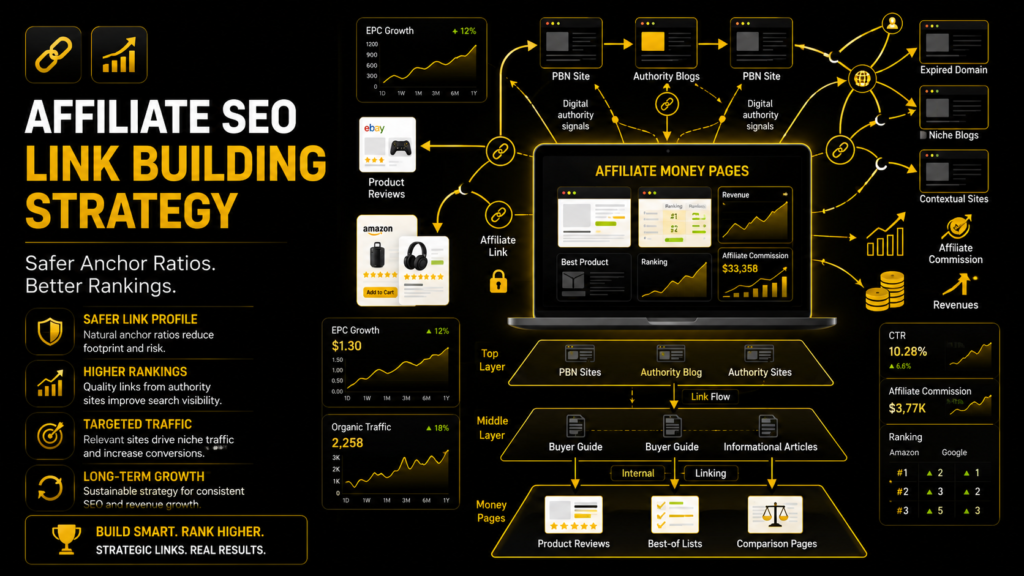
This guide explains how to use PBN links for affiliate sites to rank product review pages, best-of lists, and comparison pages the money pages that generate commissions. It covers which page types deserve PBN links first, what anchor text ratios keep affiliate sites safe from over-optimization penalties, how fast to build links based on site age and niche competition, and how tiered linking protects your highest-value pages from direct PBN footprints.
Unlike generic PBN guides, this article addresses the specific risks affiliate marketers face: Google manual actions on commercial-intent pages, Amazon Associates violations, and the narrow ranking windows created by seasonal and trending products. You will also find a practical audit framework for identifying which of your current pages will benefit most from link building, and a recovery workflow for affiliate sites already carrying over-optimized anchor text profiles.
Whether you are building a new niche site from scratch or trying to move established review pages off page two, this guide gives you the exact numbers, ratios, and timelines you need to build PBN links to affiliate content without triggering penalties.
TABLE OF CONTENTS
- Introduction: why affiliate sites need a different PBN strategy
- Which affiliate pages deserve PBN links first?
- How to audit your affiliate pages before building links
- Anchor text strategy for commercial intent pages
- Link velocity: how fast to build for affiliate sites
- Tiered linking: protecting your money pages
- Niche-specific PBN domain strategy
- Tracking what matters: EPC, not just rankings
- FAQ
- Conclusion
KEY TAKEAWAYS
- Product review pages, best-of lists, and comparison pages are your highest-priority targets they carry buyer intent and generate direct affiliate commissions.
- Safe anchor text ratio for commercial pages: 5-8% exact match, 15-20% branded + modifier, 25-30% long-tail, 45-50% generic and naked URLs.
- New affiliate sites should build no more than 2-3 PBN links per month in months 1-2 and scale slowly velocity spikes are the most common cause of penalties on young domains.
- Tiered linking (PBN links → buyer guides → money pages) reduces direct PBN footprints on your highest-converting pages while still delivering link equity.
- Track earnings per click alongside rankings a page at position 4 with 3% conversion can outperform a page at position 1 with 0.8% conversion.
Introduction: why affiliate sites need a different PBN strategy

Your product reviews and best-of lists are sitting on page two. The content is good. The site is clean. But the pages that should be generating commissions are invisible to the buyers searching for them.
PBN links for affiliate sites solve a specific problem: commercial-intent pages in competitive niches need more authority to move past established domains, and organic link earning through outreach is too slow for the ranking windows that affiliate monetization demands. A review page that ranks in month eight is worth far less than one that ranks in month three especially for seasonal products where the buying window is narrow.
But affiliate sites carry risks that general authority sites do not. Google applies heightened scrutiny to sites with heavy commercial anchor text profiles. Amazon Associates terms of service prohibit practices that generate suspicious or artificial traffic. Over-optimize your anchor texts or spike your link velocity and you face not just a ranking penalty but a potential program ban.
The strategy in this guide is built specifically for affiliate content. It tells you which pages to build links to first, what anchor ratios keep you safe, how fast to build, and how to protect your highest-value pages using tiered structures so you rank faster without the risks that come from a generic PBN approach.
Which affiliate pages deserve PBN links first?
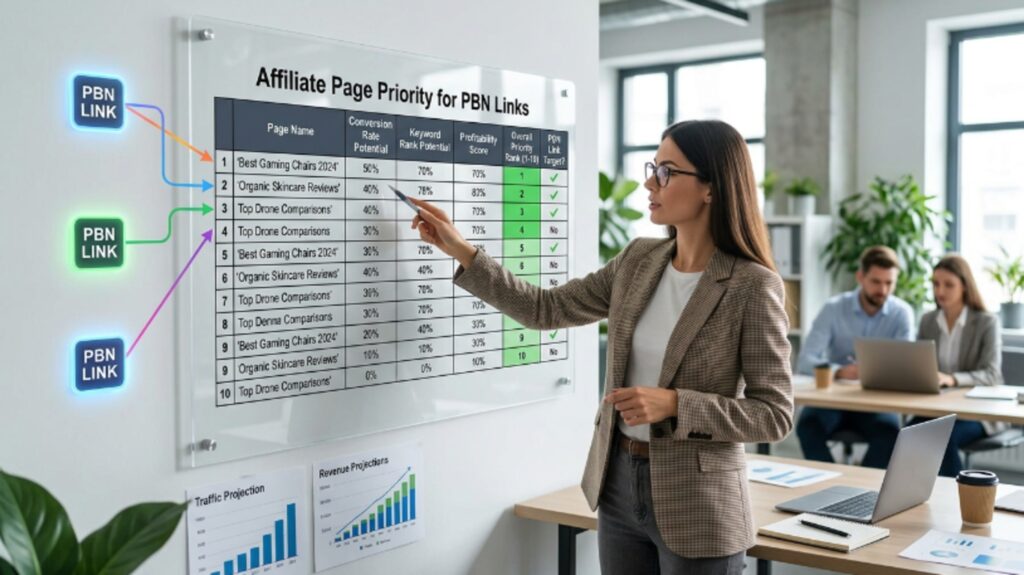
Not every page on your affiliate site deserves PBN links. Spreading your link budget equally across all content is one of the most common and costly mistakes affiliate marketers make. The correct approach is to rank page types by their commercial value, then allocate links accordingly.
Product review pages (individual reviews)
Individual product reviews targeting buyer-intent keywords like “[product name] review” or “is [product] worth it” are your highest-priority targets. The reader landing on these pages is one step away from a purchase decision. A page at position 3 for “[product] review” with a 4% affiliate conversion rate is worth more per visitor than almost any informational page on your site.
Link requirements by competition level:
- Low competition (long-tail products, niche items): 5–10 PBN links
- Medium competition (mid-range consumer products): 10–20 PBN links
- High competition (flagship consumer electronics, mattresses, supplements): 20–30+ PBN links
Space links over 2–3 months to avoid velocity spikes. Content must hit 1,500+ words minimum with genuine hands-on testing, pros and cons tables, and a clear recommendation thin review content with PBN links is what gets sites penalized, not the links themselves.
Best-of lists and roundup reviews
Best-of lists “Best Blenders 2026,” “Top 10 Running Shoes for Overpronators” generate the highest return on link investment because a single visitor clicks multiple affiliate links per session. One well-ranked roundup can outperform five individual review pages combined.
These pages also face the stiffest competition. Every affiliate marketer in your niche is building links to the same “best [category]” keywords.
Link requirements:
- Medium competition roundups: 15–30 PBN links
- High competition (“best mattress,” “best noise-cancelling headphones”): 40–60+ PBN links
- Established sites (DR 40+): need 30–40% fewer links than new sites for same results
Do not build links to thin roundups that rehash the Amazon top seller list. Your roundup needs original comparison tables, testing methodology, use-case specific recommendations, and 2,500+ words before any link building starts. Links amplify the quality of your content they cannot substitute for it.
Comparison pages (head-to-head)
Comparison pages targeting “[Product A] vs [Product B]” keywords sit in a high-intent, lower-competition sweet spot. Readers in comparison mode are in final decision stage they have already decided to buy, they are just choosing which product. Conversion rates on comparison pages regularly exceed individual review pages.
Build 8–15 PBN links per comparison page. The most effective comparisons pit two popular products in the same price bracket against each other: “Vitamix 5200 vs Blendtec Total Classic,” “Asana vs Monday.com for Small Teams.” Each comparison needs a side-by-side feature table, outcome-based testing, and a clear winner declaration for different user types fence-sitting conclusions lose the click.
Buyer’s guides and how-to-choose content
Buyer’s guides serving informational queries with commercial overtones “How to Choose a Blender,” “What to Look for in a Running Shoe” are tier 2 targets, not tier 1. Do not point PBN links directly at these pages unless they have direct affiliate monetization.
The correct approach: build 5–10 PBN links to the buyer’s guide → buyer’s guide internally links to your product reviews and best-of lists → link equity flows to money pages without creating direct PBN footprints on your highest-converting URLs.
This two-layer structure passes ranking power downstream while keeping your review and roundup pages one level removed from direct PBN signals.
Category and collection pages
Category pages “Kitchen Appliances,” “Home Office Gear” are topical authority plays. They tell Google you cover a niche comprehensively and distribute link equity across your site through internal links. They do not generate direct commissions.
Use PBN links on category pages only after your money pages are fully covered. 3–8 links per category page, focused on topical relevance rather than commercial anchor text. Think of them as link equity distribution hubs, not conversion targets.
Seasonal and deal pages
Seasonal pages “Best Black Friday Mattress Deals,” “[Brand] Cyber Monday Coupon” have the highest short-term ROI but the narrowest ranking windows. You have 2–3 months before the event to establish rankings. Once the event passes, traffic and rankings both drop.
Seasonal link timeline:
- 10–12 weeks before event: Publish page + build 10–15 links
- 6–8 weeks before: Add 8–12 more links
- 4 weeks before: Add final 5–8 links
- During event: Stop building entirely
Front-loading over 8–12 weeks looks natural. Building 30 links the week before Black Friday looks manipulative — Google has seen this pattern thousands of times.
When to skip PBN links entirely
Purely informational content with no affiliate links does not need PBN links. Articles like “What Is a Blender?” or “History of Running Shoe Design” build topical authority but generate no commissions. Link to them through internal linking from money pages; do not spend link budget on them.
Skip PBN links when: zero commercial intent, no internal links to monetized pages, and low buyer-intent keyword targets.
The 80/20 rule applies here: 80% of your affiliate commissions come from 20% of your pages. Concentrate your PBN budget on those pages.
How to audit your affiliate pages before building links
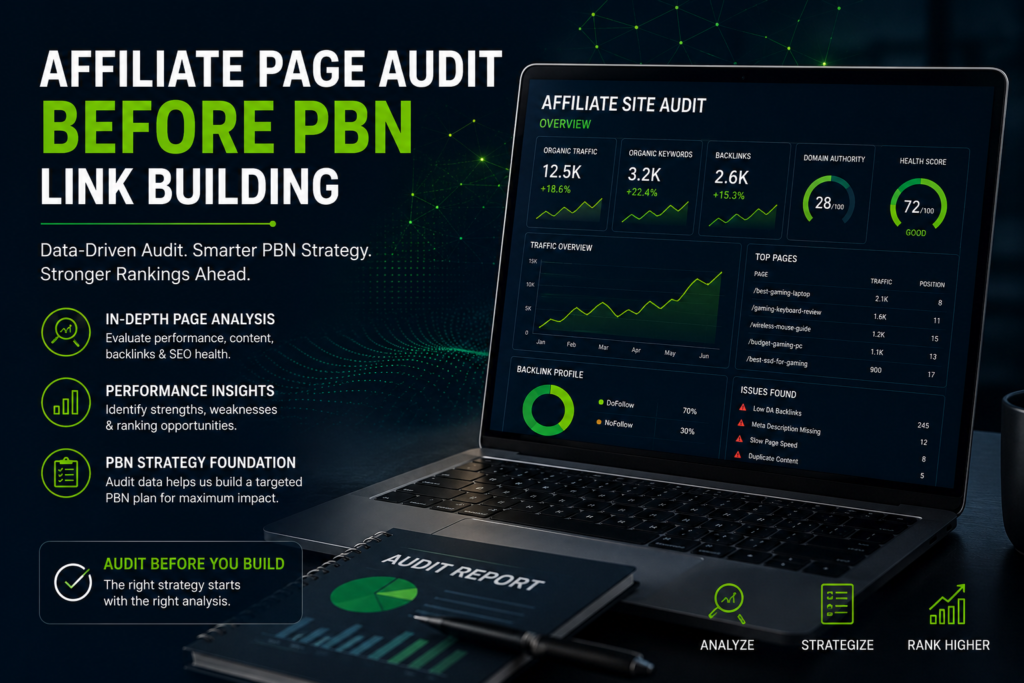
Before spending any link budget, audit your existing pages. Building links to a page with conversion problems or thin content wastes money and risks penalty without any ranking benefit.
The 4-question pre-link audit
1. Is the content worthy of ranking? Run the page through this filter: does it offer something the top 5 ranking pages do not? If the answer is no, improve the content before buying a single link. PBN links do not overcome fundamentally inferior content in competitive niches.
2. Is the page already converting? Check your affiliate dashboard for any existing traffic to the page, even minimal traffic from position 8–15 positions. If the page is getting clicks but not converting, the problem is content or offer not rankings. Fix conversion first.
3. What does the current backlink profile look like? Pull the page’s backlink data in Ahrefs or Semrush. If it already has links with 40%+ exact match commercial anchor text, your first move is to dilute that ratio with generic anchors not to add more commercial links.
4. Is the page indexed and crawlable? Run site:yourdomain.com/page-slug in Google. If the page is not indexed, no amount of links will help. Fix indexation issues first: check robots.txt, canonical tags, and internal linking depth.
Pages that pass all four checks are ready for link building. Pages that fail any check need remediation first.
Anchor text strategy for commercial intent pages
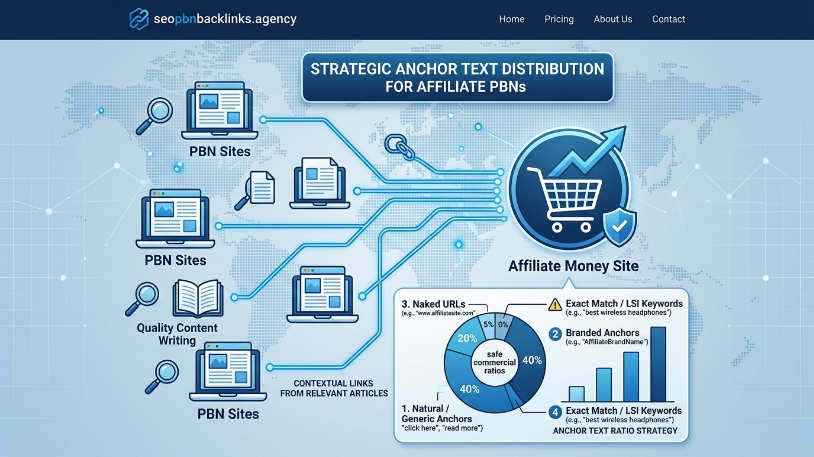
Anchor text is where most affiliate sites trigger Google’s manipulation filters. The commercial nature of affiliate content pages explicitly targeting “best [product]” and “[product] review” keywords makes exact-match anchor overuse a constant temptation and a frequent cause of manual actions.
The safe anchor text ratio for affiliate pages
Use this distribution across all PBN links pointing at product reviews, best-of lists, and comparison pages:
| Anchor type | Safe percentage | Examples |
|---|---|---|
| Exact match commercial | 5–8% | “best blender,” “Vitamix review” |
| Branded + modifier | 15–20% | “Vitamix 5200 review,” “KitchenAid mixer comparison” |
| Long-tail phrases | 25–30% | “best blender for smoothies under $100,” “top running shoes for flat feet 2026” |
| Generic + naked URL | 45–50% | “click here,” “read more,” “check it out,” yourdomain.com/page |
For new sites under 12 months old: drop exact match to 3–5% and raise generic to 55–60%. Established authority sites (DR 40+, 2+ years) can push exact match to a maximum of 10% never higher regardless of site strength.
The pattern mistake that triggers site-wide penalties
The most dangerous anchor text error is not having too many exact match anchors on one page it is repeating the same anchor pattern across multiple pages. “Best blenders” to your blenders page, “best mixers” to your mixers page, “best food processors” to your processors page.
Google’s algorithms detect this coordinated pattern across your domain and issue site-wide penalties, not page-level ones. Vary your anchor patterns between pages even when targeting similar keywords.
Good vs bad anchor text worked examples
Bad profile 20 links to “best blenders” page:
- 8 links: “best blenders” (40% exact match)
- 6 links: “best blender 2026” (30% near-exact)
- 4 links: “top blenders” (20% commercial)
- 2 links: generic (10% generic)
This profile triggers a penalty. Over 70% of anchors are commercial variations of the same target keyword.
Good profile 20 links to “best blenders” page:
- 1 link: “best blenders” (5% exact match)
- 3 links: “Vitamix blender comparison,” “KitchenAid mixer review” (15% branded modifier)
- 6 links: “best blender for green smoothies,” “quietest blenders under $150” (30% long-tail)
- 10 links: “click here,” “read the full guide,” yourdomain.com/best-blenders (50% generic/naked)
This profile looks natural even though you are clearly targeting “best blenders.” The diversity of anchors signals organic link acquisition.
Recovering from an over-optimized profile
If your affiliate site already has too many exact-match anchors which is common on sites that built links early without a strategy do not remove links. Removal creates its own unnatural pattern.
Recovery process:
- Add 10–15 new generic anchor links (“check this out,” naked domain URLs) to dilute the exact match percentage
- Build tier 2 links to buyer’s guides and informational posts that internally link to your over-optimized money pages
- Wait 3–4 months for the anchor ratio to normalize before adding any more commercial anchors
- Monitor rankings monthly they typically begin recovering within 4–6 months
Link velocity: how fast to build for affiliate sites
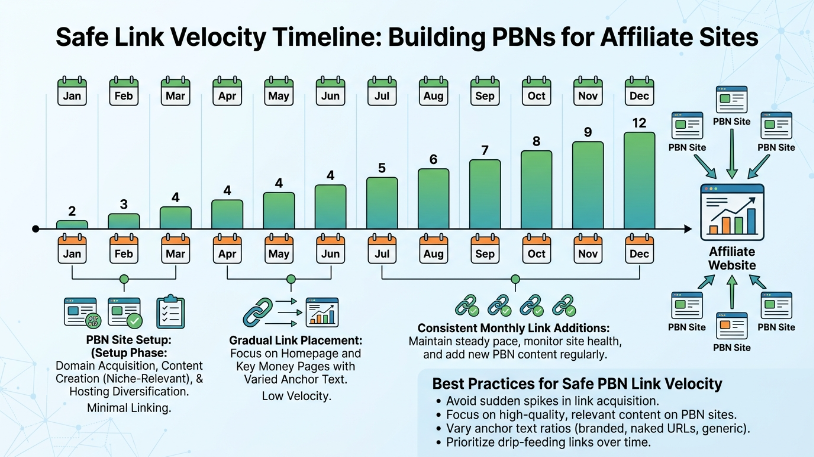
Link velocity matters more for affiliate sites than for general authority sites because the combination of commercial anchor text and rapid link acquisition is Google’s clearest signal of artificial link building. Affiliate niches are also among the most heavily monitored competitors regularly report each other and Google’s spam teams are familiar with the patterns.
Safe velocity by site age
New niche sites (0–6 months old):
- Months 1–2: 2–3 links per month total
- Months 3–4: 5–7 links per month
- Months 5–6: 8–12 links per month
- After 6 months: 25–35 total backlinks on the domain
Space individual links 7–10 days apart minimum. Never add more than 2 links to the same page in the same week during your first 6 months. New domains have no established link velocity baseline any sudden growth looks manipulative.
Established sites (1+ years, 50+ indexed pages, existing backlink profile):
- Standard rate: 15–25 PBN links per month across the site
- Seasonal spikes: can handle 30–40 links in a peak month
- Mix PBN links with other link types niche edits, digital PR, contextual guest posts
The key rule regardless of site age: never more than double your existing link count in a single month. If you have 20 backlinks and acquire 40 more in 30 days, Google flags the velocity. Grow 20–30% month over month maximum.
Monthly link budget by niche competition
| Competition level | New site (0–6 months) | Established site (1yr+) | Example niches |
|---|---|---|---|
| Low | 3–5 links/month | 8–12 links/month | Yoga accessories, niche gardening tools |
| Medium | 5–8 links/month | 12–20 links/month | Blenders, running shoes, laptop bags |
| High | 8–12 links/month | 20–30 links/month | Mattresses, headphones, fitness equipment |
| Ultra-competitive | 10–15 links/month | 30–50+ links/month | Credit cards, supplements, web hosting |
To assess your niche competition level: pull the top 10 ranking pages for your target keyword in Ahrefs and check their average referring domain count. Under 50 referring domains = low competition. 50–150 = medium. 150–300 = high. Over 300 = ultra-competitive.
Tiered linking: protecting your money pages
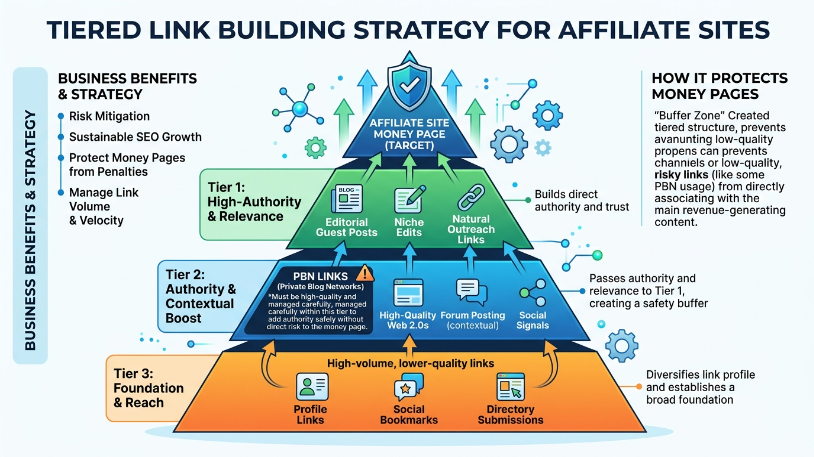
Most affiliate marketers point all their PBN links directly at money pages. This creates the most concentrated footprint pattern every PBN link in your profile touches your revenue-generating URLs. Tiered linking reduces that exposure without sacrificing link equity.
How the two-tier structure works
Tier 1 Direct links to money pages:
- Targets: product reviews, best-of lists, comparison pages
- Use only your strongest, most topically relevant PBN domains
- Conservative allocation: 30–40% of your total monthly PBN budget
- Aggressive allocation (established sites with clean profiles): 50–60% of budget
Tier 2 Links to supporting content:
- Targets: buyer’s guides, how-to-choose articles, category overviews, informational posts that internally link to money pages
- Use 60–70% of budget here (conservative approach)
- These pages then pass equity downstream to money pages through internal links
- Anchor text can be more relaxed informational phrases, branded terms, topic-related anchors
The equity flow: Tier 2 PBN links → supporting content page → internal links → money page. The money page receives link equity without having a direct PBN footprint on it.
When to use tier 1 vs tier 2
Use direct Tier 1 links when:
- Your money page has a clean, diversified anchor text profile
- The page has been live for at least 3–6 months with some existing backlinks
- You are targeting a page with existing rankings in positions 5–15 that needs a push
Use Tier 2 links when:
- Your money page already has a heavy commercial anchor profile
- The page is brand new and has no existing backlink history
- You want to protect high-revenue pages during seasonal link building pushes
- You are recovering from a previous over-optimization issue
Building effective Tier 2 pages
Tier 2 works only if your supporting content is strong enough to rank or at least get indexed and crawled. A buyer’s guide that is thin and poorly structured will not pass meaningful equity downstream.
For each Tier 2 page that receives PBN links:
- Minimum 1,200 words of genuine informational content
- At least 3–5 natural internal links to the money pages you want to benefit
- Content must be indexed check Search Console to confirm
- Anchor text of internal links to money pages should include natural commercial phrases
Niche-specific PBN domain strategy
Generic PBN links links from domains with no topical relationship to your affiliate niche carry less authority and more detection risk than niche-relevant ones. Google’s understanding of topical relevance means a link from a domain previously covering kitchen appliances passes more meaningful authority to your blender review page than a link from a general lifestyle blog.
Selecting niche-relevant expired domains
When evaluating expired domains for affiliate site link building, topical relevance should be a primary selection criterion alongside DR and Trust Flow. Look for:
- Matching niche history: A domain previously covering consumer electronics is ideal for tech affiliate sites. Cooking-focused domains work for kitchen product affiliates.
- Buyer-intent content in the domain’s archive: Check the Wayback Machine. If the previous site published review-style or comparison content in your niche, the topical signals are even stronger.
- Clean penalty history in the niche: Some expired domains were previously penalized specifically for their affiliate content. Avoid domains that show dramatic organic traffic drops in the 2019–2022 period (Google’s major affiliate-targeting update cycles).
Niche PBN clusters for multi-page campaigns
If you are building links across 10+ affiliate pages simultaneously, cluster your PBN domains by sub-niche rather than spreading them randomly. A cluster of 5–8 PBN domains all covering kitchen products linking to your kitchen affiliate pages creates a stronger topical authority signal than 5–8 unrelated domains pointing at the same pages.
This clustering approach also makes your link profile harder to detect the pattern looks like natural editorial interest from a defined niche audience rather than a coordinated manufactured network.
Tracking what matters: EPC, not just rankings
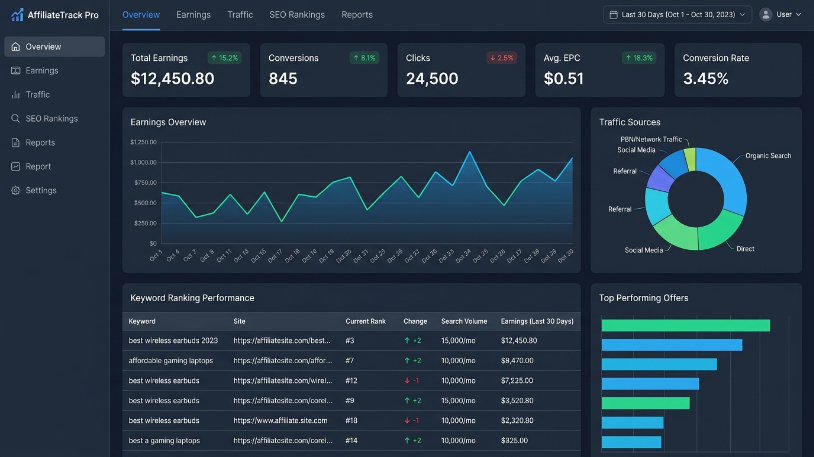
Ranking position is a vanity metric for affiliate sites. A page at position 3 for a low-converting product review earns less per month than a page at position 6 for a high-commission, high-conversion product. Track earnings per click (EPC) alongside rankings to make informed decisions about where to concentrate your PBN budget.
The EPC-first link prioritization framework
Before allocating PBN links, calculate the current or projected EPC for each candidate page:
EPC = (Monthly affiliate revenue from page) ÷ (Monthly clicks to affiliate links on page)
A page earning $0.40 EPC at position 8 with 200 clicks per month earns $80. If PBN links move it to position 3 and triple clicks to 600, projected monthly revenue is $240 a $160 monthly gain. That is your maximum justifiable link spend per month for that page.
This framework stops you spending $300 in PBN links to push a page generating $30/month in commissions.
Monthly tracking checklist for affiliate PBN campaigns
Monitor these metrics monthly for every page receiving PBN links:
- Ranking position — track target keyword in Semrush or Ahrefs Rank Tracker
- Organic clicks — pull from Google Search Console
- Affiliate link clicks — from your affiliate dashboard (Amazon Associates, ShareASale, etc.)
- Conversion rate — clicks to commissions ratio
- EPC — revenue divided by affiliate clicks
- New referring domains — confirm links are being indexed by Google in Ahrefs
If ranking improves but EPC drops, the traffic quality has changed the new ranking may be capturing different searcher intent. Audit the page’s content against the actual search intent of the keyword.
FAQs
How many PBN links does an affiliate review page need to rank?
The number depends on competition level and site authority. Low-competition long-tail product reviews typically need 5–10 PBN links to move to page one. Medium-competition pages (“best blenders,” “running shoe reviews”) need 10–20 links. High-competition pages in saturated niches (mattresses, supplements, credit cards) need 20–40+ links, and even then, domain authority and content quality play a decisive role. Always check what the top 5 ranking pages have in terms of referring domains match their link count, do not exceed it dramatically or you risk triggering velocity alerts.
Will PBN links get my Amazon Associates account banned?
Amazon’s terms of service focus on traffic quality and source transparency, not the specific tactics used to build your organic rankings. PBN links improve organic rankings the traffic that arrives through those rankings appears as normal organic search traffic to Amazon. There is no direct mechanism by which PBN link building triggers an Amazon ban. The real risk is indirect: if PBN links trigger a Google penalty that causes your site to disappear from search results, your traffic drops and your affiliate commissions collapse. Manage the Google risk correctly and the Amazon risk manages itself.
Should I build PBN links to new affiliate pages or wait?
Wait. New pages with no ranking history and no existing backlinks are not ready for PBN links until they have been indexed and have had at least 4–8 weeks to establish a baseline. Build internal links first, ensure full indexation, and let the page sit in Google’s evaluation period. Early PBN links on brand-new pages in competitive niches often produce no movement and sometimes trigger manual reviews because the link acquisition pattern looks unnatural for a newly-published URL.
What anchor text should I use for a product review page targeting [product name] review?
For a keyword like “Vitamix 5200 review”: use the exact match anchor (“Vitamix 5200 review”) on at most 1 out of every 15–20 links. Use branded modifier anchors (“Vitamix 5200 blender review,” “Vitamix comparison guide”) on 3–4 links. And Use long-tail variants (“best high-performance blender review,” “Vitamix 5200 worth it?”) on 5–6 links. Use generic anchors (“read the full review,” “click here,” naked URL) on the remaining 10–12 links. This distributes safely across the 5-8% / 15-20% / 25-30% / 45-50% framework.
How do I know if my PBN links are working?
Monitor rankings weekly using Semrush or Ahrefs Rank Tracker for your target keyword. In parallel, check Google Search Console weekly for organic click growth to the page. PBN links typically begin influencing rankings within 2–6 weeks of being indexed by Google check Ahrefs Site Explorer to confirm the links have been discovered. If rankings have not moved after 8 weeks and links are confirmed indexed, the issue is either content quality, anchor text ratios, or competition level requiring more links than initially budgeted.
Conclusion
PBN links work for affiliate sites when the strategy accounts for the specific pressures that commercial content creates. The combination of buyer-intent anchor text, competitive niches, and revenue-dependent ranking windows makes affiliate link building materially different from general authority building and requires a different set of rules.
The framework in this guide comes down to three principles. First, prioritize ruthlessly direct PBN links to product reviews, best-of lists, and comparison pages, and use tiered structures to protect those pages once their anchor profiles mature. Second, respect ratios a maximum of 5–8% exact match commercial anchors with the remainder distributed across branded modifiers, long-tail phrases, and generic links. Third, build at sustainable velocity the most common penalty trigger for affiliate sites is not the use of PBN links but the speed and anchor concentration with which they are deployed.
Continue learning about PBN link building: Start with our complete PBN SEO guide for the full picture, dive into what PBN links are and how they work, understand how PBN networks and domains are structured, check the PBN terminology glossary, browse our full PBN FAQ for quick answers, see how long PBN links take to rank, build a safe anchor text strategy, learn how backlink equity works, read our white hat vs black hat SEO guide, and our white label link building guide for agencies.

Ben Davis is a seasoned SEO strategist with over a decade of hands-on experience in off page SEO, link building, and private blog network management.
He has helped 600+ agencies and professionals achieve top rankings in competitive niches including iGaming, crypto, CBD, and finance through data driven PBN strategies.