


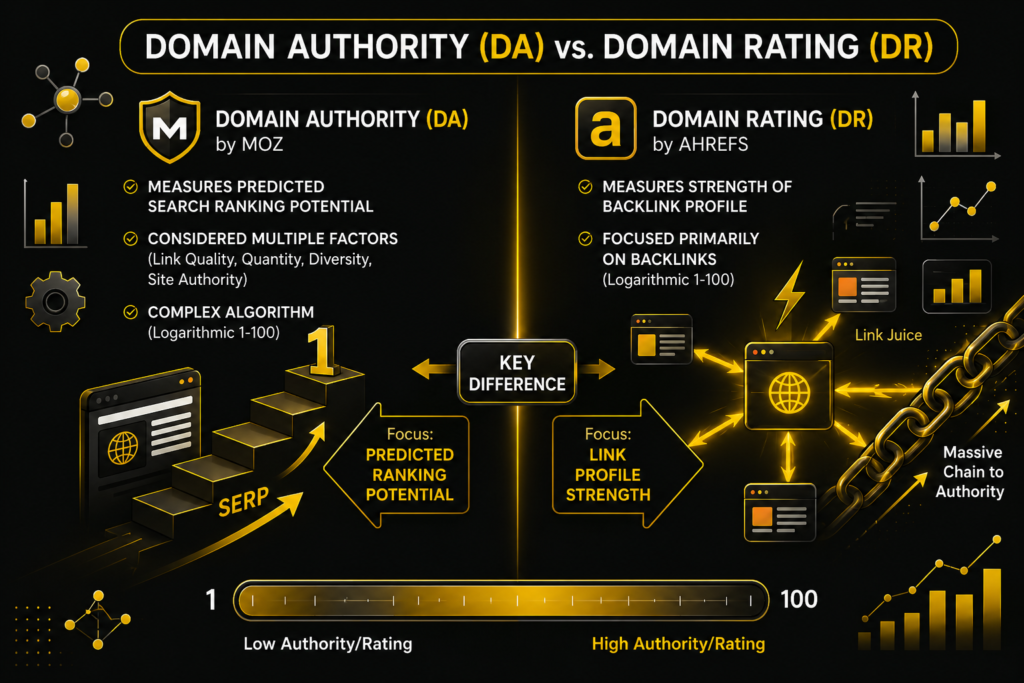
If you have ever compared notes with another SEO and realised you were talking about different metrics using the same words, you have experienced the Domain Authority vs Domain Rating confusion first-hand. DA is Moz. DR is Ahrefs. TF is Majestic. They sound interchangeable but they measure different things, are calculated differently, and correlate with ranking ability at different levels of reliability. This guide explains exactly what each metric measures, where each one fails, which one is most useful for evaluating PBN link quality, and why none of them should be used in isolation when making link building decisions.
Table of Contents
- What is Domain Authority (DA)?
- What is Domain Rating (DR)?
- What is Trust Flow (TF)?
- DA vs DR vs TF: the honest comparison
- Which metric best predicts actual ranking ability?
- How to use these metrics when evaluating PBN links
- Common mistakes when relying on these metrics
- FAQ
- Conclusion
Key Takeaways
- Domain Authority (DA) is Moz. Domain Rating (DR) is Ahrefs. Trust Flow (TF) is Majestic. They are not interchangeable.
- DR is most widely used in 2026 because Ahrefs has the largest and most frequently updated link index. But DR measures link volume quality, not content quality or spam resistance.
- Trust Flow is the most reliable metric for evaluating PBN link quality because it is quality-weighted — domains need links from genuinely trusted seed sites to score well.
- None of these metrics correlate perfectly with ranking ability. Google uses hundreds of signals; third-party metrics approximate one small piece of that.
- For PBN link evaluation: DR for a quick first pass, Trust Flow for quality confirmation, organic traffic for the final verification that Google actually values the domain.
What is Domain Authority (DA)?
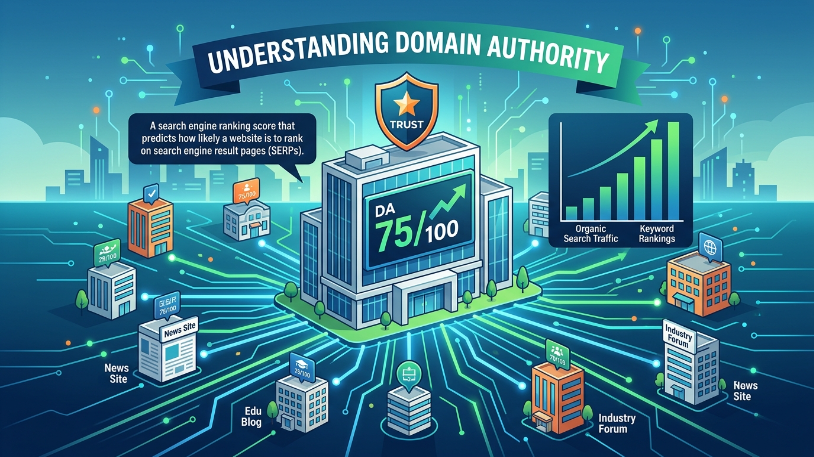
Domain Authority (DA) is a metric created by Moz that predicts how likely a domain is to rank in search engine results, on a scale of 1 to 100. DA was one of the first widely adopted third-party authority metrics and remains familiar because of Moz early dominance in the SEO tooling market.
How DA is calculated
DA is calculated using a machine learning model that correlates dozens of link-based factors with actual Google rankings. The inputs include the number of unique linking domains, the quality of those linking domains weighted by their own DA, and historical ranking data patterns. Moz recalibrates DA scores periodically — a site can lose DA points without losing any links, simply because other sites in the index gained more links faster.
Key limitations of DA
DA is calculated on Moz crawl data, which is smaller than Ahrefs or Semrush crawl data — meaning its authority estimates for smaller or newer domains are less accurate. DA can also be gamed: high-spam link profiles can produce artificially inflated scores because DA is primarily link-volume weighted.
What is Domain Rating (DR)?
Domain Rating (DR) is Ahrefs metric measuring the strength of a domain backlink profile on a scale of 0 to 100. DR is the most widely used domain-level authority metric in the link building industry in 2026, primarily because Ahrefs maintains one of the largest and most frequently updated link indexes available.
How DR is calculated
DR is based on the number and quality of unique root domains linking to the target domain, weighted by the DR of those linking domains. It is updated frequently — typically within days to weeks of new links being indexed by Ahrefs.
Key limitations of DR
DR is volume-weighted, not quality-filtered. A domain with hundreds of referring domains from link farms and spam directories can score high DR because the calculation counts referring domain quantity and their own DR scores. This makes DR gameable. More importantly: DR is a domain-level metric, not a page-level metric. For link building decisions, the URL Rating (UR) of the specific linking article page is more relevant than domain-level DR. A DR 50 domain with UR 3 article pages passes less equity per link than a DR 35 domain with UR 20+ article pages. See our backlink equity guide for the full page-level mechanics.
What is Trust Flow (TF)?

Trust Flow (TF) is a metric created by Majestic SEO that measures how close a domain or URL is to a set of trusted seed sites. Unlike DA and DR which are primarily influenced by the volume of incoming links, Trust Flow is quality-weighted from the start — it evaluates the quality pathway from trusted seed sites to your domain through the link graph.
How Trust Flow is calculated
Majestic maintains a manually curated list of trusted seed sites — highly authoritative domains like major government sites, major university domains, established news publications, and widely trusted reference sites. Trust Flow measures how closely connected a domain is to these seed sites through the link network. If a seed site links directly to a domain, that domain gets very high Trust Flow. If a seed site links to a domain that links to another domain, the second domain gets lower but still significant Trust Flow. Trust Flow degrades as the number of links in the chain from a seed site increases.
Citation Flow vs Trust Flow
Majestic also provides Citation Flow (CF) alongside Trust Flow. Citation Flow measures the volume of links pointing to a domain — similar in concept to DR. Trust Flow measures their quality. The ratio between the two is revealing: a domain with CF 40 and TF 35 (ratio close to 1:1) has high-quality links that are genuinely trusted. A domain with CF 60 and TF 10 (ratio 6:1) has enormous volume of low-quality links. For PBN domain evaluation, you want TF as close to CF as possible — a ratio above 3:1 (CF more than three times higher than TF) typically indicates a spammy link profile.
Trust Flow topic categories
One of Majestic most useful features for PBN evaluation is Trust Flow topic classification. Each domain is assigned a Trust Flow category — Topical Trust Flow — showing which topic areas the domain authority comes from. A domain with Topical Trust Flow of 25 in “Sports” and “Entertainment” is genuinely authoritative in those categories. This topical weighting is directly useful for selecting PBN domains: a sports-topical domain with TF 20 passes stronger relevance signals for a sports betting site than a generic DR 50 domain with no topical concentration.
DA vs DR vs TF: the honest comparison
| Factor | Domain Authority (Moz) | Domain Rating (Ahrefs) | Trust Flow (Majestic) |
|---|---|---|---|
| Scale | 1–100 | 0–100 | 0–100 |
| Primary input | Link volume + quality, ML model | Unique linking root domains, weighted by their DR | Proximity to trusted seed sites via link graph |
| Quality filtering | Partial — ML model attempts to filter spam | Minimal — volume-weighted, gameable | Strong — seed sites are manually curated |
| Gameable? | Partially | Yes — bulk PBN links raise DR | Hard — requires links from genuinely trusted domains |
| Update frequency | Periodic recalibration | Frequent — days to weeks | Regular — less frequent than Ahrefs |
| Index size | Smaller than Ahrefs | Largest in industry | Large, different crawl methodology |
| Topical data | No | No domain-level topical breakdown | Yes — Topical Trust Flow categories |
| Best used for | Quick industry familiarity benchmark | Fast first-pass domain assessment | Quality verification for link buying decisions |
Which metric best predicts actual ranking ability?
The honest answer is that none of these metrics correlates perfectly with ranking ability — because none of them measures the same thing Google measures. Google uses hundreds of signals including content quality, user engagement, technical SEO, E-E-A-T, entity recognition, and many link quality signals that third-party tools cannot fully replicate.
Multiple correlation studies have shown DR to be the most predictive of the three for ranking position, primarily because Ahrefs has the largest index and its DR calculation most closely mirrors the volume-weighted link graph that underpins PageRank. However, the correlation is imperfect and varies significantly by niche.
When DR misleads
DR misleads most in two situations: when a domain has artificially inflated DR from bulk link schemes (the domain looks authoritative but Google has discounted most of its links), and when a domain has low DR but strong topical authority and genuine user engagement (the domain will outperform its DR in relevant niches).
A notable pattern: many DR 20–35 domains with genuine editorial history and real organic traffic significantly outperform DR 50–60 domains built on link farm foundations when it comes to passing actual ranking equity. This is the core reason Trust Flow is more reliable for PBN domain selection — it filters out domains whose DR was built artificially.
The organic traffic test
The single most reliable proxy for whether a domain has genuine authority with Google is organic traffic. A domain with DR 35 and 2,000 monthly organic visitors has definitively demonstrated that Google is crawling it regularly, finding its content valuable, and ranking it for real queries. A domain with DR 55 and zero organic traffic has definitively demonstrated that Google either is not crawling it regularly or is not ranking it despite its link profile.
For PBN link evaluation, organic traffic on the specific linking article page is the verification step that neither DR nor TF alone can replace. A linking article with measurable organic traffic has proven Google values it — which is the strongest available signal that a link from that page will carry genuine equity.
How to use these metrics when evaluating PBN links
The correct approach for evaluating PBN domains and niche edit placements uses all three metric types in a specific sequence, with organic traffic as the final verification.
Step 1: DR filter (quick pass in Ahrefs)
Use DR as a minimum threshold to filter out clearly low-quality domains quickly. For standard PBN campaigns: DR 20+ minimum. For competitive niches (finance, legal, health): DR 30+ minimum. Domains below these thresholds are unlikely to pass meaningful equity regardless of other factors. This filter takes seconds and eliminates obvious low-quality inventory.
Step 2: Trust Flow quality check (in Majestic)
For domains that pass the DR filter, check Trust Flow in Majestic. Minimum recommended TF: 15 for standard campaigns, 25+ for competitive niches. Check the CF:TF ratio — it should be below 3:1 for a clean-looking profile. Check the Topical Trust Flow category to confirm the domain authority comes from a niche relevant to your money site. A sports domain with Sports topical TF passing a link to a casino site is more credible than an unrelated domain passing the same DR.
Step 3: URL Rating check on specific article pages
Never evaluate PBN quality at domain level alone. Check the URL Rating (UR) of the specific article page in Ahrefs Site Explorer. Target UR 10+ for standard placements. A high-DR domain with UR 0–3 article pages is passing negligible equity regardless of its domain-level score. This is the most commonly skipped step in PBN quality evaluation and the most common source of disappointment when links fail to move rankings.
Step 4: Organic traffic verification
Check organic traffic on both the domain and the specific article page in Ahrefs. Some organic traffic at domain level is the minimum bar — a domain with zero organic traffic is either deindexed, penalised, or completely unvalued by Google. Organic traffic on the specific article page confirms that page is being crawled regularly and is valued for real queries. This is the final quality gate before accepting any PBN or niche edit placement.
For the full framework on how domain quality translates into per-link equity, including the PageRank dilution mechanics that explain why article-level UR matters more than domain-level DR, see our backlink equity guide.
Common mistakes when relying on these metrics
Mistake 1: Using DA, DR, and TF as if they are the same
Specifying “DA 30+” in a link building brief and accepting DR 30 placements — or vice versa — is comparing scores from different scales calculated by different methodologies. A DR 30 domain and a DA 30 domain are completely different sites. Always specify which tool and metric you are using in any link building brief. The industry default in 2026 is DR (Ahrefs), but be explicit.
Mistake 2: Accepting domain-level DR without checking page-level UR
The most common single mistake in PBN link buying. A DR 45 domain whose articles all have UR 1–3 passes almost no equity per link. Domain-level authority only translates to page-level equity when the internal link structure of the PBN site actually distributes that authority to article pages — through homepage links to articles, category page links to articles, and internal cross-links between articles. Always check UR on the specific article before accepting a placement.
Mistake 3: Ignoring organic traffic entirely
A domain can have DR 40 and TF 20 and still have been deindexed, penalised, or have had its links mass-discounted by a spam update. These metric scores are calculated from crawled link data — they are not updated the moment Google takes an action against a domain. A domain that was penalised six months ago may still show healthy DR and TF in Ahrefs and Majestic while generating zero organic traffic in Google. Organic traffic is the real-time signal; DR and TF are the historical snapshot.
Mistake 4: Confusing URL Rating (UR) with Domain Rating (DR)
URL Rating (UR) is the page-level equivalent of DR — it measures the authority of a specific page URL. Domain Rating (DR) is the domain-level metric. They are related but different: a high-DR domain with low-UR article pages passes less equity per link than a lower-DR domain with high-UR article pages. For any link building decision, UR of the linking page is more relevant than DR of the linking domain. This distinction is explained in detail in our niche edits guide in the context of why aged pages outperform new content placements.
FAQ
What is the difference between Domain Authority and Domain Rating?
Domain Authority (DA) is a metric created by Moz. Domain Rating (DR) is a metric created by Ahrefs. Both attempt to measure a domain backlink profile strength and predict ranking ability, but they use different data sources, different calculation methods, and different scales. They are not interchangeable. A DA 40 and a DR 40 domain are completely different things. In the link building industry in 2026, DR (Ahrefs) is the more widely used metric because Ahrefs maintains a larger and more frequently updated link index.
Is Domain Rating or Domain Authority more accurate?
DR (Ahrefs) generally correlates more closely with actual ranking ability than DA (Moz), primarily because Ahrefs has a larger link index and updates more frequently. However, neither correlates perfectly with Google rankings because both measure link volume quality, not the full range of signals Google uses. Trust Flow (Majestic) is more useful than either for assessing link quality because it is quality-weighted from trusted seed sites rather than volume-weighted.
What is Trust Flow and why is it better than DR for PBN evaluation?
Trust Flow (TF) is a Majestic metric that measures how closely connected a domain is to a set of manually curated trusted seed sites through the link graph. It is harder to game than DR because high Trust Flow requires actual links from genuinely trusted sources, not just volume of links. For PBN link evaluation, Trust Flow is more reliable than DR because it is more resistant to the bulk link schemes that can inflate DR without reflecting genuine Google-valued authority.
What is a good DR for a PBN link?
DR 20+ is the standard minimum threshold for most PBN campaigns. DR 30+ is recommended for competitive niches. However, DR should not be the sole criterion — check Trust Flow (minimum TF 15 for standard, TF 25+ for competitive niches) and organic traffic on both the domain and the specific article page. A DR 25 domain with TF 20 and measurable organic traffic often produces better ranking impact than a DR 45 domain with TF 10 and zero organic traffic.
Does a high DA/DR domain guarantee better rankings?
No. High DA or DR on a linking domain does not guarantee ranking improvement for several reasons: the linking article page may have very low URL Rating (page-level authority), the domain may have had its links discounted or penalised by Google despite still showing healthy third-party metric scores, the topical relevance of the linking domain to the money site may be low, or the anchor text distribution may be over-optimised. Rankings improve when equity actually reaches target pages from genuinely valued sources — not when third-party metric scores look impressive on a delivery report.
Conclusion
Domain Authority, Domain Rating, and Trust Flow are tools that help SEOs make faster link quality assessments — they are not direct measures of Google-valued authority and should never be treated as such. DA, DR, and TF each approximate a different piece of the authority picture: DA uses machine learning on link patterns, DR uses weighted linking domain volume, TF uses proximity to trusted seed sites. Each has a specific context where it is most useful.
For practical link building in 2026, the evaluation sequence is: DR for a fast first-pass filter, Trust Flow for quality confirmation and topical relevance, URL Rating on the specific article page for equity potential, and organic traffic as the final verification that Google actually values the domain. Any single metric used in isolation will mislead you — typically toward paying for placements that look impressive on paper but pass no real ranking equity.
Get PBN links evaluated against all four criteria — not just DR. Quality PBN backlinks with Trust Flow verification, URL Rating checks, and organic traffic confirmation on every placement. Supporting guides: backlink equity and page-level authority, niche edits — where page URL Rating beats domain DR, complete PBN SEO guide, anchor text strategy, and our Google penalties guide.

Ben Davis is a seasoned SEO strategist with over a decade of hands-on experience in off page SEO, link building, and private blog network management.
He has helped 600+ agencies and professionals achieve top rankings in competitive niches including iGaming, crypto, CBD, and finance through data driven PBN strategies.