


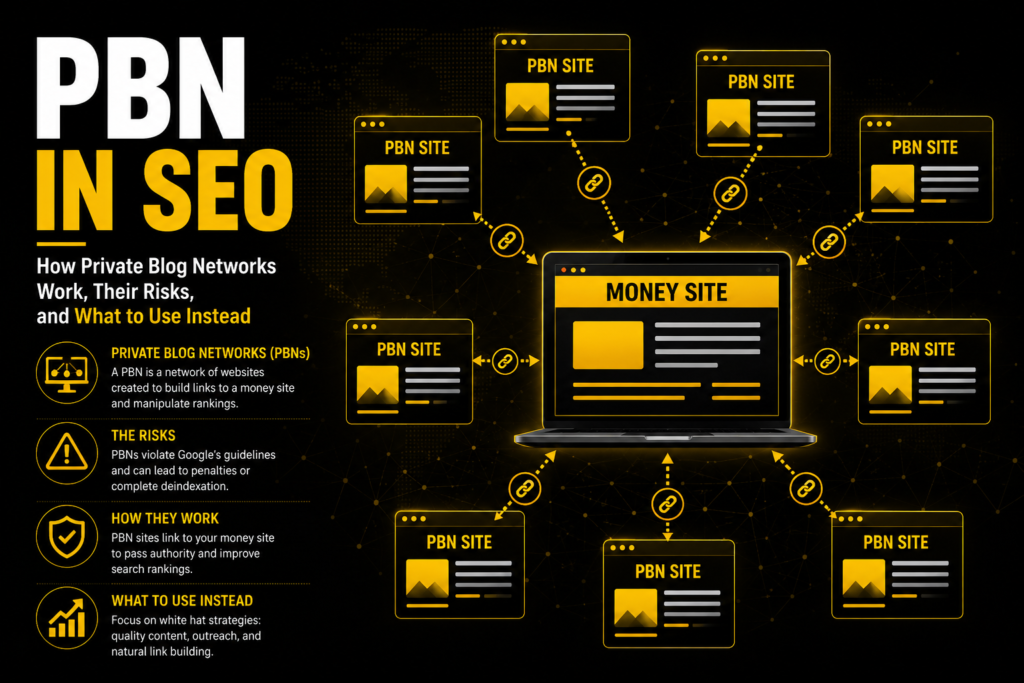
A private blog network commonly called a PBN in SEO is a collection of websites built or acquired for the sole purpose of linking to a central “money site” and inflating its search engine rankings. This guide explains exactly what a PBN is, how the link equity mechanics work, why Google treats PBNs as a black-hat tactic, and what the real penalty consequences look like in 2026. You will learn how to identify PBN footprints, understand the role expired domains play in network construction, and see why AI-powered spam detection has made PBNs far riskier than they were even three years ago.
Table of Contents
- Introduction: what is PBN in SEO and why does it matter?
- What is a PBN? The clearest definition
- How does a PBN work? The link equity mechanics
- Why do people use PBNs in SEO?
- Is PBN SEO black hat? Google’s stance explained
- What happens if Google detects your PBN?
- PBN footprints: how to identify a private blog network
- White-hat alternatives to PBN link building
- FAQ: your PBN questions answered
- Conclusion: is PBN SEO worth the risk in 2026?
Key Takeaways
- A PBN (Private Blog Network) is a group of websites controlled by one entity, built exclusively to create artificial backlinks to a target money site.
- PBNs violate Google’s link spam policies and can result in manual actions, algorithmic penalties, and full deindexation.
- Google’s SpamBrain AI system has made PBN detection significantly more accurate since 2022.
- Google may quietly neutralize PBN links meaning you pay the cost with zero ranking benefit.
- White-hat alternatives including digital PR, strategic guest posting, and broken link building consistently outperform PBNs over 12 months.
Introduction: what is PBN in SEO and why does it matter?

If you have spent any time in SEO circles, you have encountered the term pbn seo but depending on who you ask, you will get wildly different opinions about it. Some SEOs swear by private blog networks as a fast-track to first-page rankings. Others treat them as career-ending landmines. The truth leans firmly toward caution.
Understanding what a PBN is matters even if you would never build one yourself. Link sellers routinely pass PBN placements off as legitimate outreach links or editorial placements. Without knowing the footprints that distinguish a real editorial site from a fake feeder site, you are flying blind.
This guide is for three types of readers: SEOs auditing their link strategy, site owners evaluating cheap backlink offers, and anyone who wants a clear explanation of what a PBN actually is. By the end, you will understand the full mechanics of how private blog networks work, why Google has become very effective at detecting them, and what you should be doing instead.
What is a PBN? The clearest definition
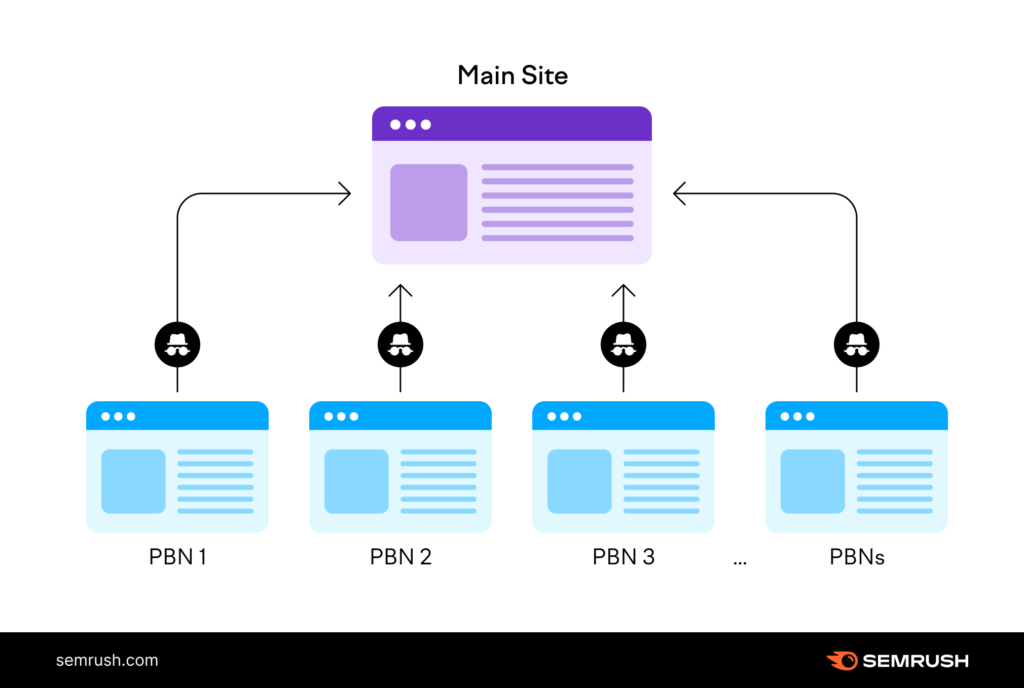
A private blog network is a group of websites typically built on expired domains with existing backlink authority all owned and controlled by a single person or organization, and used exclusively to generate backlinks pointing to one target domain. That target domain is called the money site.
PBN full form: what does PBN stand for?
PBN stands for Private Blog Network. Private — ownership is deliberately concealed. Blog — sites are structured as content websites. Network — the sites function as a coordinated system directing link authority toward the money site. For the complete terminology breakdown, see our PBN meaning and glossary guide.
What makes a site a PBN site vs a normal website?
A PBN site exists to hold a dofollow backlink to the money site and nothing else. It typically has thin generic content, no social media presence, a backlink profile far outpacing its content quality, and exact-match or commercial anchor text links pointing at the money site.
How does a PBN work? The link equity mechanics

The money site and feeder site relationship
The architecture of a private blog network has two layers. The money site is the real target. Feeder sites (satellite sites or PBN nodes) each publish content containing at least one link to the money site, creating the illusion of organic link acquisition from multiple independent domains. For a full breakdown of how these networks are assembled, see our guide on PBN networks and domains.
How PBN backlinks pass authority (PageRank flow explained)
In a PBN backlink, no editorial decision existed the link was placed because you own both ends. Google classifies this as a link scheme. The pbn in seo tactic is explicitly prohibited under Google’s link spam policies.
Why expired domains are the foundation of most PBNs
PBN operators build on expired domains because they carry inherited authority from their previous operational life. Without that inherited authority, a PBN site is just a fresh domain with nothing to transfer.
Why do people use PBNs in SEO?
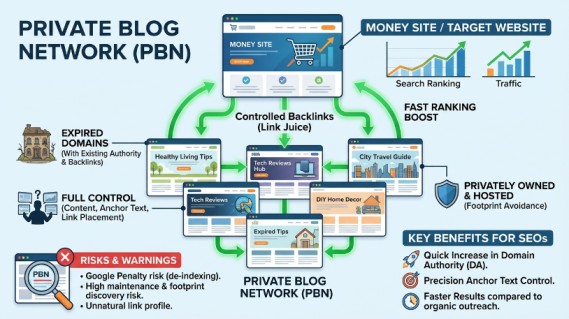
Speed: fast-track rankings without outreach
A PBN link can be placed in hours versus weeks for genuine editorial outreach. The problem is durability a fast link that gets devalued or triggers a penalty sets you back rather than forward.
Control: choosing your own anchor texts
PBN operators control every anchor text but an unnatural concentration of exact-match or commercial anchors from multiple sites is one of the clearest detection signals Google looks for. Read our dedicated article on what PBN links are and how they work for a full breakdown of anchor text risk.
Cost comparison: PBN links vs organic outreach
Building a 20-site PBN requires $3,000-$12,000 startup plus $1,500-$5,000/year maintenance. Marketplace PBN links cost $30-$200 each. Legitimate outreach links cost $150-$500+. This what is pbn seo cost comparison ignores the catastrophic penalty risk that can wipe out years of ranking gains overnight.
Is PBN SEO black hat? Google’s stance explained
Yes seo pbn usage is definitively black-hat SEO. Google’s link spam policies explicitly prohibit private blog networks as a link scheme.
The Google Webmaster Guidelines violation
Google states that any links intended to manipulate rankings may be considered link spam. PBNs are an organized, deliberate attempt to do exactly this. Google can respond with an algorithmic action or a manual action both are damaging, the manual action is worse.
The 2014 Google PBN crackdown and what changed
In 2014, Google deindexed hundreds of PBN sites in a single coordinated campaign. Not only did the backlinks stop working the entire network infrastructure was dismantled. This tail risk is what makes PBNs uniquely dangerous compared to other risky SEO tactics.
How AI and machine learning detect PBNs in 2025-2026
Google’s SpamBrain system uses machine learning to analyze the entire link graph and identify coordinated network clusters detecting sites with authority far exceeding content quality and link profiles showing unnatural anchor text distributions, all without requiring individual site review.
What happens if Google detects your PBN?
Manual action vs algorithmic penalty
A manual action appears in Google Search Console under Manual Actions rankings suppressed until links are disavowed and a reconsideration request is approved. An algorithmic penalty is silent no notification, just unexplained ranking drops with no clear path to diagnose the cause.
Real penalty examples: traffic drops and deindexation cases
Sites relying on PBN links have experienced 70-100% traffic drops following Google’s 2022 link spam update. In severe cases both the money site and network sites are fully deindexed. Recovery typically takes 12-24 months with no guarantee of full restoration.
How to recover: using the Google Disavow tool
Audit backlinks in Ahrefs, Semrush, or Majestic. Contact site owners to request removal. Create a disavow file and submit via Google’s Disavow tool. Then submit a reconsideration request if a manual action was issued.
PBN footprints: how to identify a private blog network
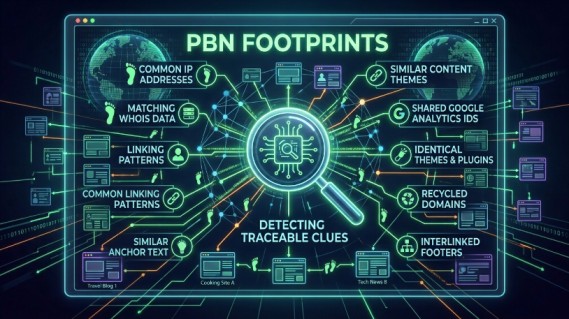
Technical signals: IP addresses, WHOIS data, hosting patterns
Shared IP addresses, identical nameservers, the same Google Analytics tracking ID across multiple sites, and identical WordPress theme and plugin fingerprints are classic PBN technical footprints. Sophisticated operators diversify infrastructure but perfect diversification at scale is expensive and rarely fully achieved.
Content signals: thin content, niche mismatch, low engagement
PBN content is typically thin, niche-inconsistent, and shows zero audience engagement no comments, no social shares, no evidence of real readers. A site that looks authoritative by metrics but reads as though no human cares about it is a significant PBN signal.
Backlink profile signals: exact-match anchors, link velocity
High percentages of exact-match commercial anchor text, unnatural link velocity, low referring domain diversity, and no brand mentions outside the network are key red flags. Majestic Trust Flow, Ahrefs, and Semrush surface these patterns quickly during any backlink audit.
White-hat alternatives to PBN link building
| Method | Speed | Cost per link | Risk | Durability |
|---|---|---|---|---|
| PBN (self-built) | Fast | Low-medium | Very high | Low |
| PBN (bought) | Very fast | Low | Extreme | Very low |
| Digital PR | Slow | High | Very low | Very high |
| Guest posting | Medium | Medium | Low-medium | High |
| HARO outreach | Medium | Low | Very low | High |
| Broken link building | Medium | Low | Very low | High |
Digital PR and editorial link earning
Digital PR creates original research or genuinely newsworthy content that journalists reference. Links come from real editorial sources with real audiences, carry full Google trust, and build brand authority as a byproduct.
Strategic guest posting (done correctly)
Strategic guest posting means writing genuinely valuable content for relevant publications in exchange for a natural link. The publication must have real readership, and the placement must not be paid. Paid placements violate Google’s link spam policies.
HARO / media outreach platforms
Responding to journalist queries earns links from major publications with zero payment and full editorial legitimacy. One link from a major news site carries more durable ranking value than fifty PBN links.
Broken link building and resource page outreach
Broken link building identifies dead links on authoritative sites and offers your content as a replacement — high response rates because you are solving a real problem. Explore our link building resources for additional white-hat strategies.
FAQs
Are PBN links still effective in 2026?
Short-term, PBN links can still generate ranking movement in less competitive niches. Long-term, Google’s SpamBrain has significantly improved detection since 2022. Sites relying on PBN links consistently show fragile rankings that collapse during algorithm updates. The risk-reward ratio in 2026 strongly favors white-hat alternatives for sustainable organic growth.
What is the difference between a PBN and a guest post?
A legitimate guest post comes from an independent publication that decided your content was good enough for their audience. A PBN link comes from a site you or the seller owns where no independent editorial judgment exists. The key distinction Google draws is editorial independence.
Is buying PBN backlinks illegal?
Buying PBN links is not illegal — it violates Google’s terms of service, not a legal statute. Consequences include loss of organic rankings, deindexation from Google Search, and significant business impact from lost organic traffic revenue.
How much does it cost to build a PBN?
A 20-site PBN on quality expired domains costs $3,000-$12,000 to set up plus $1,500-$5,000 per year to maintain. Marketplace PBN links cost $30-$200 each — cheaper upfront but with no control over network quality, footprint management, or detection risk.
Can PBN links be removed from your backlink profile?
You cannot remove links directly — only the site owner can. Submit a disavow file through Google Search Console telling Google to ignore specific domains. This instructs Google not to count them in its ranking evaluation.
What is the difference between PBN and tiered link building?
Tiered link building places PBN-style links in Tier 2 or Tier 3 positions to amplify upper-tier links without directly connecting the money site to low-quality domains. Google’s link graph analysis traces these indirect relationships — the detection risk is fundamentally the same as direct PBN link building.
Conclusion: is PBN SEO worth the risk in 2026?
Private blog networks represent a persistent tension in SEO: the appeal of fast, controllable link acquisition vs the reality of fragile rankings, ongoing detection risk, and catastrophic downside scenarios. In 2026, that tension has tilted decisively against PBNs.
Google’s SpamBrain and link graph analysis have fundamentally changed the detection landscape. Links that work today may be neutralized silently tomorrow. The time and budget spent on a PBN would deliver stronger long-term returns invested in digital PR, genuine content quality, and strategic outreach.
The strategies that consistently win are the ones that create real editorial value and earn genuine backlinks from independent sources that actually chose to link to you.
Want to understand more about PBN link building? Read our detailed guide on what PBN links are and how they work, explore how PBN networks and domains are structured, check the complete PBN meaning and terminology glossary, browse our full PBN FAQ, see how PBN links work for affiliate sites, understand how long PBN links take to rank, master exact match anchor text strategy, learn about backlink equity and how to maximise it, and read our honest white hat vs black hat SEO breakdown, and our guide to white label link building for agencies.

Ben Davis is a seasoned SEO strategist with over a decade of hands-on experience in off page SEO, link building, and private blog network management.
He has helped 600+ agencies and professionals achieve top rankings in competitive niches including iGaming, crypto, CBD, and finance through data driven PBN strategies.