


Link building ROI is one of the most asked and least satisfactorily answered questions in digital marketing. Most link building ROI discussions fail because they try to measure link building as if it produces immediate, attributable revenue — which it rarely does directly. This guide provides the honest ROI framework for link building: how to calculate the revenue value of ranking improvements, how to set the right measurement timeline, which leading indicators to track before rankings move, how to build the business case for continued link building investment, and the specific calculations that let you compare link building ROI against other marketing channels on a fair basis.
Table of Contents
- Why link building ROI is hard to measure
- Calculating the revenue value of a ranking
- Leading indicators: what to measure before rankings move
- The complete link building ROI calculation
- Setting the right measurement timeline
- Reporting link building ROI to clients and management
- How to maximise link building ROI per pound spent
- FAQ
- Conclusion
Key Takeaways
- Link building ROI is best measured by calculating the revenue value of the organic ranking positions produced — not by counting links or measuring traffic immediately after link placement.
- The correct ROI timeline is 6-12 months from campaign start to meaningful ranking movement, and 12-24 months to full compound ROI — measuring at 30 days produces misleading data that leads to incorrect budget decisions.
- Leading indicators — URL Rating improvement on target pages, indexation confirmation, keyword rank movement — allow you to demonstrate campaign progress before revenue attribution is possible.
- Link building ROI typically ranges from 3:1 to 20:1 over a 24-month horizon for competitive keywords, making it one of the highest long-term ROI marketing investments available — but requires the patience to measure at the right time horizon.
- The ROI of quality links compounds over time: a ranking produced in month 6 continues generating revenue in months 12, 18, 24 and beyond — making the denominator (link cost) fixed while the numerator (revenue) grows indefinitely.
Why link building ROI is hard to measure
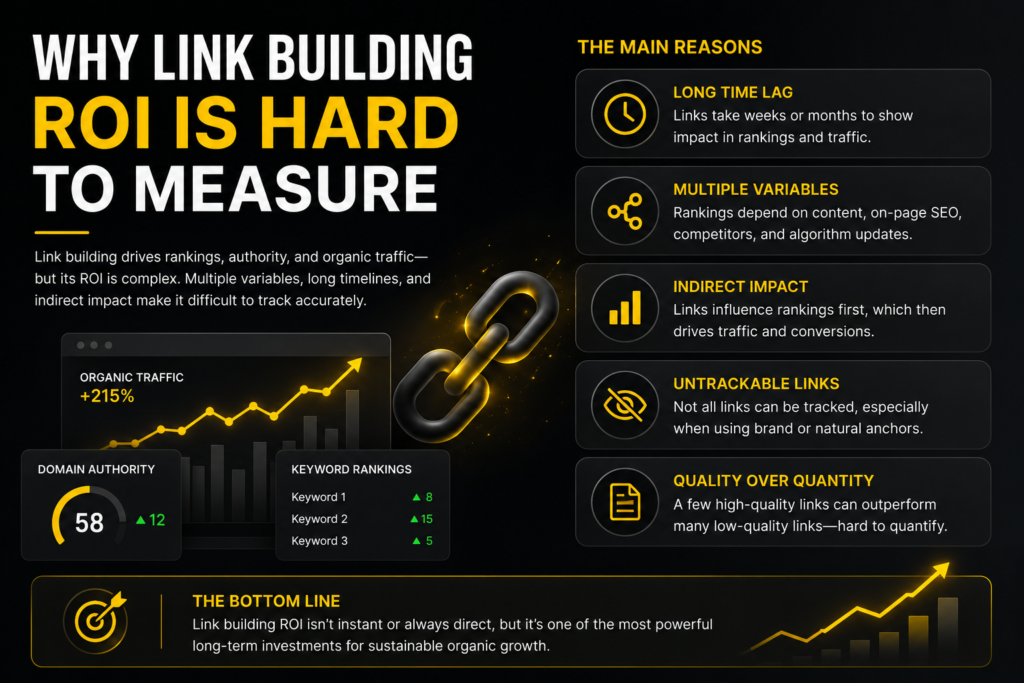
Link building ROI is difficult to measure for three structural reasons that most ROI frameworks fail to account for.
Reason 1: Time lag between investment and outcome
A link placed today begins influencing rankings 2-6 weeks after indexation. First measurable ranking movement on established sites typically appears 4-8 weeks after confirmed indexation. Consistent directional movement toward target positions takes 3-5 months from campaign start. Revenue attribution becomes meaningful 6-12 months after campaign commencement. This means that a 30-day link building ROI measurement produces essentially zero — not because the investment is not working, but because the outcome has not yet manifested. The measurement horizon must match the mechanism timeline. See our ranking timeline guide for the full breakdown.
Reason 2: Attribution is indirect
Link building does not directly generate revenue. It generates ranking improvements, which generate organic traffic, which generates leads, trials, or sales. Each step in this chain has its own conversion rate. Attributing revenue to link building requires tracking the full chain: link building investment → URL Rating improvement → ranking improvement → organic traffic increase → conversions → revenue. Most GA4 reports do not make this chain visible in a single view, which is why link building investment often appears difficult to justify in standard attribution reports.
Reason 3: Compounding vs one-time return
Paid advertising ROI is straightforward because the return occurs within the campaign period — spend £1,000 on Google Ads in October, measure revenue in October, calculate ROI. Link building ROI does not work this way. A ranking produced by a link building campaign in month 6 continues generating revenue in months 7, 8, 9 and indefinitely into the future — as long as the ranking holds. The investment is a one-time cost; the return compounds over years. Standard monthly ROI calculations that divide monthly revenue by monthly cost severely understate the true ROI of link building investment.
Calculating the revenue value of a ranking
Before calculating link building ROI, you need the revenue value of the ranking you are trying to achieve. This is the denominator against which link building cost is compared. Here is the calculation process:
Step 1: Get monthly search volume for the target keyword
Use Ahrefs Keyword Explorer or Semrush to get the monthly search volume for your primary target keyword. This is the total pool of searches your ranking will draw from.
Step 2: Apply position click-through rate
Average click-through rates by position (approximate 2026 data): Position 1: 27-30% CTR. Position 2: 13-15%. Position 3: 8-10%. Position 4-7: 4-7%. Position 8-10: 2-4%. Multiply search volume by expected CTR at your target position to get estimated monthly organic visits.
Example: Target keyword with 2,000 monthly searches. Target position: 2. Expected CTR: 14%. Estimated monthly visits: 2,000 × 14% = 280 monthly visits.
Step 3: Apply your site conversion rate
Use your actual site conversion rate from GA4 — organic traffic to conversion (lead, trial, purchase). If you do not have this data, use an industry benchmark: ecommerce typically 1-3%, SaaS free trial 2-5%, lead generation 3-8%. Apply the conversion rate to monthly visits to get expected monthly conversions.
Example continued: 280 monthly visits × 2.5% conversion rate = 7 conversions per month.
Step 4: Apply conversion revenue value
For ecommerce: average order value. For SaaS: monthly recurring revenue per customer × average customer lifetime in months. For lead gen: average revenue per closed lead. Apply to monthly conversions to get monthly revenue from the ranking.
Example continued: 7 conversions × £200 average order value = £1,400 monthly revenue from this single ranking.
Step 5: Calculate annual and lifetime revenue
£1,400 per month × 12 months = £16,800 annual revenue from this ranking. A ranking that holds for 3 years produces £50,400 in lifetime revenue. This is the value pool against which your link building investment is compared.
Leading indicators: what to measure before rankings move
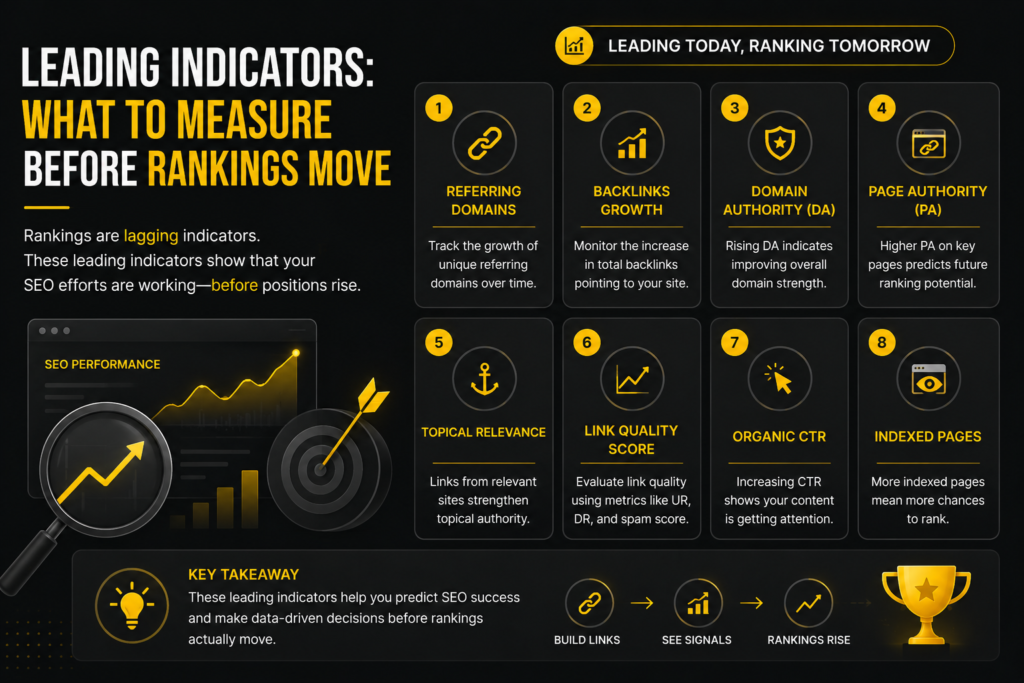
Because revenue attribution takes months, demonstrating link building progress requires tracking leading indicators — metrics that change before rankings and revenue move, proving the mechanism is working. Three leading indicators should be in every link building ROI report.
Leading indicator 1: Indexation rate
Verify that placed links are indexed by Google. Check each Tier 1 PBN article page URL with a site: search in Google. An indexed link is an active equity contributor; an unindexed link passes nothing. Track percentage of placed links confirmed indexed each month. 85-95% indexation within 3-4 weeks is the benchmark for quality PBN campaigns.
Leading indicator 2: URL Rating improvement on target pages
Check the URL Rating of target money pages in Ahrefs weekly. UR improvement on target pages confirms that indexed links are passing equity and that the equity chain (PBN article → money page) is functioning. Track UR at campaign start and weekly thereafter. A target page moving from UR 8 to UR 18 over 8 weeks of link building is strong evidence the campaign is working — even before keyword rankings move. This is the most reliable leading indicator available. See our URL Rating guide for the mechanics.
Leading indicator 3: Referring domain growth rate
Track the referring domain count on target pages in Ahrefs monthly. Consistent growth in referring domains at the target velocity confirms the link building programme is executing correctly. Flat or declining referring domains despite active link building indicates indexation problems, link removal issues, or quality problems causing discounting.
The complete link building ROI calculation
With the revenue value of the target ranking established, the ROI calculation is straightforward. Use a 12-month and 24-month view to show both near-term and compounding ROI.
The ROI formula
ROI = (Revenue generated – Link building investment) / Link building investment × 100
Worked example: ecommerce category page
Target: Rank page 2 → page 1 position 3 for “running shoes UK” (4,000 monthly searches).
Campaign cost: 40 quality standard links at £35 each over 6 months = £1,400 total.
Revenue calculation: 4,000 searches × 9% CTR at position 3 = 360 visits/month. 360 × 2% conversion rate = 7.2 purchases/month. 7.2 × £85 average order value = £612/month revenue from this ranking.
12-month ROI: Campaign reaches page 1 by month 6. Revenue generated months 7-12: £612 × 6 = £3,672. ROI = (£3,672 – £1,400) / £1,400 × 100 = 162% in year 1.
24-month ROI: Full year 2 at £612/month = £7,344 additional revenue. Total 24-month revenue: £3,672 + £7,344 = £11,016. ROI = (£11,016 – £1,400) / £1,400 × 100 = 687% over 24 months.
Worked example: SaaS comparison page
Target: Rank “best project management software” comparison page to position 2 (1,800 monthly searches).
Campaign cost: 60 premium links at £55 each over 8 months = £3,300 total.
Revenue calculation: 1,800 × 14% CTR = 252 visits/month. 252 × 4% trial sign-up rate = 10 trials/month. 10 × 25% trial-to-paid conversion × £80/month MRR × 24-month average lifetime = £4,800 monthly new MRR contribution at full rate.
Even at a conservative 6-month ramp: £4,800 × 6 months = £28,800 year 1 revenue contribution. ROI = (£28,800 – £3,300) / £3,300 × 100 = 773% in year 1. This is why SaaS companies with high LTV can justify premium link building investment — the revenue value of a competitive ranking dramatically outweighs the link building cost.
Setting the right measurement timeline
The single most common link building ROI mistake is measuring at the wrong time. Here is the correct measurement schedule:
| Timeframe | What to measure | What to expect |
|---|---|---|
| Month 1 | Link indexation rate, Tier 1 article page UR | 70-85% indexation, early UR movement |
| Month 2-3 | Money page URL Rating, referring domain count | UR improvement on target pages, RD count growing |
| Month 3-5 | Keyword ranking movement (top 20 entry) | First keywords entering top 20 for long-tail targets |
| Month 5-7 | Keyword ranking movement (top 10 entry) | Primary keywords approaching page one |
| Month 6-9 | Organic traffic to target pages | First measurable organic traffic increase |
| Month 9-12 | Conversion and revenue attribution | Meaningful revenue attribution becomes possible |
| Month 12-24 | Full ROI calculation | Compounding returns, full ROI picture visible |
Presenting this timeline upfront to clients or management — before the campaign begins — sets accurate expectations and prevents the premature cancellation of campaigns that are executing correctly but have not yet reached the revenue attribution phase.
Reporting link building ROI to clients and management
Link building ROI reports that only show link counts lose clients. Reports that show the full leading-indicator-to-revenue chain retain clients and justify budget expansion. Here is the reporting structure that works at each stage of the campaign.
Months 1-3: Progress and leading indicators report
The early-stage report focuses on execution quality and leading indicators — not rankings or revenue, which have not yet manifested. Include: link delivery summary (domain, URL, DR, TF, UR, anchor, indexation status), referring domain count trend (chart showing growth), URL Rating improvement on target pages (before/after table), and projected ranking movement timeline. Accompany with a narrative explaining the mechanism: “These 15 new referring domains from Trust Flow 20+ sources are raising the URL Rating on your target pages — UR improvement at this stage is the leading indicator that rankings will follow in months 4-6.”
Months 4-7: Ranking movement report
The mid-campaign report introduces keyword ranking movement alongside the link metrics. Show rank tracker screenshots for all target keywords, highlighting directional movement. Calculate the projected monthly traffic value at current ranking positions versus campaign start using Ahrefs Traffic Value metric as a proxy for the commercial value of ranking improvements.
Months 7-12: Revenue attribution report
The mature campaign report introduces organic traffic data and conversion attribution. From GA4: organic traffic to target pages month-over-month, goal completions or purchases from organic traffic to those pages, and revenue attributed to organic traffic. Present the full ROI calculation: link building investment to date versus revenue attributed to improved organic performance. For the white label agency reporting framework, see our white label link building guide.
How to maximise link building ROI per pound spent
Five practices consistently produce higher ROI per pound of link building investment.
1. Target commercial pages first
Links to commercial money pages (product, category, comparison, feature, pricing pages) produce higher revenue ROI than links to blog content because those pages convert visitors directly. A ranking improvement on a product category page drives purchases immediately. A ranking improvement on a blog post drives traffic that may or may not convert. Always prioritise commercial page authority in the link building plan. Our PBN link building strategy covers the page targeting priority framework.
2. Use single-outbound-link placements
A single-outbound-link PBN article passes 100% of available link equity to your money page. A shared placement on an article with 5 outbound links passes 20%. The equity difference between these two scenarios has direct ROI implications: you need fewer single-placement links to achieve the same UR improvement on target pages, which means less budget for the same ranking outcome. Always specify single outbound link placement in your link building brief.
3. Deploy Tier 2 amplification
Tier 2 link building raises the URL Rating of Tier 1 article pages — multiplying the equity they pass to your money site without requiring new Tier 1 placements. At 15-20% of total link building budget, Tier 2 amplification can increase the effective equity contribution of your Tier 1 investment by 2-3x. This is the highest-leverage ROI multiplier available for campaigns that already have Tier 1 links in place. Full strategy in our second tier link building guide.
4. Start with lower-competition keywords in the target cluster
Every target niche has a range of keyword competition levels. Long-tail and lower-competition keywords in your cluster require fewer links to rank, reach page one faster, and start generating revenue sooner — which means the early-stage ROI (months 6-12) is higher than for primary head terms. Start link building on your most achievable ranking gaps, generate early revenue attribution, and use those results to justify continued investment in more competitive primary keywords.
5. Fix on-site issues before building links
Links cannot overcome fundamental on-site problems. Slow page speed, missing canonical tags (particularly critical for Shopify — see our ecommerce PBN guide), thin or duplicated content, and poor internal linking all reduce the ROI of external link building by preventing the equity from reaching target pages or by failing to convert the traffic that rankings generate. Audit on-site factors before significant link building investment — fixing a canonical tag issue or adding internal links from high-authority pages to commercial pages can produce immediate ranking improvements that amplify every subsequent link building pound spent.
FAQ
What is a good ROI for link building?
Quality link building typically produces ROI of 3:1 to 10:1 over a 12-month period for competitive keywords, and 8:1 to 20:1 over 24 months when the compounding nature of rankings is accounted for. Exact ROI depends on the commercial value of the target keyword (search volume × conversion rate × revenue per conversion), the competition level and budget required to close the authority gap, and how quickly the site reaches page-one positions. For high-LTV niches (SaaS, finance, legal), link building ROI frequently exceeds 10:1 over 24 months.
How do you measure link building ROI?
Measure in four stages: (1) month 1-3: indexation rate and URL Rating improvement on target pages as leading indicators, (2) month 3-6: keyword ranking movement toward page one, (3) month 6-9: organic traffic increase to target pages from improved rankings, (4) month 9-12+: revenue attributed to organic traffic improvements. Calculate ROI as (revenue generated from improved organic performance – total link building investment) / total link building investment × 100.
How long before link building shows ROI?
Meaningful revenue ROI is typically measurable from month 9-12 for established sites. Leading indicators (URL Rating improvement) are visible from month 1-3. Ranking movement appears in months 4-7. Organic traffic increases appear in months 6-9. Revenue attribution becomes meaningful in months 9-12. Any link building ROI claim that promises measurable revenue return within 30-60 days is setting expectations the mechanism cannot support.
How does PBN link building ROI compare to white hat outreach?
PBN links typically produce ranking results in 3-6 months versus 12-18 months for white hat editorial outreach — which means PBN link building reaches the revenue-generating phase 6-12 months earlier. The cost per link is significantly lower for PBN links versus genuine editorial placements, and anchor text control is complete. The risk profile is higher, but when calculated on a risk-adjusted ROI basis, quality PBN links frequently outperform editorial outreach for competitive commercial keywords within a 24-month horizon.
How do I justify link building investment to management?
Present the revenue value of the target rankings first: calculate estimated monthly revenue from a page-one position (search volume × CTR × conversion rate × revenue per conversion) then multiply by 12 for annual value. Compare this to the link building budget required. A £5,000 link building investment that produces a ranking generating £2,000/month breaks even in 2.5 months and generates compounding returns indefinitely. Frame it as a capital investment with known return characteristics — not as an ongoing cost.
Conclusion
Link building ROI is one of the strongest ROI profiles in digital marketing when measured correctly — but it requires measuring at the right time horizon, tracking the right leading indicators, and framing the investment as compounding capital rather than monthly spend. The mechanism is straightforward: quality links produce ranking improvements, ranking improvements produce organic traffic, organic traffic produces revenue, and that revenue continues arriving as long as the ranking holds.
The practitioners who struggle to demonstrate link building ROI are typically measuring too early (at 30-60 days rather than 9-12 months), measuring the wrong things (link counts rather than URL Rating improvement and ranking movement), or failing to calculate the revenue value of the target rankings before the campaign begins. Fix these three measurement failures and link building consistently shows some of the strongest long-term ROI of any marketing investment available.
Build links that produce the ROI your investment deserves. Quality PBN backlinks — Trust Flow verified, URL Rating confirmed, single outbound link articles available. Supporting guides: complete PBN link building strategy, ranking timelines — when to expect ROI, URL Rating — the leading indicator that predicts ranking ROI, Tier 2 links — the highest ROI amplifier per pound spent, and our outsource link building guide for agency ROI reporting models.

Ben Davis is a seasoned SEO strategist with over a decade of hands-on experience in off page SEO, link building, and private blog network management.
He has helped 600+ agencies and professionals achieve top rankings in competitive niches including iGaming, crypto, CBD, and finance through data driven PBN strategies.