


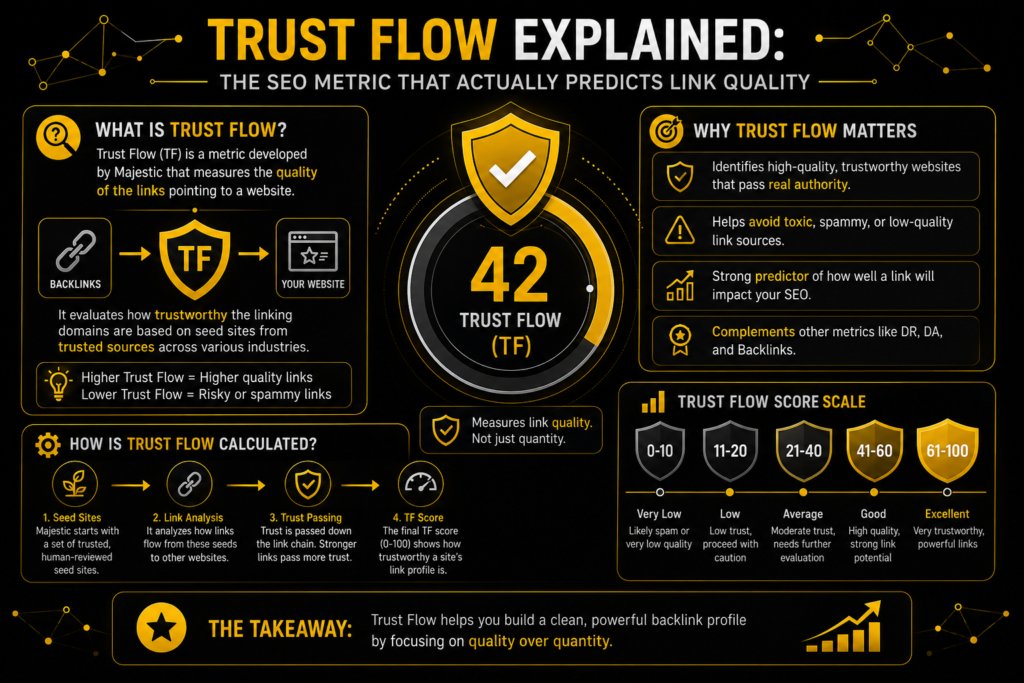
Trust Flow is the most reliable third-party metric for evaluating link quality — and the most underused one. While Domain Rating (DR) and Domain Authority (DA) dominate most link buying conversations, Trust Flow from Majestic is consistently more predictive of whether a domain will actually pass ranking-moving equity to your money site. This guide explains exactly what Trust Flow measures, how it is calculated, what the numbers mean in practice, how to interpret the Citation Flow to Trust Flow ratio, and how to use Topical Trust Flow to select PBN domains with genuine niche relevance for your target keywords.
Table of Contents
- What is Trust Flow?
- How Trust Flow is calculated
- Citation Flow vs Trust Flow: the ratio that reveals quality
- Topical Trust Flow: the metric most SEOs ignore
- What is a good Trust Flow score?
- Trust Flow vs Domain Rating: when to use each
- How to use Trust Flow when evaluating PBN links
- Can you improve your site Trust Flow?
- FAQ
- Conclusion
Key Takeaways
- Trust Flow (TF) is a Majestic SEO metric that measures how closely connected a domain is to a set of manually curated trusted seed sites through the link graph. It is quality-weighted, not volume-weighted.
- The Citation Flow to Trust Flow ratio is the most useful single diagnostic in link quality assessment. A ratio below 2:1 (CF no more than double TF) indicates a clean, quality-weighted profile. A ratio above 4:1 indicates a spam-heavy profile that has accumulated volume without genuine quality.
- Topical Trust Flow shows which topic categories a domain authority comes from. A domain with Sports Topical TF of 22 has demonstrably received links from the sports ecosystem — far more useful for niche targeting than a generic DR score.
- Minimum recommended Trust Flow for PBN link evaluation: TF 15 for standard campaigns, TF 20+ for most competitive niches, TF 25+ for YMYL niches like finance, health, and legal.
- Trust Flow is harder to game than Domain Rating because it requires actual links from domains that are themselves trusted — bulk link farm links do not raise TF the way they raise DR.
What is Trust Flow?
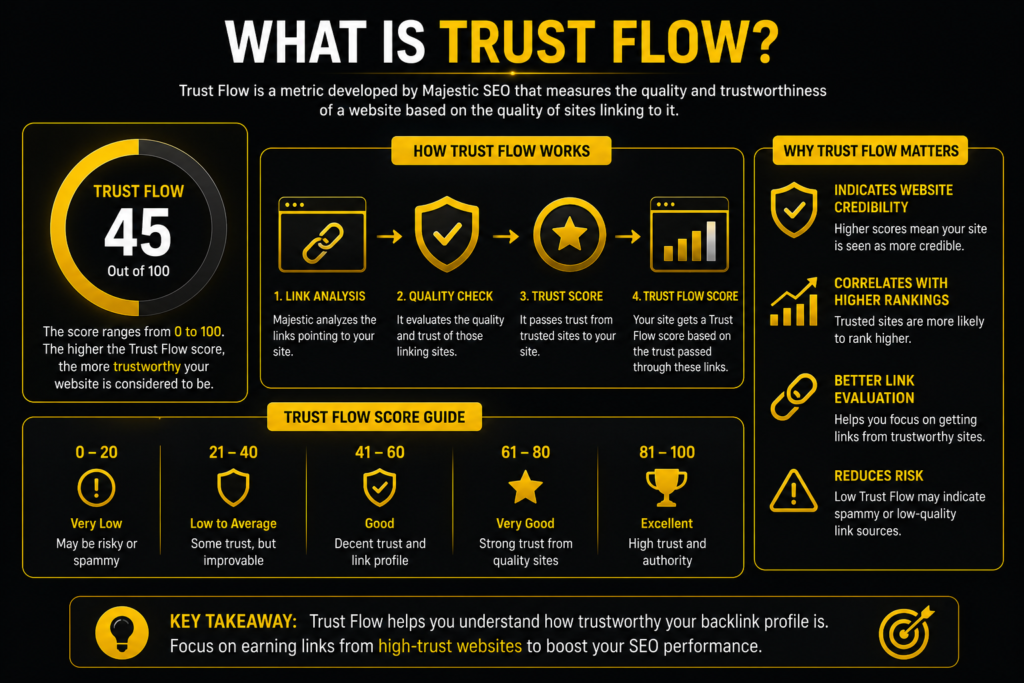
Trust Flow is a metric developed by Majestic SEO that measures the quality and trustworthiness of a domain or URL backlink profile. Unlike Domain Rating (Ahrefs) and Domain Authority (Moz) which are primarily influenced by the volume of links pointing to a domain, Trust Flow is built on a fundamentally different principle: proximity to trusted sources.
Majestic maintains a manually curated list of seed sites — domains that are widely accepted as genuinely authoritative and trustworthy. Think major government websites, established university domains, long-standing national news publications, and widely trusted reference sites. Trust Flow measures how many “hops” a domain is away from these seed sites through the link graph, and how strong those connections are.
A domain that receives a direct link from a seed site gets a very high Trust Flow contribution from that link. A domain that is linked to by a domain that is linked to by a seed site gets a lower but still meaningful Trust Flow contribution. Trust Flow attenuates with each additional link in the chain — so the closer a domain is to genuinely trusted sources, the higher its Trust Flow.
The result is a metric that is significantly harder to manipulate than volume-based metrics like DR. Buying thousands of cheap links from link farms raises DR. It does not raise Trust Flow, because those link farms are not connected to trusted seed sites. To raise Trust Flow, a domain needs links from domains that are themselves trusted — which requires either genuine editorial content or careful acquisition of already-trusted referring domains.
How Trust Flow is calculated
Majestic starts with its set of trusted seed sites — a list that is manually reviewed and maintained. Every link on the internet that Majestic has crawled is then evaluated in terms of its relationship to these seed sites.
The propagation model
Trust Flow propagates through the link graph similarly to how PageRank propagates — with attenuation at each step. When a seed site links directly to a domain, it passes a large Trust Flow contribution. When that domain links to another domain, it passes a proportion of its Trust Flow to that domain. Each hop in the chain reduces the Trust Flow contribution, but the signal is never entirely zero — meaning a domain several hops removed from a seed site can still have meaningful Trust Flow if the intervening domains are themselves high-TF.
Why it is harder to game
The seed site model creates a fundamental asymmetry between Trust Flow and DR. To raise DR, you need referring domains — and cheap PBN links, forum profiles, and link farm placements all count as referring domains for DR calculation purposes. To raise Trust Flow, you need referring domains that themselves have Trust Flow — which means you need links from domains that are already connected to the trusted seed site network. This cannot be achieved through bulk link farms because those farms are not connected to the seed site network.
This is precisely why Trust Flow is the preferred quality metric for evaluating PBN domains intended for client campaigns. A domain with TF 25 has demonstrably received links from a chain of trusted sources. A domain with DR 50 may have received those links from a mix of genuine and spam sources — DR does not distinguish between them.
Citation Flow vs Trust Flow: the ratio that reveals quality
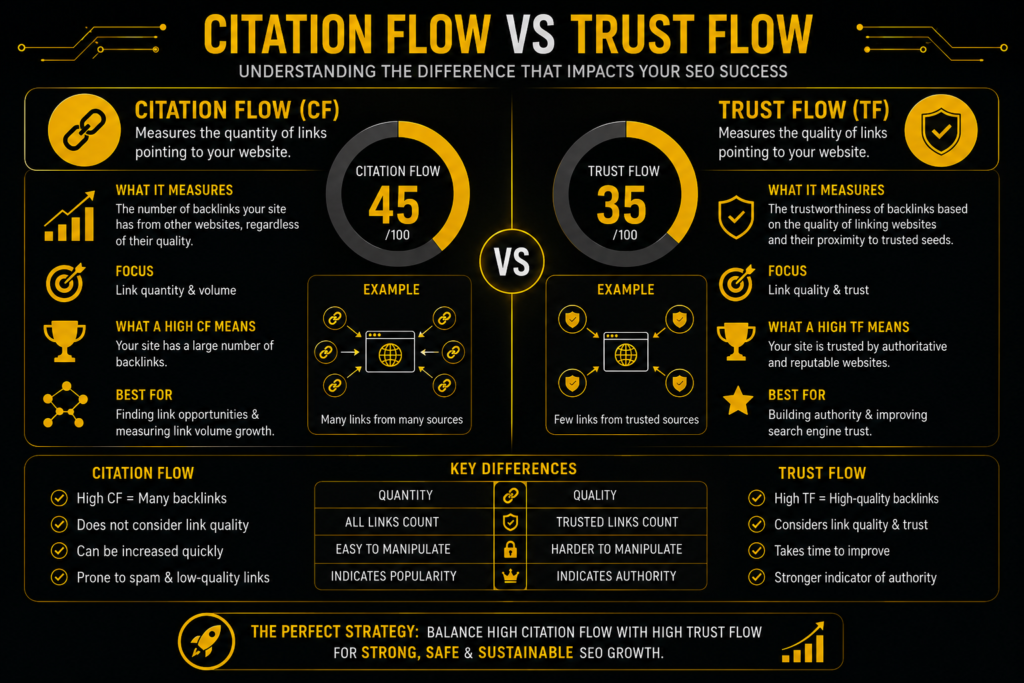
Majestic provides two metrics that work together: Citation Flow (CF) and Trust Flow (TF). Understanding their relationship is as important as understanding either metric in isolation.
What Citation Flow measures
Citation Flow measures the volume of links pointing to a domain — the raw quantity of the link profile, weighted by the Citation Flow of the linking domains. It is Majestic version of a volume metric, conceptually similar to DR. A domain with many incoming links, even low-quality ones, will have high Citation Flow. Citation Flow is easy to inflate with bulk links.
The CF:TF ratio diagnostic
The relationship between Citation Flow and Trust Flow is the most useful single diagnostic tool in link quality assessment. Here is how to read it:
| CF:TF ratio | What it indicates | Action |
|---|---|---|
| 1:1 (CF = TF) | Extremely high quality — every link is from a trusted source. Rare. | Excellent PBN domain candidate |
| 1.5:1 to 2:1 | High quality — most links are from trusted or near-trusted sources | Strong PBN domain candidate |
| 2:1 to 3:1 | Good quality — healthy mix of trusted and general links | Acceptable PBN domain |
| 3:1 to 4:1 | Moderate quality — notable proportion of lower-quality links | Use cautiously, check organic traffic |
| 4:1 or higher | Spam-heavy — high volume with low trusted links. Classic link farm profile. | Reject — likely discounted by Google |
Example: A domain with CF 40 and TF 20 has a ratio of 2:1 — the link volume is double the trust quality, which is within normal range for an editorial site that has accumulated some opportunistic links alongside genuine ones. A domain with CF 60 and TF 10 has a ratio of 6:1 — it has accumulated enormous volume of low-quality links that have not contributed meaningfully to its trust signal. This is exactly the type of domain that looks impressive on DR but passes minimal real equity to money sites.
When evaluating PBN domains, the CF:TF ratio is the first quality diagnostic after checking the raw TF score. Any domain with a ratio above 4:1 should be rejected regardless of its DR score.
Topical Trust Flow: the metric most SEOs ignore
Topical Trust Flow is one of the most practically useful features Majestic provides — and the one that most SEOs overlook. Every domain is assigned Trust Flow across specific topic categories based on where its link authority actually comes from.
How Topical Trust Flow works
Majestic classifies its trusted seed sites by topic. Links that trace back to seed sites in the Sports category contribute to Sports Topical Trust Flow. Links tracing back to Finance seed sites contribute to Finance Topical Trust Flow. And so on across hundreds of topic categories. A domain ends up with a Trust Flow score for each topic category that reflects how its link authority is distributed across subject areas.
The top 3–5 Topical Trust Flow categories for any domain tell you where its genuine authority comes from. A domain showing its highest Topical TF scores in Sports, Recreation, and Entertainment has its authority rooted in those ecosystems. This is directly actionable for PBN and niche edit domain selection.
Why Topical Trust Flow matters for PBN link building
Generic domain authority metrics like DR tell you that a domain has a strong link profile — but not whether that profile is relevant to your money site niche. Topical Trust Flow tells you which niche ecosystems the domain authority actually comes from.
A domain with Topical TF of 20 in “Gambling” and “Sports” passing a link to a casino site is passing topically relevant authority — Google can evaluate the trust signal in the context of the domain established subject area. The same link from a domain with Topical TF of 20 in “Cooking” and “Home Improvement” passes generic authority without topical reinforcement.
For PBN domain selection, matching the Topical Trust Flow categories to your money site niche is the highest-impact quality criterion available after raw TF score and CF:TF ratio. This is especially important in YMYL niches — a finance site receiving links from domains with Finance Topical Trust Flow is significantly more credible to Google quality assessment than the same links from topically unrelated domains. Our finance and crypto PBN links guide covers the YMYL topical relevance requirements in full.
How to check Topical Trust Flow
In Majestic Site Explorer, enter the domain URL and look for the Topical Trust Flow chart on the Overview or Summary tab. It shows the top categories as a visual breakdown — each topic category with its proportional TF contribution. Hovering or clicking on categories in the paid version shows the specific TF score for each category.
What is a good Trust Flow score?
Trust Flow scores are not absolute — they need to be evaluated in context of the niche, campaign type, and what the competition looks like. That said, practical benchmarks help set minimum standards for link buying decisions.
| Campaign type | Minimum TF | Ideal TF range | Notes |
|---|---|---|---|
| Standard PBN campaigns (general niches) | TF 10 | TF 15–30 | TF 10 is a floor — meaningful but not impressive |
| Competitive national keywords | TF 15 | TF 20–35 | Higher TF needed to move competitive SERPs |
| YMYL niches (finance, health, legal) | TF 20 | TF 25–40 | Google scrutinises YMYL link profiles more carefully |
| iGaming and casino SEO | TF 15 | TF 20–35 | Niche-relevant TF categories essential |
| Tier 2 links (supporting Tier 1 pages) | TF 8 | TF 10–20 | Lower standard acceptable — not touching money site directly |
| Niche edit placements | TF 15 | TF 20–40 | Page-level TF of the specific article most important |
These benchmarks work alongside the CF:TF ratio check — a domain with TF 20 and CF:TF ratio of 1.5:1 is considerably stronger than a domain with TF 20 and CF:TF ratio of 5:1, even though the raw TF score is identical.
The TF scale is logarithmic — moving from TF 10 to TF 20 requires significantly more trusted link accumulation than moving from TF 0 to TF 10. This means that TF 30 is not “twice as good” as TF 15 — it represents a substantially more authoritative and trusted link profile.
Trust Flow vs Domain Rating: when to use each
Trust Flow and Domain Rating serve different purposes in a link quality evaluation workflow. Neither is universally better — they answer different questions.
Use Domain Rating (Ahrefs) for: Fast first-pass filtering of large domain lists. DR is calculated more frequently and Ahrefs has a larger index, making it faster and more accurate for identifying clearly low-quality domains quickly. When evaluating 100 PBN domains as part of a network audit, DR provides the most reliable rapid filter.
Use Trust Flow (Majestic) for: Quality confirmation before accepting a placement, evaluating individual domains for specific high-value campaigns, assessing whether a domain authority comes from genuine or spam sources, and selecting domains with specific topical authority through Topical Trust Flow. Trust Flow is the deeper quality verification step that follows a DR filter.
Where Trust Flow specifically outperforms DR:
- Detecting domains with inflated DR from link farms — high DR, low TF, high CF:TF ratio is the signature of a spam-built profile
- Niche targeting through Topical Trust Flow — DR provides no topical information whatsoever
- YMYL and competitive niche evaluation where link quality signals matter more to Google
- Identifying genuinely expired domains with real editorial history vs. expired domains that accumulated DR through paid link schemes
For the full comparison of DA, DR, and TF including how they correlate with ranking ability, see our Domain Authority vs Domain Rating guide.
How to use Trust Flow when evaluating PBN links
The practical Trust Flow evaluation workflow for PBN domains and niche edit placements follows four steps.
Step 1: Check raw TF against your campaign minimum
Open Majestic Site Explorer and enter the domain. The Trust Flow score is prominently displayed in the summary. Apply your campaign minimum threshold: TF 15 for standard campaigns, TF 20+ for competitive niches, TF 25+ for YMYL. Domains below your threshold fail at this step without further investigation.
Step 2: Check the CF:TF ratio
Note both the Citation Flow and Trust Flow scores. Divide CF by TF. If the ratio is above 4:1 — reject. Between 2:1 and 4:1 — investigate further with the remaining steps. Below 2:1 — strong quality signal, proceed confidently.
Step 3: Check Topical Trust Flow categories
Look at the Topical Trust Flow distribution. Is the domain authority concentrated in topic areas relevant to your money site? A domain with strong Topical TF in your money site niche provides stronger topical relevance signals. A domain with Topical TF in completely unrelated categories provides generic authority without topical reinforcement. For niche-specific campaigns, Topical TF category match is a non-negotiable criterion.
Step 4: Cross-reference with Ahrefs organic traffic
After Trust Flow checks pass, verify organic traffic in Ahrefs Site Explorer. A domain that passes TF and CF:TF checks but shows zero organic traffic has likely been penalised by Google since its last Majestic crawl. Organic traffic is real-time evidence that Google values the domain. TF scores are calculated from crawled link data which may be days or weeks old. See our backlink equity guide for the full four-step domain evaluation sequence including URL Rating checks at the article page level.
Can you improve your site Trust Flow?
Yes — Trust Flow improves when you acquire links from domains that themselves have Trust Flow. The most effective ways to improve your site Trust Flow in 2026:
1. Editorial outreach to high-TF publications
Links from established editorial publications — news sites, industry trade press, established blogs with genuine editorial history — carry Trust Flow because those publications are themselves close to seed sites in the link graph. A single link from a national news publication can meaningfully raise a site Trust Flow more than 50 links from generic PBN domains.
2. PBN links from high-TF domains
PBN domains with high Trust Flow pass Trust Flow to your money site through their links. This is why Trust Flow is central to PBN domain selection — buying links from PBN domains with TF 25+ raises your money site TF score, while buying links from TF 5 domains does nothing for TF even if it raises DR. Our complete PBN SEO guide covers domain selection for maximum Trust Flow contribution.
3. Niche edits on aged, high-TF pages
Niche edit placements on pages that themselves have high Trust Flow pass that trust signal to your money site. An aged article that has accumulated TF from years of being linked by trusted sources in its niche is one of the most efficient Trust Flow improvement mechanisms available — you get the accumulated trust of an established page through a single placement. Our niche edits guide covers how to identify high-TF pages for niche edit placement.
What does NOT improve Trust Flow
Bulk cheap PBN links from TF 0–5 domains, social bookmarks, Web 2.0 profile links, forum profile links, and low-quality directory citations all raise DR and Citation Flow but do not meaningfully raise Trust Flow. If your Trust Flow score is low, the solution is fewer but higher-quality links from genuinely trusted sources — not more volume of the same low-quality links.
FAQ
What is Trust Flow in SEO?
Trust Flow is a metric developed by Majestic SEO that measures the quality and trustworthiness of a domain backlink profile. It is calculated based on how closely connected a domain is to a set of manually curated trusted seed sites through the link graph. Unlike Domain Rating (Ahrefs) which measures link volume quality, Trust Flow specifically measures link quality through proximity to trusted sources. It runs on a scale of 0 to 100, though most real-world domains score between 0 and 50.
What is a good Trust Flow score?
For PBN link evaluation, TF 15 is the recommended minimum for standard campaigns, TF 20+ for competitive niches, and TF 25+ for YMYL niches like finance, health, and legal. For the linking site as a whole, TF 20–35 represents a genuinely healthy link profile with real editorial authority. TF 40+ is outstanding and typically only seen in established publications with years of genuine editorial history. Always evaluate TF alongside the CF:TF ratio — TF 20 with a 1.5:1 ratio is considerably stronger than TF 20 with a 5:1 ratio.
What is the difference between Citation Flow and Trust Flow?
Citation Flow (CF) measures the volume of links pointing to a domain — conceptually similar to Domain Rating. Trust Flow (TF) measures the quality of those links through their proximity to trusted seed sites. A domain can have high Citation Flow and low Trust Flow if it has accumulated many low-quality links. The CF:TF ratio is the most useful diagnostic: a ratio below 2:1 indicates a quality-weighted profile; a ratio above 4:1 indicates a spam-heavy profile that has accumulated volume without genuine quality signals.
Is Trust Flow or Domain Rating better for evaluating PBN links?
Trust Flow is more reliable for quality evaluation because it is harder to game — bulk link farm links raise DR but do not raise TF. Domain Rating is faster and based on a larger index, making it better for initial filtering of large domain lists. The recommended approach: use DR for a quick first-pass filter (reject below DR 20), then use Trust Flow for quality confirmation (reject below TF 15 or CF:TF above 4:1), then check Topical Trust Flow for niche relevance, then verify organic traffic in Ahrefs as the final quality gate.
What is Topical Trust Flow?
Topical Trust Flow is a breakdown of a domain Trust Flow score by topic category. Majestic classifies its trusted seed sites by topic, and each domain ends up with Trust Flow scores across the topic categories that reflect where its link authority actually comes from. A domain with high Topical Trust Flow in “Finance” has demonstrably received links from the finance ecosystem — making it more relevant and valuable for linking to finance sites than a domain with the same overall TF but authority concentrated in unrelated topics.
Conclusion
Trust Flow is the link quality metric that the link building industry should use as its primary evaluation standard — and the one that most practitioners currently underuse in favour of the easier-to-obtain Domain Rating. The reason Trust Flow is more reliable is structural: it requires genuine proximity to trusted sources, which cannot be manufactured through bulk link schemes the way DR can.
The three Trust Flow tools that should be part of every link quality evaluation are: the raw TF score against your campaign minimum, the CF:TF ratio to identify spam-heavy profiles, and Topical Trust Flow categories to verify that domain authority comes from your target niche. Together they provide a quality assessment that DR alone cannot match.
For practical link building, Trust Flow should sit at the centre of your PBN domain selection process — not as a replacement for DR but as the quality confirmation step that follows a DR filter. A domain that passes both DR and Trust Flow thresholds, with a healthy CF:TF ratio and topically relevant Topical TF categories, is the profile you are building toward for every link in a well-managed campaign.
Every placement verified against Trust Flow, CF:TF ratio, and Topical TF categories. Quality PBN backlinks with Majestic Trust Flow verification on every domain. Supporting guides: Domain Authority vs Domain Rating — full metric comparison, backlink equity and URL Rating, niche edits — Trust Flow on aged article pages, PBN networks and domain selection, and our complete PBN SEO guide.

Ben Davis is a seasoned SEO strategist with over a decade of hands-on experience in off page SEO, link building, and private blog network management.
He has helped 600+ agencies and professionals achieve top rankings in competitive niches including iGaming, crypto, CBD, and finance through data driven PBN strategies.