


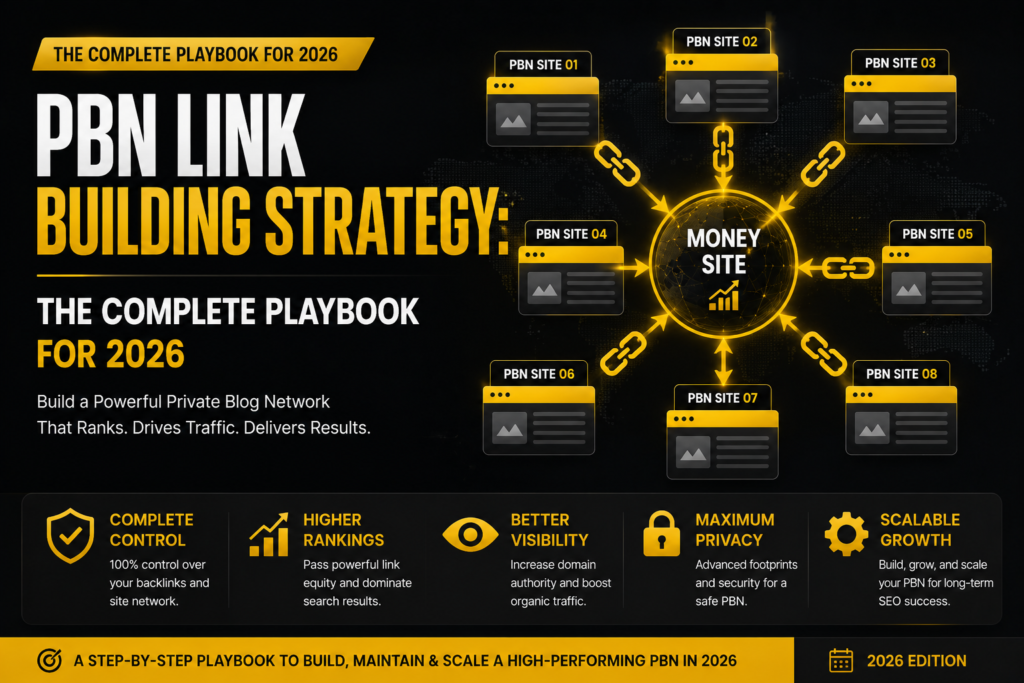
Building a PBN that actually works in 2026 is a materially different challenge from building one in 2016. The footprint patterns that went undetected for years are now routinely identified by SpamBrain, and the thin AI-generated content that filled thousands of PBN sites in the early 2020s fails Google Helpful Content standards. This guide covers every stage of how to build a PBN that produces durable ranking results: domain selection criteria, the hosting diversity requirement, content strategy for the post-Helpful-Content era, internal linking structure that raises article-page URL Rating, and the specific footprint mistakes that most DIY PBN builders make in years one and two. If you are evaluating whether to build your own PBN or buy links from a provider, the cost-of-ownership section at the end will help you make that decision with accurate numbers.
Table of Contents
- Should you build a PBN or buy links?
- Step 1: Domain selection
- Step 2: Hosting setup and diversity
- Step 3: CMS setup and configuration
- Step 4: Content strategy for 2026
- Step 5: Internal linking structure
- Step 6: Footprint mistakes to avoid
- Step 7: Ongoing management and maintenance
- The real cost of building a PBN yourself
- FAQ
- Conclusion
Key Takeaways
- A quality PBN domain must have genuine Trust Flow (TF 15+ minimum), real organic traffic history, a content niche relevant to your money site, and clean WHOIS history with no previous spam associations.
- Hosting diversity is the most critical technical requirement — every site in the network needs a different IP range, different hosting account, and ideally different registrar. Shared infrastructure is the most detectable PBN footprint.
- Content on PBN sites must pass the Google Helpful Content standard in 2026 — minimum 600 words per article, topically coherent, genuinely useful to a human reader. Thin AI filler fails the classifier and degrades the entire domain quality signal.
- Internal linking within each PBN site raises article-page URL Rating — the metric that determines how much equity each placed link passes to money sites. An orphaned PBN article with UR 1 passes a fraction of the equity of a well-linked article with UR 18.
- Building a quality PBN costs £200–£500 per domain in year one when all costs are accounted for. Buying links from a quality provider is almost always more cost-efficient unless you are building at 50+ links per month scale.
Should you build a PBN or buy links?
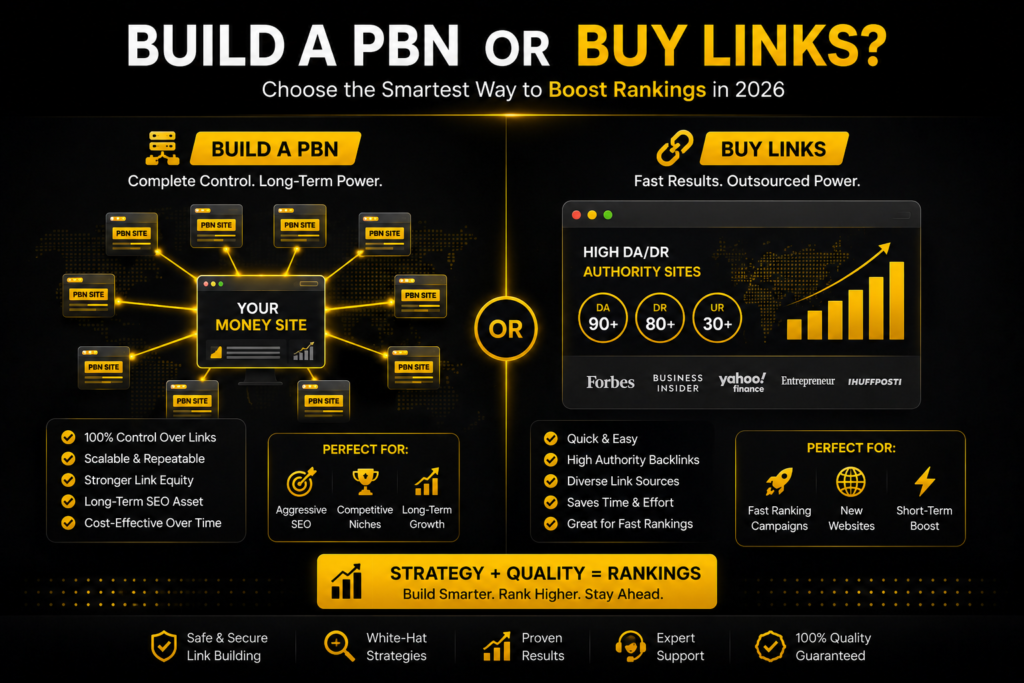
Before investing significant time and capital in building a PBN, it is worth being honest about when building makes sense versus when buying from a quality provider produces better ROI.
Build your own PBN when: You need 50+ links per month consistently, you have the technical SEO knowledge to manage hosting diversity and footprint avoidance, you have a long-term domain acquisition strategy and are willing to invest 6–12 months before the network produces meaningful results, and you have the content production budget for genuine 600+ word articles on each site.
Buy from a quality provider when: You need fewer than 50 links per month, you want results within weeks rather than months, you do not want to manage ongoing hosting and content costs, or you are building for client accounts where the infrastructure cost and operational complexity is not justified by the link volume. Our PBN link building cost guide covers the full cost comparison in detail.
This guide is for those who have decided to build. If you are still evaluating, read the cost section at the end before committing.
Step 1: Domain selection
Domain selection is the most important decision in PBN building. A weak domain produces minimal equity regardless of how well you execute everything else. The domains that make the best PBN foundations have accumulated genuine link authority from their previous life as real content sites — and that authority is what you are acquiring.
Where to find PBN domains
Expired domain auctions: GoDaddy Auctions, Namecheap Marketplace, Sedo, and DropCatch list domains that have lapsed and are available for purchase. These are the primary source of quality PBN domains — the best ones have expired because the original owner moved on, not because the domain was penalised. Filter by Trust Flow, backlink count, and niche relevance to find candidates worth evaluating.
Domain drop catching: Services like Dropcatch.com and NameJet allow you to bid on domains at the moment they expire and drop from the registry. High-quality expired domains often attract multiple bidders — be prepared to compete on price for TF 20+ domains in valuable niches.
Manual prospecting: Use Ahrefs Content Explorer or Majestic to search for domains in your target niche that have gone offline — the original site returning a 404, parked page, or blank page. Some of these domains are unregistered and available at standard registration price despite having strong backlink profiles.
Domain evaluation criteria
Trust Flow: Minimum TF 15 for a viable PBN domain. TF 20+ for competitive niche campaigns. TF 25+ for YMYL niches. Trust Flow is harder to fake than DR and more predictive of actual equity passed — see our Trust Flow guide for the full evaluation process including CF:TF ratio checking.
Niche relevance: The domain historical content should be in a niche adjacent to your money site. Check Wayback Machine to verify previous site content type and topical focus. A domain previously operating as a sports news site is ideal for a sports betting money site. A cooking domain is poor for a SaaS money site — it will pass generic authority without topical relevance reinforcement.
Clean history check: Use Wayback Machine to scan for: previous use as a spam site, previous use as a link-selling network, previous deindexation periods (gaps with no crawl data), adult or gambling content if your money site is in an unrelated niche, and any regulatory enforcement associations (finance fraud, health misinformation). Domains with these histories carry residual risk regardless of current metrics.
Backlink quality: Open the domain in Ahrefs and review the backlink profile. Are the linking domains themselves real sites with organic traffic? Is the anchor text natural (branded and generic) or over-optimised (all commercial exact match)? A clean, naturally accumulated backlink profile from real sites is exactly what you want. A profile full of exact match anchors from other PBN sites is a red flag — the domain may already be partially detected. Full evaluation framework in our DA vs DR vs TF guide.
No manual action history: Check if the domain shows any historic manual action signals — sudden traffic drops in Wayback Machine crawl frequency gaps, or organic traffic data in Ahrefs showing cliff-edge drops following major spam updates. Domains previously penalised and then abandoned can carry residual algorithmic risk.
Step 2: Hosting setup and diversity
Hosting diversity is the single most important technical requirement in PBN operation. Shared hosting infrastructure — multiple PBN sites on the same IP range, same hosting account, or same hosting provider — is the most consistently detectable PBN pattern. Google SpamBrain cross-references infrastructure signals across domains, and a network of 20 sites all hosted on the same cPanel server is identifiable as a coordinated network regardless of how different the surface-level content looks.
The hosting diversity requirements
Different IP Class C ranges: The first three octets of the IP address (e.g., 192.168.1.x) should be different for each PBN site. Sites sharing the same Class C range are on the same hosting infrastructure block — a clear network signal. Use different hosting providers or different VPS instances across multiple providers to ensure Class C diversity.
Different hosting accounts: Even if two sites are hosted by the same company (e.g., SiteGround), they should be on different hosting accounts with different billing information. Same account, same payment method, same contact email across multiple PBN sites creates a coordination footprint in registrar and hosting records.
Different registrars: Register different PBN domains through different domain registrars. GoDaddy, Namecheap, Cloudflare Registrar, Name.com, and dozens of others all provide legitimate domain registration. Spreading domains across registrars makes the coordination pattern less visible in WHOIS data.
Practical hosting setup options
Multiple shared hosting accounts: The entry-level approach. Create separate cPanel or DirectAdmin accounts at different hosting providers. Use different payment methods and contact emails for each. Cost: approximately £3–£8/month per site. Risk: shared hosting IPs sometimes overlap with other customers — check your assigned IP Class C against existing PBN sites.
VPS with diverse providers: A step up in both cost and diversity. DigitalOcean, Vultr, Linode, Hetzner, OVH, and dozens of others provide VPS instances from different IP ranges. £3–£10/month per VPS with full IP control. More work to manage but maximum IP diversity.
Dedicated IP reseller hosting: Specialist PBN hosting services like SeekaHost offer shared hosting with unique IPs per site — designed specifically for PBN diversity requirements. Convenient but carries the risk that these providers are known to the SEO community and therefore somewhat known to Google intelligence gathering.
Step 3: CMS setup and configuration
WordPress is the dominant CMS for PBN sites because it is easy to install, widely supported, and produces clean HTML that indexes well. The setup configuration choices affect both functionality and footprint.
Theme diversity
Every site in the network should use a different WordPress theme. A network of 20 sites all using the same Astra or GeneratePress theme creates a visual and code fingerprint. Use a variety of free themes from the WordPress repository, ensuring different theme authors and different design styles across the network. Avoid premium theme club licenses where the same license key appears across multiple domains.
Plugin minimalism
Keep plugins minimal and varied. A network where every site uses the same three plugin combinations (same SEO plugin, same cache plugin, same security plugin) is detectable through source code analysis. Use Yoast on some sites, RankMath on others, All in One SEO on others. Vary cache plugins. Avoid installing any plugin that “phones home” with license keys that could be cross-referenced.
Author and contact setup
Each site should have unique author profiles with different names and bios. The About page, contact page, and author meta should not reuse the same personal information across sites. Different email addresses (not all from the same Gmail account), different “about us” narratives, and different social profile links if included. These on-page signals are less technically detectable than IP fingerprints but contribute to the holistic network pattern assessment.
Step 4: Content strategy for 2026
Content strategy is where most DIY PBN builders cut corners — and where cutting corners has the most direct negative consequences in 2026. The Google Helpful Content system, integrated into the core algorithm in March 2024, runs continuously on every indexed page. It evaluates whether content is genuinely useful to human readers or exists primarily for search engine manipulation. PBN articles are by definition created for link placement — but they can also be genuinely useful articles that pass the Helpful Content classifier, and they need to be.
What the Helpful Content standard requires for PBN articles
Minimum 600 words per article — shorter articles cannot provide the depth required to pass as genuinely informative. 800–1,200 words is the target for money-page placement articles.
Topical coherence — the article topic must make sense on the domain it is hosted. A sports domain hosting an article about cryptocurrency because a crypto client needed a link fails topical coherence. Every article should fit naturally within the domain content history and niche.
Genuine informational value — the article should answer a real question or explain a real concept that a human reader would find useful. It does not need to be expert journalism, but it must not be generic padding that a reader could tell was written to fill word count rather than to inform.
Human editorial review — AI-drafted content is acceptable as a drafting tool, but it must be reviewed, edited for accuracy, and supplemented with specific details that make it genuinely informative rather than generically correct. The December 2025 core update data showed 85–95% traffic losses for domains publishing completely unedited AI output at scale. Even lightly edited AI content with minimal human input saw 60–80% drops. The threshold is clear: human editorial involvement is required.
The contextual link placement
The article carrying your money site link must make the link placement feel natural. A 600-word article about “best practices for sports recovery” can naturally include a link to a sports supplement site — the link fits the context. The same article cannot naturally include a link to a cryptocurrency exchange. Forcing topically irrelevant money site links into contextually unrelated articles is both a quality signal failure and a topical relevance failure.
Plan the article topic around the link placement, not the other way around. Identify the topic category of your money site page, write an article in that general category on the PBN domain, and insert the money site link where it reads naturally. This produces better content and better link relevance simultaneously.
Step 5: Internal linking structure
Internal linking within each PBN site is the mechanism that raises article-page URL Rating — which directly determines how much equity each placed link passes to your money site. An article page with UR 1 passes minimal equity. The same page boosted to UR 18 through internal links from higher-authority pages on the same domain passes substantially more equity to every money site it links to.
The internal linking priority for PBN sites
Homepage links to money-placement articles: The homepage typically has the highest URL Rating on any domain because it receives the most external backlinks. An internal link from the homepage to a money-placement article passes meaningful UR to that article immediately. Every money-placement article on a PBN site should receive a homepage internal link — either in the featured posts section, a recent posts widget, or contextually within homepage content.
Category page links: Well-structured PBN sites use category pages that list and link to all articles within a topic. A category page for “sports nutrition” on a sports domain links to all articles in that category — including the article carrying your supplement money site link. Category pages accumulate UR from the homepage linking to them, which they then distribute to all articles within the category.
Cross-article internal links: Articles on the PBN site that link to other articles on the same site distribute URL Rating within the site. A PBN site with 20 articles that all interlink contextually has significantly higher article-page UR across the board than 20 orphaned articles with no internal linking. Build at least 2–3 internal links to each money-placement article from other articles on the same PBN domain.
The full mechanics of how URL Rating flows through internal links and why it matters for per-link equity are covered in our URL Rating guide and backlink equity guide.
Step 6: Footprint mistakes to avoid
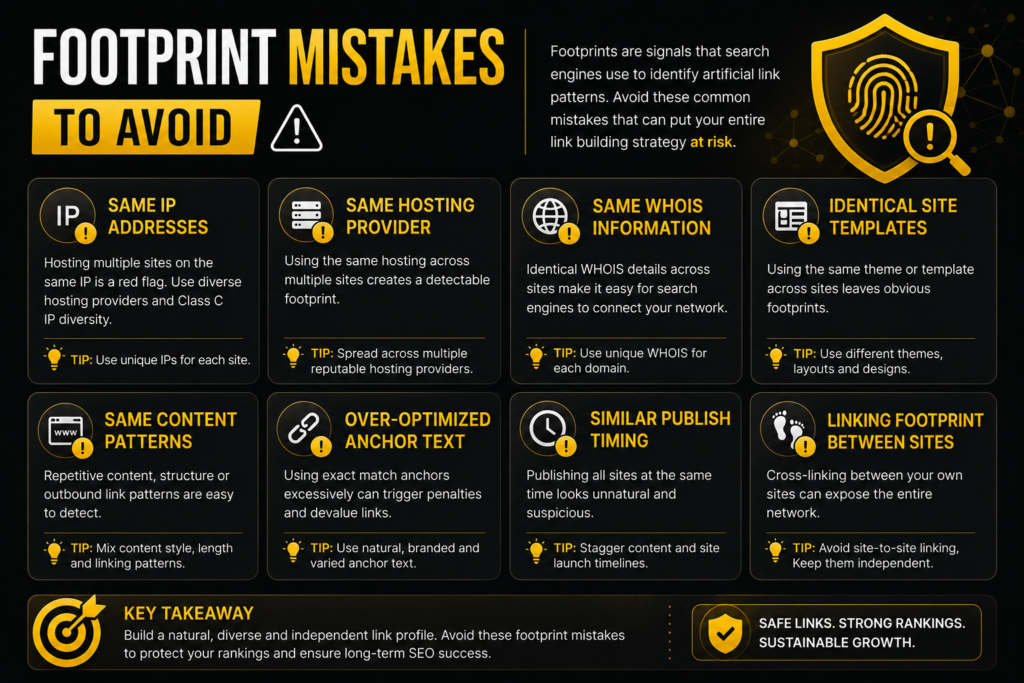
These are the most common footprint mistakes made by DIY PBN builders — patterns that Google SpamBrain identifies as network coordination signals.
Footprint 1: Same WHOIS registration information
Registering multiple PBN domains with the same name, email address, and postal address creates a public coordination signal. Use WHOIS privacy protection (available through most registrars) to mask registration details, and use different email addresses for domain registration accounts across different registrars. Privacy protection does not eliminate footprints entirely — registrar metadata and payment information can still create patterns — but it removes the most obvious public signal.
Footprint 2: All sites linking to the same money site simultaneously
When multiple new PBN sites all publish their first external link pointing to the same money site within a short time window, the coordination is statistically obvious. Stagger money-site link placement across weeks and months. Vary the money sites each PBN domain links to rather than having every site link exclusively to one money site. Mix some internal outbound links and natural-looking external links to other sites alongside money site links.
Footprint 3: Identical publishing patterns
Sites that all publish articles on the same days of the week, at the same times, with the same article lengths, create a coordination signature. Vary publication schedules across the network. Some sites publish weekly, some fortnightly, some sporadically. Vary article lengths, publish dates, and authorship. Real editorial sites have irregular publishing patterns — your network should too.
Footprint 4: Only outbound links to money sites
A website that only ever links to money sites — never to external reference sources, authoritative publications, or other resources — does not behave like a real editorial site. Real editorial content naturally references external sources. Include 1–2 outbound links per article to credible external sources (Wikipedia, authoritative publications in the niche, relevant studies) alongside your money site link. This is standard editorial practice and makes the linking pattern look natural.
Footprint 5: Identical site structure and navigation
Every site having the same navigation menu structure (Home, About, Blog, Contact), same widget placement, same sidebar configuration, and same footer links creates a visual and structural fingerprint. Vary navigation menus, widget types, sidebar content, and footer structures across the network. Some sites should have no sidebars; some should have search widgets; some should have category widgets. Real sites look different from each other.
Step 7: Ongoing management and maintenance
A PBN is not a build-once asset. It requires ongoing maintenance to remain effective and avoid the decay that turns quality domains into liabilities.
Monthly monitoring checklist
- Verify all PBN sites are live and returning 200 status codes — hosting failures cause link equity loss
- Check organic traffic trends on PBN domains in Ahrefs — a domain losing organic traffic may be experiencing quality degradation
- Verify money-site links are still indexed by checking each article URL in Google Search Console or via site: search
- Monitor money-site URL Rating on target pages — UR stagnation may indicate PBN links are being discounted
- Update WordPress core, themes, and plugins across all sites — outdated installations are security vulnerabilities and bot targets
Content refresh schedule
PBN sites that never publish new content gradually lose crawl frequency and URL Rating — Google crawls frequently-updated sites more often. Publish one to two new articles per site per month to maintain crawl activity and signal that the site is a living publication. These additional articles can be shorter (400–500 words) since they are maintaining activity rather than carrying links.
The real cost of building a PBN yourself
| Cost component | Per domain (Year 1) | Per domain (Year 2+) |
|---|---|---|
| Domain acquisition (expired auction) | £50–£400 | £10–£15 renewal |
| Hosting (diverse IPs, monthly) | £60–£120 | £60–£120 |
| Domain registration/renewal | £10–£15 | £10–£15 |
| WordPress theme (diverse) | £0–£50 | £0 |
| Placement article content (£30–£60 each, 6 per year) | £180–£360 | £180–£360 |
| Maintenance articles (£15–£25 each, 12 per year) | £180–£300 | £180–£300 |
| Management time (2–3 hours/month at £30/hr) | £720–£1,080 | £720–£1,080 |
| Total per domain | £1,200–£2,325 | £1,160–£1,770 |
At 6 placement articles per domain per year, the cost per link from your own PBN is approximately £200–£390 per link in year one when all costs are accounted for honestly — significantly higher than buying from a quality provider at £30–£80 per link. The economics shift in your favour only when: you value the control over link placement timing and targeting, you are running at sufficient scale (15+ domains, 90+ placements per year), or you are factoring in the long-term asset value of the domain portfolio itself.
For most practitioners, buying from a quality provider is more cost-efficient. Building makes sense for those who want the maximum control, are already operating at scale, or see the domain portfolio as a long-term investment asset in its own right.
FAQ
How many sites do I need in a PBN?
There is no minimum number — a single high-quality PBN domain passing a well-placed link is more valuable than 10 low-quality domains. In practice, most effective private networks contain 15–50 domains to provide sufficient volume across multiple money site campaigns while maintaining hosting diversity and content quality across the network. Starting with 5–10 quality domains and building gradually is more sustainable than trying to build 30 domains simultaneously with reduced quality on each.
How long does it take to build a PBN?
A functional PBN with 10 domains, diverse hosting, populated content, and strong internal linking takes approximately 3–6 months to build properly. Domain acquisition requires time to find quality expired domains at reasonable prices. Hosting setup across multiple providers takes weeks rather than days when done correctly. Content production for 10 sites at 6 articles each is 60 articles — even at efficient production rates, this represents months of work. The first links from a newly built PBN should be placed 4–6 weeks after the domain is populated with content and properly indexed.
What is the best hosting for a PBN?
There is no single best hosting — the requirement is diversity, not any specific provider. Use a combination of shared hosting accounts from different providers (SiteGround, Hostinger, Bluehost, A2 Hosting, etc.), VPS instances from cloud providers (DigitalOcean, Vultr, Linode, Hetzner), and possibly some dedicated IP reseller hosting. The goal is different IP Class C ranges across the network, different billing accounts, and different provider names. See our PBN networks and domain selection guide for the full infrastructure framework.
How do I choose domains for a PBN?
Prioritise Trust Flow (TF 15+ minimum), verify the domain content history in Wayback Machine for niche relevance and no penalty history, check the CF:TF ratio (reject above 4:1), confirm some organic traffic exists in Ahrefs, and verify the backlink profile is naturally accumulated rather than previously bought. Find candidates through GoDaddy Auctions, Namecheap Marketplace, Dropcatch.com, and manual prospecting for dead sites in your target niche via Ahrefs Content Explorer.
Do PBN articles need to be human-written?
They need to pass the Google Helpful Content standard, which requires content that is genuinely useful and not obviously mass-generated without quality oversight. AI-generated content is acceptable as a drafting tool but must be reviewed, edited for accuracy, and enriched with specific details. Completely unedited AI output published at scale fails the classifier and degrades the entire domain quality signal. The practical standard in 2026: human editorial review and enrichment of every placement article, even if AI is used for initial drafting.
Conclusion
Building a PBN in 2026 that produces durable ranking results requires a higher quality standard than most PBN guides written before 2023 describe. The footprint avoidance requirements are more stringent, the content quality standard is higher due to Helpful Content integration, and the domain selection criteria need Trust Flow verification rather than relying on DR alone. But the fundamental mechanics are unchanged: quality domains with genuine authority, diverse hosting, well-structured content, strong internal linking, and careful link placement produce equity that moves rankings.
The build-vs-buy decision comes down to scale and control preference. At 50+ links per month, the economics of building your own network can justify the investment. Below that threshold, buying from a quality provider consistently produces better cost-per-ranking-movement than operating your own PBN infrastructure. If you have decided to build, the seven steps in this guide provide the foundation for a network that can sustain rankings through core updates rather than collapse under them.
Not ready to build your own network? Get the same quality results without the infrastructure cost. Quality PBN backlinks — Trust Flow verified domains, diverse hosting, 600+ word expert content, gradual indexation standard. Supporting guides: complete PBN SEO guide, PBN networks and domain selection, Trust Flow — domain evaluation standard, URL Rating — why internal linking matters, PBN link cost — build vs buy comparison, and our Google penalties guide.

Ben Davis is a seasoned SEO strategist with over a decade of hands-on experience in off page SEO, link building, and private blog network management.
He has helped 600+ agencies and professionals achieve top rankings in competitive niches including iGaming, crypto, CBD, and finance through data driven PBN strategies.